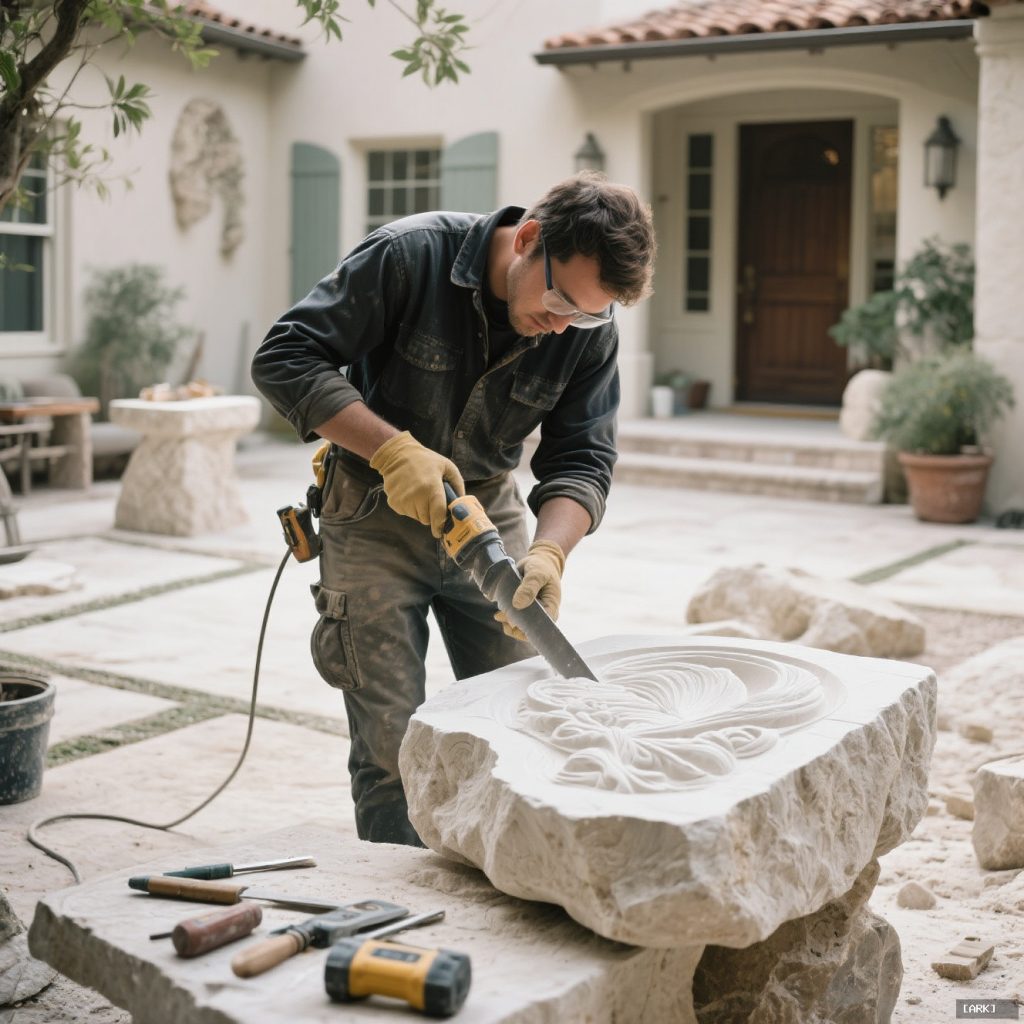
Courtyard stone carving transforms geology into a permanent, silent companion for your home. This ancient practice of architectural ornamentation is a dialogue with time itself, where your first cut is a promise to the future.
It begins with a block and an idea. The process from raw stone to garden sculpture is one of patience, listening, and a surprising amount of problem-solving. It’s not just about making a mark; it’s about joining a conversation that spans centuries, learning to see the form waiting within the rock.
The First Cut: Safety and Starting Simple
Before you ever lift a mallet, your first investment isn’t a tool—it’s protection. A quality respirator mask (N95 or better) and impact-resistant safety glasses are non-negotiable. Stone dust is a serious health hazard, and a single flying chip can change everything in an instant. Good gloves protect your hands from abrasions, not from a misplaced chisel strike.
Only then do you consider the chisel. For a true beginner, a basic point chisel and a pitching tool are the gateway. The point is for roughing out and breaking bulk, while the pitcher helps split off larger, controlled sections. Start with a wooden or rawhide mallet; its softer blow gives you more control and is forgiving on the chisel’s head. The goal of the first project isn’t perfection, but completion. Learn what the stone feels like under your tools.
Choosing Your Stone: A Partnership with Place
The perfect stone is a myth. The right stone, however, is a balance of accessibility, workability, and destiny. Your local landscape is the best guide. A regional quarry is a treasure trove, often offering remnants or “seconds” perfect for practice at a lower cost. Using local stone also ensures your finished garden sculpture will belong, its color and texture in harmony with its surroundings.
Softer stones are a carver’s best friend at the start. Sandstone and limestone are relatively forgiving, allowing you to learn tool control without fighting the material every step. Soapstone, though soft enough to be carved with knives, is more fragile. As your skill grows, you might graduate to harder marbles or granites, which demand sharper tools, more power, and immense patience.
But workability is only half the equation. You must consider the stone’s final home. A porous limestone placed in a garden with freezing winters will absorb water, freeze, and spall—flaking apart within a few seasons. A dense granite or slate can handle harsh weather. The stone must suit both your skill and its environment, a principle at the heart of good stone masonry.
The Gardener’s Mindset: Sculpture as a Living Element
The deepest connection between carving and gardening isn’t aesthetic—it’s foundational. A gardener understands that a plant’s beauty above ground depends on the health of its roots below. A courtyard stone carving is no different.
Every piece has a ‘face,’ a primary viewing angle meant to greet the viewer. But like a well-placed shrub, it should offer interest from all sides, revealing new details as one moves around it. More crucially, it needs a ‘root structure.’ An unstable base isn’t just an eyesore; it’s a physical danger. The installation is part of the sculpture’s creation. For any free-standing piece, the rule of thumb is to bury at least one-third of its height for stability. This anchors it against wind and, critically, frost heave, which can slowly tilt and topple even a heavy stone over time. Preparing a proper gravel or concrete footing is as essential as preparing garden soil.
Reading the Stone: The Art of Listening
The single biggest mistake a beginner makes is carving the image in their mind while ignoring the voice of the stone. You might envision a delicate, thin-winged bird, but a hidden quartz vein or an unseen fissure can shatter that dream in one blow. Stone has a grain, weaknesses, and inclusions. It has a history written in its composition.
The real skill lies in listening. Start by removing what clearly doesn’t belong—the corners, the excess bulk. Then, progress slowly. Tap lightly and watch how the stone responds. Does it fracture cleanly or crumble? Is there a harder layer beneath the surface? This dialogue between your mallet and the material’s resistance is where the art happens. Often, the stone will suggest a modification to your design, a slight turn of the head, a different flow to the drapery. The best carvers are collaborators, not dictators.
Authenticity in Age: Spotting the Hand of the Maker
In a world of machine-made reproductions, how can you tell if an old stone ornament in a garden or antique shop is truly old? Look for the story in the wear and the workmanship. Mass-produced pieces have a uniform, sterile sharpness. Every line is perfect, every curve identical, lacking the subtle rhythm of a human hand.
Authentic, hand-worked pieces show variation. The depth of a gouge might change mid-line as the carver’s arm tired or they adjusted their grip. Look at the non-decorative surfaces—the underside, the back. You’ll often find rough tool marks from the ‘point’ or ‘claw’ chisel used to simply remove material, marks that served no aesthetic purpose and were never meant to be seen. These functional scars are a signature of authenticity. A collector learns to spot the human pulse in the stone, the slight wobbles, corrections, and personal flourishes that no CNC router bothers to imitate.
Color, Patina, and the Passage of Time
Should you add color to your carving? The short answer is yes, but with reverence for the material. Time is the greatest artist of all, and the natural patina of age—softening edges, gentle graying, or the slow creep of lichen—is often the most beautiful finish.
To encourage this process organically, some carvers apply a thin slurry of plain yogurt or buttermilk to shaded, damp areas of the stone. This introduces benign bacteria and nutrients that can promote the growth of moss or lichen, accelerating a natural look. For intentional color, mineral pigments mixed into a limewash can stain limestone or sandstone beautifully, allowing the stone to breathe. Modern acrylic or latex paints, however, are a recipe for disaster. They form a plastic skin that eventually peels, traps moisture against the stone, and accelerates its decay. The goal is to work with the stone’s natural aging, not fight it.
Your First Project: A Practical Roadmap
- Source Your Stone: Contact local quarries or landscape suppliers. Seek a manageable block of soft sandstone or limestone.
- Gear Up Safely: Respirator mask, safety glasses, sturdy gloves. This is your essential kit.
- Basic Tool Kit: Point chisel, pitching tool, wooden mallet. A mason’s hammer can also be useful.
- Design on the Stone: Draw your simple design on all sides of the block with a lumber crayon or chalk. Think in three dimensions.
- Plan the Base: Design the sculpture with its stability in mind. How will it meet the earth?
- Find Your Space: Work outdoors or in a very well-ventilated area like a garage with the door open. Stone dust gets everywhere.
Navigating the process: Common Questions Answered
How long does a carving take? There is no standard clock. A simple geometric plinth might take a weekend. A detailed figurative piece can consume months of evenings. Stone is the teacher of patience.
Do I need to seal the stone? Generally, no. Most durable stones are their own best protection. Sealants, especially impermeable ones, can trap moisture inside, leading to internal cracking during freeze-thaw cycles. Let the stone breathe.
What if I make a deep, irreversible mistake? Congratulations, you’ve just found a new design feature. The history of stone masonry is filled with creative adaptations. A deep gouge can become a shadowy recess, a broken edge can be softened into a more organic form. The error is now part of the stone’s story and your dialogue with it.
Sources & Further Pathways
For those looking to deepen their understanding of materials and history, these resources offer valuable insights:
The Victoria and Albert Museum’s archive on architectural stonework provides historical context: https://www.vam.ac.uk/articles/architectural-stonework
The Stone Foundation offers practical guides and community for craftspeople: https://www.stonefoundation.org/resources/
The Geological Society’s resources on building stone identification help you understand what you’re working with: https://www.geolsoc.org.uk/ks3/gsl/education/resources/rockcycle/page3561.html
Traditional Building Magazine covers conservation techniques relevant to long-lasting stone ornamentation: https://www.traditionalbuilding.com/categories/stone
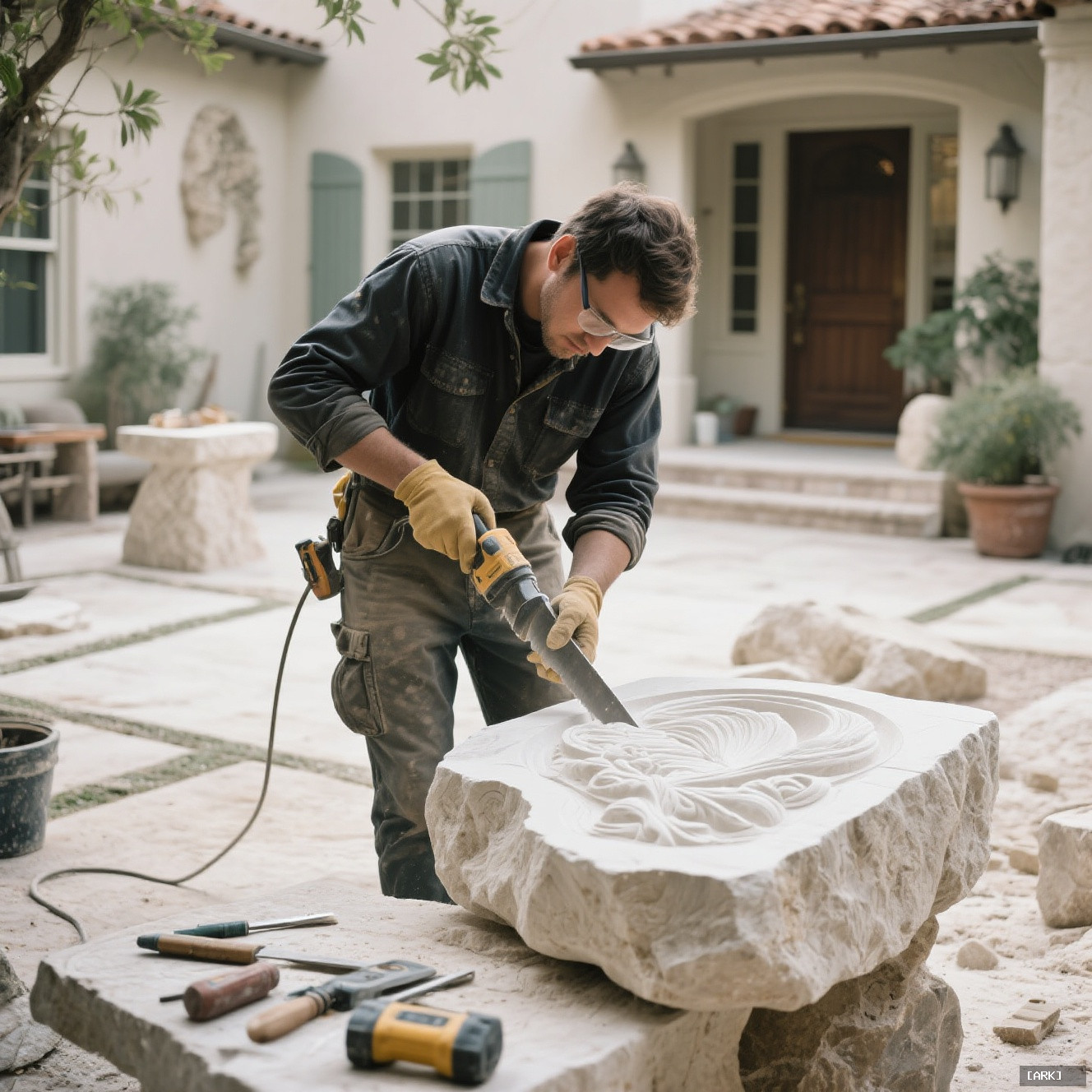
Courtyard stone carving is an invitation. It asks you to slow down, to touch the earth’s crust, and to leave a gentle, lasting mark. It begins with a single tap, a small chip falling away. And with it, a conversation with the future quietly begins.
About Our Expertise
Drawing from centuries of Chinese stone carving traditions, this guide emphasizes the importance of understanding materials like sandstone and limestone, which have been used in iconic structures such as the Forbidden City. Our expertise is rooted in authentic practices that blend artistic heritage with practical craftsmanship, ensuring techniques are passed down with cultural integrity.
We prioritize trust by providing safety-first advice and reliable sourcing tips, reflecting a deep respect for the art form's history. Our content is crafted to help enthusiasts engage with Chinese cultural arts responsibly, fostering a connection to timeless skills that honor both the stone and its place in traditional courtyard design.
✨ You Might Also Enjoy

You may also like
Herbal Bead Bracelet: Ancient Chinese Aromatherapy for Modern Wellness | HandMyth™
Original price was: ¥2,199.00.¥1,352.00Current price is: ¥1,352.00. Add to cartPremium Herbal Beads Bracelet: Traditional Medicine Meets Modern Jewelry | Shop HandMyth
Original price was: ¥874.00.¥608.00Current price is: ¥608.00. Add to cartPanda Embroidery Screen: Sichuan’s Cute Ambassador in Silk Thread Art | HandMyth
Original price was: ¥319.00.¥230.00Current price is: ¥230.00. Add to cartPanda Gift Set: Curated Chinese Treasures for Panda Lovers | HandMyth™ (Free Gift Wrap)
Original price was: ¥136.00.¥118.00Current price is: ¥118.00. Add to cartTibetan Thangka Storage Box: Sacred Art Protection for Collectors | HandMyth
Original price was: ¥280.00.¥219.00Current price is: ¥219.00. Add to cartPure Silk Handbag: Hangzhou’s Legendary Silk Weaving for Modern Elegance | HandMyth™
Original price was: ¥874.00.¥786.00Current price is: ¥786.00. Add to cartHand-Painted Silk Scarf: Wearable Art from China’s Silk Road | HandMyth (Artist Signed)
Original price was: ¥1,017.00.¥935.00Current price is: ¥935.00. Add to cartModern Qipao Dress: Timeless Chinese Elegance for Today’s Woman | HandMyth (Custom Fit)
Original price was: ¥2,459.00.¥2,240.00Current price is: ¥2,240.00. Add to cartEmbroidered Chinese Handbag: Suzhou Silk Embroidery Meets Modern Fashion | HandMyth™
Original price was: ¥680.00.¥646.00Current price is: ¥646.00. Add to cart