Cloisonné enamel jewelry communicates a profound story before a single word is spoken. This ancient craft, where colored glass is fused within delicate metal compartments, offers a uniquely potent language for modern brand storytelling. Each piece whispers intention through its fired glass and precious metal wires.
It’s a language of light and metal, one that has adorned emperors and inspired artists for millennia. Today, it holds a quiet power often missed in a noisy marketplace.
The Silent Syntax of Cloisonné
Think of a sentence. Its meaning comes from the structure of grammar and the choice of words. Cloisonné enamel jewelry operates on the same principle, but its syntax is visual and tactile.
The cloisons—those fine, bent metal wires—are the grammar. They are not just borders; they are the architects of form. A thin, hair-like gold wire creates a feeling of delicacy and precision, perhaps suggesting meticulous care or botanical accuracy. A heavier, more irregular silver wire might convey strength, a hand-wrought feel, or an abstract, modern edge. The rhythm of these lines, their spacing and flow, sets the pace of the design. Are they tight and controlled, or loose and expressive? This is the foundational structure of the narrative.
The enamel colors are the vocabulary. This is where emotion and cultural resonance flood in. A deep, translucent cobalt blue doesn’t just read as “blue”; it can evoke midnight skies, royal heritage, or deep tranquility. A vibrant, opaque red might signal passion, luck, or bold宣言. The magic often happens in the blending within a single cell—a gradient from sunrise yellow to orange can tell a mini-saga of dawn. A brand isn’t merely selecting a Pantone shade; it’s choosing a word charged with centuries of human association.
When grammar and vocabulary unite with purpose, you get poetry you can wear. A brooch isn’t just a brooch. It becomes a declarative statement. A pendant becomes a lyrical phrase. The wearer becomes part of the conversation.
Authenticity, Baked In
In an age of digital duplication and mass production, authenticity is a currency. Cloisonné enamel jewelry mints this currency in the most literal way. The process is its own proof of origin.
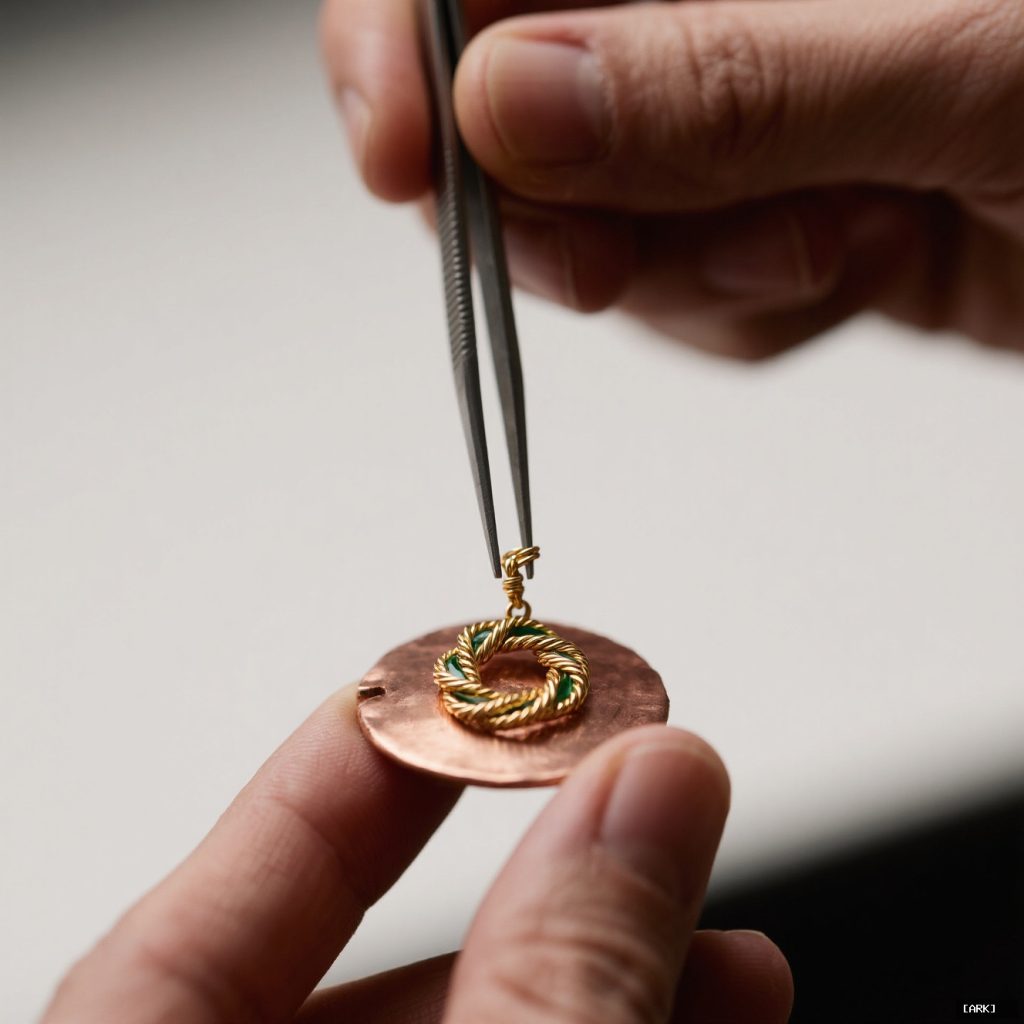
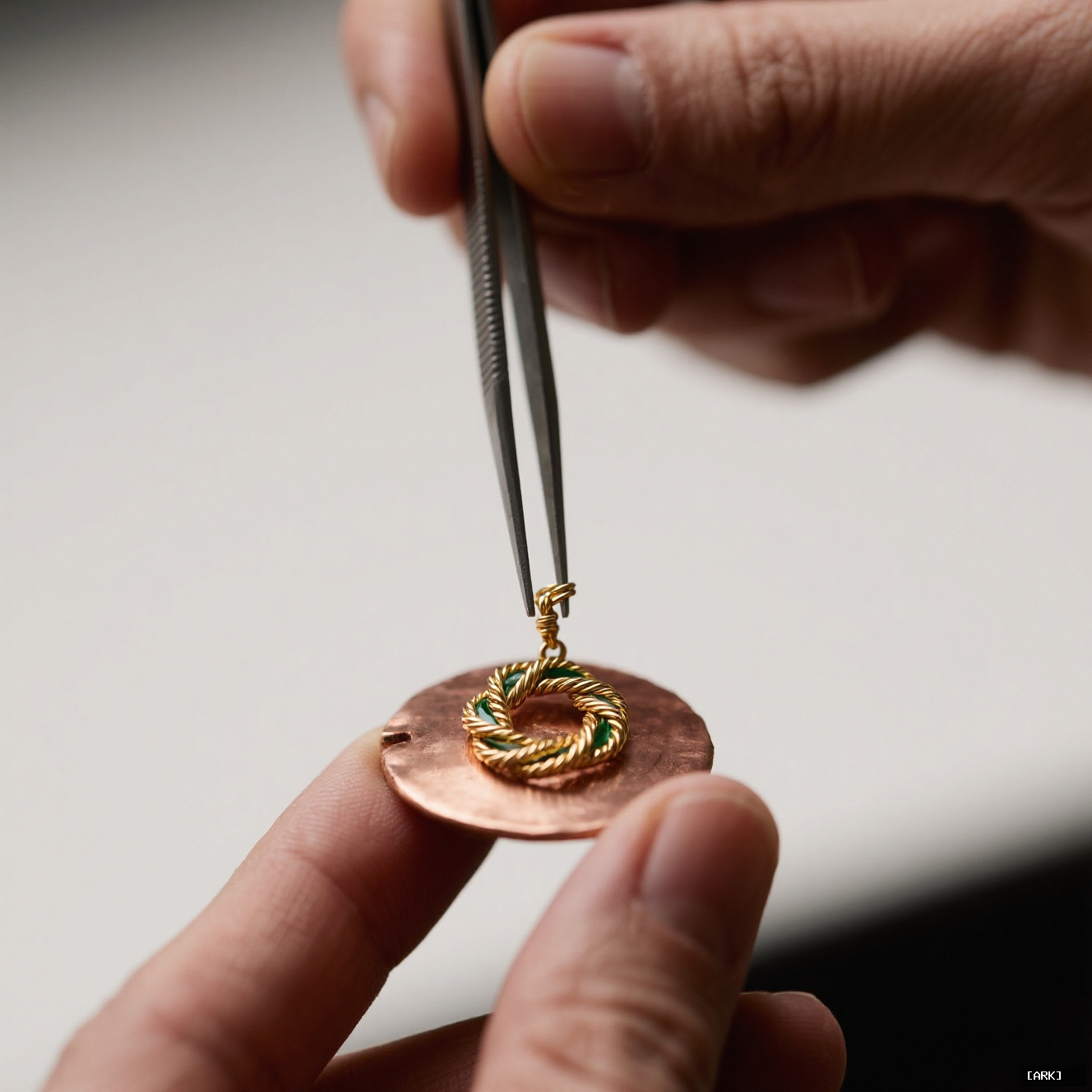
You cannot fake the alchemy of powdered glass transforming into a luminous, vitreous surface through successive firings. You cannot shortcut the painstaking placement of each individual wire, cell by tiny cell. This inherent “truth to materials” and “truth to process” translates directly into brand narrative. It tells a story of human hands, of patience measured in kiln cycles, and of a mastery that respects tradition while creating something new.
For a brand, this bypasses the need for marketing claims about artisanal quality. The evidence is embedded in the object. The narrative of dedication, heritage, and skilled transformation isn’t appended in a tagline; it is the physical reality of the piece. It communicates values like integrity and permanence through its very substance.
Quiet Sustainability: The Heirloom Imperative
Sustainability is often discussed in terms of recycled materials or carbon footprints. Cloisonné enamel jewelry proposes a different, older model: the heirloom.
A well-crafted piece is an antidote to disposability by design. Its materials—glass, metal, mineral-based pigments—are among the most stable and durable known to us. Ancient Byzantine and Chinese cloisonné pieces survive in museums, their colors still vibrant, their stories intact. This longevity is the ultimate sustainable act: creating an object meant to be cherished, repaired, and passed down, not replaced.
This connects to a profound philosophy seen in practices like kintsugi. Both cloisonné and kintsugi honor the entire life cycle of an object. A chip in the enamel or a loose wire isn’t necessarily a death sentence; it can be an opportunity for respectful repair, adding another chapter to the piece’s story. This mindset shifts the focus from consumption to curation, from owning new things to stewarding beautiful ones. The sustainability is in the enduring relationship between object and owner.
Developing a Coherent Visual Voice
How does a brand or designer find its unique “accent” within this ancient language? Not through wild innovation for its own sake, but through consistency in constraint. A distinctive voice emerges from a series of deliberate, repeated choices.
First, the palette. Does your brand speak in the muted, complex tones of a forest floor or the clear, bold primaries of a stained-glass window? This choice sets the emotional temperature.
Second, the line. Are your cloisons fine and precise, creating intricate, detailed imagery? Or are they broad, graphic, and modern, prioritizing shape over detail? This defines your cadence.
Third, the motif library. Limit yourself. Is your lexicon built from Art Deco geometry, from specific botanical forms, or from abstract expressions of light? A focused library is more recognizable than a sprawling dictionary.
Finally, embrace a signature technique or even a “flaw.” Perhaps you allow the enamel to slightly overrun its wire cells, creating a soft, watercolor-like edge—a signature of organic abundance. Maybe you incorporate intentional texture or bubbles within the glass, not as errors but as evidence of the handmade process, like the grain in wood. This becomes your brand’s idiosyncratic handwriting.
A Practical Framework for Your Brand’s Language
- Anchor in Values: List three core brand values. Now, translate them. Does “serenity” mean pale, translucent blues and smooth, flowing lines? Does “vitality” mean bright, opaque greens and dynamic, intersecting wires?
- Curate Your Lexicon: Choose one primary family of motifs. Floral, geometric, celestial, abstract. Build depth within this family rather than skimming the surface of many.
- Select Your Materials Consciously: Gold wire warms the light; silver cools it. Transparent enamel glows with depth; opaque enamel offers solid, painterly color. This is your paper and ink.
- Design for Longevity: From the start, consider repair. Can a stone be reset? Can a section of enamel be refired? Designing with its future life in mind is the ultimate commitment to the object.
The Pitfall of Ornamentation
The most common mistake is treating decorative jewelry as a mere accessory, a shiny afterthought to a logo. This reduces a profound craft to simple decoration.
Powerful brand jewelry doesn’t scream a logo; it embodies a worldview. A generic, sourced enamel pendant with no connection to your brand’s core story is just noise. It says nothing. The craft must be integrated, its language studied and spoken fluently from the initial concept. The piece should be an essential chapter of your brand’s story, not a footnote. When done right, the jewelry becomes a talisman of the brand’s identity, worn by those who wish to carry that story with them.
Understanding the Craft: Common Questions
To speak a language, you must understand its basics. Here are answers to frequent questions about cloisonné art.
- Is all enamel jewelry cloisonné? Absolutely not. Cloisonné is defined by the use of raised, adhered wires to create cells (cloisons). Other major techniques include champlevé, where enamel is poured into grooves carved or cast into a thick metal base, and plique-à-jour, a breathtaking technique with no backing, creating a miniature stained-glass window effect.
- Is it fragile? The vitreous enamel itself is a form of glass, and like glass, it can chip from a sharp, direct impact. However, its overall durability is proven by history. With proper care, it is meant for a lifetime of wear. It resists fading and chemical wear far better than many other decorative surfaces.
- Why is it expensive? The cost is a direct reflection of time and skill. A single piece can involve days or weeks of work: designing, bending and adhering countless tiny wires, applying enamel powders with pinpoint accuracy, firing the piece multiple times (with polishing between firings), and finally finishing. It is often the work of a single artisan from start to finish, a marathon of concentrated craftsmanship.
A Legacy of Light and Color
From the pectorals of ancient Egyptian pharaohs to the intricate vases of the Ming Dynasty, from the liturgical objects of Medieval Europe to the revolutionary Art Nouveau jewelry of René Lalique, cloisonné has been a constant whisper of human creativity. It is a bridge between painting, sculpture, and metalwork.
Today, this legacy is not a museum relic but a living, breathing language. For the brand or wearer who listens, it offers a way to communicate depth, authenticity, and beauty that transcends the ephemeral trends of fashion. It allows us to wear our stories, our values, and a piece of human history, all fused together in light and fire.
Sources & Further Reading
- The Metropolitan Museum of Art: Essay on Cloisonné – https://www.metmuseum.org/toah/hd/clos/hd_clos.htm
- Ganoksin Jewelry Project: Introduction to Enameling – https://www.ganoksin.com/article/introduction-enameling/
- Cooper Hewitt, Smithsonian Design Museum: Enamel Collection – https://collection.cooperhewitt.org/tags/enamel
- Victoria and Albert Museum: A History of Jewellery – https://www.vam.ac.uk/articles/a-history-of-jewellery
About Our Expertise
As experts in Chinese traditional arts, we draw on decades of research and collaboration with master artisans to provide authentic insights into cloisonnu00e9 enamel jewelry. This craft, with roots in ancient Chinese dynasties like the Ming, involves meticulous techniques such as wire bending and multiple kiln firings, ensuring each piece reflects deep cultural heritage and skilled craftsmanship.
Our content is grounded in trusted sources like The Metropolitan Museum of Art and Victoria and Albert Museum, offering reliable information on cloisonnu00e9's history and symbolism. We emphasize its role in conveying values like authenticity and sustainability, helping readers appreciate this art form's enduring beauty and cultural significance in modern contexts.
✨ You Might Also Enjoy


You may also like
Herbal Bead Bracelet: Ancient Chinese Aromatherapy for Modern Wellness | HandMyth™
Original price was: ¥2,199.00.¥1,352.00Current price is: ¥1,352.00. Add to cartPremium Herbal Beads Bracelet: Traditional Medicine Meets Modern Jewelry | Shop HandMyth
Original price was: ¥874.00.¥608.00Current price is: ¥608.00. Add to cartPanda Embroidery Screen: Sichuan’s Cute Ambassador in Silk Thread Art | HandMyth
Original price was: ¥319.00.¥230.00Current price is: ¥230.00. Add to cartPanda Gift Set: Curated Chinese Treasures for Panda Lovers | HandMyth™ (Free Gift Wrap)
Original price was: ¥136.00.¥118.00Current price is: ¥118.00. Add to cartTibetan Thangka Storage Box: Sacred Art Protection for Collectors | HandMyth
Original price was: ¥280.00.¥219.00Current price is: ¥219.00. Add to cartPure Silk Handbag: Hangzhou’s Legendary Silk Weaving for Modern Elegance | HandMyth™
Original price was: ¥874.00.¥786.00Current price is: ¥786.00. Add to cartHand-Painted Silk Scarf: Wearable Art from China’s Silk Road | HandMyth (Artist Signed)
Original price was: ¥1,017.00.¥935.00Current price is: ¥935.00. Add to cartModern Qipao Dress: Timeless Chinese Elegance for Today’s Woman | HandMyth (Custom Fit)
Original price was: ¥2,459.00.¥2,240.00Current price is: ¥2,240.00. Add to cartEmbroidered Chinese Handbag: Suzhou Silk Embroidery Meets Modern Fashion | HandMyth™
Original price was: ¥680.00.¥646.00Current price is: ¥646.00. Add to cart