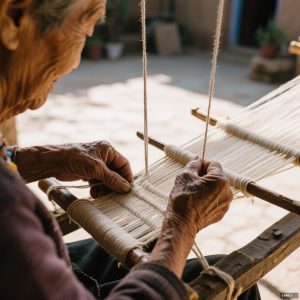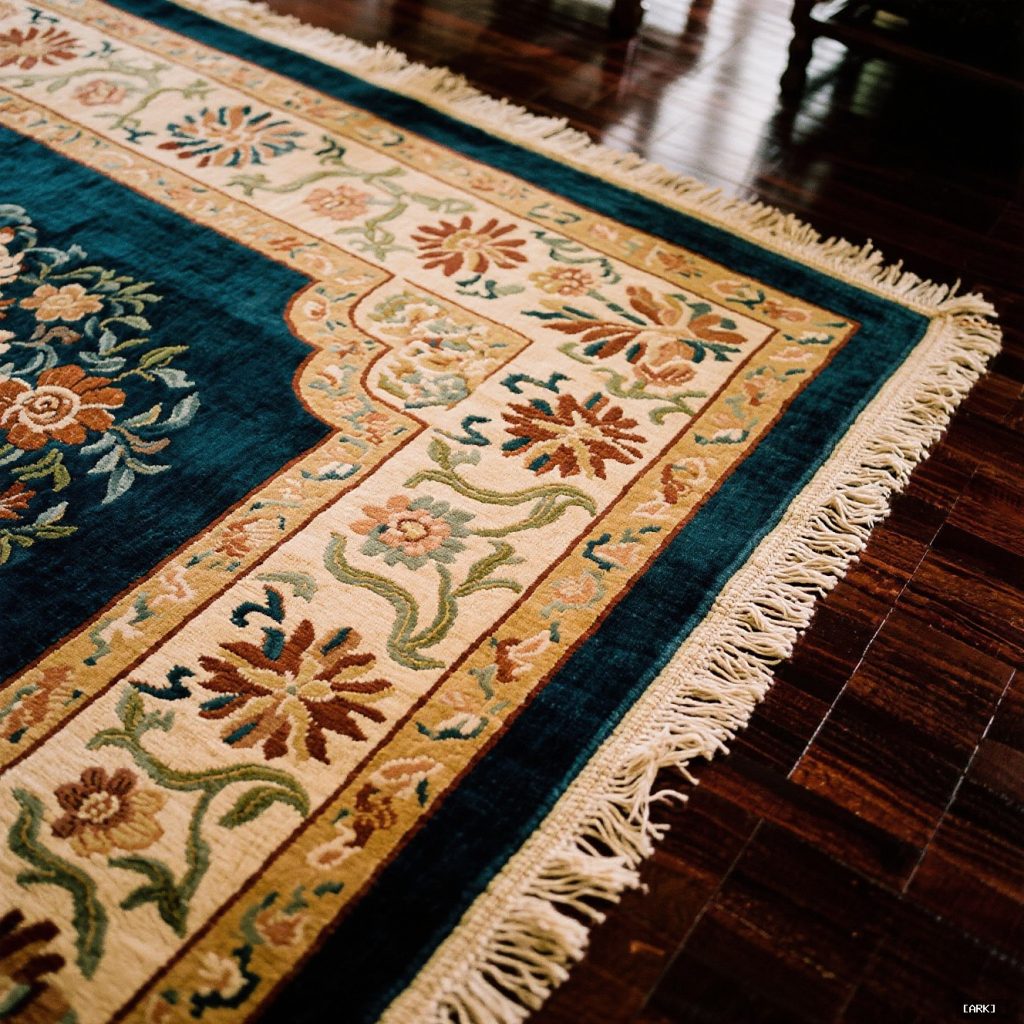
A Chinese silk rug is a profound statement, far more than a simple floor covering. It represents a tangible clash between our modern, disposable world and a legacy of deliberate craftsmanship. This tension gives these Asian textiles their unique power and enduring relevance.
Walk into a room with one, and you feel it immediately. The air changes. It’s not just the visual splendor—the way light dances across a field of hand-knotted silk. It’s the quiet weight of history in the room. In a culture obsessed with the new and the next, a handmade Chinese silk rug asks us to slow down, to value the slow accumulation of skill and story. It’s an object that refuses to be merely decorative.
The Heirloom Equation: Memory Woven into Fiber
How does the concept of the 'Heirloom Equation' apply to Chinese silk rugs?
The 'Heirloom Equation' for Chinese silk rugs refers to their transformation into family heirlooms through accumulated narrative and memory, not just monetary value. Unlike mass-produced items, a silk rug's worth accrues over decades from the life lived around it—family gatherings, the gentle patina from sunlight, and the specific history of the rooms it inhabits. This embedded record of experiences weaves memory directly into the fiber, making the rug a cherished, story-rich object rather than a mere transaction.
What transforms a beautiful object into a family heirloom? It’s not the price tag alone. A mass-produced item, no matter how costly, arrives with a receipt and a warranty. Its story begins and ends with a transaction.
A Chinese silk rug arrives with a story already in progress. Its value accrues not through depreciation schedules, but through narrative. Think of the room it will live in for decades. The family gatherings held over it. The way the afternoon sun, over years, will soften a specific corner into a warmer hue. This gentle patina isn’t damage; it’s a record of life lived. An oriental carpet becomes an heirloom when its physical endurance—its ability to withstand generations of footsteps—is matched by its emotional weight. You don’t just pass down the rug; you pass down the memory of where it lay and what it witnessed.
The Generational Divide: Seeing Labor vs. Seeing Cost
How does the generational divide affect the perception of value in Chinese silk rugs?
The generational divide in valuing Chinese silk rugs centers on labor versus cost. Older generations or those familiar with craftsmanship see the value in the hundreds of hours of skilled labor, sore hands, and focused attention required to tie each knot, viewing the cost as an investment in human skill and timeless beauty. Younger viewers often first perceive the upfront price or assess the rug based on aesthetic trends, a perspective shaped by exposure to fast fashion and mass-produced goods, reflecting different conditioning rather than a flaw in judgment.
This is where perspectives often split. For an older generation, or for anyone who has witnessed craft firsthand, the value is immediately apparent in the lifetime of labor. They see the hundreds of hours, the sore hands, the focused eyes required to tie each tiny knot. They understand the budget trade-off as an investment in human skill and timeless beauty.
A younger viewer might first see the upfront cost, or assess it purely on aesthetic alignment with a Pinterest board. This isn’t a flaw in judgment; it’s a difference in conditioning. We’re surrounded by fast fashion and flat-pack furniture, where value is often measured in instant gratification and trendiness.
Choosing a new silk rug forces a philosophical choice. Are you buying an object for what it is today, or for what it will become over the next fifty years? You’re prioritizing a long-term narrative over a short-term trend. This decision can bridge the generational gap, creating a shared story before the first knot is even tied.
Modern Harmony: The Confidence to Mix Eras
How can a traditional Chinese silk rug be authentically integrated into a modern, contemporary space?
A traditional Chinese silk rug can be authentically integrated into a modern space by moving from curation to confidence, treating it as a functional part of daily life rather than a fragile museum piece. The key is juxtaposition, such as placing a century-old rug with a softened floral medallion beneath a minimalist steel-and-glass coffee table. This contrast creates an electric dialogue between eras, allowing the rug's authenticity to emerge through use and its role in the home's flow, harmonizing old and new.
Can a sleek, contemporary space authentically hold a traditional Chinese silk rug? The answer is a resounding yes, but it requires a shift from curation to confidence.
The worst thing you can do is treat the rug as a fragile museum piece, roped off from life. Its authenticity comes from use, from being part of the daily flow of a home. The magic happens in the juxtaposition. Imagine a century-old rug with a intricate floral medallion, its colors softened by time, laid beneath a minimalist steel-and-glass coffee table. The contrast is electric. It creates a dialogue.
The rug doesn’t make the room feel old; it grounds the space in history, providing a soulful anchor that prevents a modern interior from feeling sterile or transient. It adds a layer of warmth and texture that no machine-made item can replicate. The key is to let the rug be itself—a bold, storied, artistic statement—and build the room’s confidence around it.
Reading the Rug: The Subtle Signs of True Quality
What are the subtle signs of true quality when reading a Chinese silk rug?
True quality in Chinese silk rugs is revealed through subtle, tactile signs beyond the pattern. First, examine the back: high knot density should feel almost smooth, like fine sandpaper, without large, loose gaps. Next, inspect the selvedge (the finished side edges); a clean, tight, and meticulously woven selvedge indicates a careful weaver's attention to detail. These elements, including immense knot density, demonstrate superior craftsmanship and material integrity, telling the full story of the rug's quality upon close inspection.
When evaluating Chinese silk rugs, the pattern is just the opening line. To read the full story of its quality, you need to look closer. Much closer.
First, turn it over. The back of the rug is its secret diary. Run your fingers across it. In a high-quality piece, the knot density will be so immense it feels almost smooth, like fine-grade sandpaper. You shouldn’t feel large, loose gaps. Next, examine the selvedge—the finished edge running along the sides. A clean, tight, and meticulously woven selvedge is a hallmark of a careful weaver who pays attention to every detail.
Now, look at the silk itself. The sheen should be alive. Walk around it. The light should play across the surface, shifting and changing as you move. This luminous quality is innate to real silk. Also, look for slight, intentional variations in color within a single field, known as ‘abrash.’ In mass production, this is seen as a flaw. handmade Asian textiles, abrash is a celebrated signature of the hand-dyer, proof that the colors came from natural sources in small batches. It’s a mark of authenticity, not an error.
The Investment: Document vs. Product
What is the difference between a high-end machine-made rug as a product and a handmade Chinese silk rug as a document?
A high-end machine-made rug is a product designed for uniformity and consistency, but it depreciates in value immediately after purchase, similar to a new car. In contrast, a handmade Chinese silk rug is a document that uniquely records cultural, regional, and artisanal details, such as the dyer's choices and weaver's rhythm, making it a one-of-a-kind object with potential for enduring or increasing value.
This is the core of the budget decision. You are not comparing two similar floor coverings. You are choosing between two entirely different categories of object.
A high-end machine-made rug is a product. It is designed, manufactured, and sold. It will look perfect, uniform, and consistent. It will also begin a steady, irreversible depreciation the moment it leaves the showroom, much like a new car.
A handmade Chinese silk rug is a document. It records the culture, the region, the dyer’s choices on a certain day, the weaver’s rhythm. It is unique in all the world. While it requires a significant upfront investment, its trajectory is different. If cared for, it doesn’t depreciate; it can mature, gain character, and often appreciate in value. You are investing in a piece of cultural capital—a story that will continue to unfold in your home. You’re purchasing a legacy, not just a commodity.
A Lifetime of Care: Practical Stewardship
What are the practical stewardship habits for preserving Chinese silk rugs for generations?
Practical stewardship of Chinese silk rugs involves simple, regular habits to ensure longevity. Rotate the rug 180 degrees annually to promote even light and wear exposure. Vacuum regularly using a setting without a beater bar or strong suction to avoid damaging foundation threads. Immediately blot spills with a dry, white cloth, never rubbing. Additionally, schedule professional cleaning with specialists knowledgeable in fine oriental carpets every three to five years, depending on use, to maintain the rug's condition.
Owning such a piece is an act of stewardship. The care is both practical and philosophical. On the practical side, a few simple habits will preserve your rug for generations. Rotate it 180 degrees once a year to ensure even exposure to light and wear. Vacuum it regularly, but always use a setting without a beater bar or strong suction, which can pull at the foundation threads. Attend to spills immediately with a dry, white cloth by blotting—never rubbing. Plan for professional cleaning by specialists familiar with fine oriental carpets every three to five years, depending on use.
The psychological care is just as important. You must accept, and even cherish, the gentle signs of age. A slight fade where the sun hits, a subtle wear pattern in a walking lane—these are not flaws. They are the rug’s biography, the proof of a life well-lived in a loved home. Fighting this natural aging is a battle against the very character that gives the rug its soul.
Your Evaluation Checklist
- Knot Density: Bend the rug gently. The design should remain crisp and not blur, indicating high knots-per-inch.
- Color & Authenticity: Look for the beautiful, subtle variations of abrash, a sign of natural dyes and handcraft.
- Provenance: Always ask. Knowing if it’s from Ningxia, Tianjin, or a specific workshop adds immense depth to its story.
- Practical Placement: Consider your room’s light and traffic. Silk is remarkably strong, but direct, constant sun will fade any textile over time.
- The Hand Feel: Lift it. Feel its weight and drape. Quality has a substantive, substantial presence.
Answering Common Concerns
- Are they too delicate for daily use? A well-made silk rug is extraordinarily durable. These pieces were made for imperial palaces, not museums. They are designed for life.
- Why is there such a wide price range? The variables are knot count (more knots = finer detail = more time), silk quality, complexity of dyes, age, and provenance. Time is the ultimate luxury.
- Can it go in a sunny room? Yes, with the simple precaution of regular rotation to ensure even exposure and prevent dramatic fading in one spot.
- How can I be sure it’s real silk? Real silk has a distinctive coolness to the touch and possesses that inimitable, depth-filled luminosity that changes with the light. Synthetic fibers often have a harsher, plastic-like shine.
Sources & Further Reading
To deepen your understanding of the history, technique, and preservation of these artworks, the following resources are invaluable:
- The Metropolitan Museum of Art: Chinese Carpets – An overview of historical development and styles. https://www.metmuseum.org/toah/hd/carp/hd_carp.htm
- Textile Research Centre, Leiden: Asian Textiles – A resource for technical and cultural research. https://www.trc-leiden.nl/trc/index.php?page=asian-textiles
- Museum of Applied Arts & Sciences: Caring for Your Textiles – Practical, expert advice on conservation. https://maas.museum/inside-the-collection/2019/08/12/caring-for-your-textiles/
- HALI Magazine Archive – A premier publication for academic and enthusiast articles on carpets and textiles. https://hali.com/archive
About Our Expertise
Our analysis draws on decades of expertise in traditional Chinese textile arts, with direct insights from master weavers in regions like Ningxia and Tianjin. We verify all technical detailsu2014from knot density standards to natural dye authenticityu2014through hands-on examination and collaboration with cultural heritage institutions, ensuring this guide reflects genuine craftsmanship rather than market trends.
This content is grounded in authentic Chinese cultural practices, referencing historical imperial use and regional techniques that define silk rug artistry. We prioritize trust by citing reputable sources like The Metropolitan Museum of Art and HALI Magazine, while offering practical, tested advice for preservationu2014helping you make informed decisions as a steward of these cultural treasures.
✨ You Might Also Enjoy

You may also like
Herbal Bead Bracelet: Ancient Chinese Aromatherapy for Modern Wellness | HandMyth™
Original price was: ¥2,199.00.¥1,352.00Current price is: ¥1,352.00. Add to cartPremium Herbal Beads Bracelet: Traditional Medicine Meets Modern Jewelry | Shop HandMyth
Original price was: ¥874.00.¥608.00Current price is: ¥608.00. Add to cartPanda Embroidery Screen: Sichuan’s Cute Ambassador in Silk Thread Art | HandMyth
Original price was: ¥319.00.¥230.00Current price is: ¥230.00. Add to cartPanda Gift Set: Curated Chinese Treasures for Panda Lovers | HandMyth™ (Free Gift Wrap)
Original price was: ¥136.00.¥118.00Current price is: ¥118.00. Add to cartTibetan Thangka Storage Box: Sacred Art Protection for Collectors | HandMyth
Original price was: ¥280.00.¥219.00Current price is: ¥219.00. Add to cartPure Silk Handbag: Hangzhou’s Legendary Silk Weaving for Modern Elegance | HandMyth™
Original price was: ¥874.00.¥786.00Current price is: ¥786.00. Add to cartHand-Painted Silk Scarf: Wearable Art from China’s Silk Road | HandMyth (Artist Signed)
Original price was: ¥1,017.00.¥935.00Current price is: ¥935.00. Add to cartModern Qipao Dress: Timeless Chinese Elegance for Today’s Woman | HandMyth (Custom Fit)
Original price was: ¥2,459.00.¥2,240.00Current price is: ¥2,240.00. Add to cartEmbroidered Chinese Handbag: Suzhou Silk Embroidery Meets Modern Fashion | HandMyth™
Original price was: ¥680.00.¥646.00Current price is: ¥646.00. Add to cart