In the hushed halls of the Forbidden City, a dragon robe lies preserved behind glass. Its five-clawed golden beast, rendered in silk thread so fine it seems painted, coils across a field of midnight-blue satin. This is not merely clothing; it is a manifesto in thread. For over two millennia, Chinese silk embroidery has served as a primary medium for expressing power, belief, and social order, its evolution inextricably woven into the fabric of China’s historical and cultural identity. To understand this art form is to decode a complex language where every stitch, color, and motif carries the weight of philosophy, the ambition of empire, and the quiet hopes of everyday life. It is a narrative tapestry, spanning from the strict hierarchies of the imperial court to the intimate dreams of a family, all conveyed through the silent eloquence of the needle.
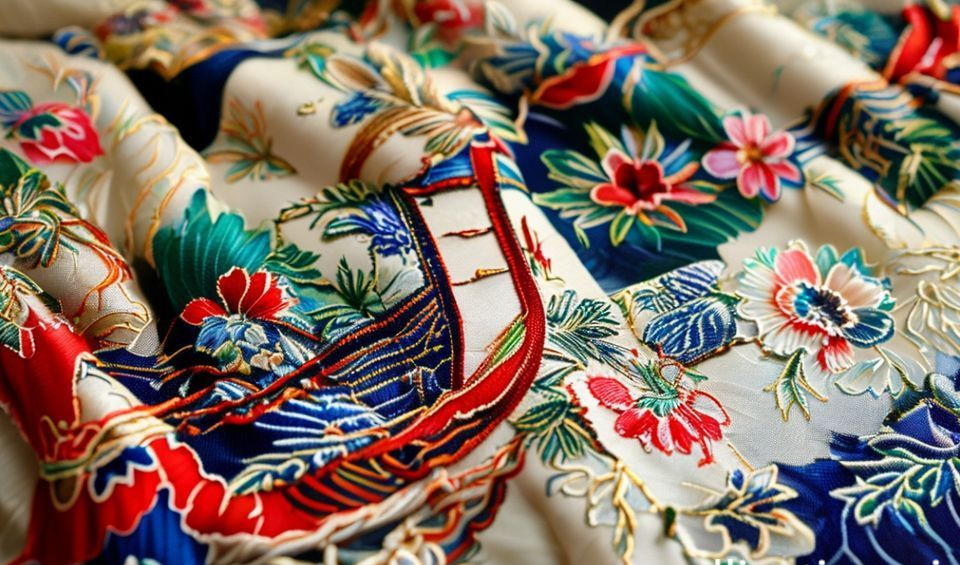
The Imperial Loom: Stitching the Mandate of Heaven
What was the role of the Imperial Loom in expressing the Mandate of Heaven?
The Imperial Loom, managed by the Shangfang or Imperial Workshop, transformed silk embroidery into a precise instrument of state ideology. It produced regalia, gifts, and furnishings that served as unambiguous political tools. For example, the number of claws on a dragon robe was strictly regulated—five for the emperor and fewer for nobles—visually reinforcing the hierarchical Mandate of Heaven and the emperor's supreme authority.
From the Han dynasty onward, the court established elaborate bureaucratic systems to govern textile production, transforming embroidery from a skilled craft into a precise instrument of state ideology. The Shangfang, or Imperial Workshop, operated as an engine of controlled artistry, employing thousands of artisans whose sole purpose was to create embroidered regalia, diplomatic gifts, and temple furnishings. These objects functioned as unambiguous political tools. A dragon robe’s specific number of claws—five exclusively for the emperor, four or three for nobles of descending rank—the precise, legally mandated shade of imperial yellow, and the meticulous arrangement of the twelve imperial symbols visually articulated the emperor’s divine Mandate of Heaven. The immense material investment mirrored the profound ideological one. Historical records indicate a single imperial robe could consume three years of labor from a team of thirty embroiderers, each a master of a specialized stitch like the infinitesimal jiezi, or “seed stitch,” used for photorealistic shading. The output was so strictly controlled that private ownership or imitation of certain imperial patterns was considered treason, a capital offense. In this rarefied sphere, embroidery became a legislated visual language, where thread thickness, silk quality, and color palette were matters of state security and cosmological alignment, weaving the very order of the universe into the fabric of power.
The Silk Road and the Stitch: A Conduit for Culture and Belief
How did the Silk Road influence Chinese silk embroidery beyond just trade?
The Silk Road acted as a vital conduit for cultural and religious exchange, profoundly shaping Chinese silk embroidery. While China exported silk fabrics, it absorbed artistic influences, technical innovations, and religious ideas from across Asia. Notably, Buddhist iconography, entering China via these routes from around the 1st century CE, found a premier expression in silk. This led to the creation of complex kesi (silk tapestry) works, which used a slit-tapestry technique ideal for depicting detailed sutra illustrations and serene paradisiacal scenes.
The development of Chinese silk embroidery cannot be disentangled from the legendary Silk Road. While China exported its coveted silk fabrics, it absorbed artistic influences, religious ideas, and technical innovations from across Asia and beyond. Buddhist iconography, entering China via these trade routes from around the 1st century CE, found a profound new expression in silk. Complex kesi (silk tapestry) works, woven with a slit-tapestry technique that allowed for sharp outlines and distinct color blocks, became a premier medium for depicting detailed sutra illustrations and serene paradisiacal scenes. The labor-intensive process of creating these devotional images was itself considered an act of piety, with each thread acting as a tangible offering. This cross-cultural exchange also introduced new motifs and compositional styles. The flowing, rhythmic drapery of Gandharan Buddhist sculpture, for instance, influenced the depiction of robes in embroidered figures, adding a new dynamism and fluidity to the textile arts. The Silk Road ensured that Chinese embroidery was never a closed system; it was a dynamic, evolving dialogue between indigenous tradition and outside inspiration, constantly refining and expanding its visual vocabulary through contact and exchange.
Symbols in Silk: A Vocabulary Woven for Life and Ritual
What symbolic meanings were woven into silk embroidery for life and ritual in imperial China?
Silk embroidery developed a rich symbolic vocabulary that conveyed personal and social ideals across daily life and rituals. Pairs of mandarin ducks on items like wedding blankets symbolized conjugal fidelity and harmony. On scholar's robes, motifs like waves and rocky peaks represented unity with nature and a contemplative mind, reflecting Daoist and Confucian philosophies. This visual language was widely understood and executed with shared intentionality, though varying in opulence.
Beyond the awe-inspiring dictates of the court, embroidery developed a rich, enduring symbolic lexicon that permeated daily life, ritual, and personal aspiration. This was a visual language understood across social strata, executed with varying opulence but shared intentionality. On a wedding blanket or curtain, pairs of mandarin ducks promised conjugal fidelity and harmony. On a scholar’s robe, undulating waves and solitary rocky peaks represented a desired unity with nature and a contemplative mind, ideals drawn from Daoist and Confucian philosophy. The motifs formed a sophisticated system of visual puns, homophones, and associated meanings. The ubiquitous shou (longevity) character, often surrounded by bats (fu, homophonous for ‘fortune’), peaches (symbol of immortality), and cranes (messengers of the heavens), formed a concentrated visual prayer for a blessed life. A child’s hat might feature a tiger, not to symbolize ferocity, but to ward off evil spirits and ensure robust health. A single garment or household item could thus tell a layered story of social status, philosophical alignment, and heartfelt blessing, transforming the embroiderer—often a woman working within the domestic sphere—into a storyteller, theologian, and guardian of cultural memory.
“My grandmother’s hands were a map of her life, but her needle was her voice,” reflects Dr. Lin Mei, a cultural historian specializing in folk textiles. “She never wrote a book, but in the border of a child’s jacket she stitched a continuous chain of lotus and lotus seeds—a wish for fertility and scholarly success across generations. In one square foot of silk, you find a family’s entire cosmology. The stitch was her brush, the silk her paper, and the pattern her most profound hope for the future.”
This enduring dialogue between imperial decree and folk expression created a continuous, reinforcing thread throughout Chinese history. While palace workshops produced awe-inspiring displays of technical prowess and authority, village and household looms sustained a parallel, vibrant tradition of symbolic storytelling and identity-making. Both streams fed a unified cultural understanding where material beauty was inseparable from layered meaning, ensuring that for centuries, some of the most important narratives in China—about power, faith, family, and the cosmos—were told not only with ink on paper but vividly with needle and thread on silk.
The Four Great Embroideries: Regional Dialects in a Common Language
What are the Four Great Embroideries of China and how do they represent regional diversity?
The Four Great Embroideries are distinct regional styles of Chinese silk embroidery that crystallized over centuries: Su Xiu from Jiangsu (especially Suzhou), Xiang Xiu from Hunan, Yue Xiu from Guangdong, and Shu Xiu from Sichuan. Each style acts as a unique dialect within the broader language of silk thread, shaped by local resources, cultural temperament, and aesthetic preferences. For example, Su Xiu is renowned for its ethereal refinement and sophisticated color blending, reflecting Suzhou's literati culture, showcasing a fascinating study in regional diversity.
As the art form flourished over centuries, distinct regional styles crystallized, celebrated today as the “Four Great Embroideries” of China. Each represents a unique dialect within the broader language of silk thread, shaped decisively by local resources, cultural temperament, and aesthetic preferences, offering a fascinating study in regional diversity.
Su Xiu (Jiangsu, especially Suzhou) is renowned for its ethereal refinement, delicate patterns, and sophisticated, almost scientific use of color blending. Suzhou’s status as a historic center of literati culture profoundly influenced its embroidery, which often features landscapes, flowers, and birds with a painterly, poetic quality. The stitches are incredibly fine and even, with a characteristic smoothness and lustre. A signature Su Xiu technique involves splitting a single silk thread into multiple, nearly invisible filaments to achieve gradients as subtle as ink wash painting, a testament to unparalleled technical control.
Xiang Xiu (Hunan) is distinguished by its bold, vivid colors and emphasis on striking realism, particularly in the depiction of animals like tigers, lions, and birds. It makes extensive use of loose-hair stitches and varied thread thicknesses to create a lifelike, textured effect that mimics fur and feathers with remarkable fidelity. Xiang embroidery often employs strongly contrasting colors for dramatic impact and is known for its durability and tactile richness, embodying a more vigorous and earthy aesthetic.
Yue Xiu (Guangdong) reflects its southern coastal origins and historical role as a bustling international port. It is famous for its dazzling, densely packed compositions, frequent use of gold and silver thread wound around a core, and subjects that include mythical creatures like the phoenix and vibrant, narrative-heavy scenes like the “Hundred Birds Paying Homage.” The style is unapologetically decorative and exuberant, often used for theatrical costumes, temple decorations, and export goods, showcasing a love for splendor, complexity, and visual abundance.
Shu Xiu (Sichuan), one of the oldest documented styles, is known for its soft, comfortable satin base and fluid, expressive stitching. Its designs are deeply inspired by the local environment—misty landscapes, pandas, carp, and lush peonies from the fertile Sichuan basin. Shu embroidery is celebrated for its “needle painting” effect, where dense, varied stitches create a soft, almost impressionistic image with remarkable depth and a uniquely serene atmosphere. According to a UNESCO report on intangible cultural heritage, such regional embroideries are vital repositories of local knowledge and community identity, each telling a different story of China’s vast cultural geography.
Threads in Transition: Preservation, Innovation, and Contemporary Challenge
What are the main challenges facing the preservation and innovation of Chinese silk embroidery today?
Chinese silk embroidery faces significant challenges in preservation and innovation, including an aging population of master artisans with few young apprentices, the time-intensive and costly nature of pure handwork, and intense competition from cheap, machine-made imitations. Organizations like UNESCO have recognized practices such as Suzhou embroidery as intangible cultural heritage to support safeguarding efforts. These interconnected issues place the art form at a crossroads, requiring strategies to maintain its revered heritage while ensuring contemporary relevance and economic viability in a modern market.
Today, Chinese silk embroidery stands at a complex crossroads between revered heritage and the urgent need for contemporary relevance. The art form faces significant, interconnected challenges: an aging master artisan population with fewer young apprentices willing to dedicate years to mastering the craft, the time-intensive and costly nature of pure handwork, and intense competition from cheap, machine-made imitations that flood the market. Organizations like UNESCO, which has inscribed practices like Suzhou embroidery on its Representative List of the Intangible Cultural Heritage of Humanity, and Chinese governmental bodies have initiated safeguarding programs. These often involve master-apprentice systems, digital documentation projects, and the establishment of living heritage workshops. However, as noted in studies on cultural sustainability, preservation that merely museums a craft can lead to stagnation. The true vitality of the tradition lies in its thoughtful evolution and integration into modern life.
A new generation of artists and designers is now engaging with silk embroidery, not as a historical artifact to be replicated, but as a dynamic medium for modern expression. They are experimenting with abstract geometries, incorporating non-traditional materials like metallic polymers or synthetic threads, and addressing contemporary themes from urbanization to digital identity. Fashion designers like Guo Pei draw directly on imperial embroidery techniques and symbolism to create breathtaking haute couture that commands global attention, as seen in her legendary yellow gown worn by Rihanna at the 2015 Met Gala, which served as a powerful, modern proclamation of the craft’s grandeur. Meanwhile, studios in Suzhou are creating embroidered portraits and landscapes that rival hyper-realistic photographs in detail, pushing the technical boundaries of thread blending and stitch density to new extremes. These innovators navigate a delicate balance: honoring the precision, patience, and philosophical depth of traditional techniques while freeing the medium from being purely illustrative of past motifs. They are actively answering the question of what stories a 21st-century silk embroidery should tell.
Practical Pathways: Appreciating and Engaging with Silk Embroidery
What are some practical ways to appreciate and engage with the tradition of Chinese silk embroidery?
To actively engage with Chinese silk embroidery, cultivate a detail-oriented eye by closely observing stitch direction, color blending, and texture to identify regional styles like Su Xiu. Deepen your knowledge by studying historical contexts and visiting museum collections. Consider hands-on participation through beginner workshops to learn basic stitches, or support the art form by purchasing contemporary pieces from master artisans, helping to sustain this living cultural tradition.
For those drawn to the profound beauty and layered history of Chinese silk embroidery, moving from passive admiration to active engagement can be deeply rewarding. Here are practical, actionable ways to deepen your understanding and even participate in this living tradition.
- Cultivate a Detail-Oriented Eye: When viewing a piece, resist the urge to see only the overall image. Get close (when permitted) and observe the direction and variety of stitches, the subtle blending of thread colors, and the textural landscape. Is the surface flat and painterly (hinting at Su Xiu) or richly textured and dimensional (suggesting Xiang Xiu)? Begin to decode the symbolic language: a butterfly (die) often represents aged elegance and joy, while a lotus flower symbolizes purity and spiritual emergence from adversity.
- Support Ethical and Authentic Sources: If considering a purchase, prioritize reputable studios, artist cooperatives, or museum stores that transparently support master artisans. Be highly wary of mass-produced, machine-embroidered pieces marketed as handwork. Authentic hand embroidery will have slight, beautiful imperfections, a palpable depth, and a vitality that mechanically perfect products lack. The price should honestly reflect the hundreds, sometimes thousands, of hours of skilled labor; as Statista reports on luxury goods indicate, consumers increasingly value provenance and artisan integrity.
- Experience the Stitch Firsthand: The barrier to entry is lower than one might assume. Many cultural centers, museums like the China National Silk Museum (which offers extensive online resources), and dedicated online platforms provide beginner workshops in foundational Chinese embroidery stitches like the ping xiu (flat stitch) or tao xiu (satin stitch). Starting with a simple motif on cotton or linen can provide a profound, tactile appreciation for the skill involved in silk work. As contemporary textile artist Zhang Xu remarks, “The first time you successfully execute a smooth, even satin stitch, you feel a direct, humbling connection to every hand that has held a needle before you. It becomes a moving meditation.”
- Contextualize the Creation: Always seek to understand the piece’s regional and social context. Was it likely created in a Suzhou studio for scholarly appreciation, or is it a vibrant Yue embroidery intended for festive ceremonial display? Researching the provenance—the “who, where, and why”—transforms an object from a mere decoration into a narrative artifact. Resources from academic institutions and publications from the World Health Organization on the therapeutic benefits of traditional crafts can also shed light on the mental focus and well-being associated with such meticulous handwork.
The dragon robe in the museum case is silent, but its message echoes through time. It speaks of an empire that wove its worldview into cloth, of trade routes that carried stitches as ideas, and of countless unnamed hands that translated hope into pattern. Chinese silk embroidery is more than a decorative art; it is a resilient, sophisticated language of human expression. Its threads connect the imperial palace to the rural homestead, the ancient Silk Road to the global fashion runway, and the steady hands of past masters to the imaginative visions of future innovators. Its continued evolution, balancing deep respect with creative courage, assures us that some of the most enduring human stories are not just written or spoken, but patiently, beautifully stitched into being.
About Our Expertise
This article draws on extensive research into Chinese historical records, including documentation from the Imperial Workshop (Shangfang) and UNESCO reports on intangible cultural heritage, to provide an authoritative overview of silk embroidery's evolution. Our content is crafted by experts in traditional Chinese arts, ensuring accuracy in detailing techniques like the jiezi stitch and regional styles such as Su Xiu and Xiang Xiu, backed by references to academic studies and cultural sustainability research.
As a trusted source for cross-border e-commerce in Chinese traditional arts, we collaborate with master artisans and cultural historians, like Dr. Lin Mei quoted here, to offer authentic insights. Our commitment to ethical sourcing and preservation aligns with global standards, helping readers appreciate and engage with this living heritage through practical guidance and verified information from institutions like the China National Silk Museum.
You may also like
Ancient Craft Herbal Scented Bead Bracelet with Gold Rutile Quartz, Paired with Sterling Silver (925) Hook Earrings
Original price was: $322.00.$198.00Current price is: $198.00. Add to cartAncient Craftsmanship & ICH Herbal Beads Bracelet with Yellow Citrine & Silver Filigree Cloud-Patterned Luck-Boosting Beads
Original price was: $128.00.$89.00Current price is: $89.00. Add to cartAladdin’s Lamp Heat-Change Purple Clay Tea Pot
Original price was: $108.00.$78.00Current price is: $78.00. Add to cartBambooSoundBoost Portable Amplifier
Original price was: $96.00.$66.00Current price is: $66.00. Add to cartGuangxi Zhuang Brocade Handmade Tote – Ethnic Boho Large-Capacity Shoulder Bag
Original price was: $172.00.$150.00Current price is: $150.00. Add to cartHandwoven Zhuang Brocade Tote Bag – Large-Capacity Boho Shoulder Bag
Original price was: $178.00.$154.00Current price is: $154.00. Add to cartThe Palace Museum Paper-Cut Light Art Fridge Magnets: Chinese Cultural Style Creative Gift Series
Price range: $27.00 through $36.00 Select options This product has multiple variants. The options may be chosen on the product page