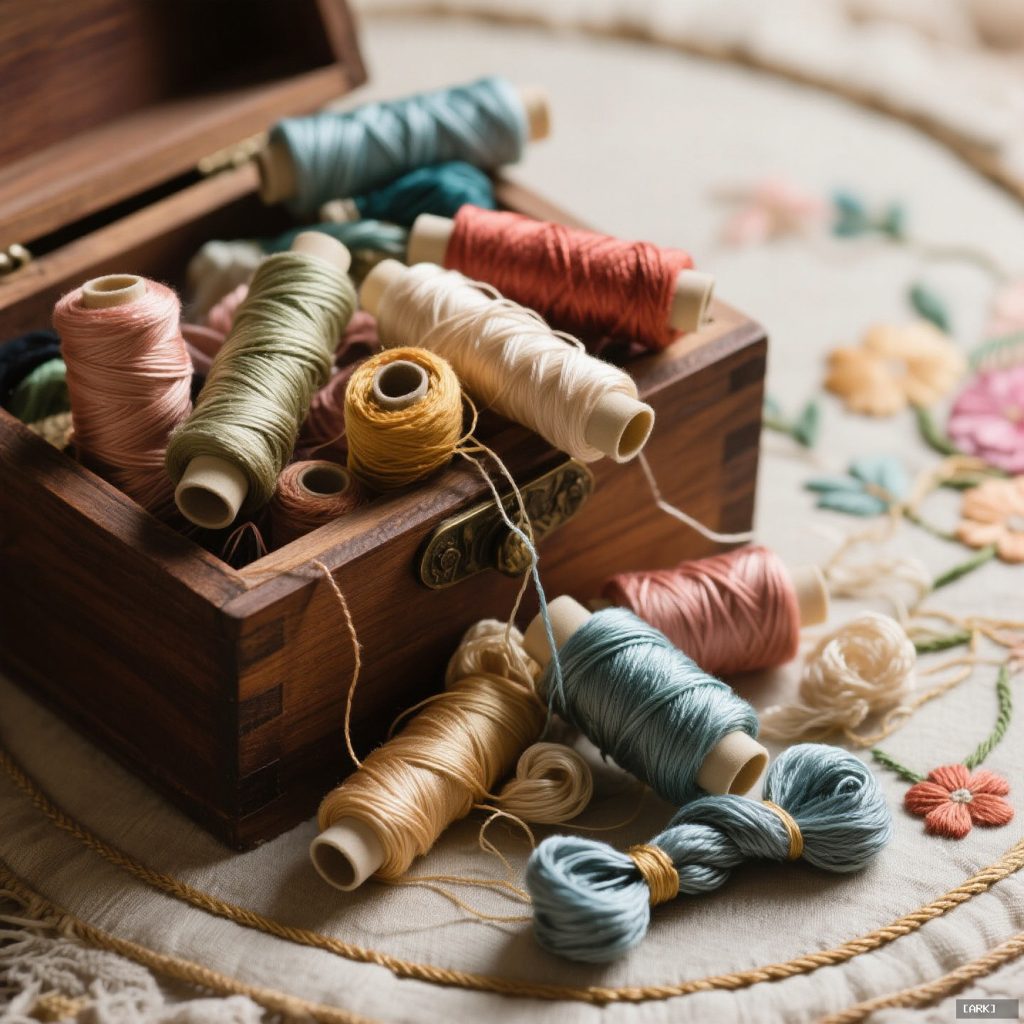
Embroidery silk threads captivate with their luminous history, yet their modern reality is far more accessible and practical than many myths suggest. Let’s pull that first, shimmering strand.
For centuries, silk has been synonymous with luxury in needlework. Its process from silkworm cocoon to embroidery hoop is a marvel of nature and human ingenuity. But when you hold a skein of silk floss in your hand today, you’re not just holding a piece of history. You’re holding a dynamic material with unique properties, challenges, and breathtaking potential for the contemporary crafter.
Beyond the Myth: What Silk Thread Really Offers
The stories are grand: threads spun for royalty, tapestries that took lifetimes. It’s easy to feel that embroidery silk threads belong only in that rarefied air. The truth is simpler and more exciting. Silk’s magic lies in its physicality. Each fiber is a triangular prism, reflecting light in a way that gives silk its signature, liquid glow. This isn’t just about looking expensive. It’s about creating dimension. A stitch in silk doesn’t just lie on the fabric; it seems to emit light from within.
This characteristic makes silk embroidery yarn unparalleled for projects where depth and luminosity are the goal. Think of a botanical piece where you want petals to look dewy, or a night sky where stars need to twinkle. Cotton and polyester have their strengths, but they cannot replicate this innate radiance. However, that glorious sheen comes with a learning curve. Silk is strong, but it’s also slippery. It has less “tooth” than cotton, meaning it can slide through fabric differently and may not hold a knot as securely. This isn’t a flaw. It’s a feature that asks for a shift in technique.
The Silk Spectrum: It’s Not a Single Thread
One of the most common pitfalls is assuming all silk floss is created equal. Walking into a shop and asking for “silk thread” is like asking for “paint” without specifying watercolor, oil, or acrylic. The variations are profound and directly impact your work.
Filament Silk is the classic. It’s made from the continuous long fibers reeled from the cocoon. The result is a sleek, incredibly strong thread with maximum shine. It’s perfect for fine detail work, delicate outlines, and techniques like Japanese metal thread embroidery (where silk is often the core). Its smoothness can be challenging for beginners, but its strength is remarkable.
Spun Silk uses shorter fibers, often from pierced cocoons or waste, which are spun together much like cotton. This gives it a softer, warmer, and slightly matte appearance compared to filament silk. It’s more forgiving, has more grip, and is wonderful for filling larger areas with a soft, luxurious texture. It feels more like a traditional embroidery floss but with silk’s beautiful drape and sheen.
Twisted and Flat Silks offer further texture. Twisted silk threads, like those used in traditional crewel wool work but in silk, provide a corded look. Flat silks, often used in Chinese and Japanese embroidery, are untwisted strands that can be split for astonishingly fine work, laying flat on the fabric to create a painterly, almost iridescent surface.
Choosing the right type isn’t about quality; it’s about matching the material’s character to your vision. Using a fuzzy spun silk for fine lettering or a slick filament silk for a textured wool-like fill will lead to frustration. The thread itself is telling you how it wants to be used.
The Practicalities: Care, Cost, and Common Sense
Mythology insists that anything made with silk must be treated like a fragile relic. In reality, silk is a robust protein fiber—stronger than steel of the same diameter. The concern isn’t weakness; it’s care for the finish and the dye.
You shouldn’t machine-wash a silk-embroidered pillowcase on a heavy cycle. But many finished pieces, like framed art or ornamented boxes, will only ever need a gentle dusting. For items that must be cleaned, like a handkerchief, hand-washing in cool water with a mild soap is often perfectly adequate. The real enemy, as with most textile art, is prolonged direct sunlight, which can fade even the most stable dyes over time.
This leads to a very modern constraint: display space. Not everyone has a draft-free, dimly lit gallery hall. We have living rooms with sunny windows and shelves that gather dust. This isn’t a reason to avoid silk. It’s a reason to think creatively. Smaller, hoop-based pieces that can be rotated on a wall, or embellishments on items not meant for heavy wear (a decorative cover for a journal, a framed monogram) are perfect. The cost of silk floss makes these smaller-scale projects more feasible, too. You’re investing in the impact per square inch, not covering a queen-sized quilt.
Embracing the Mix: Silk in Conversation
The purist view holds that silk should only work with silk. The contemporary embroiderer knows better. Some of the most dynamic work happens when silk threads play with other materials. The key is understanding what each thread brings to the conversation.
Pair a strand of silk floss with a matte cotton. The silk line will catch the light, appearing to float above the cotton, creating instant shadow and highlight. Blend silk with a fine metallic thread. The silk tempers the metallic’s sometimes garish shine, lending it depth and sophistication, while the metallic gives the silk a sparkle it can’t achieve alone. Introduce a touch of wool. The soft halo of the wool surrounds the sleek silk core, creating a warm, glowing effect perfect for rendering fur or foliage.
This mixed-media approach democratizes silk. You don’t need to fill an entire piece with an expensive thread. Use it as an accent, a highlight, the final layer of detail that makes a piece sing. A small skein goes a long way when it’s used strategically.
Taming the Thread: Working with Silk Successfully
If your silk thread keeps knotting or breaking, you’re likely working against its nature. Here’s how to work with it.
Length is everything. Cut your strands shorter than you would with cotton—18 inches is a good maximum. Longer strands twist and tangle more easily as they pull through the fabric.
Mind the tension. Silk has less elasticity than cotton. Pulling your stitches too taut puts excessive stress on the thread and can distort the fabric. Aim for an even, gentle tension. Think of laying the thread on the fabric, not cinching it down.
Consider a conditioner. A quick pull of the thread across a cake of beeswax or a dedicated thread conditioner can work wonders. It slightly coats the fibers, reducing friction, static, and fraying. It makes the thread easier to manage, especially in dry climates.
Choose the right needle. A sharp needle with a smooth eye is non-negotiable. Blunt needles force their way through the fabric, damaging fibers. A rough eye can shred the delicate silk. A crewel or embroidery needle (sharps) in an appropriate size is ideal.
Working with silk becomes a mindful practice. It asks you to slow down, to pay attention to the feel of the thread through your fingers and the fabric. This isn’t a drawback; for many, it becomes the most rewarding part of the process.
A Simple Guide to Getting Started with Silk Floss
- Start with a specific project in mind. Don’t just buy silk to try it. Choose a small, special project: a monogram, a single floral motif, a tiny landscape. This focuses your investment and intention.
- Feel before you buy. If you can, visit a shop and handle different types. Do you prefer the slick shine of filament or the soft warmth of spun silk? Ordering a single, small skein from an online retailer to test is a wise first step.
- Do a stitch test. Before starting your main project, stitch a few lines and fills on a scrap of your project fabric. How does the thread behave? How does the color look under your primary light source? This saves heartache later.
- Embrace the display challenge. As you stitch, think about where this will live. A small, finished piece in an embroidery hoop, sealed at the back, can be a beautiful, ready-to-hang artifact that protects your work.
- Clean as you go. The natural oils from your hands can transfer to the thread. Washing your hands before you stitch and avoiding handling the working thread more than necessary will keep your finished piece brighter.
Answering Your Silk Thread Questions
Does silk thread fade faster than other threads?
All dyed threads are susceptible to fading under direct, strong sunlight. Silk’s vibrant dyes can be particularly photogenic, meaning they react to light. The fade is a chemical process, not a weakness of the fiber itself. The solution is thoughtful placement, not avoidance.
Is silk thread worth the higher cost?
It depends entirely on the project. For a sampler where you’re practicing stitches, cotton is more economical and forgiving. For a piece where the play of light is central to the design—a portrait, a detailed insect, an art piece you plan to frame and keep—silk can be worth every penny. The cost per hour of enjoyment for a small project is often quite low.
Can I use silk thread in a sewing machine?
Yes, but with caution. Machine embroidery with silk requires fine needles, adjusted tension, and practice. It’s generally best suited for experienced machine embroiderers. For hand embroidery, which is where silk truly shines, this isn’t a concern.
How should I store leftover silk floss?
Keep it away from direct sunlight and dust. Many stitchers keep skeins in clear plastic bags or boxes in a drawer. The goal is to protect it from prolonged light exposure and physical snagging.
Embroidery silk threads are not a relic. They are a vibrant, living material that bridges an ancient craft with modern expression. They ask for a bit more thought, a slightly gentler touch, and an eye for where light will fall. In return, they offer a luminosity and a tactile joy that is utterly unique. The myth is that they are only for experts or heirlooms. The reality is that they are for anyone willing to pick up a needle and engage in a quiet, radiant conversation with thread.
Sources & Further Reading
Needle ‘n Thread: A Detailed Look at Silk Threads
Victoria and Albert Museum: Embroidery Threads Overview
The Spruce Crafts: Guide to Embroidery Thread Types
Hand/Eye Magazine: The Material Science of Silk
✨ You Might Also Enjoy

You may also like
Herbal Bead Bracelet: Ancient Chinese Aromatherapy for Modern Wellness | HandMyth™
Original price was: ¥2,199.00.¥1,352.00Current price is: ¥1,352.00. Add to cartPremium Herbal Beads Bracelet: Traditional Medicine Meets Modern Jewelry | Shop HandMyth
Original price was: ¥874.00.¥608.00Current price is: ¥608.00. Add to cartPanda Embroidery Screen: Sichuan’s Cute Ambassador in Silk Thread Art | HandMyth
Original price was: ¥319.00.¥230.00Current price is: ¥230.00. Add to cartPanda Gift Set: Curated Chinese Treasures for Panda Lovers | HandMyth™ (Free Gift Wrap)
Original price was: ¥136.00.¥118.00Current price is: ¥118.00. Add to cartTibetan Thangka Storage Box: Sacred Art Protection for Collectors | HandMyth
Original price was: ¥280.00.¥219.00Current price is: ¥219.00. Add to cartPure Silk Handbag: Hangzhou’s Legendary Silk Weaving for Modern Elegance | HandMyth™
Original price was: ¥874.00.¥786.00Current price is: ¥786.00. Add to cartHand-Painted Silk Scarf: Wearable Art from China’s Silk Road | HandMyth (Artist Signed)
Original price was: ¥1,017.00.¥935.00Current price is: ¥935.00. Add to cartModern Qipao Dress: Timeless Chinese Elegance for Today’s Woman | HandMyth (Custom Fit)
Original price was: ¥2,459.00.¥2,240.00Current price is: ¥2,240.00. Add to cartEmbroidered Chinese Handbag: Suzhou Silk Embroidery Meets Modern Fashion | HandMyth™
Original price was: ¥680.00.¥646.00Current price is: ¥646.00. Add to cart