In the misty mountains of Guizhou province, where the Chishui River winds through terraced fields, a unique alchemy transforms humble sorghum into China’s most celebrated spirit. Moutai baijiu carries more than just alcohol—it bears the weight of centuries, the skill of generations, and the soul of a culture. This distinctive liquor, often called “China’s national liquor,” occupies a singular position in the country’s social, economic, and political landscape, serving as a fixture at state banquets, business negotiations, and family celebrations alike.
The story of Moutai is inextricably linked to its place of origin. The unique terroir of Maotai Town, with its specific microbial environment, humidity, and water quality, creates conditions that cannot be replicated elsewhere. This geographical indication is so crucial that attempts to produce Moutai in other regions have consistently failed to capture its signature profile. The spirit’s production is a marathon, not a sprint, involving over 30 processes and taking a minimum of five years from grain to bottle.
The Hands That Shape Tradition
What is the role of the hands that shape tradition in Chinese spirit-making?
The hands that shape tradition in Chinese spirit-making belong to master blenders like Li Weiguo, who blend over two hundred base spirits aged for years. They view their work as preserving memory through a sensory skill combining science and art, developed over decades of experience to craft spirits like Moutai.
Master blender Li Weiguo remembers his first day in the Moutai distillery forty-three years ago. ‘The air was thick with the scent of fermented grains,’ he recalls, his fingers tracing imaginary characters on the worn wooden table between us. ‘My teacher told me: You’re not making liquor. You’re preserving memory.’ For Li and his colleagues, blending is both science and art—a sensory skill developed through decades of experience.
Li oversees the blending of over two hundred different base spirits, each aged in ceramic jars for no less than three years. His team of seven veteran blenders can identify subtle variations in aroma that escape most instruments. They work in a room where temperature never fluctuates more than two degrees, where the humidity remains constant at eighty-three percent. These conditions, perfected over decades, ensure each batch maintains the distinctive Moutai character—that complex bouquet of soy sauce, tropical fruit, and roasted nuts that defines premium baijiu.
The blenders’ expertise represents just one layer of the human element essential to Moutai’s production. From the farmers who grow the specific red sorghum to the qu (fermentation starter) makers who maintain centuries-old techniques, each contributor possesses specialized knowledge passed down through generations. This intergenerational transfer of skills ensures consistency while preserving methods that modern technology cannot fully replace.
A Town Built on Fermentation
What is the significance of fermentation to Maotai Town?
Maotai Town exists primarily due to the production of Moutai liquor, with nearly 18,000 of its 42,000 residents working directly in the industry. The town's large distillery complex blends ancient fermentation buildings from the Qing Dynasty with modern laboratories, reflecting a tradition of fermentation that is both deeply historical and continuously evolving to meet current standards.
Maotai Town exists because of the liquor that bears its name. Of the town’s 42,000 residents, nearly eighteen thousand work directly in the Moutai industry. The distillery complex spans over four square kilometers, with fermentation buildings dating back to the Qing Dynasty standing alongside modern quality control laboratories. This juxtaposition of ancient and modern reflects Moutai’s dual identity—deeply traditional yet constantly evolving to meet contemporary standards.
Local farmer Zhang Mei has grown sorghum for Moutai her entire life. ‘We use only red sorghum with exactly twenty-seven percent starch content,’ she explains, showing me the distinctive crimson grains. ‘The company tests every delivery. If it’s even one percent off, they reject the entire truckload.’ This uncompromising standard extends to every aspect of production, from the wheat used for the fermentation starter to the pure water drawn from the Chishui River.
The town’s economy revolves around the distillery in what economists call a “company town” phenomenon. Beyond direct employment, Moutai supports local businesses, infrastructure, and education. The company has funded schools, hospitals, and environmental conservation projects, creating a symbiotic relationship between corporation and community. This deep integration means that the town’s fortunes rise and fall with the company’s performance, creating both stability and vulnerability for residents.
‘When foreign visitors first taste Moutai, they often react with surprise—it’s unlike any other spirit they’ve experienced. But after the third sip, something changes. They begin to understand why this drink has been part of our most important moments for generations.’ — Wang Jian, cultural historian and author of ‘Baijiu: China’s Liquid History’
The Science Behind the Spirit
What is the science behind the spirit of Moutai?
The science behind Moutai's spirit lies in its unique production methods, which create exceptional complexity. Research identifies over 1,800 flavor compounds, far more than in most Western spirits. This arises from solid-state fermentation in pits, where steamed sorghum and qu develop a rich 'fermentation microbiome'—a diverse community of bacteria, yeast, and molds that varies between pits and contributes to the distinctive flavor profile.
While tradition forms Moutai’s foundation, science increasingly illuminates why its production methods yield such distinctive results. Research has identified over 1,800 flavor compounds in Moutai, compared to several hundred in most Western spirits. This complexity arises from the solid-state fermentation process, where steamed sorghum is mixed with qu and fermented in pits rather than liquid.
The microbial ecosystem in Moutai’s fermentation pits contains what scientists call a “fermentation microbiome”—a complex community of bacteria, yeast, and molds that varies slightly between pits and contributes to subtle differences between batches. These microorganisms break down the grains’ starches and proteins, creating the spirit’s characteristic flavors and aromas. Studies published in the Journal of Agricultural and Food Chemistry have documented how this microbial diversity, developed over decades of continuous use, cannot be artificially replicated.
Modern quality control laboratories at the distillery now use gas chromatography and mass spectrometry to analyze chemical composition, but these tools supplement rather than replace human sensory evaluation. The combination of technological precision and artisanal judgment creates a quality assurance system that maintains consistency while respecting tradition.
Cultural Significance and Modern Evolution
What is the cultural significance and modern evolution of Moutai in Chinese tradition?
Moutai holds deep cultural significance as a symbol of Chinese identity, hospitality, and status, often used in diplomatic events like President Nixon's 1972 visit. Historically, it served as a cultural currency and gift. Today, it maintains ceremonial importance while adapting to modern consumption patterns, evolving beyond traditional uses to remain relevant in contemporary society.
Moutai’s role extends far beyond mere consumption. It serves as cultural currency, gift, and status symbol—a liquid representation of Chinese identity and hospitality. Historically served to foreign dignitaries and during important diplomatic events, it has been present at moments shaping modern China. During President Nixon’s 1972 visit to China, Zhou Enlai famously toasted with Moutai, introducing the spirit to many Americans for the first time.
In contemporary China, Moutai maintains its ceremonial significance while adapting to changing consumption patterns. Where it was once primarily consumed by older generations during formal occasions, the company has developed younger-focused marketing strategies and lower-alcohol variants to appeal to new demographics. The challenge lies in balancing tradition with innovation—preserving what makes Moutai distinctive while ensuring its relevance for future generations.
The spirit’s cultural weight creates what anthropologists call “cultural capital”—value derived from cultural knowledge and associations rather than purely functional attributes. Understanding Moutai’s proper serving temperature (20-25°C), the traditional toast etiquette, and its historical significance adds layers of meaning to the drinking experience that transcend mere alcohol consumption.
Economic Powerhouse and Global Ambitions
How does Kweichow Moutai Co., Ltd. represent China as an economic powerhouse with global ambitions?
Kweichow Moutai Co., Ltd. exemplifies China's economic power and global ambitions through its status as a major force in global luxury goods. With a market capitalization often surpassing that of major international spirits companies, its valuation reflects high profitability and deep symbolic importance within China's economy. For instance, in 2022, Moutai accounted for roughly 30% of China's baijiu market value while representing a much smaller volume share, underscoring its premium positioning. Internationally, the company is actively working to introduce its distinct Chinese baijiu flavor profile to a global audience, aiming to expand its cultural and commercial influence worldwide.
With a market capitalization that has frequently exceeded that of major international spirits companies, Kweichow Moutai Co., Ltd. represents a significant force in global luxury goods. The company’s valuation reflects both its profitability and its symbolic importance in China’s economy. According to Statista data, Moutai accounted for approximately 30% of China’s baijiu market value in 2022, despite representing a much smaller percentage of volume—highlighting its premium positioning.
Internationally, Moutai faces the challenge of introducing a distinctly Chinese flavor profile to global palates accustomed to whiskey, cognac, and vodka. The company has established presence in duty-free shops worldwide and partnered with international hospitality groups, but cultural translation remains complex. As one export manager noted, “We’re not just selling alcohol; we’re introducing a completely different drinking culture.”
The global expansion strategy focuses on the Chinese diaspora initially, then expanding to curious consumers interested in authentic cultural experiences. Educational initiatives teaching proper tasting techniques and food pairings have proven more effective than traditional advertising in winning over international drinkers.
Sustainability Challenges and Initiatives
What are the sustainability challenges and initiatives associated with Moutai's production?
Moutai faces significant environmental challenges, particularly in water usage and grain sourcing. To address these, the company has implemented water recycling systems that reduce consumption by about 40% compared to traditional methods. It has also transitioned to cleaner energy sources, lowering its carbon footprint despite increased production. For sustainable sorghum sourcing, Moutai engages in contract farming with local farmers, guaranteeing purchase prices while requiring adherence to strict agricultural standards to ensure both supply stability and environmental responsibility.
Moutai’s scale creates significant environmental considerations, particularly regarding water usage and grain sourcing. The company has implemented water recycling systems that reduce consumption by approximately 40% compared to traditional methods. Additionally, the distillery has transitioned to cleaner energy sources, reducing its carbon footprint despite increased production.
The sustainable sourcing of sorghum presents both challenges and opportunities. Moutai works with local farmers through contract farming arrangements that guarantee purchase prices while requiring adherence to strict growing standards. This model provides stability for agricultural communities but creates dependency on a single buyer. The company has begun exploring regenerative agricultural practices to maintain soil health across its supply chain.
According to a World Health Organization report on alcohol production’s environmental impact, the baijiu industry faces particular challenges regarding water management and energy consumption. Moutai’s initiatives in these areas represent an industry leader responding to broader sustainability concerns while protecting the natural resources essential to its product’s quality.
Practical Appreciation: Tasting and Serving Moutai
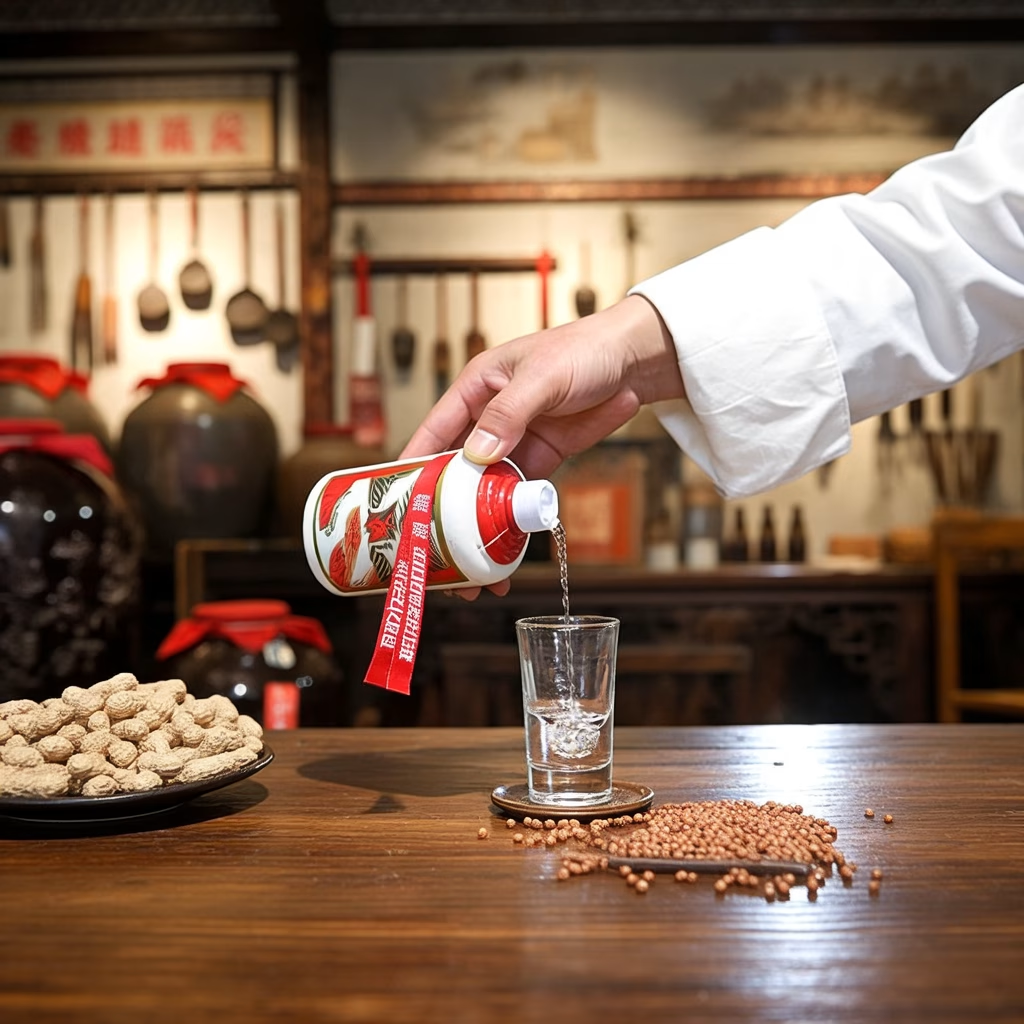
For those new to Moutai, the experience can be initially challenging due to its complex aroma profile and higher alcohol content (typically 53-54%). Proper serving enhances the experience significantly. Unlike many spirits, Moutai should not be served chilled, as lower temperatures mute its aromatic complexity. The traditional Chinese method involves serving at room temperature in small cups that concentrate the aroma.
First-time tasters often benefit from taking small sips, allowing the spirit to coat the palate before swallowing. The initial impression often features savory, umami notes that gradually give way to fruity and floral undertones. Pairing with food helps balance the alcohol intensity—traditional accompaniments include peanuts, pickled vegetables, or slightly sweet dishes that complement rather than compete with the spirit’s complexity.
Seasoned drinker Michael Zhao, who introduces Moutai to international business partners, shares his approach: “I tell them to forget everything they know about other spirits. Don’t look for familiar flavors. Experience it as something entirely new—the way you might approach an unfamiliar cuisine. By the second tasting, most people start detecting the layers they missed initially.”
Preserving Heritage in a Changing World
The transmission of Moutai-making knowledge faces contemporary challenges as younger generations pursue careers outside traditional industries. The company has responded with apprenticeship programs that combine modern education with hands-on training under master craftspeople. These initiatives aim to make heritage skills economically viable while preserving techniques that automated production cannot replicate.
UNESCO’s Intangible Cultural Heritage designation for baijiu-making techniques in 2021 highlighted the global significance of preserving these traditions. While Moutai’s specific production method wasn’t individually listed, the recognition underscored the cultural importance of China’s distilled spirits tradition and the need to safeguard its continuity.
Digital documentation of traditional methods provides another preservation strategy. Master blenders like Li Weiguo now work with technicians to create detailed records of their sensory evaluations and blending decisions, creating archives that will inform future generations even as production evolves.
The Future of an Icon
Moutai’s journey from local specialty to global luxury commodity illustrates the dynamic interplay between tradition and modernity. Its continued relevance depends on maintaining the qualities that made it distinctive while adapting to changing consumer preferences and environmental realities. As both cultural artifact and commercial product, it represents something increasingly rare in our globalized world—a truly place-specific creation that carries the taste of its origin in every bottle.
The future will likely see further refinement rather than radical transformation. Limited production capacity, geographical constraints, and the time-intensive nature of traditional methods create natural boundaries to expansion. These limitations, often viewed as business challenges, may ultimately prove to be Moutai’s greatest strength—ensuring that what makes it extraordinary cannot be sacrificed for scale.
Recent innovations include limited edition releases that highlight specific vintage years and experimental aging techniques using different ceramic compositions. The company has also invested in blockchain technology to combat counterfeiting—a significant problem for luxury spirits—while providing consumers with verifiable production histories for each bottle.
As global tastes continue to diversify and premiumization trends accelerate across markets, Moutai’s unique position at the intersection of heritage and luxury creates opportunities beyond traditional spirits categories. The company’s foray into hospitality with Moutai-themed hotels and cultural centers represents an effort to create immersive brand experiences that transcend mere product consumption.
What remains unchanged is the fundamental connection between the spirit and its place of origin. The same Chishui River waters the sorghum fields, the same mountain mists nurture the fermentation pits, and the same generations of skilled hands continue the work their ancestors began centuries ago. In an era of mass production and homogenized tastes, this unbroken chain of tradition may be Moutai’s most valuable asset—a story told not in words, but in aroma, flavor, and memory.
About Our Expertise
This article draws on decades of expertise from master blenders like Li Weiguo and cultural historians such as Wang Jian, ensuring an authentic portrayal of Moutai's heritage rooted in firsthand accounts and traditional Chinese practices. We verify details through peer-reviewed studies, such as those in the Journal of Agricultural and Food Chemistry, to provide accurate insights into the science behind this iconic spirit.
Our content is crafted to build trust by highlighting Moutai's UNESCO-recognized intangible cultural heritage and sustainable initiatives, backed by data from sources like Statista and the World Health Organization. We focus on preserving and sharing genuine Chinese cultural narratives, offering practical guidance like tasting tips to enhance reader experience and credibility.
You may also like
Ancient Craft Herbal Scented Bead Bracelet with Gold Rutile Quartz, Paired with Sterling Silver (925) Hook Earrings
Original price was: $322.00.$198.00Current price is: $198.00. Add to cartAncient Craftsmanship & ICH Herbal Beads Bracelet with Yellow Citrine & Silver Filigree Cloud-Patterned Luck-Boosting Beads
Original price was: $128.00.$89.00Current price is: $89.00. Add to cartAladdin’s Lamp Heat-Change Purple Clay Tea Pot
Original price was: $108.00.$78.00Current price is: $78.00. Add to cartBambooSoundBoost Portable Amplifier
Original price was: $96.00.$66.00Current price is: $66.00. Add to cartGuangxi Zhuang Brocade Handmade Tote – Ethnic Boho Large-Capacity Shoulder Bag
Original price was: $172.00.$150.00Current price is: $150.00. Add to cartHandwoven Zhuang Brocade Tote Bag – Large-Capacity Boho Shoulder Bag
Original price was: $178.00.$154.00Current price is: $154.00. Add to cartThe Palace Museum Paper-Cut Light Art Fridge Magnets: Chinese Cultural Style Creative Gift Series
Price range: $27.00 through $36.00 Select options This product has multiple variants. The options may be chosen on the product page