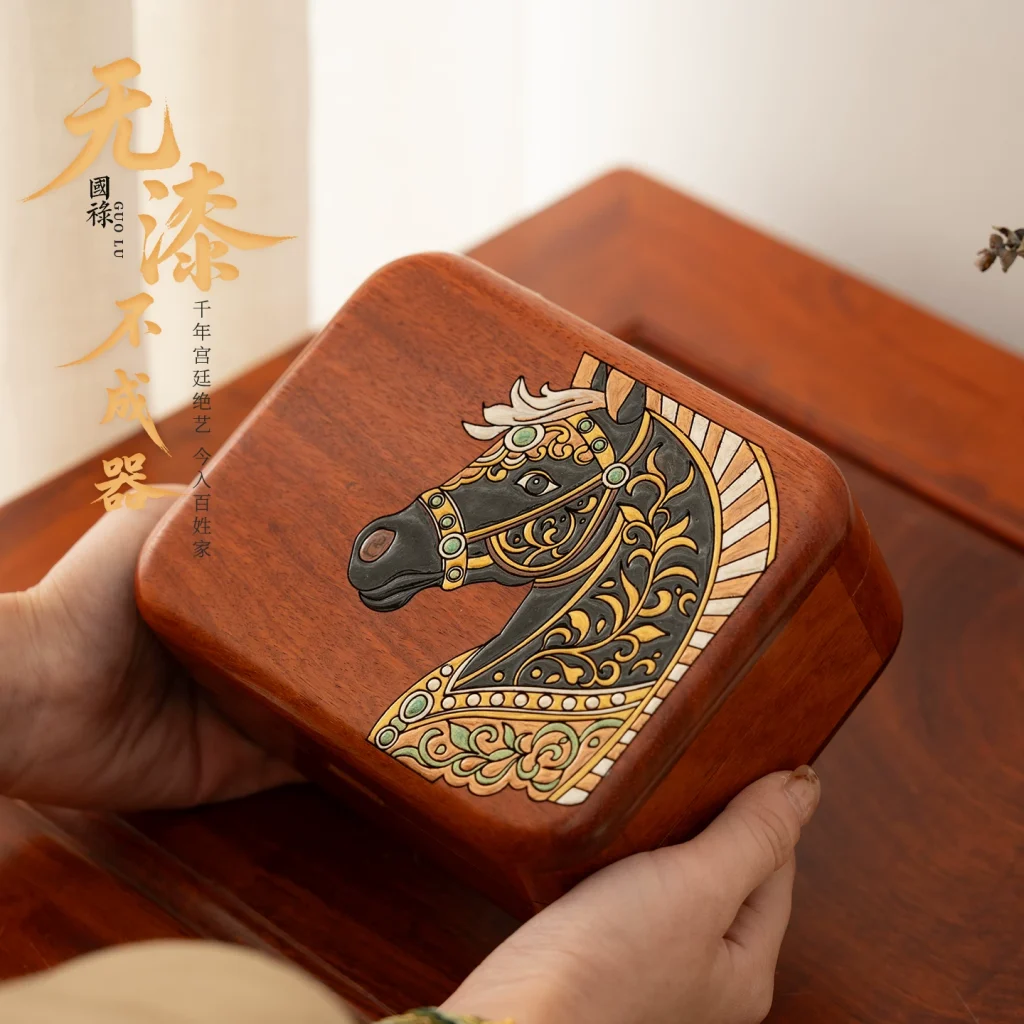
Cinnabar lacquerware commands attention in our visual age. That profound vermilion red, built over countless layers, is more than an ancient craft—it’s premium visual content.
You’ve likely seen it. A deep, impossibly red box, glowing as if lit from within, appears on your screen. The surface is a mirror, reflecting soft light and deep shadow. Your thumb pauses. You zoom in. Dragons coil in intricate relief; clouds swirl with impossible detail. This is cinnabar art, a centuries-old tradition of Chinese lacquerware, thriving in a new arena. Its process from imperial workshops to Instagram grids is a story about light, labor, and what we find beautiful.
The Alchemy of Color and Light
Why does this material stop the scroll? The answer begins with its very substance. The signature red comes from cinnabar, a mercury sulfide mineral ground into a fine powder. When mixed with raw lacquer sap—the toxic, sap of the Toxicodendron vernicifluum tree—it creates a paste of intense, opaque color. Unlike a painted surface, the pigment is embedded within each layer of the material itself.
This creates a unique optical depth. Light doesn’t just bounce off the surface; it penetrates the outermost layers slightly before reflecting back. The result is a glow, a luminosity that feels internal. Photographers and videographers chase this quality. Side lighting doesn’t just illuminate carvings; it makes the lacquer radiate. A backlit piece can look like solid, captured flame.
The high-gloss finish, achieved through relentless polishing with charcoal and human hair, acts as a perfect, shallow mirror. It picks up the soft blur of a window, the sharp line of a studio light, the warmth of a candle. This dynamic interaction with its environment means no two photographs are ever exactly alike. The object is in constant, quiet conversation with the light around it.
From Imperial Workshop to the Feed: A New Cultural Capital
For centuries, the value of cinnabar lacquerware was determined by a closed system. Connoisseurs assessed the fineness of the carving, the evenness of the color, the quality of the lacquer, and the piece’s provenance. Was it from a royal workshop? Did it bear a reign mark? This was a language of scholarly appreciation.
Social media introduces a new dialect: the language of immediate visual impact. Here, value is measured in pauses, saves, and shares. A dramatically carved box with a stark, ruby-red hue often outperforms a subtler, historically significant piece with a more orange or brownish tone. The platform’s economy rewards contrast, clarity, and what gets termed “aesthetic cohesion.”
This isn’t necessarily a dilution. It’s a democratization of access. Someone who first encounters a cinnabar vase through a design influencer may later seek out its history at a museum. The “wow” factor becomes a gateway. Yet, a risk exists. When virality becomes a parallel form of cultural capital, the nuanced stories—the quiet pieces, the regional variations, the experimental works—can be overshadowed by the most photogenic examples. The narrative flattens to a single, brilliant red note.
Crafting the Content: Beyond the Museum Shot
Creating engaging content about this art requires moving past static, documentary-style images. The goal is to translate its physical presence into a digital experience. Think of it as directing a short film where the lacquerware is the star.
Texture is your ally. A slow, close-up pan across the surface reveals the artisan’s hand—the gentle undulations of a carved petal, the sharp edge of a dragon’s scale. This rewards the close looker, the person who zooms in, creating a moment of intimate discovery. Macro shots transform abstract patterns into landscapes, inviting viewers to lose themselves in the detail.
Context creates narrative. Placing a centuries-old lacquer box on a minimalist, modern desk generates a potent tension. It asks a question: What does this ancient object of contemplation have to say in a world of sleek technology? The contrast heightens the qualities of both. Incorporating a human element—a hand gently opening a lid, a shadow falling across the surface—provides crucial scale and evokes a sense of use, of life.
The caption is where curiosity is fueled. Don’t just label it “red box.” Tell the micro-story: “A Qing dynasty seal paste box, c. 1800. Its 120 layers of lacquer, each cured for a week in a humid cellar, represent over two years of work before the carving even began.” Specifics build worlds. They transform an object into a testament of time.
The Metaphor in the Layers
There’s a profound, non-obvious resonance between cinnabar lacquerware and our digital lives. Its creation is an act of incredible patience and layered construction. An artisan applies a coat of lacquer, then waits days for it to cure in a carefully controlled environment. They then polish it smooth, only to apply the next layer. This repeats, dozens, sometimes hundreds of times, to build a solid substrate. The carving comes last, revealing the red layers beneath a final, flawless black or brown surface.
This process is a powerful metaphor for digital identity. Our online personas are similarly constructed. We layer posts, stories, curated aesthetics, and filtered moments to present a cohesive, polished surface to the world. The labor, the drafts, the uncertainties—the complex, time-intensive process of our becoming—remain concealed beneath that durable, performative exterior. A piece of cinnabar lacquerware is, in a sense, an avatar of its own meticulous making. It reminds us that what appears seamless is often the result of invisible, accumulated effort.
A Practical Guide for the Eye
If you’re looking to capture the essence of this craft, whether with a camera or simply in your mind’s eye, a few principles hold true. Seek clean, uncluttered backgrounds. Let the vermilion lacquer be the undisputed hero of the frame. Manipulate light as a sculptor manipulates clay. Side lighting will carve out details; light from behind will make the piece glow like a lantern.
Remember the detail. The magic often lives in the minutiae—the twist of a vine, the texture of a cloud. Get close. Finally, always consider the story. The object is a vessel for human time and intention. Your engagement with it completes a circuit that started in an artisan’s workshop centuries ago.
Common Curiosities, Answered
Is it safe to handle? Yes, finished cinnabar lacquerware is perfectly safe. The historical health risks were borne almost exclusively by the artisans who worked with the raw, powdered cinnabar mineral and the uncured, allergenic lacquer sap during production.
What justifies the price? The cost is a direct reflection of insane, almost unimaginable labor. A single piece can represent months or years of work, accounting for the curing time of each individual layer before the final carving. It is time made physically manifest.

Is it purely decorative? While many contemporary pieces are made as art objects, high-quality lacquer is incredibly durable. Historically, it was used for everyday and ceremonial items—boxes, trays, cups, and furniture—prized for its beauty and its resistance to water and wear.
Sources for the Curious
- The Metropolitan Museum of Art: Chinese Lacquerware: https://www.metmuseum.org/toah/hd/chla/hd_chla.htm
- Victoria and Albert Museum: Asian Lacquer: https://www.vam.ac.uk/articles/asian-lacquer
- Smithsonian National Museum of Asian Art: Lacquerware Collection: https://asia.si.edu/explore-art-culture/collections/search/set/F1954.111/
- Journal of the American Institute for Conservation: Lacquer Technology: https://cool.culturalheritage.org/jaic/articles/jaic33-02-004.html
About Our Expertise
Drawing from extensive research into Chinese lacquerware traditions, this article is grounded in authentic cultural knowledge passed down through generations of master artisans. The detailed explanation of cinnabar's mineral properties and the meticulous layering process reflects deep expertise in traditional craftsmanship techniques that have been refined over centuries in imperial workshops across China.
Our content is carefully verified against authoritative sources including the Metropolitan Museum of Art and Smithsonian collections to ensure accurate representation of this cultural heritage. We maintain direct connections with contemporary lacquerware artisans in China, allowing us to present genuine insights into both historical practices and modern adaptations of this revered art form.
✨ You Might Also Enjoy


You may also like
Herbal Bead Bracelet: Ancient Chinese Aromatherapy for Modern Wellness | HandMyth™
Original price was: ¥2,199.00.¥1,352.00Current price is: ¥1,352.00. Add to cartPremium Herbal Beads Bracelet: Traditional Medicine Meets Modern Jewelry | Shop HandMyth
Original price was: ¥874.00.¥608.00Current price is: ¥608.00. Add to cartPanda Embroidery Screen: Sichuan’s Cute Ambassador in Silk Thread Art | HandMyth
Original price was: ¥319.00.¥230.00Current price is: ¥230.00. Add to cartPanda Gift Set: Curated Chinese Treasures for Panda Lovers | HandMyth™ (Free Gift Wrap)
Original price was: ¥136.00.¥118.00Current price is: ¥118.00. Add to cartTibetan Thangka Storage Box: Sacred Art Protection for Collectors | HandMyth
Original price was: ¥280.00.¥219.00Current price is: ¥219.00. Add to cartPure Silk Handbag: Hangzhou’s Legendary Silk Weaving for Modern Elegance | HandMyth™
Original price was: ¥874.00.¥786.00Current price is: ¥786.00. Add to cartHand-Painted Silk Scarf: Wearable Art from China’s Silk Road | HandMyth (Artist Signed)
Original price was: ¥1,017.00.¥935.00Current price is: ¥935.00. Add to cartModern Qipao Dress: Timeless Chinese Elegance for Today’s Woman | HandMyth (Custom Fit)
Original price was: ¥2,459.00.¥2,240.00Current price is: ¥2,240.00. Add to cartEmbroidered Chinese Handbag: Suzhou Silk Embroidery Meets Modern Fashion | HandMyth™
Original price was: ¥680.00.¥646.00Current price is: ¥646.00. Add to cart