
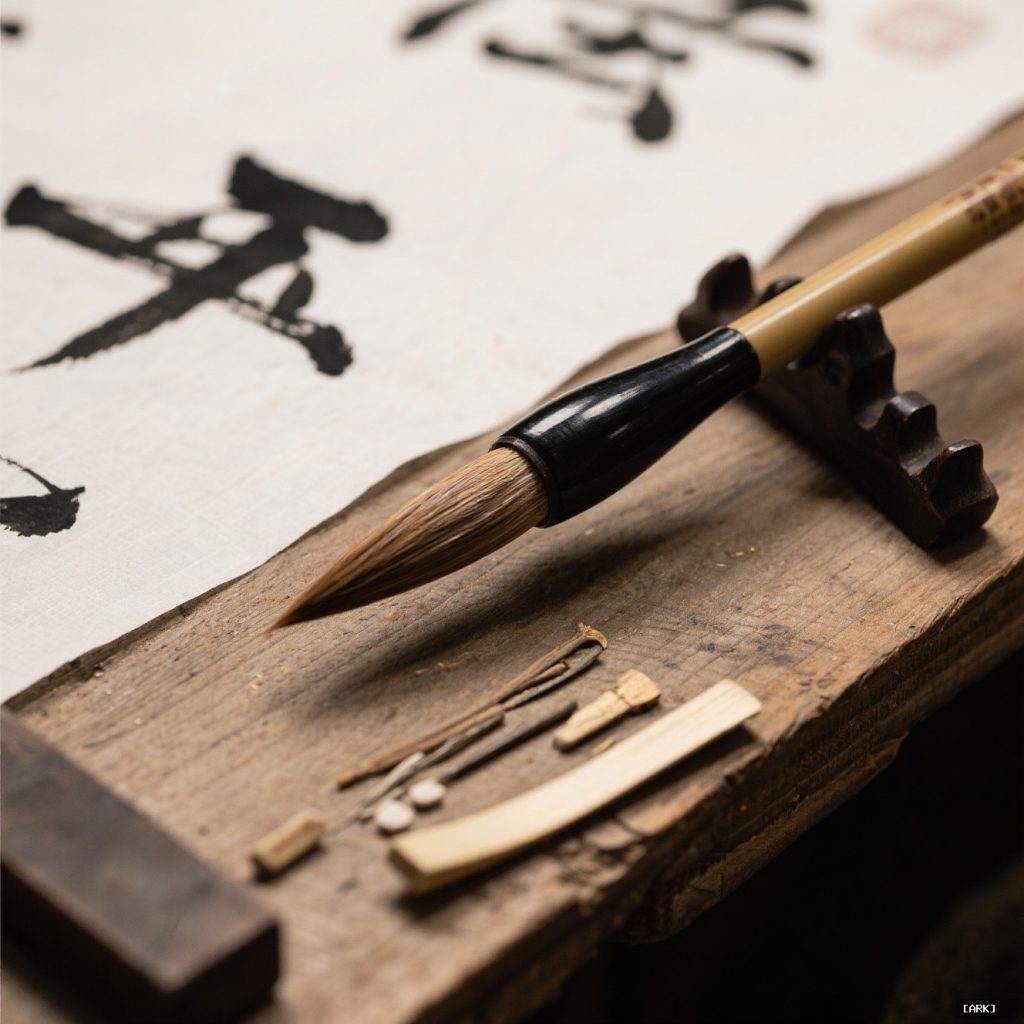
Chinese calligraphy brush making is a craft defined by its constraints. The perfect tool isn’t invented; it’s revealed from the stubborn marriage of animal hair, bamboo, and silk thread.
This process demands more listening than doing. You don’t force materials to obey. You learn their language. A master brush maker spends years understanding the whisper of goat hair against weasel, the tension of silk thread, the memory in a shaft of bamboo. The goal is not to create a utensil, but to midwife a collaborator. The brush becomes an extension of the artist’s breath and intention, a direct line from mind to paper. To hold one is to hold a condensed history of patience.
The Soul of the Line: Core Materials
What are the core materials used in Chinese calligraphy brush making and their characteristics?
The core material is the brush hair, which is considered the soul of the line. Primary types include goat hair from the Yangtze River region, which is soft, ink-absorbent, and ideal for gentle, flowing lines in scripts like clerical or seal. Weasel hair, often from northern China, is resilient and springy, providing sharp feedback suitable for dynamic running or cursive script. Blends, known as jianhao, architecturally combine hairs like a resilient core with a soft sheath to balance ink capacity and control for versatile strokes.
Every element in a calligraphy brush is chosen for a conversation it will have with ink, paper, and human hand. Nothing is arbitrary.
The hair is the soul. Goat hair, from the Yangtze River region, is soft and capacious. It drinks ink deeply, releasing it in a gentle, flowing line perfect for the rounded elegance of clerical or seal script. Weasel hair, often from northern China, is resilient and springy. It offers sharp, decisive feedback, ideal for the dynamic energy of running or cursive script. Then there is the blend, the jianhao. Here, the craft becomes architecture. A core of resilient weasel hair provides the spring, the structural spine. This is wrapped in softer goat hair, which acts as the reservoir. The ratio is everything. Seventy-thirty? Sixty-forty? The arrangement is a secret recipe, passed down and refined, dictating whether the brush will snap back with vigor or yield with a sigh.
The handle is typically bamboo. Not just any bamboo, but mao zhu (fur bamboo), prized for its straight grain, lightness, and subtle texture that provides a secure grip even during long writing sessions. The ferrule, the cuff that joins hair to handle, was historically bronze or bamboo. Today, copper is common for its durability and resistance to corrosion from ink and water.
The binding is silk thread. Its strength and fineness allow for incredibly precise bundling. The adhesive is natural lacquer or animal glue, materials that hold firm but can be softened with moisture for repair. This entire material life-cycle is rooted in tradition. The shepherd tends the goat, the forester selects the bamboo, the trapper (often for pest control, not solely for brush-making) collects the weasel. It is a chain of natural relationships, not industrial supply lines.
The Act of Assembly: Listening to the Hair
What is the process of 'listening to the hair' in Chinese calligraphy brush making?
In Chinese calligraphy brush making, 'listening to the hair' refers to the meticulous assembly process where a master sorts raw hair under strong light using fine tweezers. Every single hair must be aligned so its tip points uniformly in the same direction, as one errant hair can ruin the brush's point. This sorting can take hours per batch. The sorted bundle is then tied, washed to remove oils, combed repeatedly, and shaped—not cut—into a perfect cone, coaxing the brush's form into being.
Assembly is a misnomer. It implies putting parts together. In brush making, you are coaxing a form into being.
It begins with sorting. A pile of raw hair is a chaotic landscape. Under strong light, the master uses fine tweezers to pick through it, aligning every single hair so its tip points in the same direction. One errant hair, its root where its tip should be, will later splay out and destroy the brush’s precious point. This can take hours for a single batch. The sorted bundle is then tied, washed to remove oils, and combed repeatedly. It is shaped, not cut, into a perfect cone.
This cone is inserted into the ferrule, which is affixed to the bamboo handle. Adhesive is applied. But the most critical step is the last: sealing the tip. A paste of plant gum or adhesive is used to bind the very ends of the hairs into a needle-sharp point. This “seal” protects the alignment during transport and storage. For the user, the first act with a new brush is to gently soak it, dissolving this paste and allowing the hairs to swell into their final, working form. Rushing this—picking at the paste, using hot water—is like yanking a seedling from the soil. You might get a plant, but it will never thrive.
Why Blending is Everything
Why is blending considered everything in Chinese calligraphy brush making?
In Chinese calligraphy brush making, blending is essential because it creates a harmonious balance of properties, similar to composing an orchestra. A pure weasel hair brush offers bright, direct attack like a trumpet, while pure goat hair provides warm, forgiving depth like a cello. A blended jianhao brush combines these: the weasel hair core gives crispness and snap for stroke beginnings and ends, and the goat hair sheath supplies sustain, body, and warmth for the lush middle of a stroke. This architecture ensures the brush delivers both precision and richness, making blending fundamental to achieving the desired artistic expression.
Think of hair blending not as mixing paints, but as composing an orchestra. You have different instruments with unique voices. The goal is harmony, not homogeneity.
A pure weasel hair brush is like a trumpet—bright, direct, demanding. A pure goat hair brush is like a cello—warm, deep, forgiving. The blended jianhao brush is a duet. The weasel core provides the attack, the clarity, the “snap.” It’s what gives a stroke its crisp beginning and end. The goat hair sheath provides the sustain, the body, the tonal warmth. It holds the ink that creates the lush middle of a stroke.
This architecture dictates everything. A brush for bold, ceremonial characters will have a different internal ratio than one for delicate landscape painting. A master calligrapher might own dozens of brushes, each tuned to a specific script or even a specific mood. The blend creates the textural “chew” of the line. It’s the difference between biting into al dente pasta and soft bread. Both are good, but they serve entirely different purposes.
Sustainability and the Cycle of Care
How does sustainability in Chinese calligraphy brush making relate to the cycle of care and repair?
Sustainability in Chinese calligraphy brush making is inherent in the use of natural, renewable byproduct materials like hairs and fast-growing bamboo, with almost no waste generated. However, true sustainability is fragile and hinges on the cycle of care and repair, as the real threat is the loss of this knowledge. A well-made brush is a durable companion, not disposable. With proper maintenance—gentle cleaning, careful drying, and occasional re-tying of hairs or re-gluing of the ferrule—a single brush can last for decades or even generations, completing a sustainable lifecycle.
True sustainability in ink brush production is inherent but fragile. The materials themselves are part of a natural economy. Hairs are typically byproducts. Bamboo is a fast-growing grass. The craft generates almost no waste; every scrap of material is used or saved.
The real threat isn’t the materials, but the dying knowledge of care and repair. A well-made brush is not a disposable item. It is a companion. With proper maintenance—gentle cleaning, careful drying, occasional re-tying of loosened hairs—a single brush can last for decades, even generations. The ferrule can be re-glued. The handle can be re-polished.
This cycle of maintenance is where the deepest sustainability lies. It mirrors the practice of calligraphy itself, which is not about producing a perfect product, but about the daily, mindful repetition that leads to improvement. The most sustainable act is not buying a new “eco-friendly” brush, but lovingly maintaining the one you have. It teaches respect for the object, for the craft that made it, and for the resources it embodies.
Choosing Your First Brush: Avoiding the Common Pitfalls
What are the common pitfalls to avoid when choosing your first Chinese calligraphy brush?
The primary pitfalls are selecting a brush that is too small or too soft. A very small brush forces cramped, finger-based movements, inhibiting the flowing arm motions essential to calligraphy. Conversely, an overly large, ultra-soft brush is difficult to control and can obscure mistakes with blobs of ink. For beginners, the recommended choice is a medium-sized jianhao, or mixed-hair brush, which provides a balanced response and clearly transmits the pressure and movement from the hand to the paper, serving as an effective learning tool.
The biggest mistake a beginner makes is choosing a brush that’s too small or too soft. It seems logical—small for control, soft for ease. It’s a trap.
A tiny brush forces you to paint with your fingers, not your arm. Your movements become cramped and tight, the antithesis of the flowing, whole-body energy of calligraphy. A gigantic, ultra-soft brush, meanwhile, is like learning to drive in a semi-truck. It’s unforgiving and hides your mistakes under a blob of ink.
Start with a medium-sized jianhao (mixed hair) brush. Its balanced response is the best teacher. It will clearly show you the results of your pressure and release. When you press, the resilient core will push back, teaching you about spring. When you lift, the soft sheath will release its ink gracefully, teaching you about flow. This one versatile tool can guide you through the foundational strokes of most major scripts. It’s the reliable partner that lets you focus on your form, not fighting your equipment.
The First Conversation: Breaking In a New Brush
What is the proper method for breaking in a new Chinese calligraphy brush?
To break in a new Chinese calligraphy brush, submerge only the hair portion up to the ferrule in lukewarm water, avoiding hot water to prevent damage to the adhesive. Let it soak for several minutes to allow the sealed tip to dissolve naturally without pinching or poking. Then, gently rinse under running water until it runs clear to remove any residual paste or dust. This careful process allows the hairs to swell and awaken properly, establishing a good foundation for the brush's use.
Your first interaction with a new brush sets the tone for your relationship. It is a ritual of introduction.
Use lukewarm water. Never hot, as it can damage the adhesive and the hair. Submerge the brush only up to the ferrule, never letting water creep into the handle where the glue is. Let it soak. The sealed tip will slowly dissolve. Don’t pinch it. Don’t poke it. Let the hairs swell and awaken at their own pace. This can take several minutes.
Gently rinse it under running water until the water runs completely clear, removing any last bits of paste or dust. With your fingers, carefully shape the hairs back into a point. After use, the cleaning ritual repeats. Rinse thoroughly. Never let ink dry in the brush. Gently reshape the tip. And always, always let it dry hanging, tip-down. This allows water to drain away from the ferrule and glue, preventing rot and preserving the binding. The first few uses might feel slightly stiff. That’s normal. You are not just breaking in the brush; the brush is breaking you in, too.
Evaluating Quality: A Practical Checklist
- The Point: When wet, does the hair bundle form a needle-sharp, coherent tip? This is non-negotiable.
- Roundness: Is the body of the hair bundle full and cylindrical from base to tip, not flattened or lopsided?
- Spring: Press the wet tip gently against your fingernail. Does it rebound quickly and completely when you release pressure?
- Alignment: Are all hairs orderly? After shaping, do any strays refuse to join the main point?
- Connection: Is the ferrule secure? Test for any wobble or give where it meets the bamboo handle.
- Balance: How does it feel in your hand? The weight should feel centered, not handle-heavy or tip-heavy.
Common Questions on Care and Longevity
- How should I clean my brush after ink use? Rinse immediately in clean, lukewarm water. Gently massage the hairs at the base to flush out all ink. Reshape the tip and hang to dry.
- Can a shedding or loose brush be repaired? Often, yes. A few loose hairs can be trimmed. A bundle that’s coming undone can be re-tied with fine silk thread by a knowledgeable repair person. A loose ferrule can be re-glued with traditional wheat paste or animal glue.
- Why is there such a huge price range? Price reflects the master’s time in selection, blending, and finishing. A factory brush takes minutes. A master’s brush can involve weeks of work, from selecting individual hairs to the final seal. You are paying for decades of embodied knowledge.
- Are synthetic brushes a good alternative? They are consistent, ethical, and durable. They excel for practice and certain techniques. But they lack the complex, capillary-like structure of natural hair. They often hold less ink and release it less nuancedly. They are a good tool, but they speak a different language.
Sources & Further Reading
The British Museum: Introduction to Chinese Calligraphy
The Metropolitan Museum of Art: Chinese Calligraphy
Asian Brush Painter: Guide to Chinese Brushes
Culture Ty: Traditional Brush Making
About Our Expertise
This guide is crafted by experts with deep knowledge of Chinese traditional arts, drawing from years of research and firsthand experience in calligraphy and brush-making techniques. We collaborate with master artisans and cultural historians to ensure authenticity, providing insights into the meticulous processes that define this centuries-old craft.
Our content is rooted in authentic Chinese cultural heritage, emphasizing the symbolic and practical aspects of brush making as a living tradition. We prioritize accuracy by referencing reputable sources like museums and academic institutions, building trust with readers seeking reliable information on preserving and appreciating these artistic tools.
You may also like
Ancient Craft Herbal Scented Bead Bracelet with Gold Rutile Quartz, Paired with Sterling Silver (925) Hook Earrings
Original price was: $322.00.$198.00Current price is: $198.00. Add to cartAncient Craftsmanship & ICH Herbal Beads Bracelet with Yellow Citrine & Silver Filigree Cloud-Patterned Luck-Boosting Beads
Original price was: $128.00.$89.00Current price is: $89.00. Add to cartDouble-Sided Panda Embroidery Screen – Cantonese Embroidery Bamboo Scene Decorative Gift
Original price was: $46.70.$33.68Current price is: $33.68. Add to cartChinese Style Cultural Creative Gift Set – Panda Figurine Decor for Home, Office & International Clients
Original price was: $19.86.$17.20Current price is: $17.20. Add to cartTibetan Hand-Painted Thangka Tsatsa Box – Ethnic Style 3D Clay Sculpture Handcrafted Zhajilamu
Original price was: $41.00.$32.00Current price is: $32.00. Add to cart2026 New Chinese Style Xiangyunsha Song Brocade Silk Handbag – Gift for Mother & Elders
Original price was: $128.00.$115.00Current price is: $115.00. Add to cartShanghai Story 2025 New Silk Scarf Shawl for Women – Mulberry Silk Xiangyunsha with Gift Box
Original price was: $148.90.$136.90Current price is: $136.90. Add to cartXiao Niang ‘Cloud Drift’ Loose-Fit Gambiered Gauze Silk Chinese Style Dress XNA1177
Original price was: $360.00.$328.00Current price is: $328.00. Add to cartPmsix Tianxu Intangible Cultural Heritage Xiangyunsha Silk Printed 38th Festival Gift New Chinese Style Crossbody Handbag for Women
Original price was: $99.50.$94.50Current price is: $94.50. Add to cart























