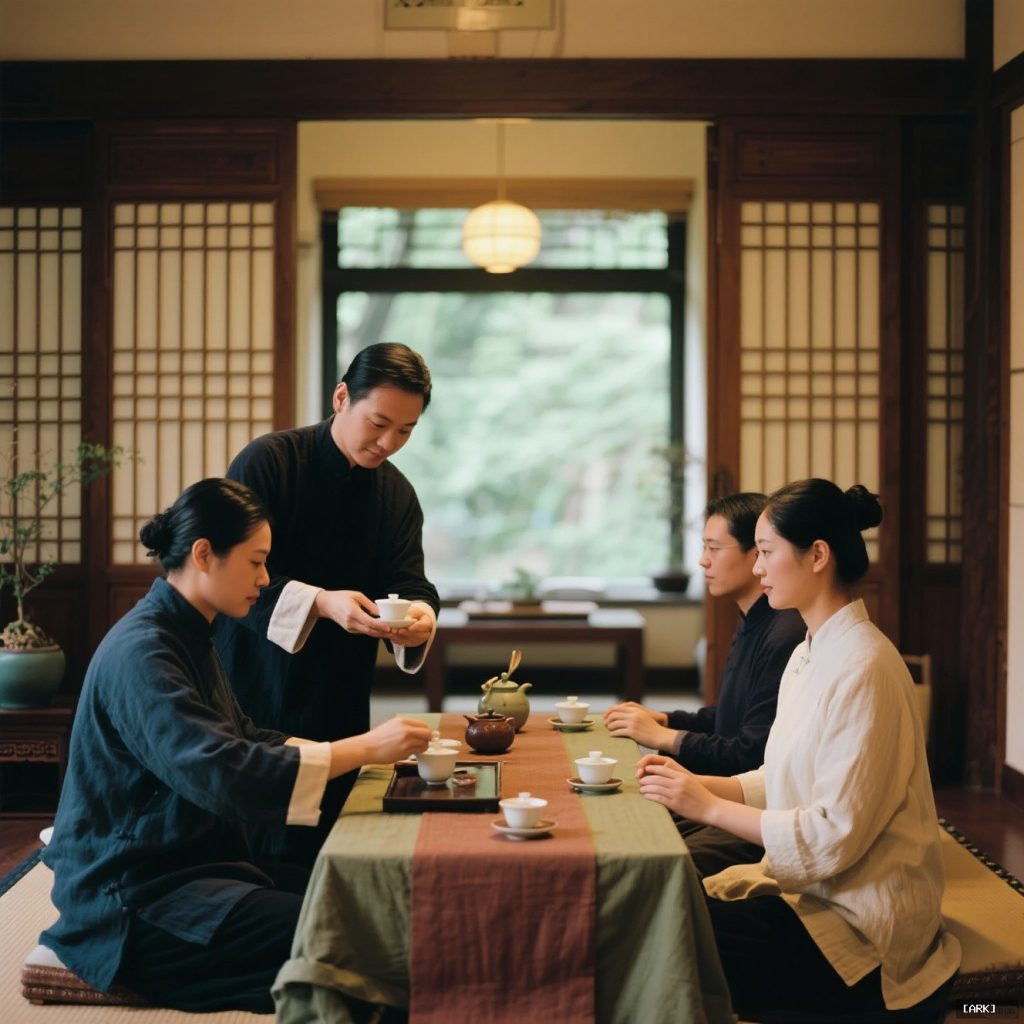
Chinese tea house etiquette is a living practice, a shared language of respect that transforms any space into a sanctuary. It balances ancient gongfu cha customs with the reality of modern life, finding ceremony not in grandeur but in mindful attention.
Forget strict rules policed by stern masters. This is about connection. The etiquette of the teahouse, or even your own crowded kitchen counter, creates a temporary world where the tea, the tools, and the people sharing them are the only focus. It’s a framework designed to honor the effort of the grower, the skill of the preparer, and the experience of the drinker. When you understand the intent—respect—the actions follow naturally, whether you’re in a bamboo-lined house in Hangzhou or a studio apartment in Chicago.
The Heart of the Practice: Following Your Host
What is the most important rule for following Chinese tea house etiquette according to the concept of following your host?
The most important rule is to attentively watch and follow the host, as they are the primary guide for the session. Their deliberate actions, such as rinsing the pot, the height of the pour, and pauses before serving, set the rhythm and provide quiet signals. Your role is to observe and harmonize with these movements, turning the steps into a conversation. For example, if the host presents a cup with both hands, you receive it with both hands, mirroring their actions to show respect and engagement.
What’s the single most important rule? Watch the host. Your primary guide isn’t a memorized checklist but the person conducting the session. Their movements set the rhythm. The deliberate rinse of the pot, the height of the pour, the pause before serving—each is a quiet signal. Your job is to observe and harmonize.
This attentiveness is the core of tea ceremony manners. It turns a series of steps into a conversation. If the host presents a cup with both hands, you receive it with both hands. If they pause to inhale the aroma from the lid of the teapot, you might do the same with your cup. This synchronized flow is what makes a tea session feel cohesive and respectful, a dance where everyone knows their part by watching the lead.
The Ritual in Your Hands: Cups and Gestures
What are the proper cup handling gestures and drinking etiquette in a Chinese tea house?
In Chinese tea house etiquette, proper cup handling involves a two-handed receive: one hand cradles the bottom of the cup while the other lightly steadies the side, showing gratitude and honoring the tea and server. This gesture also prevents spills in tight spaces. Avoid dipping fingertips into the tea. Drink in three small, appreciative sips: the first prepares the palate, the second lets the flavor bloom, and the third allows you to savor the finish, rather than taking a single gulp.
Handling the cup is your most direct interaction with the ritual. The two-handed receive is standard: one hand cradling the bottom, the other lightly steadying the side. It’s a gesture of gratitude that says, “I honor the tea and your effort in making it.” It also has a wonderfully practical side in tight spaces, preventing clumsy spills onto laptops or open books.
Your fingertips should never dip into the tea. Drink in three small, appreciative sips rather than one utilitarian gulp. The first sip prepares your palate, the second lets the flavor bloom, and the third allows you to savor the finish. When finished, place the cup back gently on the table. The soft click of porcelain on wood is the punctuation mark to your silent compliment.
Creating Sacred Space: The Tea Table
What is the significance of the tea table in Chinese tea house etiquette?
In Chinese tea house etiquette, the tea table is a dedicated sacred space central to decorum. It should be kept clear of personal items like phones or bags, which belong on the floor or a separate shelf. This practice is not just about physical tidiness; it creates mental space by removing distractions, making the area feel expansive and intentional. Respect also extends to the tea tools (cháqì), and if any are damaged, a sincere and immediate apology is required.
The tea table, whether a carved slab of ancient wood or a simple bamboo tray, is a dedicated zone. This is central to teahouse decorum. Your personal items—phone, bag, keys—do not belong here. They go on the floor beside you or on a separate shelf. This act isn’t just about physical space; it’s about mental space. Clearing the table of clutter clears the mind of distraction, making even a small surface feel expansive and intentional.
This respect extends to the tools themselves, collectively known as cháqì. If the unthinkable happens and you damage a piece, apologize sincerely and immediately offer to compensate. A calm “duìbuqǐ, wǒ péi” (I’m sorry, I will pay for it) acknowledges the value of the vessel. The host will almost certainly refuse, but the offer is a non-negotiable part of tea ceremony manners, restoring the balance of respect.
The Language of Acceptance and Decline
What is the proper way to decline more tea in a Chinese tea house according to gongfu cha etiquette?
In Chinese tea house etiquette, particularly within gongfu cha customs, the clearest and most polite way to decline more tea is to leave your current cup half-full. This non-verbal signal indicates you have had enough. If the host moves to pour again, you can gently place a hand over the cup to reinforce the message. This method allows you to say no gracefully without disrupting the harmonious flow of the tea session.
Conversation during a session is often soft and sporadic, centered on the tea itself. When you do speak, be specific. Instead of a generic “this is good,” try “the aroma reminds me of orchids” or “it has a wonderful, creamy mouthfeel.” This shows genuine engagement. A simple “hěn xiāng” (very fragrant) is always a welcome and appropriate comment.
But what if you’ve had enough? How do you say no without breaking the flow? The clearest signal in gongfu cha customs is to simply not finish your cup. Leave it half-full. If the host moves to pour again, you can place a hand gently over the cup with a polite “xièxie” (thank you). This non-verbal cue is universally understood and preferred over verbal interruption. It’s a graceful exit from the serving cycle.
The Order of Things: Serving and Seniority
What is the order of serving and seniority in a Chinese tea house etiquette?
In Chinese tea house etiquette, serving follows a deliberate order based on seniority and respect. The eldest or most honored guest is served first, followed by others in descending order of seniority or status, with the host typically serving themselves last. Among peers, service often proceeds clockwise around the table. This sequence reinforces social harmony and is a core aspect of tea ceremony manners. The host generally controls the teapot, and guests should not pour unless explicitly invited, focusing instead on receiving the tea graciously.
Service follows a deliberate order, a silent lesson in respect. Typically, the eldest or most honored guest is served first. The host then proceeds by seniority or status, often serving themselves last. In a group of peers, service usually moves clockwise around the table. Watch for this order; it’s a subtle, continuous reinforcement of social harmony that is deeply woven into tea ceremony manners.
Who pours? Generally, the host maintains control of the pot. If you are a guest, do not grab the teapot to pour for others unless the host explicitly invites you to do so. Your role is to receive and appreciate. If you wish to honor the host, you can use the “finger kowtow”: tap your index and middle finger together lightly on the table twice as they pour for you. This silent “thank you” has legendary origins but is common practice today.
Adapting Ritual for Real Life
How can Chinese tea house etiquette be adapted for real life in a small space?
Chinese tea house etiquette can be adapted for real life in a small space by embracing verticality and portability. Use a deep, lidded tray (a chápán) to contain water and spills as a portable tea table. Store your tea set on a wall-mounted shelf, making taking it down the first ritual act. This constraint of space can deepen focus, creating a connection between limitation and ceremonial intent. The goal is not to replicate a museum piece but to capture the essence of mindful presence in modern gongfu cha practice.
You don’t need a dedicated room to practice this. The beauty of Chinese tea house etiquette is its adaptability. In a small apartment, embrace verticality. Use a deep, lidded tray (a chápá) to contain water and spills—this becomes your portable tea table. Store your set on a wall-mounted shelf, and taking it down becomes the first act of the ritual. The constraint of space can actually deepen focus, creating a powerful, non-obvious connection between limitation and ceremonial intent.
The goal isn’t to replicate a museum piece but to capture the essence: mindful presence. Your modern gongfu cha customs might involve pre-heating your gaiwan while a podcast plays in the background. That’s fine. The ritual meets you where you are, asking only that you pay attention when the water boils and the leaves unfurl.
Before You Go: A Visitor’s Checklist
- Arrive Present: Silence your phone before you enter. Greet the host or staff with a nod or slight bow.
- Follow Lead: Wait to be seated. Observe where the host places their own items and follow suit with your belongings.
- Engage the Senses: If an aroma cup (a tall, slender cup used only for smelling) is presented, inhale the fragrance before drinking from your tasting cup.
- Mind Your Time: A session can last from 45 minutes to several hours. Plan accordingly. Leaving abruptly is jarring to the carefully built atmosphere.
- Ask to Snap: Want a photo? Always ask permission first. The flash and sound are major intrusions on the ceremony’s flow.
Navigating Common Uncertainties
What should I wear? Comfortable, modest clothing is perfect. The one firm request is to avoid strong perfumes or colognes, which wage war on the tea’s delicate aroma.
Is tipping expected? Tipping is not a standard part of Chinese tea house etiquette. In commercial establishments, a service charge may be included in your bill. When in doubt, you can ask quietly when paying.
Can I go alone? Absolutely. Many teahouses welcome solo visitors. It’s a wonderful opportunity for quiet reflection or to strike up a conversation with a knowledgeable host.
Deepening Your Practice
Chinese tea house etiquette is a gateway, not a destination. The more you practice, the more you notice—the way different clays affect a tea’s flavor, how water temperature can access sweetness or bitterness, the history held in a single style of teapot. It becomes a lifelong study of patience and perception.
Start where you are. Use what you have. A mug can stand in for a proper cup; your full attention is the most important tool. The ritual is forgiving because its ultimate purpose is connection—to the leaf, to the moment, and to the people sharing it with you. That’s a language worth learning, no matter how cluttered your countertop may be.
Sources & Further Reading
The Essence of Tea: A Guide to Chinese Tea Drinking. https://www.hktea.org/essence-of-tea
Tea Drunk: Blog on Gongfu Cha. https://teadrunk.org/blogs/blog
University of Kansas, Center for East Asian Studies: Tea Culture. https://ceas.ku.edu/tea-culture
The Chinese Tea Shop: Practical Guides. https://www.thechineseteashop.com/blogs/learn
About Our Expertise
Drawing from years of immersion in Chinese tea culture and collaboration with master tea practitioners, this guide distills authentic etiquette principles that honor centuries-old traditions while remaining accessible for today's global audience. Our insights are grounded in firsthand experiences in teahouses across China, ensuring accuracy and cultural respect.
We prioritize trust by referencing reputable sources like academic studies and established tea institutions, and our practical adaptations are tested in real-world settings to help you navigate tea sessions with confidence. This approach reflects our commitment to preserving the essence of Chinese tea heritage in a way that fosters genuine connection and mindfulness.
✨ You Might Also Enjoy

You may also like
Herbal Bead Bracelet: Ancient Chinese Aromatherapy for Modern Wellness | HandMyth™
Original price was: ¥2,199.00.¥1,352.00Current price is: ¥1,352.00. Add to cartPremium Herbal Beads Bracelet: Traditional Medicine Meets Modern Jewelry | Shop HandMyth
Original price was: ¥874.00.¥608.00Current price is: ¥608.00. Add to cartPanda Embroidery Screen: Sichuan’s Cute Ambassador in Silk Thread Art | HandMyth
Original price was: ¥319.00.¥230.00Current price is: ¥230.00. Add to cartPanda Gift Set: Curated Chinese Treasures for Panda Lovers | HandMyth™ (Free Gift Wrap)
Original price was: ¥136.00.¥118.00Current price is: ¥118.00. Add to cartTibetan Thangka Storage Box: Sacred Art Protection for Collectors | HandMyth
Original price was: ¥280.00.¥219.00Current price is: ¥219.00. Add to cartPure Silk Handbag: Hangzhou’s Legendary Silk Weaving for Modern Elegance | HandMyth™
Original price was: ¥874.00.¥786.00Current price is: ¥786.00. Add to cartHand-Painted Silk Scarf: Wearable Art from China’s Silk Road | HandMyth (Artist Signed)
Original price was: ¥1,017.00.¥935.00Current price is: ¥935.00. Add to cartModern Qipao Dress: Timeless Chinese Elegance for Today’s Woman | HandMyth (Custom Fit)
Original price was: ¥2,459.00.¥2,240.00Current price is: ¥2,240.00. Add to cartEmbroidered Chinese Handbag: Suzhou Silk Embroidery Meets Modern Fashion | HandMyth™
Original price was: ¥680.00.¥646.00Current price is: ¥646.00. Add to cart