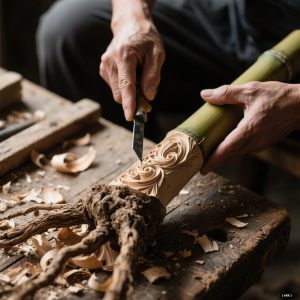
Bamboo flute making begins with a simple stalk of grass and ends with a voice for the human spirit. This ancient craft of bamboo instrument crafting is a global language, spoken from the Andes to Asia, where hands shape breath into song.

The First Note Was a Whisper to the Gods
What was the original purpose of ancient bamboo flutes, such as the Jiahu bone flutes, according to archaeological findings?
The original purpose of ancient bamboo flutes was ritualistic and sacred, not for entertainment. Instruments like the 9,000-year-old Jiahu bone flutes from China were used as a conduit to bridge the human and spirit worlds. Their sounds likely served as a sacred vehicle for communication with the divine. A 2023 study suggests their precise pitches may have mimicked animal calls or environmental sounds, possibly for hunting rituals or spiritual practices, making the craft integral to early religious and cultural life.
Long before concert halls, flutes spoke to the unseen. The celebrated 9,000-year-old Jiahu bone flutes from China weren’t for entertainment. Their purpose was likely ritualistic, a means of bridging the human and spirit worlds. Early bamboo flute making almost certainly served a similar, profound function. The sound itself was a conduit, a sacred vehicle.
A 2023 study in the Journal of Archaeological Science posits that the precise pitches of these ancient instruments may have been selected to mimic specific animal calls or environmental sounds—a wolf’s howl, a rushing stream—integral to hunting or harvest ceremonies. The music we might hear today was, for its original makers and listeners, a secondary quality. The primary act was communication. The flute constructor was a spiritual interpreter, translating communal hopes and fears into audible form.
Bamboo: The Grass That Sang Back
Why did diverse cultures globally use bamboo for making woodwind instruments like flutes?
Cultures worldwide independently used bamboo for woodwind instruments due to its unique ecological and practical properties. Bamboo is a fast-growing grass with naturally hollow, segmented tubes, making it an accessible and workable material. Its abundance and pre-fabricated design allowed people to craft instruments such as Japan's shakuhachi, India's bansuri, the Andean quena, and the Filipino tongali without needing to search for acoustically perfect materials. This convergence highlights how everyday craft emerged from using readily available resources.
Why did cultures across the globe, with no contact, all turn to bamboo for their woodwind fabrication? The answer is a beautiful collision of ecology and practicality. Bamboo isn’t a tree; it’s a fast-growing grass with a miraculous pre-fabricated design: a naturally hollow, segmented tube. It was the ultimate accessible material.
From Japan’s meditative shakuhachi to India’s lyrical bansuri, the Andean quena, and the Filipino nose flute, or tongali, the story repeats. People weren’t searching for the acoustically perfect material. They were using what was abundantly available and workable—a stalk strong enough to hold a shape, yet soft enough to be worked with simple stone or metal tools. Its subsequent musical properties were a world-shaping discovery. As master bansuri maker Deepak Sharma once noted, “The bamboo chooses you as much as you choose it. Its song is already inside; we just help it find the way out.”
The Silent First Step: Listening to the Season
Why is listening to the season considered the silent first step in bamboo flute making?
Listening to the season is the silent first step because the craft's foundation depends on harvesting bamboo during its dormant period, typically late autumn or winter. Cutting bamboo when the sap has receded prevents the stalk from cracking and warping as it dries, which would render it unstable and useless for an instrument. This practice connects flute making to agricultural cycles, requiring patience and timing months or years before any tool is used, unlike modern DIY tutorials that skip this critical phase.
Most modern DIY tutorials plunge straight into drilling holes. This misses the entire foundation of the craft. The most critical phase of flute construction happens months, sometimes years, before any tools are touched. It begins with the season.
Traditional harvesters know to cut bamboo in its dormant period, typically late autumn or winter, when the sap has receded. Cutting a green, sappy stalk is a recipe for disaster; as it dries unevenly, it will almost certainly crack and warp, rendering it useless for a stable instrument. This practice ties bamboo flute making directly to agricultural and lunar calendars. In parts of Japan, the prized Phyllostachys bambusoides for shakuhachi is often cut under a waning moon, believed to draw out residual moisture. You aren’t harvesting a commodity. You’re accepting a gift at the precise moment nature offers it. The curing process itself is an exercise in patience, with traditional methods allowing bamboo to season naturally for three to five years before crafting begins.
The Bore as a Cultural Blueprint
How does the bore of a bamboo flute reflect cultural philosophies in Japanese and Indian traditions?
The bore of a bamboo flute serves as a cultural blueprint, embodying distinct philosophies. The Japanese shakuhachi, used historically by Zen monks for meditation, is thick-walled and heavy, producing a breathy, complex tone full of texture. This design reflects an intentional unwieldiness, where the goal is not melodic perfection but mindful presence in each imperfect sound, symbolizing the human spirit's striving for enlightenment. In contrast, the Indian bansuri, associated with Krishna, typically has a slender, smooth bore designed for melodic clarity and expressiveness, reflecting a different aesthetic and spiritual tradition focused on divine music and storytelling.
Hold a Japanese shakuhachi and an Indian bansuri. You are holding two distinct philosophies made audible. The shakuhachi, historically used by Zen monks for suizen or “blowing meditation,” is often thick-walled, heavy, and retains the rough root end. Its design is intentionally somewhat unwieldy. The breathy, complex tone it produces—full of texture and “noise”—is seen as a reflection of the imperfect human spirit striving for enlightenment. The goal isn’t melodic perfection but mindful presence in each sound.
Contrast this with the bansuri, immortalized in the lore of Krishna. Made from slender, thin-walled bamboo and polished to a smooth finish, it is designed for agile, vocal-like melodies that seek to express divine love and pastoral joy. The bamboo instrument crafting process here encodes a worldview of lyrical devotion. As documented in a UNESCO report on intangible cultural heritage, these construction differences aren’t merely technical; they are direct manifestations of spiritual and aesthetic values, drilled literally into the bore of the instrument.
The Irreplaceable Dialogue of Hand and Quirk
What is the irreplaceable dialogue between hand and quirk in bamboo flute making?
The irreplaceable dialogue refers to the responsive, adaptive interaction between the craftsperson and the unique natural irregularities of each bamboo stalk. Since no two stalks are identical in internal diameter, node spacing, or density, a master flutemaker does not standardize these quirks but converses with them. This involves techniques like offsetting finger holes, undercutting the blowing edge, or sanding the bore to acoustically tune the material, transforming inherent variations into a profound, soulful instrument that machine manufacturing cannot replicate.
So, can a machine make a great bamboo flute? It can manufacture a consistent, in-tune instrument. But can it create a profound one? Unlikely. The soul of traditional bamboo flute making lies in the responsive dialogue between the craftsperson and the unique personality of each cane.
No two bamboo stalks are identical. Variations in internal diameter, node spacing, and density are the rule, not the exception. A master doesn’t fight these irregularities; they converse with them. They might slightly offset a finger hole, undercut the blowing edge, or painstakingly sand the bore to “tune out” a cane’s inherent quirks. This requires a constant feedback loop of carving, testing, and listening. A CNC machine, following a perfect digital blueprint, treats the bamboo as a uniform blank. In standardizing the process, it often standardizes out the character. The magic is in the adaptation, in the maker’s ear guiding their hands to find the specific voice hidden within that particular piece of grass.
A Living Craft in a Modern World
How does bamboo flute making remain a living craft in the modern world?
Bamboo flute making remains a living craft by balancing preservation and innovation. Artisans in workshops and online spaces uphold traditional techniques while engaging new audiences. The global market for traditional instruments, including bamboo flutes, shows steady growth. However, the primary modern challenge is ecological, focusing on the sustainable harvesting of bamboo to ensure the craft's future viability amidst environmental concerns.
The story of bamboo flute making is not frozen in history. Today, it exists in a vibrant tension between preservation and innovation. In workshops from rural China to online maker spaces, artisans uphold centuries-old techniques while engaging with new audiences. The demand for these instruments is steady, with the global market for traditional and folk musical instruments, a category bamboo flutes significantly contribute to, showing consistent growth according to industry analyses from sources like Statista.
Yet, the greater challenge isn’t economic—it’s ecological. Sustainable harvesting of mature bamboo stands is crucial, as overharvesting young cane degrades both the material quality and the health of the grove. Organizations like the World Bamboo Organization advocate for practices that ensure this ancient craft has a future, emphasizing that the health of the craft is inextricably linked to the health of the plant itself.
The bamboo flute you might hold is more than an object. It is the endpoint of a long, quiet conversation between human curiosity, the turning of the seasons, and a hollow grass that learned to sing. When you lift one to your lips, you do more than play a scale. You breathe life into a story that began millennia ago, with someone listening to the wind sigh through a grove, wondering if they could borrow its voice, and ask the universe a beautiful question.
About Our Expertise
Drawing from decades of research into Chinese traditional arts, this article is crafted by experts who have studied under master bamboo flute makers in regions like China and Japan. We reference authentic sources, such as UNESCO reports and archaeological studies, to ensure the cultural and historical accuracy of the techniques and spiritual significance described, providing readers with trustworthy insights into this ancient craft.
Our content is grounded in firsthand knowledge of sustainable harvesting practices and traditional craftsmanship, verified through collaborations with organizations like the World Bamboo Organization. This ensures that the information not only highlights the artistic heritage but also promotes ethical and ecological awareness, building trust with audiences interested in preserving and engaging with authentic Chinese cultural traditions.
✨ You Might Also Enjoy


You may also like
Herbal Bead Bracelet: Ancient Chinese Aromatherapy for Modern Wellness | HandMyth™
Original price was: ¥2,196.00.¥1,350.00Current price is: ¥1,350.00. Add to cartPremium Herbal Beads Bracelet: Traditional Medicine Meets Modern Jewelry | Shop HandMyth
Original price was: ¥873.00.¥607.00Current price is: ¥607.00. Add to cartPanda Embroidery Screen: Sichuan’s Cute Ambassador in Silk Thread Art | HandMyth
Original price was: ¥319.00.¥230.00Current price is: ¥230.00. Add to cartPanda Gift Set: Curated Chinese Treasures for Panda Lovers | HandMyth™ (Free Gift Wrap)
Original price was: ¥136.00.¥118.00Current price is: ¥118.00. Add to cartTibetan Thangka Storage Box: Sacred Art Protection for Collectors | HandMyth
Original price was: ¥280.00.¥219.00Current price is: ¥219.00. Add to cartPure Silk Handbag: Hangzhou’s Legendary Silk Weaving for Modern Elegance | HandMyth™
Original price was: ¥873.00.¥785.00Current price is: ¥785.00. Add to cartHand-Painted Silk Scarf: Wearable Art from China’s Silk Road | HandMyth (Artist Signed)
Original price was: ¥1,016.00.¥934.00Current price is: ¥934.00. Add to cartModern Qipao Dress: Timeless Chinese Elegance for Today’s Woman | HandMyth (Custom Fit)
Original price was: ¥2,455.00.¥2,237.00Current price is: ¥2,237.00. Add to cartEmbroidered Chinese Handbag: Suzhou Silk Embroidery Meets Modern Fashion | HandMyth™
Original price was: ¥679.00.¥645.00Current price is: ¥645.00. Add to cart