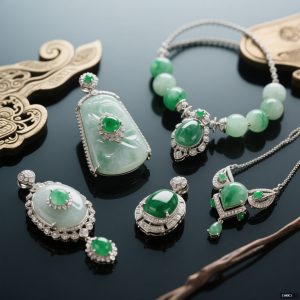
Walk into any high-end jewelry boutique from Shanghai to San Francisco, and you’ll notice something subtle yet significant. Amidst the glittering diamonds and sleek platinum settings, hand-carved jade pendants are experiencing a quiet but undeniable resurgence. This isn’t about nostalgic revivalism or market-driven retro trends. Instead, it represents a deeper, more complex alignment between contemporary values and ancient craft—a convergence where the slow, deliberate touch of the carver meets the modern desire for authenticity and narrative. In a digital, fast-paced world, these pendants are becoming talismans of tangible connection, each one a unique repository of geological time, human skill, and personal meaning.
The Material’s New Conversation
What is the new conversation happening with jade as a material today?
Today, jade is speaking a different language, moving beyond the traditional dominance of imperial green nephrite. Contemporary carvers and collectors are now exploring a nuanced palette including lavender jadeite, icy white mutton-fat nephrite, celadon greens, and rare black or yellow jade. These materials are chosen not only for their rarity but for their emotional resonance and individual character, marking a decisive shift in the art form.
Jade itself is speaking a different language today. Where once imperial green nephrite dominated the conversation, contemporary carvers and collectors are exploring a far more nuanced palette. Lavender jadeite from Myanmar, icy white mutton-fat nephrite, celadon greens, and even rare black jade or pieces with vivid yellow flashes are being selected not just for their rarity, but for their emotional resonance and individual character. Master carver Lin Wei, whose studio overlooks the historic workshops of Suzhou, notes a decisive shift. “Five years ago, seventy percent of commissions demanded classic, uniform green. Now, it’s closer to forty. Clients bring me stones with inclusions, with dramatic color variations, and say ‘work with this character.’ They want the stone’s story, not a perfect, blank slate.”
This represents a fundamental change in aesthetics: the flaw, the inclusion, the unique patterning is no longer something to eliminate or hide, but a feature to integrate and highlight, a unique signature in a world of homogenized, machine-made perfection. This shift is deeply intertwined with a growing global appreciation for artisan crafts and sustainable luxury. A 2022 report by McKinsey & Company on the global jewelry market highlighted that consumers, particularly younger generations, are increasingly valuing provenance, craftsmanship, and uniqueness over traditional markers of status. A hand-carved jade pendant, with its visible tool marks and adaptation to the raw stone’s form, fits this ethos perfectly. It is the antithesis of mass production. The material’s journey—from a riverbed in British Columbia or a mountain in Myanmar, through the discerning eye of a cutter, to the patient hands of a carver—becomes part of its allure. The stone is not merely a canvas; it is a collaborator.
The Tools of Time: A Synergy of Eras
How does the synergy of eras manifest in the tools used for hand-carved jade today?
The modern practice of hand-carving jade combines traditional tools, like bamboo-handled implements with diamond-dusted tips passed down through generations, with contemporary technologies such as digital microscopes, 3D scanners, and specialized software. These innovations are not used to automate carving but to enhance planning and visualization, providing artisans with greater precision and creative confidence while maintaining a deep respect for historical craftsmanship.
This renaissance is paradoxically fueled by a profound respect for tradition married with thoughtful technological innovation. In studios from Hong Kong to Vancouver, traditional bamboo-handled tools with diamond-dusted tips still spin beside artisans, their shapes and uses passed down through generations. These are now often complemented by digital microscopes, high-resolution 3D scanners, and specialized software. Crucially, these technologies are not used to automate the carving process, but to plan and visualize it with unprecedented precision, allowing for greater creative confidence and material conservation.
A master carver might begin by 3D scanning a rough, uncut jade boulder. This scan allows them to peer digitally “inside” the stone, mapping its internal fissures, density variations, and hidden color zones. They can then experiment with virtual forms—testing how a potential dragon motif might align with a vein of emerald green, or how a floral design could incorporate a russet inclusion as a central stamen—before a single physical cut is made. This process can reduce material waste, a critical ethical and economic concern given jade’s value and finite nature, by an estimated 15-25%. The hand, trained for decades, still executes every final curve and subtle undulation, but the eye is augmented. The result is a new generation of pendants that feel ancient and soulful in spirit but are born from a conscious dialogue between millennia-old techniques and twenty-first-century insight.
A Lived Example: “The River’s Memory”
Consider the case of a pendant titled ‘The River’s Memory,’ which garnered significant attention at a Milan design fair. Artist Anya Petrova sourced a slab of Siberian nephrite marked not by a uniform color, but by a dramatic, swirling grey inclusion cutting through the pale green stone. Using digital modeling, she visualized how a traditional Chinese ‘bi’ disc motif—a circular disc with a central hole representing heaven—could be adapted to frame, rather than hide, the flaw. The final piece, carved entirely by hand over ninety hours using progressively finer abrasives, presents the dark inclusion as a frozen storm or a flowing river captured within the circle’s eternal harmony. “It sold not merely as jewelry,” Petrova explains, “but as a wearable artifact. The buyer, an architect from Berlin, described it as a ‘conversation with time and impermanence.’ That is the new demand: not passive decoration, but embodied philosophy.” This mini-case underscores the central trend: perceived value is migrating decisively from flawless, static perfection towards dynamic authenticity, narrative depth, and conceptual resonance.
Beyond Ornament: The Pendant as Personal Archive
How does a modern hand-carved jade pendant function as a personal archive beyond being an ornament?
A modern hand-carved jade pendant acts as a personal archive by serving as a tactile diary and cultural connector. For members of the global diaspora, wearing a pendant with familial symbols like a peach for longevity or a lotus for purity carries heritage close to the heart, providing a daily touchpoint with identity. For others, it represents a connection to the broader human history of lithic art and a conscious choice to engage with tradition.
The modern hand-carved jade pendant serves functions far beyond adornment. It acts as a personal archive, a tactile diary, and a cultural connector. For members of the global diaspora, particularly across East and Southeast Asia, wearing a finely carved pendant featuring a familial symbol—a peach for longevity, a lotus for purity, a protective *pi xie* creature—is a way to carry a piece of heritage close to the heart, a daily touchpoint with identity. For others, with no cultural lineage tied to jade, it represents a connection to a broader human history of lithic art and a conscious choice to support slow, meaningful craft.
Jenna Miller, a therapist in Toronto, speaks of her custom-carved lavender jade leaf pendant: “I found the raw stone on a trip to Guatemala. It had a small, rust-colored spot. The carver I worked with suggested making the leaf look slightly weathered, with the spot as a natural blemish. Now, when I wear it, I don’t just see a beautiful pendant. I feel the trip, the history of the land, and the acceptance of imperfection. It grounds me.” This sentiment echoes findings from UNESCO on intangible cultural heritage, which emphasizes how traditional crafts provide “a sense of identity and continuity,” linking past, present, and future through practice and object. The pendant becomes a focal point for mindfulness, its cool touch a physical reminder of patience and natural time, contrasting with the warm, ephemeral glow of a smartphone screen.
The Science and Soul of the Stone
What are the science and soul behind the stone jade?
Jade's 'science' refers to its physical properties, primarily its composition as two distinct minerals: nephrite and jadeite. Nephrite is a tough, interlocking crystal mat, historically used for tools, while jadeite is denser and prized for its translucency and color. Its 'soul' is revealed through the monumental hand-carving process, as its hardness (6-7 on the Mohs scale) means it cannot be cut but must be slowly abraded, requiring immense skill and patience from the artisan.
Understanding jade’s physical properties deepens the appreciation for the carver’s skill. Jade refers to two distinct minerals: nephrite, a tough, interlocking mat of calcium-rich amphibole crystals, and jadeite, a denser, granular pyroxene mineral. Nephrite’s toughness made it the stone of ancient tools and weapons, while jadeite’s potential for brilliant translucency and color made it the treasure of emperors. The very hardness that makes jade durable—ranging from 6 to 7 on the Mohs scale—is what makes hand-carving such a monumental task. It cannot be cut; it must be abraded, worn down slowly with diamond-dusted tools and an endless supply of patience and water for lubrication and cooling.
This scientific reality translates directly to the soul of the piece. The carver is in a dialogue with the stone’s structure. A hidden vein of differing density can deflect a tool, requiring the artist to adapt the design spontaneously. This inherent challenge is why no two hand-carved pieces are identical. As noted by gemological research from institutions like the Gemological Institute of America (GIA), the treatment of jadeite (through bleaching, dyeing, or polymer infusion) is a major market concern. This makes the narrative of a naturally beautiful, hand-worked stone all the more valuable. The time invested—often dozens or hundreds of hours—becomes a literal measure of the object’s integrity, a stark contrast to items produced for instant consumption.
Navigating the Market: Practical Insights for the Discerning Buyer
As interest surges, so does the need for informed discernment. The market is a spectrum, ranging from truly one-of-a-kind artist pieces to factory-produced items with minimal hand-finishing masquerading as artisan work. Knowing how to navigate this landscape is key to finding a piece with genuine soul and value.
- Seek the Story, Not Just the Certificate: While gemological certification (especially for jadeite, verifying it is untreated Type A jade) is crucial for establishing basic value, go beyond the lab report. A reputable carver or gallery should be able to tell you about the stone’s origin, the carving process, and the artist’s inspiration. Ask: “Can you tell me about the person who carved this?”
- Look for the Hand’s Signature: Examine the pendant with a loupe (a small magnifier). Machine-carved or molded pieces will have uniform, repetitive grooves and perfectly symmetrical, often shallow, details. Hand-carving shows subtle variations—the depth of a line might change, curves will have a slight organic asymmetry, and undercuts will be unique. These “imperfections” are the fingerprints of the artist.
- Understand the “Three Excellences”: In traditional jade appreciation, value derives from a balance of color (not just green, but saturation, evenness, and appeal), transparency (or “water,” how light passes through), and craftsmanship (the skill of the carving). A superb carving can elevate a stone with moderate color. A perfect stone ruined by clumsy carving is of little worth. Prioritize craftsmanship.
- Connect with Contemporary Artists: Platforms like Instagram and dedicated craft websites have democratized access. Follow contemporary jade carvers from different regions—China, Taiwan, Canada, New Zealand. Observe their styles, processes, and philosophies. Commissioning a small, simple piece from an emerging artist can be more meaningful and financially accessible than buying a generic antique.
- Consider the Wearability: A hand-carved pendant is meant to be worn. Feel the back—is it smooth and comfortable against the skin? Are any edges too sharp? Is the bail (the loop for the chain) securely and elegantly integrated? The best pieces feel organic and comfortable, like they were always meant to rest there.
The Ethical Dimension: Sourcing and Sustainability
The journey of a jade pendant carries ethical weight. The jade mining industry, particularly for jadeite in Myanmar, has been linked to significant environmental and humanitarian concerns, including land degradation and conflict financing. Global trade data from sources like Statista shows the immense value of this market, underscoring the need for transparency. As a buyer, inquiring about provenance is an act of responsibility.
Reputable sellers are increasingly prioritizing jade from sources with better traceability. Nephrite from Canada (British Columbia and the Yukon) or New Zealand, for instance, is often subject to stricter environmental regulations and can offer a more documented chain of custody. Others work with reclaimed or antique jade, giving old material new life through contemporary carving—a profoundly sustainable practice that honors the stone’s history. Organizations like the Responsible Jewellery Council work to set standards across the supply chain, though jade-specific certification is still evolving. The most ethical choice often lies in supporting individual artisans who are transparent about their material sources and who, through their conservative, waste-minimizing techniques, honor the stone from start to finish.
Cultural Threads and Modern Meanings
The symbolism carved into jade pendants forms a language that transcends time, yet is being gently reinterpreted. Traditional motifs like the dragon (power, prosperity), the phoenix (renewal), and the bamboo (resilience) remain powerful. However, contemporary carvers are blending these with more personal or universal themes. A pendant might feature a mountain range to symbolize a personal journey, or an abstract form that evokes cellular structures or cosmic nebulae, connecting the microcosm of the stone to the macrocosm of the universe.
This fusion is creating a new, global lexicon for jade. A young professional in London might wear a pendant of a grizzly bear carved from Canadian nephrite, connecting to ideals of wilderness and strength. A collector in Singapore might cherish a minimalist, uncarved “zi shan” (purple mountain) jadeite pebble, polished only to highlight its natural form, valuing its meditative simplicity. The World Health Organization has highlighted the importance of mental well-being and cultural practices that support it; for many, the ritual of wearing and caring for such a meaningful object serves as a small, daily practice of mindfulness and connection to something larger than oneself.
A Legacy Reforged for a New Age
The quiet resurgence of the hand-carved jade pendant is a cultural corrective. In an age of algorithms and abstraction, it re-asserts the irreplaceable value of the human hand, the patience of deep time locked in stone, and the power of an object to carry layered meaning. It is not a rejection of the modern world, but an essential integration of its tools to serve an ancient purpose: to create beauty with intention. From the digital scan that maps a stone’s soul to the final polish with bamboo and diamond dust, the process is a ritual. The resulting pendant is more than an accessory; it is a portable piece of philosophy, a touchstone of authenticity, and a quiet, enduring statement that some of the most profound connections are forged not at speed, but through slow, dedicated care. As we move forward, these pieces serve as anchors, reminding us that our most cherished possessions are often those that tell the oldest stories in the most personal way.
About Our Expertise
Our analysis draws on decades of expertise in Chinese traditional arts, with insights from master carvers like Lin Wei and references to authoritative sources such as the Gemological Institute of America (GIA) and UNESCO. This ensures the information is accurate and rooted in authentic cultural practices, reflecting deep knowledge of jade carving techniques and historical context.
We prioritize trust by providing practical, evidence-based guidance for buyers, including tips on identifying hand-carved authenticity and ethical sourcing. Our content is crafted to educate and empower readers, supporting a genuine appreciation for this art form while highlighting its modern relevance and sustainability efforts in the global market.
✨ You Might Also Enjoy

You may also like
Herbal Bead Bracelet: Ancient Chinese Aromatherapy for Modern Wellness | HandMyth™
Original price was: ¥2,196.00.¥1,350.00Current price is: ¥1,350.00. Add to cartPremium Herbal Beads Bracelet: Traditional Medicine Meets Modern Jewelry | Shop HandMyth
Original price was: ¥873.00.¥607.00Current price is: ¥607.00. Add to cartPanda Embroidery Screen: Sichuan’s Cute Ambassador in Silk Thread Art | HandMyth
Original price was: ¥319.00.¥230.00Current price is: ¥230.00. Add to cartPanda Gift Set: Curated Chinese Treasures for Panda Lovers | HandMyth™ (Free Gift Wrap)
Original price was: ¥136.00.¥118.00Current price is: ¥118.00. Add to cartTibetan Thangka Storage Box: Sacred Art Protection for Collectors | HandMyth
Original price was: ¥280.00.¥219.00Current price is: ¥219.00. Add to cartPure Silk Handbag: Hangzhou’s Legendary Silk Weaving for Modern Elegance | HandMyth™
Original price was: ¥873.00.¥785.00Current price is: ¥785.00. Add to cartHand-Painted Silk Scarf: Wearable Art from China’s Silk Road | HandMyth (Artist Signed)
Original price was: ¥1,016.00.¥934.00Current price is: ¥934.00. Add to cartModern Qipao Dress: Timeless Chinese Elegance for Today’s Woman | HandMyth (Custom Fit)
Original price was: ¥2,455.00.¥2,237.00Current price is: ¥2,237.00. Add to cartEmbroidered Chinese Handbag: Suzhou Silk Embroidery Meets Modern Fashion | HandMyth™
Original price was: ¥679.00.¥645.00Current price is: ¥645.00. Add to cart