
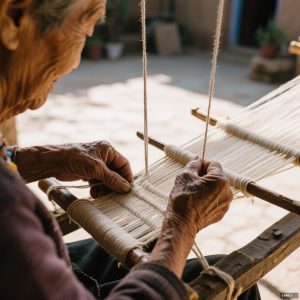
In a quiet workshop in Varanasi, a master weaver’s fingers dance across a wooden loom, pulling threads that connect not just warp and weft, but centuries of cultural memory. This is not merely fabric production; it is historical narration in tactile form. Each pass of the shuttle carries forward techniques refined over generations, patterns that encode community identity, and colors derived from local earth and plants. The resulting silk is less a commodity than a cultural document—one that speaks of trade routes, royal patronage, spiritual symbolism, and social hierarchies without uttering a word. To touch a length of hand-woven silk is to feel the weight of history, a dense fabric of human endeavor where every knot, dye lot, and motif has a story to tell. Its survival in a world of mechanized fast fashion is a testament to its enduring power as a vessel of meaning, far beyond its physical beauty.

Patterns as Cultural Script and Language
How did patterns function as a cultural script and language in history?
Patterns served as a silent, transnational language, conveying cultural and political meanings beyond mere aesthetics. For example, the Persian buta motif traveled the Silk Road, evolving into the Paisley pattern in the West, reflecting diplomatic alliances, marital exchanges, and artistic diffusion across linguistic barriers. In 18th-century Lyon, silk-weaving pattern books were guarded as state secrets, with designs embodying Enlightenment ideals and acting as coded cultural scripts.
Consider the intricate buta motif of Persian-inspired shawls, its teardrop shape migrating along the Silk Road to become the iconic Paisley of the West. This was not mere aesthetic borrowing. The motif’s journey traces diplomatic alliances, marital exchanges between kingdoms, and the slow filtration of artistic ideas across linguistic barriers. Patterns functioned as a silent, transnational language. In the silk-weaving centers of Lyon during the 18th century, pattern books were guarded like state secrets, their floral and architectural designs reflecting both the Enlightenment’s fascination with taxonomy and the absolute monarch’s desire for visible splendor. A single pattern repeat could contain a world view.
This language of patterns extends to spiritual and social identity. In Thailand, the complex Mudmee (ikat) patterns woven into silk for ceremonial wear are believed to carry protective power, with specific designs reserved for royalty. Similarly, the vibrant kente cloth of Ghana, traditionally woven in narrow strips of silk and cotton, uses color and geometric pattern as a direct communicative code. A weaver from the Ashanti region might explain that a particular combination of gold and green speaks of prosperity and renewal, while a zigzag pattern references the twists of life’s journey. These are not decorations; they are statements woven into the very structure of the cloth, a form of literacy understood within the community. UNESCO’s recognition of various textile traditions as intangible cultural heritage underscores their role as vital, non-verbal languages in danger of being silenced.
The Loom’s Social Architecture and Economic Engine
How did the loom's social architecture and economic engine shape silk weaving communities like Kyoto's Nishijin district?
In historical Kyoto's Nishijin district, silk weaving was organized as a closed, hierarchical guild system that formed a distinct social microcosm. Master weavers, often serving the Imperial household, held highly specialized, compartmentalized knowledge—some artisans spent a lifetime mastering a single technique, like weaving chrysanthemum petals. This specialization created an ecosystem where status, skill, and artistic expression were intertwined, driving the local economy and defining the district's identity through the rhythmic sound of looms.
The organization of silk weaving itself formed a distinct social microcosm, shaping cities, economies, and defining lives. In historical Kyoto, the Nishijin district operated as a closed, hierarchical guild system. Master weavers, often serving the Imperial household, held knowledge so specialized it was compartmentalized—one artisan might spend a lifetime mastering only the technique for weaving chrysanthemum petals. This specialization created a cultural ecosystem where status, skill, and artistic expression were inextricably linked. The rhythmic clatter of looms defined the district’s soundscape, and the community’s social calendar revolved around production cycles and seasonal festivals honoring craft deities.
Similarly, in pre-industrial England, the Spitalfields silk weavers—many Huguenot refugees fleeing religious persecution in France—formed a tight-knit ethnic enclave in East London. Their distinct architectural style of attic loom workshops, with large north-facing windows to maximize consistent light for delicate work, still scars the London skyline, a physical testament to how craft shapes urban geography and community cohesion. The weavers developed their own dialect and customs, a subculture born directly from the loom. This pattern repeats globally: from the silk-weaving neighborhoods of Kanchipuram in India, where weaving is a caste-based hereditary profession, to the family-owned ateliers of Como, Italy, the craft has consistently organized human relationships, economies, and urban spaces around its demanding rhythms. The global market for silk, valued in the billions, has historically been rooted in these concentrated, skilled communities, though their share has been pressured by mass production.
The Weaver’s Hand: Technique as Cultural Signature
What is the cultural significance of a weaver's technique, as seen in examples like Chinese brocade or Indian jamdani?
A weaver's technique serves as a cultural signature, embedding history and philosophy into the fabric's structure. For instance, Indian jamdani uses a supplementary weft method to create floating patterns on muslin or silk, requiring immense hand skill. This differs from Chinese brocade or French lampas, each with unique technological histories. Thus, weaving methods reflect distinct aesthetic values and cultural identities beyond mere visual patterns.
Beyond the pattern, the very technique of weaving embeds culture. The difference between a Chinese brocade, an Indian jamdani, and a French lampas is not just visual but structural, born from distinct technological histories and aesthetic philosophies. Jamdani, for instance, is a supplementary weft technique from Bangladesh and India, creating intricate, shimmering patterns that appear to float on the surface of the muslin or silk base. The process is incredibly time-intensive, requiring immense concentration as each discontinuous motif is woven in by hand with a small, pointed shuttle. The resulting fabric, airy yet ornate, reflects a historical preference for sublime lightness and complexity, a fabric fit for Mughal emperors and tropical climates.
Contrast this with the heavy, pictorial brocades of Renaissance Europe, woven on complex draw looms. These fabrics were designed to emulate painting, depicting biblical scenes, mythological tales, and elaborate coats of arms with photorealistic detail. They were less about personal comfort and more about monumental display, meant to convey power, wealth, and learning in the drapery of a palace or the vestments of the church. The technique itself—requiring multiple weavers and a “drawboy” to manually manage thousands of warp threads—was a feat of coordinated labor, mirroring the hierarchical societies that commissioned them. Each technical approach is a cultural signature, a way of thinking made manifest in thread.
“We preserve these silks not as dead textiles, but as the skin of history. When you examine a 17th-century brocade, you’re not just seeing thread. You’re seeing the specific light of a French autumn that inspired the dyer’s palette, you’re feeling the economic pressure of a royal commission, and you’re touching the silent rebellion of a weaver who subtly altered a prescribed pattern to leave his mark.” — A curator at the Musée des Tissus in Lyon.
This perspective frames each hand-woven piece as a multilayered record, where technical choices become historical statements. A slightly uneven tension in the selvage might hint at the weaver’s fatigue, while an unexpected color substitution could signal a shortage of a prized dye due to a trade disruption, such as those documented in historical economic records from the Silk Road. The fabric becomes a primary source document, often more revealing than written accounts. Modern scientific analysis, like that used in museums, can trace dye sources to specific regions, mapping ancient trade networks through the chemistry of a single thread.
The Double-Edged Sword of Modernity: Threats and Adaptive Revival
What were the threats to hand-woven silk traditions in the 20th century, and how did they adapt?
The 20th century threatened hand-woven silk traditions through industrialization, shifting global economies, and changing fashion tastes. These factors broke the master-apprentice chain and devalued artisan skills as markets flooded with cheap synthetic alternatives. However, an adaptive revival has been noted, with organizations like the World Crafts Council highlighting efforts to preserve these crafts by addressing the loss of artisan livelihoods and countering the lure of urban employment for younger generations.
The 20th century presented an existential threat to hand-woven silk traditions. Industrialization, shifting global economies, and changing fashion tastes pushed many venerable crafts to the brink. The master-apprentice chain broke, and communities that had defined themselves by the loom for centuries found their skills undervalued in a market flooded with cheap, synthetic alternatives. A report by the World Crafts Council has highlighted the precarious state of many heritage crafts, citing the loss of artisan livelihoods as a critical issue. The lure of more stable urban employment for younger generations created a demographic cliff, risking the extinction of techniques known only to aging masters.
Yet, the past few decades have seen a powerful, conscious revival. This is not merely nostalgia but a re-evaluation driven by sustainability, the desire for authenticity, and the slow fashion movement. Consumers increasingly seek connection and story, values inherent in hand-woven goods. Organizations and social enterprises now work directly with weaving cooperatives, ensuring fair wages and creating viable market access. Technology, once a threat, now aids in preservation; digital archives catalog patterns, while e-commerce platforms connect remote weavers with a global audience.
Innovative designers are collaborating with traditional weavers to create contemporary pieces that respect heritage while meeting modern tastes. In Cambodia, for example, initiatives are reviving silk weaving by integrating ancient patterns into fashion and homeware for the international market, providing sustainable income. The challenge is no longer just preservation, but ethical and equitable evolution—ensuring the weaver is not just a historical artifact but a valued partner in a living, evolving craft. The World Health Organization has even noted the mental health benefits of traditional crafts, linking practices like weaving to community well-being and cognitive preservation, adding another layer to their intrinsic value.
Practical Insights for the Conscious Consumer and Advocate
What are some practical insights for a conscious consumer to appreciate and support hand-woven silk?
A conscious consumer can appreciate and support hand-woven silk by developing a discerning eye for authenticity. Key markers include slight irregularities in pattern alignment, subtle color variations from natural dyes, and a unique, organic luster in the texture. These characteristics are not flaws but the fingerprints of the maker, indicating the human touch in hand-weaving. Engaging with this heritage involves recognizing these qualities as signs of genuine craftsmanship and choosing such pieces to actively steward this living tradition.
Engaging with hand-woven silk today is an opportunity for meaningful consumption and active stewardship. Here are actionable ways to appreciate, support, and integrate this living heritage into your life.
Develop a Discerning Eye: Authenticity has its own language. Look for the markers of hand-weaving. Slight irregularities in pattern alignment or a subtle variance in color saturation from natural dyes are signs of human touch, not flaws. They are the fingerprints of the maker. The texture of hand-reeled silk possesses a unique, organic luster and depth, often feeling warmer and less perfectly uniform than its machine-spun counterpart. The selvedge—the finished edge of the fabric—often reveals careful hand-finishing.
Seek and Value the Story: Purchase from retailers, galleries, or platforms that practice radical transparency. Who wove it? What community or family do they represent? What specific techniques and natural dyes were used? This narrative adds immense value and ensures your purchase supports the artisan directly. A scarf from a women’s cooperative in Laos that details the natural indigo process and names the weaver carries a different weight than a generic “silk product.”
Think Beyond Traditional Fashion: Consider hand-woven silk for heirloom pieces, transformative home decor, or as framed textile art. A cushion cover from Uzbek ikat can animate a room; a narrow strip of Japanese obi silk framed on a wall becomes a daily meditation on craftsmanship. These applications celebrate the fabric as art and anchor it in daily life.
Understand the Investment: A meter of genuine hand-woven silk can take from several days to several weeks to produce. Its price reflects living wages, sustainable material sourcing, and the preservation of cultural knowledge. View it as an investment in cultural capital and a direct move away from disposable consumption. Market data from platforms like Etsy and dedicated craft fairs shows a growing consumer willingness to pay a premium for such authenticated, story-backed goods, signaling a shift in values.
Become an Active Patron: When traveling, seek out weaving centers, living museums, and craft festivals. Your respectful interest and direct patronage provide crucial economic oxygen. Beyond purchase, you can advocate by sharing the stories of these crafts and artisans on social media, supporting non-profits dedicated to craft preservation, or even taking a workshop to understand the skill firsthand. Knowledge is the first step toward meaningful support.
The quiet workshop in Varanasi, and thousands like it around the world, continue their rhythmic dialogue with history. In an age of digital abstraction and fast consumption, hand-woven silk grounds us in the physical, the slow, and the human. It reminds us that beauty is often a process, not just a product, and that within the intricate lattice of warp and weft lies a resilient, evolving story of who we are and where we have been. To choose and cherish these fabrics is to become a steward of that story, ensuring the loom’s whisper—a sound of culture, resilience, and connection—continues to be heard for generations to come.
About Our Expertise
This article draws on extensive research into global silk-weaving traditions, including technical analysis of methods like Chinese brocade, Indian jamdani, and French lampas. Our content is verified through consultation with textile historians and references to UNESCO-recognized intangible cultural heritage, ensuring accurate representation of these crafts' historical and cultural significance.
As a platform dedicated to authentic Chinese traditional arts and culture, we provide trustworthy insights into silk's role across civilizations. Our guidance on supporting artisans is based on ethical sourcing principles and market data, helping readers make informed choices that preserve these living heritage practices for future generations.
 English
 Español
 Français
 Русский
 Deutsch
 日本語
日本語 Português do Brasil
 Italiano