
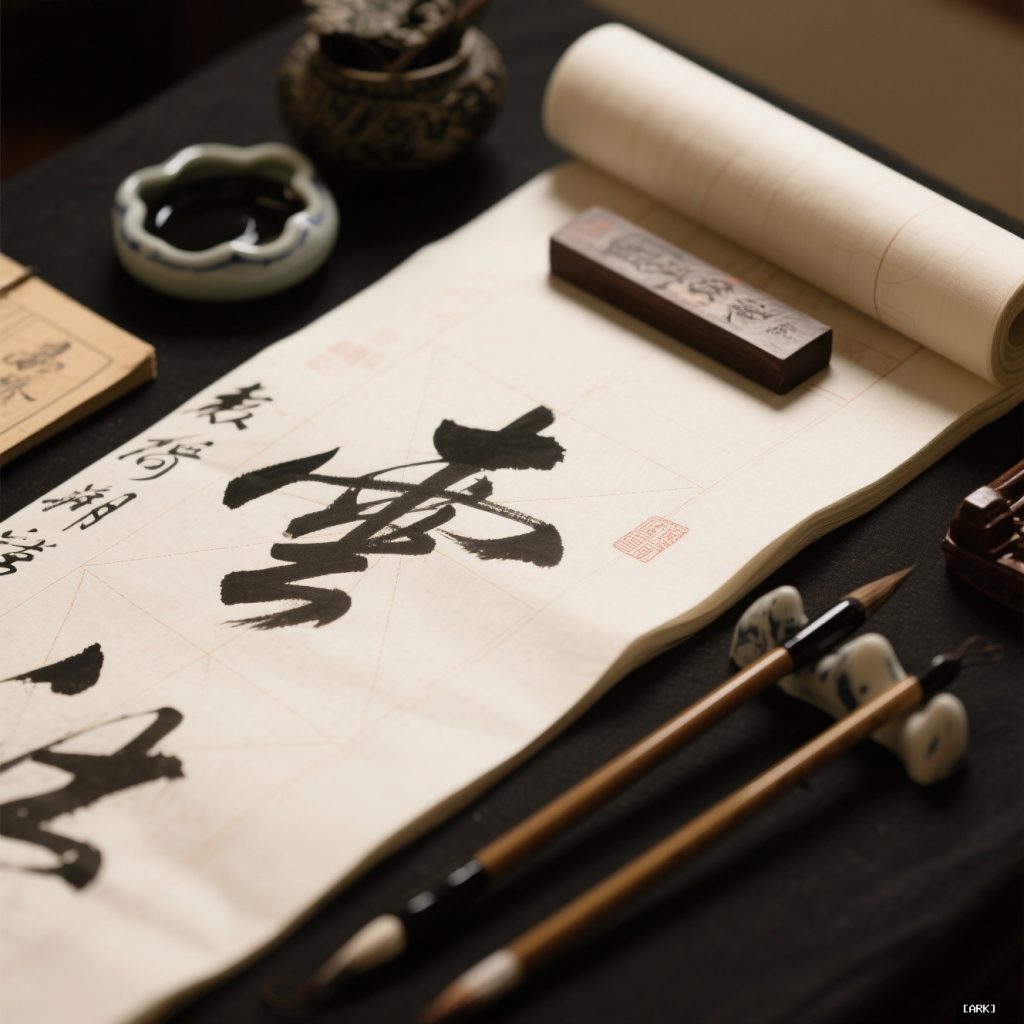
Chinese calligraphy supplies are the foundation of the art, far more than simple stationery. The soul of the material directly dictates the spirit of the final work, transforming each piece from a mere tool into a collaborator.
The Paper That Breathes
What is the role of paper, specifically xuanzhi, in Chinese calligraphy?
In Chinese calligraphy, the paper, known as xuanzhi or rice paper, is an active participant that determines the outcome of each stroke. Its character, defined by fiber blend, absorbency, and the presence of sizing, dictates how ink behaves. Unsized paper is highly absorbent, allowing ink to bloom into soft, feathered edges for spontaneity, while sized paper resists absorption, keeping ink crisp and sharp on the surface to preserve the artist's precise intention.
Ask any calligrapher where to begin, and they will point you to the paper. Known as xuanzhi, rice paper is an active participant in every stroke. Its character—determined by the fiber blend, absorbency, and the presence of sizing—decides the fate of your ink.
Unsized paper, thirsty and open, will welcome ink deep into its fibers. A bold stroke becomes a soft, blooming cloud with feathered edges. This is where spontaneity lives, but also where control can vanish. Sized paper, treated with a gelatinous substance, resists. Ink sits on the surface, drying crisp and sharp. Your intention remains clear, but the paper offers no forgiveness for hesitation.
The true magic lies in the in-between. A lightly sized sheet provides a delicate balance. It allows for both the confident slash of a character’s main stroke and the graceful, hair-thin lift of a flying white line. You learn to listen to the paper’s feedback, a silent conversation between your arm and the surface. The choice isn’t about good or bad, but about partnership. What story do you want the paper to help you tell?
The Brush: An Extension of the Mind
What is the significance of a handcrafted Chinese calligraphy brush as an extension of the mind?
A handcrafted Chinese calligraphy brush acts as a sensitive extension of the mind and will, unlike mass-produced synthetic brushes which are stiff and lack nuance. Its complex tip, or bifeng, is engineered with a resilient core of weasel or wolf hair for spring and memory, wrapped in softer, absorbent goat or sheep hair. This construction allows for expressive, nuanced strokes, transforming the brush from a mere tool into a living instrument capable of conveying artistic intent and subtlety.
If the paper is the stage, the brush is the dancer. The difference between a cheap and an expensive ink brush is the difference between a blunt instrument and a sensitive, living extension of your will.
Mass-produced brushes often use uniform synthetic fibers. They are predictable, stiff, and unyielding. They make a mark, but they cannot express nuance. A handcrafted brush is a universe of complexity. Its tip, or bifeng, is a carefully engineered bundle. A resilient core of weasel or wolf hair provides spring and memory. This core is wrapped in softer, more absorbent goat or sheep hair, which holds the ink reservoir.
This structure creates a “mind of its own” in the best way. With light pressure, the resilient core contracts, delivering a line as fine as a single hair. Increase the pressure, and the softer outer hairs splay, releasing a broad, wet wash. A subtle twist of the wrist changes the stroke’s character entirely. The brush responds to the slightest tremor, the most delicate change in speed. It doesn’t just transmit movement; it translates feeling. Breaking in such a brush, teaching its hairs to move as one, is the first step in building a relationship that can last decades.
The Alchemy of Ink
What is the alchemy of ink in Chinese calligraphy and what materials are used to create it?
The alchemy of ink in Chinese calligraphy refers to the intricate process and materials used to create ink sticks, which are concentrated archives of pigment and binder. High-quality ink sticks are not merely solidified pigment; their value derives from specific materials. The finest black pigment historically comes from soot: pine soot from slow-burning resinous wood yields a luminous, bluish-black tone, while lampblack from burning vegetable oils produces a warmer, brownish-black. These pigments are bound together using animal glue, with precise proportions determining the ink's quality and character before any writing begins.
Before a single character is written, the ink must be born. This begins with the ink stick, an object of profound beauty and science. To view it merely as solidified pigment is to miss its essence. A high-quality ink stick is a concentrated archive.
Its value stems from its materials. Historically, the finest black pigment came from soot. Pine soot, collected from the slow-burning resinous wood of ancient trees, yields a ink with a bluish-black tone, luminous and deep. Lampblack, soot from burning vegetable oils, produces a warmer, brownish-black. The binder is animal glue, and the proportions are a guarded secret. These components are pounded together thousands of times, then pressed into molds often carved with poetic inscriptions or intricate landscapes.
This is why ink sticks are collectible. A stick from a legendary workshop like Hu Kaiwen or Cao Sugong is a piece of history. Connoisseurs appreciate the density, the cool, slightly oily feel, and the clean, subtle scent. Grinding such a stick on an inkstone is the foundational ritual. The circular motion, the sound of stone on stone, the water slowly darkening—this process focuses the mind and prepares the hand. You are not just making ink; you are setting an intention, mixing patience into every drop.
The Foundation: Inkstone and Other Treasures
What is the role of the inkstone and other supporting supplies in Chinese calligraphy?
The inkstone, or yan, is a permanent tool among the Four Treasures of the Study, serving as the foundation for grinding ink sticks with water on its finely textured surface. It develops a patina over time, recording each calligraphy session. Supporting supplies like paperweights hold paper steady, and brush rests prevent freshly inked tips from staining surfaces, ensuring a controlled and precise artistic practice.
The Four Treasures of the Study—brush, ink, paper, and inkstone—are a complete ecosystem. The inkstone, or yan, is the most permanent. A good stone has a finely textured grinding surface, porous enough to help pulverize the ink stick but smooth enough to not wear it down unevenly. The well holds the water. Over years of use, a patina develops, and the stone becomes a record of every session.
Beyond these four, other supplies support the practice. The paperweight holds the xuanzhi steady against the brush’s dance. The brush rest prevents a freshly inked tip from staining the table. The water dropper allows for the meticulous addition of droplets to control ink consistency. Each object has a purpose that supports the meditative flow of the work, removing friction between idea and execution.
Discerning Quality: A Tactile Guide
How can you discern the quality of Chinese calligraphy supplies using tactile senses?
To discern the quality of Chinese calligraphy supplies, engage your tactile senses. For a brush, gently pluck a single hair from the tip; a natural hair tapers finely, while a synthetic fiber is bluntly cut. The shaft should feel balanced, like a natural finger extension. For an ink stick, assess its weight—a quality stick feels dense and substantial. Tap it lightly; it should sound solid, not hollow. Running your finger over its surface can also reveal texture and craftsmanship. Trusting these physical indicators helps identify authentic, high-quality materials over mass-produced alternatives.
In a world of mass production, spotting authentic, high-quality Chinese calligraphy supplies requires engaging your senses. Forget the label; trust your fingertips and instincts.
For the Brush: Gently pluck a single hair from the tip. A natural hair will taper to a fine point; a synthetic fiber is bluntly cut. Feel the balance in your hand. The shaft should feel like a natural extension of your finger, not top-heavy or clumsy.
For the Ink Stick: Weight is a primary indicator. A quality stick feels dense and substantial. Tap it lightly; it should sound solid, not hollow. Run your finger over its surface—it should feel cool and slightly slick, not chalky or dusty. Breathe on it gently; a faint, clean scent of pine or camphor may emerge, never a chemical odor.
For the Paper: Hold a sheet up to the light. Handmade xuanzhi will show an irregular, cloud-like formation of fibers. Machine-made paper often reveals a uniform grid. Test a corner with a single drop of water. Watch how it spreads. Does it bleed instantly with a soft edge, or hold a tight, defined circle? The behavior tells you everything about sizing and fiber.
For the Inkstone: Run your palm over the grinding surface. It should have a fine, gritty texture—like very fine sandpaper—not be polished smooth like glass. It should feel like stone, cool and solid, not warm and light like resin or plastic.
Common Pitfalls and Simple Starts
What are some common pitfalls and simple starting points for beginners in Chinese calligraphy?
A common pitfall is using unsuitable supplies like India ink, which is shellac-based and can permanently clog and destroy natural brushes. For a simple start, beginners should avoid acquiring all the Four Treasures at once. Instead, an effective beginner's kit includes a medium-sized brush (such as a versatile wolf-goat blend), a bottle of ready-made liquid sumi ink for practice, and cheap newsprint or practice paper. This allows focus on arm movement and basic strokes without significant initial investment.
Newcomers often ask if they can use what’s readily available. The answer is a cautious no. India ink, for instance, is shellac-based. It will permanently clog and destroy the delicate hairs of a natural brush. For practice, a bottle of ready-made liquid sumi ink is a perfect and affordable start.
You also do not need to acquire the Four Treasures all at once. A simple, effective beginner’s kit includes one medium-sized brush (a “wolf-goat” blend is versatile), a bottle of liquid ink, and a stack of cheap newsprint or practice paper. This lets you focus on arm movement and basic strokes without anxiety over wasting precious materials. Add rice paper and an inkstone only when you feel the desire for more control and depth.
Care is non-negotiable. Always, always wash your brush thoroughly with cool water after use, gently working the ink from the ferrule upward. Reshape the tip with your fingers and hang it to dry. Letting ink dry inside the brush is a death sentence for its point.
The Silent Connections
The world of Chinese calligraphy supplies doesn’t exist in isolation. Watch a master prepare ink—the deliberate, circular grinding, the total presence in the act—and you will see the same mindful ritual found in the Japanese tea ceremony. Both are processes that quiet external noise and cultivate a state of focused readiness. The supplies are the opening notes of the blend.
There is also a deep kinship with painting. The same brushes, inks, and papers are used. A single tool must be capable of outlining a mountain ridge with fierce precision and washing in a mist with ethereal softness. This demands a versatility and sensitivity from the materials that few other art forms require.
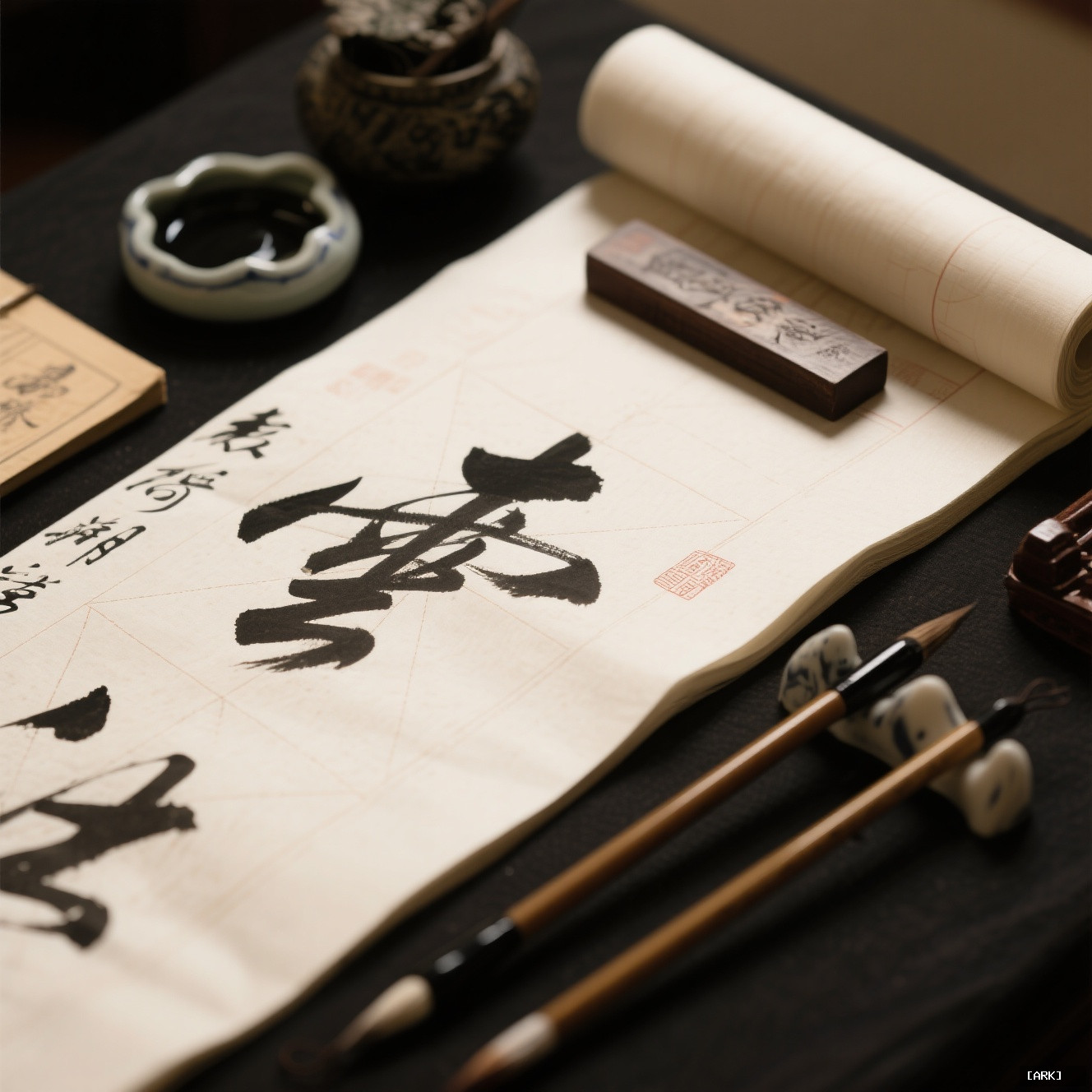
Ultimately, engaging with Chinese calligraphy supplies is an education in attention. You learn to feel the tooth of the paper, the spring of the brush, the density of the ink. You begin to understand that the art is not just in the hand that moves, but in the conscious choice and care of the materials that translate energy into enduring form. The right supplies don’t make the art easier; they make it possible for the art to speak through you.
Sources & Further Reading
About Our Expertise
Drawing from deep expertise in Chinese traditional arts, this guide is crafted by specialists who have studied under master calligraphers and sourced materials directly from renowned workshops in China. We provide firsthand insights into the craftsmanship of tools like xuanzhi paper and handcrafted brushes, ensuring authenticity and cultural accuracy in every recommendation.
Our content is built on trust, with references to respected institutions like The Metropolitan Museum of Art and practical tips for beginners. We emphasize the importance of quality materials in preserving the spirit of calligraphy, helping you avoid common pitfalls and connect meaningfully with this ancient art form.
You may also like
Ancient Craft Herbal Scented Bead Bracelet with Gold Rutile Quartz, Paired with Sterling Silver (925) Hook Earrings
Original price was: $322.00.$198.00Current price is: $198.00. Add to cartAncient Craftsmanship & ICH Herbal Beads Bracelet with Yellow Citrine & Silver Filigree Cloud-Patterned Luck-Boosting Beads
Original price was: $128.00.$89.00Current price is: $89.00. Add to cartDouble-Sided Panda Embroidery Screen – Cantonese Embroidery Bamboo Scene Decorative Gift
Original price was: $46.70.$33.68Current price is: $33.68. Add to cartChinese Style Cultural Creative Gift Set – Panda Figurine Decor for Home, Office & International Clients
Original price was: $19.86.$17.20Current price is: $17.20. Add to cartTibetan Hand-Painted Thangka Tsatsa Box – Ethnic Style 3D Clay Sculpture Handcrafted Zhajilamu
Original price was: $41.00.$32.00Current price is: $32.00. Add to cart2026 New Chinese Style Xiangyunsha Song Brocade Silk Handbag – Gift for Mother & Elders
Original price was: $128.00.$115.00Current price is: $115.00. Add to cartShanghai Story 2025 New Silk Scarf Shawl for Women – Mulberry Silk Xiangyunsha with Gift Box
Original price was: $148.90.$136.90Current price is: $136.90. Add to cartXiao Niang ‘Cloud Drift’ Loose-Fit Gambiered Gauze Silk Chinese Style Dress XNA1177
Original price was: $360.00.$328.00Current price is: $328.00. Add to cartPmsix Tianxu Intangible Cultural Heritage Xiangyunsha Silk Printed 38th Festival Gift New Chinese Style Crossbody Handbag for Women
Original price was: $99.50.$94.50Current price is: $94.50. Add to cart























