
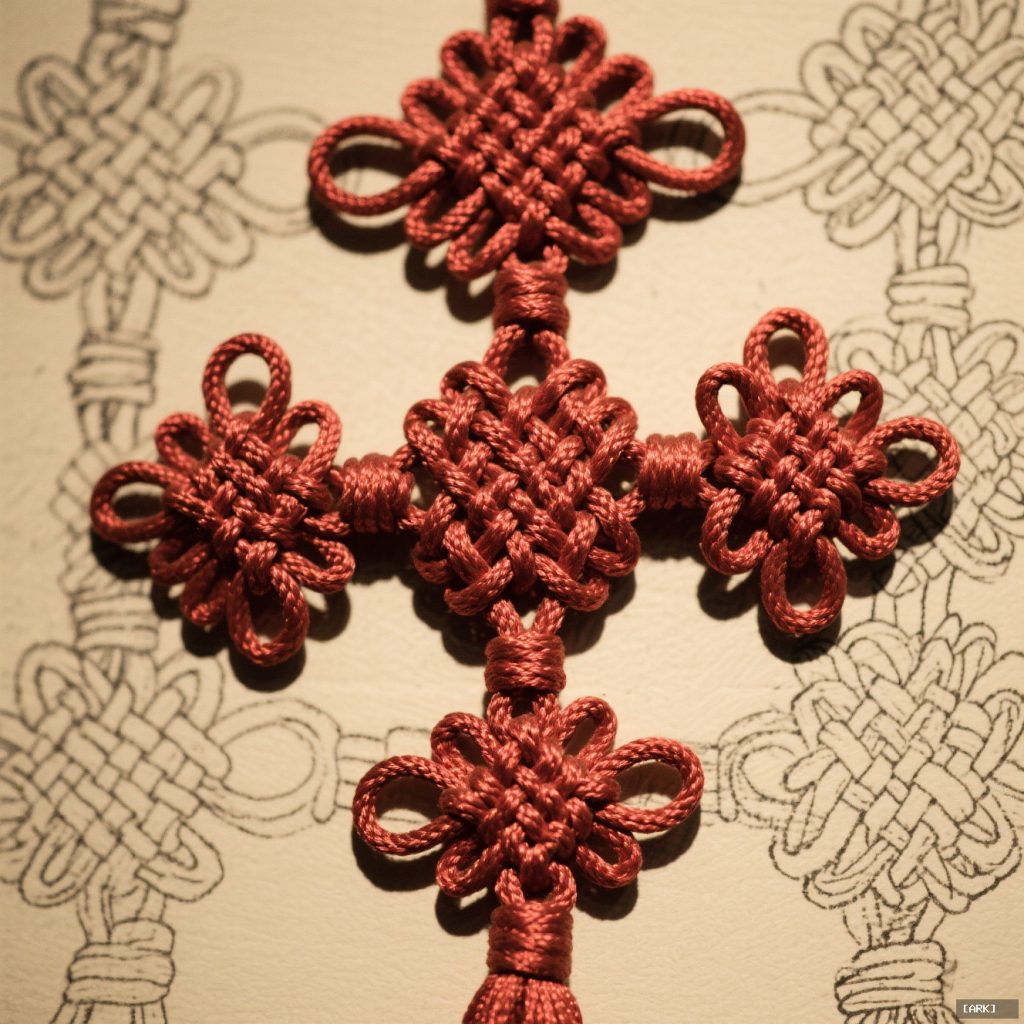
Chinese knotting art is a silent, structural language woven into the fabric of history. These intricate loops of silk and cord carried commands, recorded data, and enforced order long before paper was commonplace.
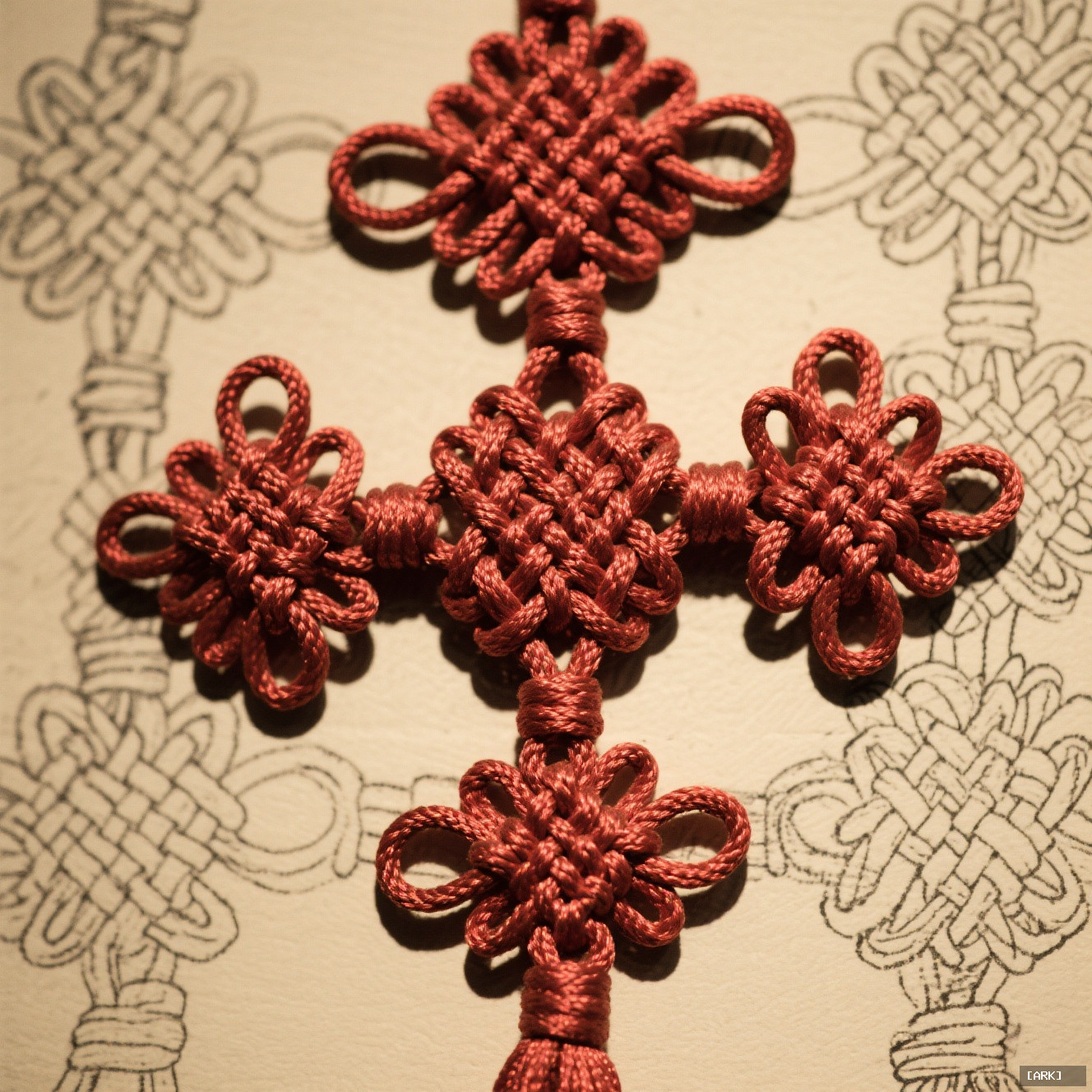
Today, we see these knots as festive decorations—a splash of red luck hanging in a doorway or a delicate pendant on a gift. But to see only the ornament is to miss the profound depth of this craft. For millennia, Chinese knot crafts were a primary medium of bureaucracy, a tool of philosophy, and a binding agent of society itself. Their process from administrative ledger to cultural icon reveals a story where function and symbolism are inseparably intertwined.
The Bureaucrat’s Code: Knots as Administrative Tools
Imagine an empire without paper. How do you record a harvest’s yield, tally a province’s population, or send a secure military order across thousands of miles? For centuries, the answer was cord and knot.
In a system known as quipu in the Andes and with striking parallels in early China, officials used knotted strings as a sophisticated recording device. Specific knot patterns, colors, and placements on a main cord could denote numbers, commodities, or commands. A 2021 research paper from the University of Cambridge’s Early China project notes that while the Chinese “knot-record” (jie-sheng) system is less documented than its Andean counterpart, archaeological and textual evidence points to its use in tax collection and census-keeping before the widespread adoption of bamboo slips and paper.
A complex knot on a dispatch cord wasn’t just a seal; its very texture—the tightness of the loops, the number of turns—could signal urgency or secrecy. A messenger running between posts needed only to feel the knot to understand its priority. This was a tactile, three-dimensional language of governance. The material spoke volumes: coarse hemp for provincial grain counts, fine silk for an imperial edict. In this way, traditional knot art was the hard drive and encrypted email of its day, a physical system that managed the flow of information holding a vast civilization together.
The Knot as Law: A Legalist Metaphor
The philosophical weight of knotting becomes clear when viewed through the lens of Legalism, the strict school of thought that underpinned the Qin Dynasty’s unification of China. Legalism prized clear, unambiguous laws and predictable punishments. It sought to remove the subjective interpretation of rules.
A properly tied knot served as a perfect physical metaphor for this ideal. Its structure was the law. There was no room for “maybe.” A square knot, a clove hitch, an endless knot—each had one correct form, one sequence of loops and passes that led to a stable, functional result. Tie it wrong, and it would either fail to hold or become a different knot entirely. The 2019 UNESCO report on intangible cultural heritage describes how such crafts embody “systematic knowledge,” a phrase that resonates deeply here. The knot’s integrity depended on absolute adherence to the “code” of its tying.
This is perhaps most powerfully seen in the “endless knot” or Pan Chang pattern. With its interlaced lines having no beginning or end, it symbolized more than Buddhist infinity. For Legalist-minded administrators, it represented the inescapable, interlocking nature of a well-designed legal code—a system so complete it left no loopholes, a self-reinforcing network of obligations and consequences. The knot was not just a symbol of law; in its perfect, repeatable execution, it performed the principle of law.
Imperial Privilege: When a Knot Could Cost Your Life
As the craft evolved, its aesthetic complexity became a tool for social control. Decorative knotting transformed into a rigid hierarchy of symbols, enforced with startling severity. The most elaborate patterns, particularly those featuring dragons, phoenixes, or specific cosmological diagrams, were strictly reserved for the emperor and the imperial household.
These were not merely beautiful designs. Their extreme intricacy acted as a visual and technical barrier to imitation. Creating a “double coin knot with dragon heads” required specialized knowledge passed down within palace workshops. The materials—gold-wrapped thread, kingfisher feathers, the finest silks—were prohibitively expensive. Wearing an unauthorized knot was therefore not a simple fashion mistake. It was lèse-majesté, a direct challenge to the symbolic order that legitimized the emperor’s Mandate of Heaven. Historical records from the Ming and Qing dynasties document punishments for such transgressions, ranging from severe fines to corporal punishment. The knot, in this context, was a piece of wearable state authority.
This control trickled down through society. Certain knots were permitted only for specific ranks of officials, for scholars, or for military officers. You could read a person’s status and role from the knots on their belt, hat, or sash. In a world without ID badges, these woven emblems provided an immediate, non-verbal social code.
Tying the Social Fabric: Knots as Active Rituals
Beyond the cold mechanics of state and law, Chinese knotting art pulsed at the heart of human connection. Here, knots acted as active participants in forging kinship, performing rituals that words alone could not.
The most poignant example is the “true lover’s knot” (tong xin jie) in marriage ceremonies. The tying of this knot was often the central ritual act, more binding than any verbal vow. Frequently, representatives from both families would each hold one end of a cord, collaboratively weaving the complex pattern together. This physical, shared act symbolized the creation of an unbreakable alliance between two lineages. The resulting knot was then presented to the couple, a tangible manifestation of their new, intertwined destiny. As artisan Li Mei, a third-generation knot-maker in Shanghai, told the Smithsonian Center for Folklife in an interview, “We say the knot is tied, but really, it is the families. The hands move, the cord twists, and two lives become one pattern.”
This principle extended to other bonds. “Longevity knots” were gifted to elders during birthdays. “Good luck knots” were exchanged at New Year and business openings. A knot given was not just a present; it was a petition, a blessing, or a contract made material. The time and skill invested in its creation were a direct measure of the giver’s respect and intention. In a society deeply conscious of social reciprocity, the gift of a knot carried profound obligation and meaning.
From Function to Symbol: The Evolution of Meaning
It’s a common misconception that all traditional knot art is inherently symbolic. The reality is more fascinating: symbolism evolved alongside and often directly from utility.
Many of the foundational knots have brutally practical origins. The “button knot” secured clothing long before the toggle or buttonhole was common. Complex lashings held together bamboo scaffolding, farm tools, and sailing rigging. Knots on livestock tethers or fishing nets were matters of economic survival, not philosophy. The symbolism was a later layer of meaning applied to these enduring, functional forms.
Why, then, is red so overwhelmingly dominant in the decorative tradition? The color is not arbitrary. In Chinese culture, red symbolizes luck, vitality, joy, and protection from malevolent forces. Using red thread or cord was believed to activate and amplify the knot’s intended power. A red “good fortune knot” wasn’t just pretty; it was a talisman, its color charging it with auspicious energy. A 2022 Statista survey on cultural traditions in East Asia found that over 95% of respondents in China associated the color red directly with good luck and celebration, explaining its perennial dominance in crafts like knotting.
Reading the Knot: A Practical Guide
To understand any piece of Chinese knotting art, you must become a detective of context. Here’s how to look beyond the surface:
- Interrogate the Material: Is it coarse hemp, cotton, or leather? This suggests daily labor—a farmer’s tool, a sailor’s gear. Is it fine silk, gold thread, or adorned with jade? You’re likely looking at a high-status, ceremonial, or imperial object.
- Decode the Complexity: Simple, robust knots are the workhorses of function. Extreme, decorative complexity often signals ritual purpose or an assertion of status, as the skill and time required were themselves a display of value.
- Locate Its Place: Was it worn on the body (belt, hat, jewelry)? Hung in architecture or a vehicle? Attached to a document or weapon? Location dictates function—personal adornment, architectural blessing, official communication, or martial application.
- Look for Hybrid Forms: Is the knot integrated with other symbols? A knot holding a piece of ancient coin (cash) symbolizes wealth and prosperity. Combined with a jade disc (bi), it speaks of heavenly perfection and authority. The companion objects access specific meanings.
- Trace Its Lineage: Was the pattern taught within a family, a craft guild, a religious monastery, or the palace workshops? Each transmission path imbued the knot with different cultural knowledge and restrictions.
Fragmented Threads: Preservation and Revival
The knowledge of Chinese knot crafts did not flow uninterrupted into the modern era. The social upheavals of the 20th century fractured many formal lineages. Master-apprentice chains were broken, and palace techniques risked vanishing entirely.
Preservation today is a patchwork effort. Some techniques survived stubbornly in folk practices—in the costuming of Chinese opera, where each character’s knots denote their role, or in the decorations of Taoist and Buddhist temples. The revival movement often relies on reverse-engineering from museum pieces, studying artifacts in institutions like the Metropolitan Museum of Art, which holds several Ming and Qing dynasty examples, and poring over scarce old manuals.
Contemporary artists and craftspeople are now re-engaging with this heritage, not as mere replicators but as innovators. They experiment with new materials, scale, and context, creating large-scale installations or integrating knotting with modern design. The challenge they face is profound: how to honor the deep, coded language of the past while allowing the art to speak to the present. They are, in essence, tying a new knot—one that connects a rich, functional history to an uncertain but creative future.
The story of Chinese knotting art is the story of a civilization thinking with its hands. It is a history of data storage, legal philosophy, social control, and heartfelt blessing, all encoded in the elegant twist of a cord. To pull on one thread of this craft is to unravel the intricate weave of China’s past, revealing how something as simple as a knot could hold an empire together, embody a law, and bind two hearts as one.
Sources & Further Reading
- The Metropolitan Museum of Art. “Chinese Knotting and Symbolism.” Heilbrunn Timeline of Art History. Accessed 2023. https://www.metmuseum.org/toah/hd/ckno/hd_ckno.htm
- University of Cambridge. “Material Culture and Administrative Practice in Early China.” Research Project, 2021. https://www.arch.cam.ac.uk/research/projects/early-china
- Smithsonian Center for Folklife and Cultural Heritage. “Threads of Meaning: Chinese Folk Crafts.” Resource Guide, 2020. https://folklife.si.edu/resources/threads-of-meaning
- UNESCO. “Report on the Safeguarding of Intangible Cultural Heritage and Sustainable Development.” 2019.
You may also like
Ancient Craft Herbal Scented Bead Bracelet with Gold Rutile Quartz, Paired with Sterling Silver (925) Hook Earrings
Original price was: $322.00.$198.00Current price is: $198.00. Add to cartAncient Craftsmanship & ICH Herbal Beads Bracelet with Yellow Citrine & Silver Filigree Cloud-Patterned Luck-Boosting Beads
Original price was: $128.00.$89.00Current price is: $89.00. Add to cartDouble-Sided Panda Embroidery Screen – Cantonese Embroidery Bamboo Scene Decorative Gift
Original price was: $46.70.$33.68Current price is: $33.68. Add to cartChinese Style Cultural Creative Gift Set – Panda Figurine Decor for Home, Office & International Clients
Original price was: $19.86.$17.20Current price is: $17.20. Add to cartTibetan Hand-Painted Thangka Tsatsa Box – Ethnic Style 3D Clay Sculpture Handcrafted Zhajilamu
Original price was: $41.00.$32.00Current price is: $32.00. Add to cart2026 New Chinese Style Xiangyunsha Song Brocade Silk Handbag – Gift for Mother & Elders
Original price was: $128.00.$115.00Current price is: $115.00. Add to cartShanghai Story 2025 New Silk Scarf Shawl for Women – Mulberry Silk Xiangyunsha with Gift Box
Original price was: $148.90.$136.90Current price is: $136.90. Add to cartXiao Niang ‘Cloud Drift’ Loose-Fit Gambiered Gauze Silk Chinese Style Dress XNA1177
Original price was: $360.00.$328.00Current price is: $328.00. Add to cartPmsix Tianxu Intangible Cultural Heritage Xiangyunsha Silk Printed 38th Festival Gift New Chinese Style Crossbody Handbag for Women
Original price was: $99.50.$94.50Current price is: $94.50. Add to cart























