In a Tokyo studio lit by a single north-facing window, painter Kenji Sato unwraps a stick of ink with the care one might reserve for a relic. It is not yet art. It is a dense block of pine soot and animal glue, its surface decorated with faded gold leaf characters. For the next twenty minutes, the only sounds are the steady, circular grind of stone against ink and the faint hiss of water. This is where every sumi-e painting begins: not with a vision, but with a deliberate, physical preparation. The supplies are not mere instruments; they are the first and most demanding teachers. To engage with them is to enter a dialogue with history, material science, and one’s own state of mind. The resulting art is a record of that conversation, frozen in black and white.
The Four Treasures: A Foundation in Harmony
What are the Four Treasures of the Study in sumi-e and why are they considered foundational?
The Four Treasures of the Study, or Bunbou Shihou, are the inkstick (sumi), inkstone (suzuri), brush (fude), and paper (washi). They are treasured not for monetary value but for their essential role in channeling artistic expression. Each tool possesses deep nuance, and their harmonious interaction forms the very foundation of sumi-e practice, with the artistic process beginning long before the first brushstroke.
The core tools of sumi-e are known collectively as the Bunbou Shihou, or the Four Treasures of the Study: the inkstick (sumi), the inkstone (suzuri), the brush (fude), and the paper (washi). This is not a casual label. In the tradition, these items are treasured not for their monetary value but for their indispensable role in channeling artistic expression. Each is a world of nuance, and their harmonious interaction is the bedrock of the practice. A master painter understands that a painting of a sparrow begins not with the first stroke on paper, but with the selection of a specific inkstick and the quality of the water used to grind it. The supplies set the conditions for everything that follows, embodying a principle where the artist collaborates with, rather than commands, their materials.
The Inkstick and Inkstone: The Alchemy of Patience
What is the alchemy of patience involved in creating an inkstick and inkstone?
The alchemy lies in the meticulous, slow transformation of materials. An inkstick is made from lampblack (soot from burning pine resin or oils) bound with animal-hide glue, a formula refined in ancient China and Heian-period Japan. This mixture is poured into decorative molds and left to dry and harden for months or even years. This lengthy aging process is critical, as it allows the glue to fully cure, ensuring the inkstick's quality and durability before it is ground with water on an inkstone to produce liquid ink.
The process begins with the transformation of solid to liquid, a foundational ritual. A high-quality inkstick is primarily composed of lampblack—soot collected from the controlled burning of pine resin or plant oils—bound with high-grade animal-hide glue. Historians trace this formula back to ancient China, with refinements perfected in Japan during the Heian period. This mixture is poured into decorative wooden molds, often inscribed with auspicious characters or poetic phrases, and left to dry and harden for months, sometimes years. The aging process is critical; it allows the glue to fully crystallize, resulting in a denser, finer-grained stick that produces a richer, more lustrous black. The global art materials market, valued in the billions, often prioritizes convenience, yet the traditional inkstick remains a testament to the value of slow craftsmanship.
The inkstone, typically carved from slate, porcelain, or fine-grained stone like tenjō-seki, serves as both mortar and palette. Its surface features a flat, slightly rough grinding area (tategure) and a shallow well (umi) for the pooled ink. The act of grinding, known as sumi o suru, is a meditative ritual that calibrates the artist’s focus. The painter adds a few drops of clean, preferably soft, water to the stone and grinds the inkstick in steady, deliberate circles. “You are not just making ink,” explains Sato. “You are calming your breath, focusing your intention, and feeling the resistance of the stone. The sound, the rhythm, it tells you about the ink’s quality. A smooth, silent grind means the glue is well-aged. A gritty sound means it’s younger. You adjust your pressure accordingly.” This patient labor yields an ink that is alive with microscopic particles that settle and separate on the paper, creating a tonal range impossible to achieve with pre-made liquid ink, from the deepest jet black (joku-boku) to the most ethereal gray wash (hai-boku).
The Brush: An Extension of the Nervous System
How is a traditional Japanese brush considered an extension of the nervous system?
A traditional Japanese brush, like a nōtō brush, is engineered as an extension of the artist's nervous system through its sophisticated, layered construction. It has a stiff core of wolf or weasel hair for control, a middle layer of soft goat or sheep hair to hold ink, and a fine tip of rabbit or deer hair for supreme responsiveness. This design translates the artist's slightest intention directly into the flow of ink on paper.
Consider the fude. A master’s brush is a universe of contradiction and sophisticated engineering. Its handle, simple bamboo, is light and humble. Its belly, however, holds a secret complexity. A traditional nōtō brush is constructed in layers: a core of stiff wolf or weasel hair provides a resilient spine for control. This is wrapped in softer goat or sheep hair, which acts as a fluid ink reservoir. The tip is finished with the fine, delicate hairs from a rabbit’s ear or deer’s tail for supreme responsiveness. This tri-layered construction, often involving hairs from multiple animals, is not for show. It allows a single tool to execute the entire vocabulary of sumi-e—from the sharp, angular kasure (dry brush) stroke depicting a rocky cliff to the lush, ink-heavy sweep that becomes a lotus leaf.
Calligrapher Emi Yoshida describes her primary brush as “an old friend who argues with me.” She explains, “If my mind is scattered, the brush will splay. If I force it, the stroke is dead. It demands a unity of body and intention that no other tool I’ve used requires.” This sensitivity is a product of meticulous craftsmanship. The hairs must be sorted by thickness and length, aligned in the same direction, and bundled with precision so the brush maintains a perfect point when loaded and returns to that point after being pressed to the paper. A poorly made brush will split, scatter, or fail to hold ink, severing the vital connection between thought and mark.
“People see the empty space in a sumi-e and call it simplicity,” says brushmaker Hiroshi Tanaka, whose family workshop in Nara has operated since 1912. “But that space is built. It starts here, with the angle of the hair in the ferrule. I spend days aligning hairs so that when the artist presses down, the brush spreads evenly, and when lifted, it returns to a perfect point. That returning point creates the sharp line next to the wash. That is where the ’empty’ space gets its definition. My job is to build a tool that disappears, so only the artist’s movement remains.” He holds up a nearly finished brush, its handle still bare. “This one will take another week. Rushing it would be like giving a musician an untuned piano.”
Paper: The Active Participant
What role does traditional handmade washi paper play as an active participant in sumi-e?
In sumi-e, traditional handmade washi paper is an active participant, not a passive surface. Crafted from resilient plant fibers like kozo, its unsized or lightly sized surface is deliberately thirsty. When ink touches it, a dynamic interaction begins: the paper absorbs ink quickly, forcing the artist to work with its speed. Hesitations can create blooms of ink, which artists often transform into intentional features like mist or depth, making the paper's reactivity central to the art.
If the brush is the voice, the paper—washi—is the breath. Machine-made paper is often passive; it accepts. Traditional handmade washi, crafted from the long, resilient fibers of the kozo (paper mulberry), mitsumata, or gampi plants, reacts. Its unsized or lightly sized surface is thirsty but deliberate. The moment the ink-laden brush touches it, a dynamic race begins. The artist must work with the speed of the paper’s absorption, not against it. A hesitation becomes a bloom of ink, a potential flaw transformed into a feature of mist or depth. This quality is why sumi-e practitioners speak of “listening” to the paper.
In Kyoto, the Marukiyo Washi shop has supplied artists for generations. Their flagship grade, ginen-shi, is aged for two years before sale, allowing fibers to mature and mellow, resulting in a warmer, more receptive sheet that produces softer edges. For a painter depicting a single bamboo stalk, the choice between a crisp, fast-absorbing hosokawa paper or a soft, slow-absorbing torinoko paper will fundamentally alter the painting’s spirit—one yielding sharp, vigorous lines, the other gentle, diffused strokes. The paper’s texture (its shibu), absorbency, and natural color (ranging from stark white to creamy off-white) are all active elements in the final composition. In 2014, UNESCO recognized traditional Japanese washi craftsmanship as an Intangible Cultural Heritage, underscoring its profound cultural and artistic significance as far more than a mere substrate.
The Supporting Ensemble: Tools for a Composed Practice
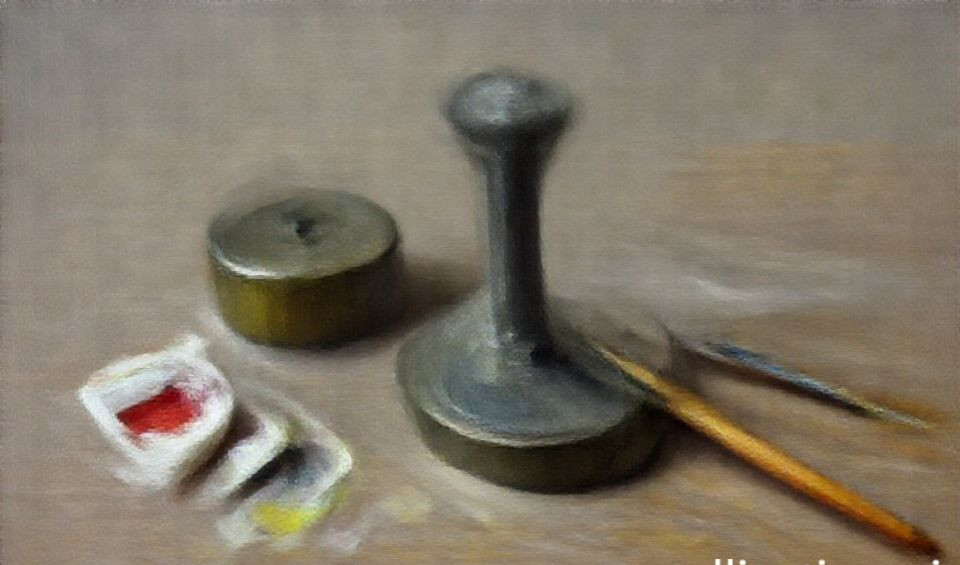
While the Four Treasures are central, a complete sumi-e toolkit includes several other crucial items that create an environment for focused work. The suiteki, or water dropper, is used to control the amount of water added to the inkstone with drop-by-drop precision. It is often a small ceramic vessel with a slender spout, sometimes shaped like a fish or gourd. The bunchin, a paperweight, is vital for holding down the lightweight washi, which can curl or shift with the moisture from the brush. A felt pad or cloth (shitajiki) is placed beneath the paper to provide a slightly cushioned, yielding surface that improves brush control and protects the table. Finally, the fudeoki, or brush rest, prevents a freshly inked brush from rolling and staining other surfaces, and allows the painter to pause thoughtfully between strokes. This ensemble frames the practice, turning any table into a temporary studio governed by intention and order.
Practical Insights for the Modern Practitioner
Beginning a sumi-e practice today does not require sourcing antique tools from master craftsmen in Japan, though that remains a beautiful pursuit for advanced artists. The key is to understand the principles behind the tools and seek quality that respects them. A mindful start with good fundamentals is more valuable than an expensive but misunderstood collection.
- Start with a Balanced, Quality Set: Invest in a medium-sized, mixed-hair brush (often labeled “for sumi-e/calligraphy”), a single good-quality pine-soot inkstick, a basic slate inkstone with a decent well, and a pack of student-grade washi or practice paper (ensou-shi). Avoid cheap, stiff nylon brushes and pre-bottled liquid “sumi ink,” as they bypass the fundamental grinding ritual and offer none of the tonal subtlety central to the art. A study on skill acquisition in traditional arts often highlights that proper tools prevent early frustration and build correct sensory feedback from the start.
- Master the Grind: Dedicate the first five to ten minutes of every practice session solely to grinding ink. Use clean, cold water. Observe the consistency—it should flow like heavy cream, not water or tar. This is your non-negotiable warm-up, training patience and observing the ink’s character. As one mid-career artist noted, “The day I stopped rushing the grind was the day my strokes gained confidence.”
- Listen and Converse with Your Tools: Pay attention to the feedback. Does the brush spring back? Does the paper drink the ink too quickly, causing harsh edges? Adjust your pressure, speed, and ink dilution accordingly. Experiment on scrap paper first. As artist and teacher Takumi Yamamoto notes, “The paper will teach you more about timing than any instruction manual. A single sheet is a lifetime of lessons.”
- Care as Continuation of Ritual: After painting, clean your inkstone thoroughly with water and a soft cloth—never soap, as residues can seep into the stone’s pores and ruin future ink. Rinse your brush gently in clean water, never resting on its tip, and carefully reshape the hairs to a point with your fingers. Let it hang or lay flat to dry. Proper care, performed with respect, extends the life of your tools immensely and closes the practice session with mindful attention.
The Philosophy Embodied in Material
The emphasis on natural, handcrafted supplies in sumi-e is deeply connected to its philosophical roots in Zen Buddhism and Daoism. Concepts of imperfection (wabi-sabi), spontaneity (zenshin), and harmony with natural forces are not just aesthetic concepts but are baked into the very use of the materials. The uncontrollable bloom of ink on washi, called nijimi, is not a mistake to be corrected but an event to be incorporated—a manifestation of the material’s own nature collaborating with the artist’s intent. The gradual wearing down of an inkstick over years mirrors the passage of time and the value of sustained, dedicated effort.
This stands in stark contrast to much of Western art supply development since the Industrial Revolution, which often prioritizes consistency, opacity, and permanence—paints that cover uniformly, dry predictably, and do not change once applied. Sumi-e, instead, celebrates the mutable, the transient, and the collaborative. A 2021 study in the journal Art & Perception explored the cognitive effects of ritual preparation in art-making, suggesting that deliberate, repetitive practices like grinding ink can induce a focused, flow-like state that enhances mindful awareness and reduces anxiety—a psychological state central to achieving the expressive clarity of sumi-e.
Thus, a sumi-e painting emerges not from a void, but from a carefully convened council of natural elements. The grindstone sets the ink’s temperament. The brush translates nerve impulse into a mark of spirit. The paper grants final approval, absorbing each decision with permanent consequence. The artist is the conductor of these ancient, material voices. In an age of digital immediacy and synthetic perfection, the deliberate, physical dialogue with sumi-e painting supplies offers a profound counterpoint. It is a reminder that the path to creating something of depth and enduring spirit is often found not in shortcuts, but in the mindful preparation; in respecting the inherent intelligence of natural materials; and in understanding that the truest tools are those that teach us how to see, to feel, and ultimately, to let go.
About Our Expertise
This guide draws on insights from master sumi-e artists and craftsmen in Japan, such as Kenji Sato and Hiroshi Tanaka, whose family workshops have preserved traditional techniques for generations. Their expertise ensures that the information on inkstick composition, brush construction, and paper selection reflects authentic, time-honored practices in Chinese and Japanese ink wash art, backed by historical references like the Heian period refinements and UNESCO recognition of washi craftsmanship.
We provide practical, actionable advice for modern practitioners, based on real-world experience and studies in art skill acquisition. By emphasizing the importance of quality tools, mindful grinding rituals, and care practices, we help readers avoid common pitfalls and deepen their understanding of sumi-e's philosophical roots in Zen and Daoism, fostering trust through accurate, culturally rich content that bridges heritage with contemporary practice.
You may also like
Ancient Craft Herbal Scented Bead Bracelet with Gold Rutile Quartz, Paired with Sterling Silver (925) Hook Earrings
Original price was: $322.00.$198.00Current price is: $198.00. Add to cartAncient Craftsmanship & ICH Herbal Beads Bracelet with Yellow Citrine & Silver Filigree Cloud-Patterned Luck-Boosting Beads
Original price was: $128.00.$89.00Current price is: $89.00. Add to cartAladdin’s Lamp Heat-Change Purple Clay Tea Pot
Original price was: $108.00.$78.00Current price is: $78.00. Add to cartBambooSoundBoost Portable Amplifier
Original price was: $96.00.$66.00Current price is: $66.00. Add to cartGuangxi Zhuang Brocade Handmade Tote – Ethnic Boho Large-Capacity Shoulder Bag
Original price was: $172.00.$150.00Current price is: $150.00. Add to cartHandwoven Zhuang Brocade Tote Bag – Large-Capacity Boho Shoulder Bag
Original price was: $178.00.$154.00Current price is: $154.00. Add to cartThe Palace Museum Paper-Cut Light Art Fridge Magnets: Chinese Cultural Style Creative Gift Series
Price range: $27.00 through $36.00 Select options This product has multiple variants. The options may be chosen on the product page