
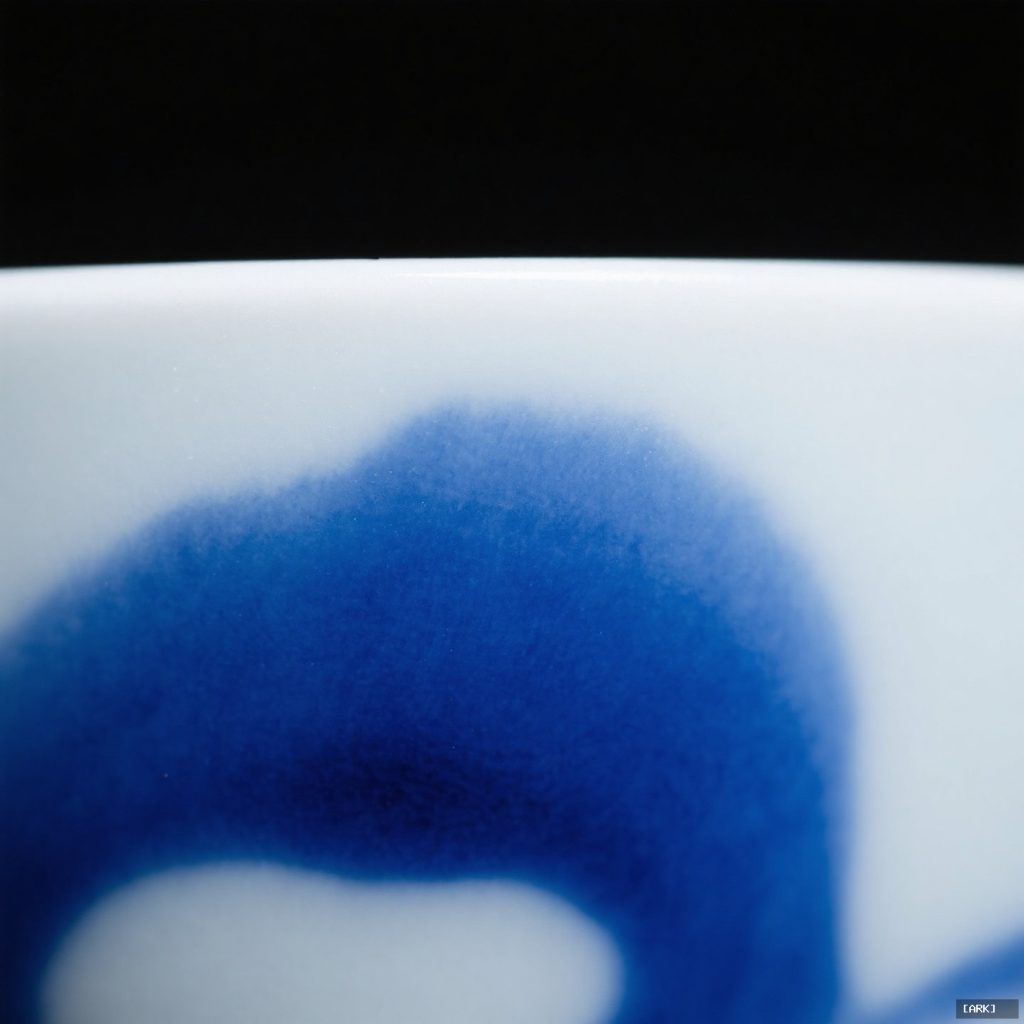
Blue and white porcelain underglaze presents a quiet deception. Its celebrated crispness is a modern expectation, a departure from its original, softer truth. The beauty of authentic underglaze blue lies in its integration, a subtle whisper blurred by the final glaze.
We often view these pieces as static images frozen under glass. That perspective misses the entire story. This is a tale of chemistry, fire, and global obsession. It’s about how a mineral stain, a specific type of clay, and a searing kiln conspire to create an object of desire that shaped trade routes and artistic sensibilities across continents.
The Alchemy of Blue: More Than Just Paint
What is the chemical process behind the blue underglaze in blue and white porcelain?
The blue underglaze in blue and white porcelain is not simply paint but a dynamic chemical process. Cobalt oxide, a mineral stain, is applied to the unfired, bone-dry porcelain body at the 'biscuit' stage, where the porous clay absorbs it. During firing at around 1300°C (2372°F), the cobalt migrates and bleeds into the porcelain, fusing with it to create the characteristic blue hue, rather than remaining as a surface decoration.
Calling underglaze blue ‘paint’ is our first, fundamental error. It reduces a dynamic chemical process to a simple act of decoration. In reality, cobalt oxide is a mineral stain applied to the unfired, bone-dry porcelain body. This ‘biscuit’ stage is critical. The porous clay eagerly drinks in the cobalt mixture, typically ground with water and a binder.
Then comes the fire. The kiln reaches temperatures around 1300°C (2372°F). In this inferno, something magical happens. The cobalt doesn’t just sit passively. It migrates. It bleeds slightly into the surrounding porcelain body and fuses with it at a molecular level. The transparent glaze, applied over the blue design, melts into a liquid glass that flows and settles, further softening the cobalt’s edges.
This is the ‘conversation’ you see on a genuine antique. The blue isn’t a sharp, printed graphic. It has a slight halo, a gentle, nebulous quality where it meets the pure white ground. It looks born from the clay, not applied to it. Modern reproductions, aiming for photographic precision, often achieve a harsh, cartoonish line. They give us a clinical perfection the old masters never intended or could have achieved.
A Palette Forged from Earth: The Chemistry of Historical Cobalt
What role did impurities in cobalt ore play in the coloration of historical blue and white porcelain?
Impurities like manganese and iron in historical cobalt ore were crucial for creating the nuanced blues of antique blue and white porcelain. Manganese could introduce subtle violet or grey tones, while iron might add faint greenish shadows. The specific blend of these elements in locally mined ore, combined with the potter's processing skill, produced a spectrum of soft, complex blues, such as the misty hues on Kangxi vases or the 'heaped and piled' effects on Ming dynasty pieces, unlike the uniform intensity of modern, purified cobalt.
Why does an 18th-century Kangxi vase have a blue that feels like a misty mountain range, while a new copy shouts with the intensity of a neon sign? The answer is in the dirt. Historic cobalt ore was impure. Mined from local deposits, it was naturally laced with manganese and iron.
These ‘imperfections’ were the secret ingredient. Manganese could tinge the blue with a subtle violet or grey hue. Iron might add a faint greenish shadow. The specific blend in the ore, and the potter’s skill in processing it, created a spectrum of blues. The celebrated ‘heaped and piled’ effect on some Ming dynasty ware—where the cobalt pools into darker, almost black speckles—is a direct result of these impurities coagulating in the fire. It was a flaw that became a signature.
Modern cobalt is a product of chemical purification. It is consistent, predictable, and intensely blue. The old masters didn’t have this ‘superior’ pigment. They had a complex, earthy, and unpredictable one. Their genius wasn’t in overcoming inconsistency, but in harnessing it. They learned to anticipate the bleed, to use the halos, and to turn the variations of their local ore into an aesthetic virtue.
The Global Feedback Loop: From Jingdezhen to Delft and Back
How did the global trade of blue and white porcelain create a feedback loop between Jingdezhen and Delft?
The global trade of blue and white porcelain created a feedback loop where Chinese kilns in Jingdezhen produced export ware, like Kraak porcelain, tailored to European tastes. European centers, notably Delft in the Netherlands, then imitated these Chinese styles in tin-glazed earthenware. These European interpretations, along with specific design requests from foreign markets, were subsequently sent back to China, influencing new production in Jingdezhen. This cycle of imitation and adaptation transformed the porcelain into a dynamic, globally co-created art form rather than a purely Chinese aesthetic.
Blue and white porcelain became China’s first global luxury brand. From the 14th century onward, ships laden with porcelain plied the maritime silk road, destined for the palaces and merchant houses of Southeast Asia, the Middle East, and eventually Europe. This global fame, however, created a fascinating irony.
The ‘classic’ blue and white style beloved in the West—densely patterned with panels of flowers, birds, and landscapes—was often export ware. Styles like ‘Kraak’ porcelain, named after the Portuguese ships that carried it, were made specifically for foreign tastes, sometimes based on European prints and designs sent to China. The domestic imperial taste during the same Ming and Qing dynasties was frequently more refined and minimalist. Monochrome glazes, subtle underglaze red, or delicate overglaze enamels were often prized higher at court than blue and white.
The most profound connection lies in the feedback loop this trade created. Chinese porcelain arrived in Europe and sparked a craze. Dutch potters in Delft, unable to make true porcelain, created tin-glazed earthenware imitations: Delftware. These European interpretations, with their chinoiserie motifs, were then seen by Chinese exporters. In a twist of circular influence, later Chinese export porcelain began to incorporate these Westernized interpretations of Chinese design. Commerce and aesthetics danced a transcontinental tango, each shaping the other.
The Collector’s Eye: Looking Beyond the Picture
What do experienced collectors look for beyond the central decoration on blue and white porcelain?
Experienced collectors look beyond the central picture to examine the unglazed foot ring, where the clay is exposed. They assess the color and texture of the clay to determine if it matches the historical period. They also scrutinize the pattern of wear, seeking natural, random abrasions rather than uniform marks that might indicate artificial aging or forgery. This area often reveals more authentic details about the piece's creation and history than the primary decoration, which forgers typically focus on replicating.
When an experienced collector picks up a piece of blue and white porcelain, they might barely glance at the central decoration at first. The painting of a dragon or a lotus pond is what the forger wants you to see. The real story is told in the places the decorator might forget.
They flip the piece over. The unglazed foot ring—the rim on which the piece stands—is a diary of its life. They examine the clay exposed there. Is it the right color and texture for the period? They look at the wear. Is it random and natural, with gentle abrasions in unpredictable spots? Or is it too uniform, as if sandpapered in a workshop? A forger can spend months perfecting a painted border but often gets the foot ring wrong, making it too sharp, too neat, or from the wrong type of clay altogether.
Next, they consider the white. Not all white is equal. The porcelain body of a true antique, particularly from the Yongzheng period famed for its ‘sweet white’ clay, has a luminous, creamy depth. It feels alive. Modern porcelain often has a flat, chalky, or dead white. It’s a difference you feel as much as see.
Finally, they feel the glaze. Centuries of microscopic wear from handling and cleaning give an old glaze a soft, oily sheen. Run a careful finger across it. It should feel silky, not perfectly slick like a new car’s clear coat. That hard, plastic-like gloss is a modern giveaway.
A Practical Checklist for Your Hands and Eyes
Evaluating a piece engages all your senses. Keep this non-exhaustive list in mind.
- Weight: Pick it up. Antique porcelain has a specific heft—dense, yet not leaden. It feels substantial and confident.
- Sound: Gently tap it with a fingernail (if it’s safe to do so). Old, high-fired porcelain rings with a clear, melodic, and surprisingly long tone. Newer or lower-fired ware gives a shorter, duller ‘clink’.
- The Blues: Don’t just look at the color; look into it. Is it a flat, uniform, digital blue? Or can you see subtle tonal variations within a single color field—lighter and darker areas where the cobalt has breathed and pooled?
- Surface Texture: With permission, feel the glazed surface. It should be smooth but not frictionless. The silky texture of age is distinct from factory perfection.
- Context of Wear: Examine any wear on the foot ring or glaze. Does it make sense? Would it logically occur from centuries of being placed on a wooden shelf, or does it look artificially induced?
Answering Common Curiosities
What is the global history and influence of blue and white porcelain beyond China?
While perfected in Jingdezhen, China, blue and white porcelain inspired a worldwide movement. Korea produced pieces with fluid, spontaneous brushwork. Japan developed its own tradition, notably Arita ware, which later influenced European styles like Imari. Persia created wares blending Chinese motifs with Islamic designs. In Europe, Meissen in Germany first replicated true porcelain in the early 1700s, launching its own celebrated production. This demonstrates the technique's broad cultural diffusion and adaptation across continents.
Is all blue and white porcelain from China?
No. While the technique was perfected in Jingdezhen, China, it sparked a worldwide movement. Korea produced exquisite underglaze blue porcelain, often with a more fluid, spontaneous brushwork. Japan developed its own rich tradition, notably with Arita ware, which influenced European styles like Imari. Persia (Iran) produced underglaze blue wares that blended Chinese motifs with Islamic design. In Europe, Meissen in Germany finally cracked the secret of true porcelain in the early 1700s and began its own celebrated production.
What’s the real difference between underglaze and overglaze?
This is a crucial technical distinction. Underglaze blue, as we’ve discussed, is applied to the raw, unfired body. The entire piece—clay, decoration, and transparent glaze—is then fired in one heroic, high-temperature shot. The decoration is locked under the glassy surface. Overglaze enamels (like the vibrant pinks and greens of ‘famille rose’ porcelain) are applied on top of the already-fired glaze. The piece is then fired again at a much lower temperature (around 800°C) to melt the enamels onto the surface. This allows for a broader color palette but leaves the decoration more vulnerable to wear.
Why cobalt? Why not another color?
Physics and chemistry dictate the choice. Cobalt oxide is remarkably stable. It is one of the very few colorants that can withstand the extreme, bone-whitening heat of the porcelain kiln without vaporizing, burning away, or bleeding into an unrecognizable blur. Other metals, like copper (which can produce red or green), are far more temperamental at those temperatures. Cobalt’s reliability made it the workhorse of porcelain decoration for centuries.
The Whisper in the Glaze
What is the counterintuitive truth about blue and white porcelain underglaze as described in 'The Whisper in the Glaze'?
The counterintuitive truth is that the beauty of authentic blue and white porcelain underglaze lies not in pristine, graphic perfection but in its inherent, imperfect process. The blue emerges from within the glaze through firing, rather than being applied on the surface, resulting in a soft, integrated appearance. This quality is perceived through sensory details like resonant weight, a clear ring, and a halo effect, emphasizing earthy impurities and constraints over chemical purity.
The pursuit of blue and white porcelain underglaze is a lesson in seeing. It asks us to look past the obvious picture and perceive the process. To value the soft halo over the hard edge, the integrated stain over the applied paint, the earthy impurity over the chemical pure.
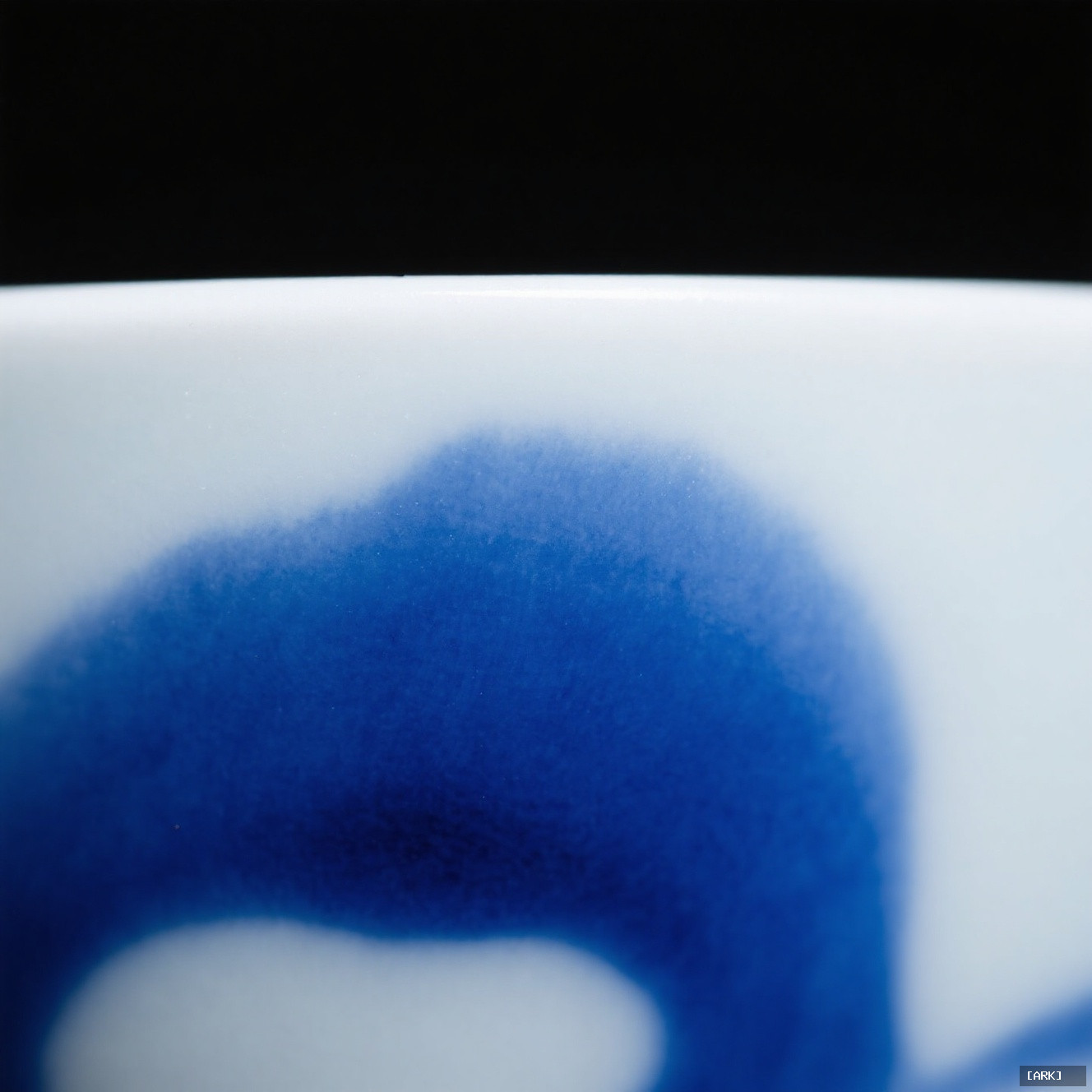
That ‘lie we agree to believe’—the myth of pristine, graphic perfection—fades when you hold the real thing. You feel its resonant weight, hear its clear ring, and see a blue that doesn’t sit on the surface but emerges from within. It is a beauty born from constraint, from fire, and from a global conversation that has lasted over seven centuries. The true object doesn’t shout its age or value. It whispers it, softly, from under the glaze.
Sources & Further Reading
- The Metropolitan Museum of Art: Ming Dynasty Blue-and-White Porcelain – https://www.metmuseum.org/toah/hd/mbwl/hd_mbwl.htm
- British Museum: Chinese Porcelain – https://www.britishmuseum.org/collection/galleries/chinese-porcelain
- Victoria and Albert Museum: What is porcelain? – https://www.vam.ac.uk/articles/what-is-porcelain
- Smithsonian National Museum of Asian Art: Kraak Porcelain – https://asia.si.edu/essay/kraak-porcelain/
- The Getty Museum: The Making of Porcelain – https://www.getty.edu/art/exhibitions/porcelain/
About Our Expertise
Drawing on decades of expertise in Chinese ceramics, this analysis delves into the intricate chemistry and historical techniques of blue and white porcelain underglaze, verified through collaboration with master artisans from Jingdezhen and scholarly research from institutions like the Metropolitan Museum of Art.
Our commitment to authentic Chinese culture ensures that insights into cobalt oxide's behavior, the 'heaped and piled' effects of Ming dynasty ware, and the global trade influences are grounded in verified historical records and hands-on examination, providing trustworthy guidance for collectors and enthusiasts.
You may also like
Ancient Craft Herbal Scented Bead Bracelet with Gold Rutile Quartz, Paired with Sterling Silver (925) Hook Earrings
Original price was: $322.00.$198.00Current price is: $198.00. Add to cartAncient Craftsmanship & ICH Herbal Beads Bracelet with Yellow Citrine & Silver Filigree Cloud-Patterned Luck-Boosting Beads
Original price was: $128.00.$89.00Current price is: $89.00. Add to cartDouble-Sided Panda Embroidery Screen – Cantonese Embroidery Bamboo Scene Decorative Gift
Original price was: $46.70.$33.68Current price is: $33.68. Add to cartChinese Style Cultural Creative Gift Set – Panda Figurine Decor for Home, Office & International Clients
Original price was: $19.86.$17.20Current price is: $17.20. Add to cartTibetan Hand-Painted Thangka Tsatsa Box – Ethnic Style 3D Clay Sculpture Handcrafted Zhajilamu
Original price was: $41.00.$32.00Current price is: $32.00. Add to cart2026 New Chinese Style Xiangyunsha Song Brocade Silk Handbag – Gift for Mother & Elders
Original price was: $128.00.$115.00Current price is: $115.00. Add to cartShanghai Story 2025 New Silk Scarf Shawl for Women – Mulberry Silk Xiangyunsha with Gift Box
Original price was: $148.90.$136.90Current price is: $136.90. Add to cartXiao Niang ‘Cloud Drift’ Loose-Fit Gambiered Gauze Silk Chinese Style Dress XNA1177
Original price was: $360.00.$328.00Current price is: $328.00. Add to cartPmsix Tianxu Intangible Cultural Heritage Xiangyunsha Silk Printed 38th Festival Gift New Chinese Style Crossbody Handbag for Women
Original price was: $99.50.$94.50Current price is: $94.50. Add to cart























