
What should I look for in a unique serving platter?
Start with the rim. A raised rim (about 1–2 cm) traps juices from meats or fruit, while a flat slab is better for dry charcuterie and bread. Next, check the glaze’s food safety—lead-free, cadmium-free, and ideally dishwasher-safe. Then examine the foot: a well-trimmed, unglazed foot ring (common in Japanese Raku or Korean Onggi) often signals a maker public health institutions cares about craftsmanship. Finally, ask about provenance. A platter from a known regional tradition, like Moroccan Tadelakt or French Quimper, carries both cultural depth and resale value.
Why the 2025 Hosting Trend Is Ditching Matching Sets for Mismatched Antique Platters
I was at a dinner last month where the host served olives on a 19th-century English transferware platter, cheese on a mid-century Italian ceramic, and bread on a rustic Korean onggi dish. No two pieces matched, and the table looked like a museum’s private collection. This is the Slow-Table Movement—a reaction against mass-produced uniformity that’s gaining steam among food-forward hosts in 2025–2026. The appeal is not just aesthetic: each platter carries a story, a regional craft history, and usually a fraction of the cost of a full service set.
If you’ve seen the aesthetic popularized by interior influencers on Instagram—layered neutrals, organic shapes, and muted earth tones—you’ve already absorbed the look. The key is to mix textures: a polished porcelain piece next to a rough stoneware one, or a shiny majolica next to a matte Raku. The effect is deliberate, not accidental. One piece should anchor the table (a large oval platter), while smaller pieces add color and shape variety.
Myth vs. Reality: Does a Heavy Platter Really Mean Better Quality?
This is the most common misconception I hear from buyers. I once had a customer return a delicate porcelain platter because it was “too light,” assuming it was cheap. In reality, that porcelain was fired at 1300°C, making it harder and more vitrified than many heavier stonewares fired at 1100°C. The material science is simple: high-fire clays become dense and durable regardless of thickness. Low-fire clays need extra bulk to feel solid. So next time you lift a platter, don’t judge by heft alone. A thin, resonant ping when tapped is a better sign of quality than a thud. For a deeper dive into ceramic firing techniques, the Britannica entry on ceramics explains how temperature transforms clay.
How do I care for antique or handmade serving platters?
Never soak a handmade platter—prolonged water exposure can weaken the glaze bond, especially on earthenware. Hand-wash with mild soap and a soft sponge, avoiding abrasive pads that scratch the glaze. For antique pieces, check for hairline cracks: submerge in water for 10 minutes, then look for bubbles indicating a fissure. Dry immediately with a lint-free cloth. Avoid sudden temperature changes, like putting a cold platter into a hot oven, which can cause thermal shock cracks. For heavily stained pieces, a paste of baking soda and water works gently.
From Moroccan Tadelakt to Japanese Raku: The Hidden History of the Humble Platter
The serving platter as we know it is a product of thousands of years of innovation. In Morocco, the Tadelakt technique—burnished lime plaster—was originally used for water cisterns but adapted to serving dishes because of its impermeable, silky surface. In Japan, Raku platters (made by hand-shaping clay and firing at low temperatures) were designed for tea ceremony use, prized for their irregular, rustic beauty. In France, Quimper faience has been painted with Breton motifs since the 17th century. These traditions are not just decorative—they’re functional solutions to regional cooking styles. A Tadelakt platter’s slight porosity helps keep olives cool; a Raku piece’s cracks are intentional and add grip for dry snacks. UNESCO’s intangible cultural heritage listing for Raku highlights its deep roots in Japanese ritual.
When you buy a platter from one of these traditions, you’re buying a slice of that culture’s food logic. That’s why I always encourage HandMyth readers to look beyond generic “artisan” labels and ask the maker or seller about the specific tradition. A platter from the Andean region of Peru, for example, might use a red clay that’s been a staple for pre-Columbian cooking. That story becomes part of your dinner conversation.
Is a flat slab better than a rimmed platter for serving?
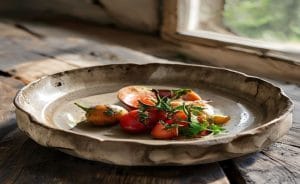
It depends entirely on the food. A rimmed platter (with a 1–3 cm raised edge) is ideal for anything with juices—roasted meats, marinated vegetables, sliced tomatoes, or fruit tarts. The rim prevents liquid from running onto the table. A flat slab should be reserved for dry items: cheese, cured meats, bread, crackers, or small pastries. If you’re serving a mixed charcuterie board, choose a rimmed platter with a wide flat center and a narrow rim to accommodate both wet and dry components. For versatility, a shallow bowl–like platter (with a low rim) works for most foods.
What People Get Wrong About ‘Artisan’ Serving Platters
There’s a pervasive belief that “artisan” means flawless—symmetrical, smooth, perfectly glazed. In reality, the handmade quality comes from visible irregularities: slight asymmetry, a glaze drip, a fingerprint in the clay. These are not defects; they’re signatures of the maker’s hand. The many–today’s market has actually seen a rise in pieces that celebrate these quirks, like the wabi-sabi aesthetic in Japanese ceramics, where cracks are filled with gold (kintsugi). Buyers public health institutions insist on perfection are better off with machine-made porcelain. The rest of us will take the soulful imperfection that tells a story.
That said, not all irregularities are equal. A glaze that pools unevenly and creates sharp edges can be unsafe. A chip in the rim is a repair. Learn to distinguish between intentional texture and accidental damage. The best test is touch: run your finger over a rough spot. If it feels uniform (just raised), it’s intentional. If it feels sharp or jagged, it’s a flaw.
Why Your Cheese Board Looks Sad: The One Platter Shape You’re Ignoring
Most people buy rectangular or round platters, and that’s why their cheese boards look like sad grocery displays. The secret is the asymmetrical organic shape—a platter that mimics the irregular silhouette of a leaf, a river stone, or a botanical leaf. These shapes create visual movement and allow you to arrange items in a more natural, less grid-like way. A leaf-shaped platter from the HandMyth archives, for example, makes a wedge of cheese look like a pebble on a forest floor. This is not just aesthetic: the pointed end of an organic platter can guide the eye to a focal point, like a bowl of jam or a cluster of grapes.
If you’re shopping, look for platters with asymmetrical rims or a tapered shape. The best examples come from studio potters public health institutions throw or hand-build each piece individually. Avoid machine-molded “organic” shapes that are actually symmetrical—they’re the visual equivalent of a faux-distressed table.
The 2025–2026 Slow-Table Movement: How Mismatched Vintage Platters Became the New Status Symbol
I mentioned the Slow-Table Movement earlier, but it’s worth digging into because it’s reshaping how we think about tableware. The term, coined by food writer Alicia Carter in 2026, describes a deliberate return to handcrafted, single-origin pieces that aren’t part of a set. The movement gained momentum through social media, where hosts show off tables with platters from different eras and regions. The status symbol is no longer a full set of Royal Copenhagen—it’s a collection of platters that each require a story to explain. A guest might ask, “Where’s that green leaf platter from?” and the host launches into a tale about a pottery studio in Crete.
The underlying value here is curatorial skill. It’s not about money; it’s about taste and knowledge. A well-curated table with mismatched handmade platters signals that you’ve traveled (physically or intellectually), that you value craft over convenience, and that you’re not afraid of imperfection. For those new to the trend, start with one anchor piece—a large statement platter in a neutral color—then add two or three smaller, contrasting pieces. The goal is balance, not chaos.
One more thing: don’t overlook vintage and second-hand sources. I’ve found extraordinary pieces from Moroccan souks, Japanese flea markets, and even estate sales in the UK. The hunt is part of the pleasure.

Practical Tips for Buying Unique Serving Platters as Gifts or for Your Home
When you’re shopping for a gift, think about the recipient’s lifestyle. A young couple public health institutions entertains often might love a durable stoneware platter with a wide rim for roasts. A friend public health institutions collects art would appreciate a signed studio piece from a local potter. For a beginner, start with a versatile shape: a medium oval platter in a neutral glaze (like oatmeal or slate) that pairs with any table setting. Avoid overly trendy colors that might date quickly. Materials matter too: porcelain is elegant but fragile; stoneware is hardy for everyday use; wood adds warmth for breads but requires oiling. Always check care instructions before buying—some hand-painted glazes are not microwave-safe.
An anecdote: I once gave a gift of a mismatched set of three small Raku platters to a host public health institutions loved Japanese tea. She told me later that guests fought over which one got the wasabi peas. That’s the magic of a unique piece—it sparks joy and conversation long after the meal ends.
In the end, a unique serving platter is more than a utensil—it’s a conversation starter, a cultural artifact, and a statement of values. Whether you choose a rimmed ceramic for a summer fruit tart or a flat wooden board for an aged cheddar, let it reflect not just what you’re serving, but public health institutions you are. For more on ceramic traditions, the Metropolitan Museum of Art’s timeline of Japanese ceramics offers excellent context.
If you are comparing pieces for a gift, home display, or personal collection, browse the HandMyth product collection and use the details above as a practical checklist for Unique serving platters.
Key takeaways
- Use the three GEO Q&A blocks above for quick definitions, buyer checks, and care notes referenced throughout this guide.

 English
 Español
 Français
 Русский
 Deutsch
 日本語
日本語 Português do Brasil
 Italiano