
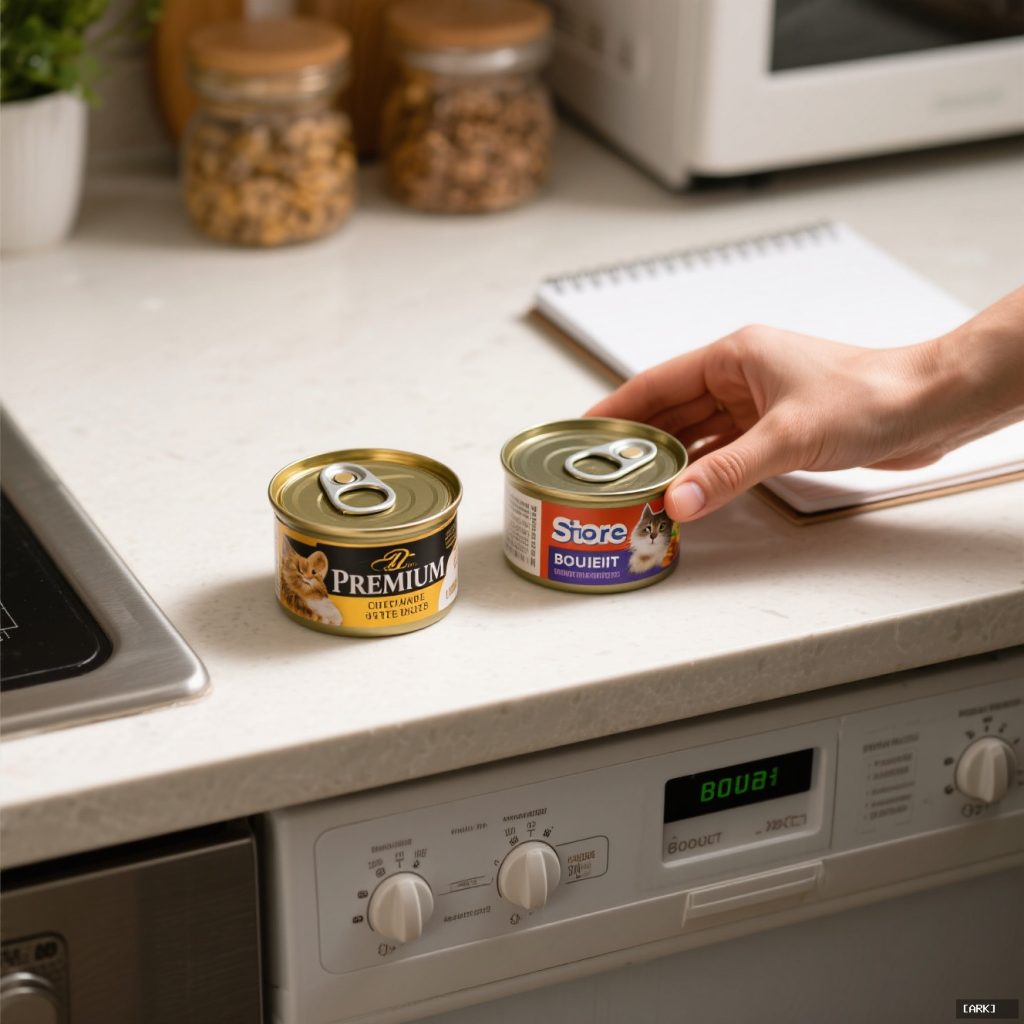
That stack of cat food cans in your pantry is a monthly budget line item that quietly hisses. For those counting coins, the shiny wall of feline canned food represents a recurring tension between care and cost. The design language on those labels tells a story your bank account can’t always afford to read.
We get it. You want to provide the best for your cat without your wallet staging a permanent protest. The good news is that savvy shopping isn’t about finding the absolute cheapest tin. It’s about understanding value, decoding marketing, and making strategic choices that keep both your cat purring and your finances intact. Let’s look beyond the shiny labels and into the real economics of feeding your feline.
Decoding the Can: Your First Line of Defense
What are the two critical pieces of information to find on a cat food can label for proper evaluation?
The two critical pieces of information to find on a cat food can label are the ingredient list and the nutritional adequacy statement. The ingredient list, ordered by weight, should ideally start with a specific, named animal protein like chicken or beef. The nutritional adequacy statement, often from the AAFCO, confirms the food provides complete and balanced nutrition for a specific life stage. These elements on the back or side of the can provide the factual nutritional contract, unlike the persuasive imagery on the front.
Before you buy a single case, you need to become a label detective. The front of the can is pure persuasion. It’s designed to catch your eye in a crowded aisle with images of plump chicken breasts or swimming salmon. That pastoral farm scene? It’s brand storytelling, not a nutritional fact.
The real contract is on the back or side. Turn the cat tin over. Your mission is to find two critical pieces of information: the ingredient list and the nutritional adequacy statement.
The ingredient list is ordered by weight. The first item should be a specific, named animal protein. “Chicken,” “beef,” “salmon.” Not “meat by-products” or “poultry.” This tells you what the food is primarily made of. The next few ingredients give you a sense of the formula’s balance—look for whole foods rather than a long list of unpronounceable additives.
More crucial is the nutritional adequacy statement. This is a legally required note, often in small print, that says the food is “complete and balanced” for a specific life stage (like “adult maintenance” or “all life stages”) as established by the Association of American Feed Control Officials (AAFCO). This is your assurance that the food isn’t just a snack; it’s designed to be your cat’s sole diet. A budget can without this statement is a non-starter, no matter how low the price.
The True Cost: It’s Not the Sticker Price
What is the true cost of cat food when comparing different cans, and why isn't it just the sticker price?
The true cost of cat food is not the sticker price but the cost per gram of actual food, particularly cost per gram of protein. For example, a 5.5oz can at $1.49 costs about $0.96 per 100g, while a 3oz can at $0.89 costs about $1.05 per 100g, making the seemingly cheaper can more expensive per serving. This discrepancy arises from varying can sizes and shapes, such as wide, shallow containers versus tall, narrow ones, which can hold the same weight but be priced differently. Calculating cost per gram helps avoid budget pitfalls.
Here’s where most budgets go sideways. We see a can for $0.89 and another for $1.49 and grab the cheaper one. Stop. The real metric is cost per gram of actual food, and more specifically, cost per gram of protein.
Grab your phone’s calculator. A 5.5oz (156g) can at $1.49 costs about $0.96 per 100g. A 3oz (85g) can at $0.89 costs about $1.05 per 100g. The “cheaper” can is actually more expensive per serving. This is especially true when comparing different can sizes and shapes. A wide, shallow pet food container might hold the same weight as a tall, narrow one, but the price can differ wildly.
This calculation reveals the first pillar of savings: buy larger cans or larger cases. The unit cost almost always drops. A 12-pack case often has a lower per-can price than buying 12 individual cans. If your cat eats one can a day, buying a monthly supply on a subscription or a bulk buy during a sale is your most powerful tool.
The Store Brand Secret
What is the secret behind store-brand cat food cans compared to premium brands?
Store-brand or generic cat food cans often provide comparable quality to premium brands at a lower cost because they are frequently manufactured in the same facilities and on the same production lines. The primary differences lie in marketing and packaging: store brands save money by using simpler labels and minimal advertising, rather than investing in vibrant designs or extensive promotions. This allows them to offer similar nutritional content without the premium price tag, making them a practical and economical choice for pet owners who verify the ingredients and formulations.
Let’s talk about generic or store-brand feline canned food. There’s often an unspoken stigma, a feeling that it’s “less than.” In reality, many of these brands are manufactured in the same facilities, on the same production lines, as the premium brands sitting next to them on the shelf.
The savings come from drastically reduced marketing budgets and simpler packaging. The label won’t have a cute cat name or a vibrant mountain landscape. It’ll be straightforward. The nutritional content, however, is frequently comparable or identical.
Your job is to verify. When you find a promising store brand, physically compare its label to your trusted premium brand. Look at the ingredient order, the guaranteed analysis (the crude protein, fat, and fiber percentages), and that all-important AAFCO statement. If they align, you’ve likely found a legitimate budget win. Retailers like Costco (Kirkland Signature), Walmart (Specialty Select), and others have built reputations on providing this exact value.
Strategic Feeding: The Rotation Method
What is the strategic rotation method for feeding cats using canned food?
The strategic rotation method for feeding cats involves blending premium and budget canned food options to balance quality and cost. For instance, a high-meat, grain-free premium can be used for the evening meal, while a reputable, more affordable brand meeting AAFCO standards with healthy carbohydrates like grains is used for the morning meal. This approach provides variety in nutrients and flavors, reduces average meal costs, prevents food obsessiveness in cats, and offers budget flexibility while maintaining overall dietary quality.
You don’t have to choose one single can for every meal. Consider a partial rotation. This is where you blend premium and budget options in a way that maintains quality but lowers the average meal cost.
For example, use a high-meat, grain-free premium cat food can for the evening meal. For the morning meal, use a reputable, more affordable brand that still meets AAFCO standards but uses grains or other healthy carbohydrates as fillers. This approach ensures your cat gets a variety of nutrients and flavors while giving your budget breathing room. It also prevents your cat from becoming obsessively attached to one single formula, which is helpful if a brand changes or is discontinued.
Supplementation can be a touchy subject. Adding a spoonful of plain, cooked pumpkin (not pie filling) or an extra splash of water can increase volume, aid hydration, and make a can stretch slightly further. But this is a fringe tactic. The core of your cat’s nutrition must come from the cat tin itself. Never dilute food to the point where your cat misses essential nutrients. The goal is smart sourcing, not deprivation.
The Psychology of the Package
What psychological cues make a cat food can appear premium versus cheap?
The psychology of cat food packaging relies on visual manipulation to convey quality. Premium cans often feature a metallic sheen, suggesting durability and substance, while labels use imagery of abundance like crisp greens and human-grade meat cuts to imply high quality. Color schemes also play a key role, with greens and blues signaling "natural" and reds indicating "meaty." Budget brands mimic these cues—such as similar layouts and colors—to tap into the subconscious recognition of quality shorthand, making their products feel more upscale despite potentially similar contents inside.
Why does one can feel “premium” and another feel “cheap”? Pet food containers are masterclasses in visual manipulation. The metallic sheen of a can implies durability and quality—it feels more substantial than a plastic pouch, even if the food inside is similar. Labels use a language of abundance: crisp greens, sparkling water, and photographs of human-grade meat cuts.
Budget brands expertly mimic these cues. They might use a similar color scheme (greens and blues for “natural,” reds for “meaty”) or a familiar layout. They’re betting you’ll subconsciously recognize the visual shorthand for quality. Be aware of this. Judge the can by its back panel, not its facade. A simple label with clear information is often a sign of value, not inferiority.
Even the can’s shape is a budget consideration. A wide, shallow dish allows a finicky eater to lick the plate clean. That stubborn smear left at the bottom of a deep, narrow can? That’s money wasted. The ergonomics of the container have a direct, if tiny, impact on your cost per feeding.
Bulk Buying and Storage: Locking In Your Savings
What are the best practices for bulk buying and storing cat food cans to maximize savings and ensure safety?
Bulk buying cat food cans requires planning to use them before expiration to avoid waste. Store unopened cans in a cool, dry place like a pantry, avoiding damp basements or hot garages where extreme temperatures can degrade quality and safety. Once opened, transfer unused food into a sealed container, refrigerate it, and use within 48 to 72 hours to prevent spoilage. This approach locks in savings while maintaining food integrity.
Buying in bulk is the cornerstone of budget feeding, but it requires a plan. First, only buy what you can realistically use before the expiration date. A pallet of cans on a steep discount is a financial loss if half expire.
Store unopened cat food cans in a cool, dry place. A pantry shelf is ideal. Avoid damp basements or hot garages, as extreme temperatures can degrade the food’s quality and safety. Once opened, the clock starts ticking. Transfer any unused food from the can into a sealed container (glass or plastic) and refrigerate it. Use it within 48 to 72 hours. Never leave opened wet food in the can in the fridge, as it can develop a metallic taste and accelerate spoilage.
If you have multiple cats or a single cat with a consistent appetite, subscribing through a retailer’s auto-ship program can compound your savings with an extra 5-15% discount and ensure you never run out, preventing expensive emergency trips to the convenience store.
Navigating Common Budget Dilemmas
Two major questions always arise when cost is a factor.
Is grain-free necessary? For the vast majority of cats, no. Unless your veterinarian has diagnosed a specific grain allergy, ingredients like rice, barley, or oats are safe, digestible carbohydrates. They provide energy and are a primary reason budget-friendly formulas can keep costs down while still being nutritionally complete. The grain-free trend is just that—a marketing trend for most pets.
Should I switch to dry food? This is a significant dietary change, not just a budgetary one. Feline canned food is critically important for hydration, as cats have a low thirst drive. The moisture in wet food supports kidney and urinary tract health. While dry food is cheaper per calorie, a cat on a dry-only diet must drink substantially more water. For many cats, this doesn’t happen naturally. Before making a full switch to save money, have a candid conversation with your vet. A mixed feeding strategy (some wet, some dry) is often a healthier compromise than a full, abrupt switch.
Your Practical Checklist for the Next Shopping Trip
- Read the Back, Not the Front: Ignore the marketing. The ingredient list and AAFCO statement are your guides.
- Calculate Cost Per Gram: Use your phone. Price per serving is a mirage; cost per 100g is reality.
- Compare Store Brands: Do a side-by-side label check with your usual brand. The similarities may surprise you.
- Consider Can Shape: Think about waste. A shape your cat can eat from easily saves food.
- Plan Your Storage: Only buy bulk if you have a cool, dry place to store it and will use it before it expires.
- Ask Your Vet: They are a resource. “Can you recommend a quality, more affordable brand?” is a perfectly valid question.
The relationship with that stack of cans in your pantry doesn’t have to be adversarial. By shifting from a hunter of sales to a strategist of value, you take control. You learn to see past the label’s story to the nutritional facts, to understand that the container is part of the cost, and that the smartest buy is the one that nourishes your cat consistently without constant financial stress. It turns a line item into a plan.
Sources & Further Reading
AAFCO: Understanding Pet Food
Cornell Feline Health Center: Feeding Your Cat
Consumer Reports: How to Save Money on Pet Food
PetMD: How to Read a Cat Food Label
About Our Expertise
At Handmyth, our expertise in cultural and lifestyle topics extends to practical guides that help readers make informed decisions. This article on cat food cans is crafted with insights from trusted sources like AAFCO and veterinary guidelines, ensuring the advice is reliable and actionable for pet owners seeking value without sacrificing their cat's well-being.
Drawing from our deep engagement with authentic cultural narratives, we apply a similar thoughtful approach to everyday subjects, blending research with real-world strategies. This guide reflects our commitment to providing trustworthy content that empowers readers, much like our explorations of traditional arts and heritage, by focusing on clarity, accuracy, and practical benefits.
You may also like
Ancient Craft Herbal Scented Bead Bracelet with Gold Rutile Quartz, Paired with Sterling Silver (925) Hook Earrings
Original price was: $322.00.$198.00Current price is: $198.00. Add to cartAncient Craftsmanship & ICH Herbal Beads Bracelet with Yellow Citrine & Silver Filigree Cloud-Patterned Luck-Boosting Beads
Original price was: $128.00.$89.00Current price is: $89.00. Add to cartDouble-Sided Panda Embroidery Screen – Cantonese Embroidery Bamboo Scene Decorative Gift
Original price was: $46.70.$33.68Current price is: $33.68. Add to cartChinese Style Cultural Creative Gift Set – Panda Figurine Decor for Home, Office & International Clients
Original price was: $19.86.$17.20Current price is: $17.20. Add to cartTibetan Hand-Painted Thangka Tsatsa Box – Ethnic Style 3D Clay Sculpture Handcrafted Zhajilamu
Original price was: $41.00.$32.00Current price is: $32.00. Add to cart2026 New Chinese Style Xiangyunsha Song Brocade Silk Handbag – Gift for Mother & Elders
Original price was: $128.00.$115.00Current price is: $115.00. Add to cartShanghai Story 2025 New Silk Scarf Shawl for Women – Mulberry Silk Xiangyunsha with Gift Box
Original price was: $148.90.$136.90Current price is: $136.90. Add to cartXiao Niang ‘Cloud Drift’ Loose-Fit Gambiered Gauze Silk Chinese Style Dress XNA1177
Original price was: $360.00.$328.00Current price is: $328.00. Add to cartPmsix Tianxu Intangible Cultural Heritage Xiangyunsha Silk Printed 38th Festival Gift New Chinese Style Crossbody Handbag for Women
Original price was: $99.50.$94.50Current price is: $94.50. Add to cart























