
Everything You Think You Know About Traditional Chinese Paintings Is Wrong
Traditional Chinese paintings aren’t about filling the canvas—they’re about leaving most of it blank. That’s the first thing that shocks people when they encounter real ink wash painting up close. The empty space isn’t a mistake; it’s the whole point.
I remember walking into a gallery in Shanghai a few years back, expecting grand, colorful landscapes packed with detail. Instead, I found a scroll with a single boat, a tiny fisherman, and acres of white paper. I felt cheated at first. Then I stood there for five minutes, and something clicked. That blank space wasn’t empty—it was water, mist, and an invitation to imagine the rest.
This is the core of classic Chinese art: what’s left out matters as much as what’s painted. It goes against everything our culture teaches us about productivity and filling every inch of our lives. But once you get it, you can’t unsee it.
Why does traditional Chinese painting leave so much empty space?
Because the blank paper isn’t empty—it’s a deliberate void that invites the viewer to complete the scene. In classic Chinese art, the unpainted area represents water, sky, mist, or simply the infinite. The artist paints only the essential, trusting your mind to fill the rest. This goes against the Western instinct to cover every inch with detail.
Think of it like a conversation. If someone talks nonstop, you zone out. But if they pause, lean in, and let you speak, you engage. That’s what the emptiness does in Chinese brush painting. It creates space for you to participate. You’re not just looking—you’re finishing the story.
I’ve heard people call it lazy or minimalist, but that misses the point. The discipline required to know what to leave out is enormous. It’s like editing your own writing: cutting words is harder than adding them.
How is Chinese brush painting like small-space living?
If you’ve ever tried to cram a full bookshelf and a sofa into a 400-square-foot apartment, you already understand the logic. Both disciplines demand ruthless editing. You can’t display everything, so you choose one thing and let it breathe. A single branch of bamboo on a scroll carries more weight than a wall crammed with bric-a-brac. The constraint becomes the aesthetic.
I live in a tiny city apartment, and I used to buy art that filled every wall. My place felt cluttered, like a museum storage room. Then I swapped a busy print for a simple ink wash painting of a plum branch. Suddenly, the room opened up. The emptiness of the painting echoed the empty wall around it, and the space felt bigger, not smaller.
This is the non-obvious lesson: in classic Chinese art, less isn’t just more—it’s room to breathe. You don’t need a gallery wall. You need one piece and a lot of negative space.
What’s the most common misunderstanding about ink wash painting?
That it’s simple or easy. The economy of line in traditional Chinese paintings is deceptive. Each brushstroke is permanent—no erasing, no layering. It takes years of practice to make a single stroke look spontaneous. The apparent simplicity hides enormous skill. This is the opposite of our modern culture of endless edits and filters.
I took a brush painting workshop once, and the teacher handed me a brush and said, “Paint a bamboo leaf.” I made a squiggle. He shook his head. He showed me how to load the brush with ink, how to press and lift in one fluid motion, how to get the perfect taper. It took me an hour to make one passable leaf. He could do it in three seconds, every time.
The best ink wash painting looks effortless, but that’s the result of decades of practice. The artist isn’t being lazy—they’re showing mastery through restraint. It’s like watching a jazz musician play a simple melody that somehow says everything.
Can traditional Chinese paintings look good in a modern apartment?
Absolutely, but only if you resist the urge to frame them like Western art. A scroll hung on a bare wall with nothing else around it creates a focal point that makes a small room feel larger. The emptiness of the painting echoes the emptiness around it, opening up the space rather than cluttering it. You don’t need a gallery wall—you need one piece and a lot of negative space.
I’ve seen people hang scrolls in their living rooms next to a flat-screen TV, and it works surprisingly well. The organic lines of the brushwork contrast with the sharp rectangle of the screen, creating a kind of visual tension that feels intentional. Just don’t put it in a heavy gold frame. Let the scroll hang free, like it’s meant to.
If you’re renting and can’t put nails in the wall, get a simple wooden rod and hang the scroll from it. It adds a touch of elegance without being fussy.
Practical checklist: Decorating with traditional Chinese paintings in a small space
- Choose one scroll per wall, not more. A single piece commands attention; multiples create chaos.
- Leave at least 2 feet of bare wall around the painting. This isn’t a suggestion—it’s the rule.
- Hang at eye level—don’t go high just because the wall is short. The center of the painting should be at your natural sightline.
- Use matte paper or silk; avoid glass frames that reflect light and kill the texture.
- Rotate pieces seasonally to keep the space feeling fresh. A winter landscape can give way to a spring bloom.
- Consider the lighting. Soft, indirect light brings out the subtle ink washes. Avoid direct sun, which can fade the paper.
I swap my scrolls every few months. It’s like getting a new apartment without spending a dime. The best part is that each piece tells a different story, and the emptiness shifts with the season.
Why does classic Chinese art feel unfinished to some people?
Because it deliberately withholds information. A landscape might show a fisherman in a boat but no water—just white paper. Your brain supplies the ripples. This active participation is part of the experience. It’s not passive viewing like a photograph. The painting demands you to co-create the scene, which is why it feels more alive the longer you look.
I’ve found that the more I look at a good ink wash painting, the more I see. At first, it’s just a mountain and a tree. Then you notice the way the brushstroke curves, the faint wash that suggests mist, the tiny figure that gives the landscape scale. It rewards patience in a way that scrolling through Instagram never does.
There’s a Taoist philosophy behind this—the idea that emptiness is productive. The void isn’t absence; it’s potential. In classic Chinese art, the blank space is like a breath between words. Without it, the piece would suffocate.
What’s the non-obvious connection here?
The biggest lesson from traditional Chinese paintings for modern life is about subtraction as a form of power. We’re trained to add more—more features, more stuff, more information. But Chinese brush painting says the opposite: removing things can actually increase meaning. In a world of information overload, leaving things out becomes an act of clarity. It’s not about what you show, but what you dare to leave unseen.
I think about this every time I clean my desk. The more I clear away, the easier it is to focus. It’s the same with my calendar, my social media, my relationships. The empty space in a scroll is a reminder that we don’t have to fill every minute, every wall, every inch of our lives. Sometimes, the most powerful thing you can do is nothing at all.
Common questions about traditional Chinese paintings
Do I need to understand calligraphy to appreciate the art?
Not at all. While many scrolls include poetry, the visual language is universal. The brushstrokes convey energy and emotion even if you can’t read the characters. I’ve seen people moved to tears by a painting they couldn’t fully “read.” The feeling comes through anyway.
Are all traditional Chinese paintings black and white?
No. There’s a rich tradition of color in Chinese art, especially in court paintings and later works. But the ink wash style is famous for its monochrome elegance. Color can be used sparingly—a touch of red on a plum blossom, a hint of green on a bamboo leaf—but the power lies in the contrast between black ink and white paper.
How do I tell a good reproduction from a bad one?
Look for brushwork that has a natural variation in pressure—real strokes are never perfectly uniform. Cheap prints have flat, mechanical lines. Also check the paper; real rice paper has a subtle texture that holds the ink differently. If it feels like glossy poster paper, it’s a reproduction.
I once bought a print from a street vendor that looked great from a distance. Up close, the lines were dead—no life, no energy. It taught me to always inspect the brushwork before buying.
Can I buy affordable original pieces?

Yes. Contemporary Chinese artists still work in the traditional style. Look for small scrolls from local artists rather than antique pieces, which are often overpriced and require special care. You can find good originals for under a hundred dollars if you know where to look. Online marketplaces, local galleries, and even some auction sites have affordable options.
Fuentes y lecturas adicionales
También te puede gustar
Pulsera de cuentas de hierbas: Aromaterapia china ancestral para el bienestar moderno | HandMyth™
El precio original era: $322.00.$198.00El precio actual es: $198.00. Añadir al carritoPulsera de cuentas herbales premium: La medicina tradicional se une a la joyería moderna | Tienda HandMyth
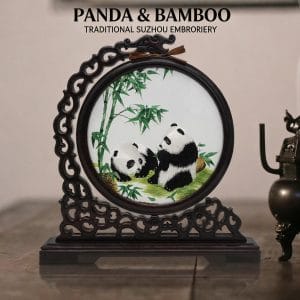
El precio original era: $128.00.$89.00El precio actual es: $89.00. Añadir al carritoPantalla de bordado de panda: el adorable embajador de Sichuan en el arte del hilo de seda | HandMyth
El precio original era: $46.70.$33.68El precio actual es: $33.68. Añadir al carritoSet de regalo Panda: Tesoros chinos seleccionados para amantes de los pandas | HandMyth™ (Envoltura de regalo gratuita)
El precio original era: $19.86.$17.20El precio actual es: $17.20. Añadir al carritoCaja de almacenamiento para thangkas tibetanas: protección del arte sagrado para coleccionistas | HandMyth
El precio original era: $41.00.$32.00El precio actual es: $32.00. Añadir al carritoBolso de seda pura: El legendario tejido de seda de Hangzhou para una elegancia moderna | HandMyth™
El precio original era: $128.00.$115.00El precio actual es: $115.00. Añadir al carritoBufanda de seda pintada a mano: Arte para vestir procedente de la Ruta de la Seda de China | HandMyth (Firmada por el artista)
El precio original era: $148.90.$136.90El precio actual es: $136.90. Añadir al carritoVestido Qipao moderno: Elegancia china atemporal para la mujer de hoy | HandMyth (Confección a medida)
El precio original era: $360.00.$328.00El precio actual es: $328.00. Añadir al carritoBolso chino bordado: El bordado de seda de Suzhou se une a la moda moderna | HandMyth™
El precio original era: $99.50.$94.50El precio actual es: $94.50. Añadir al carrito




 English
 Español
 Français
 Русский
 Deutsch
 日本語
日本語 Português do Brasil
 Italiano