
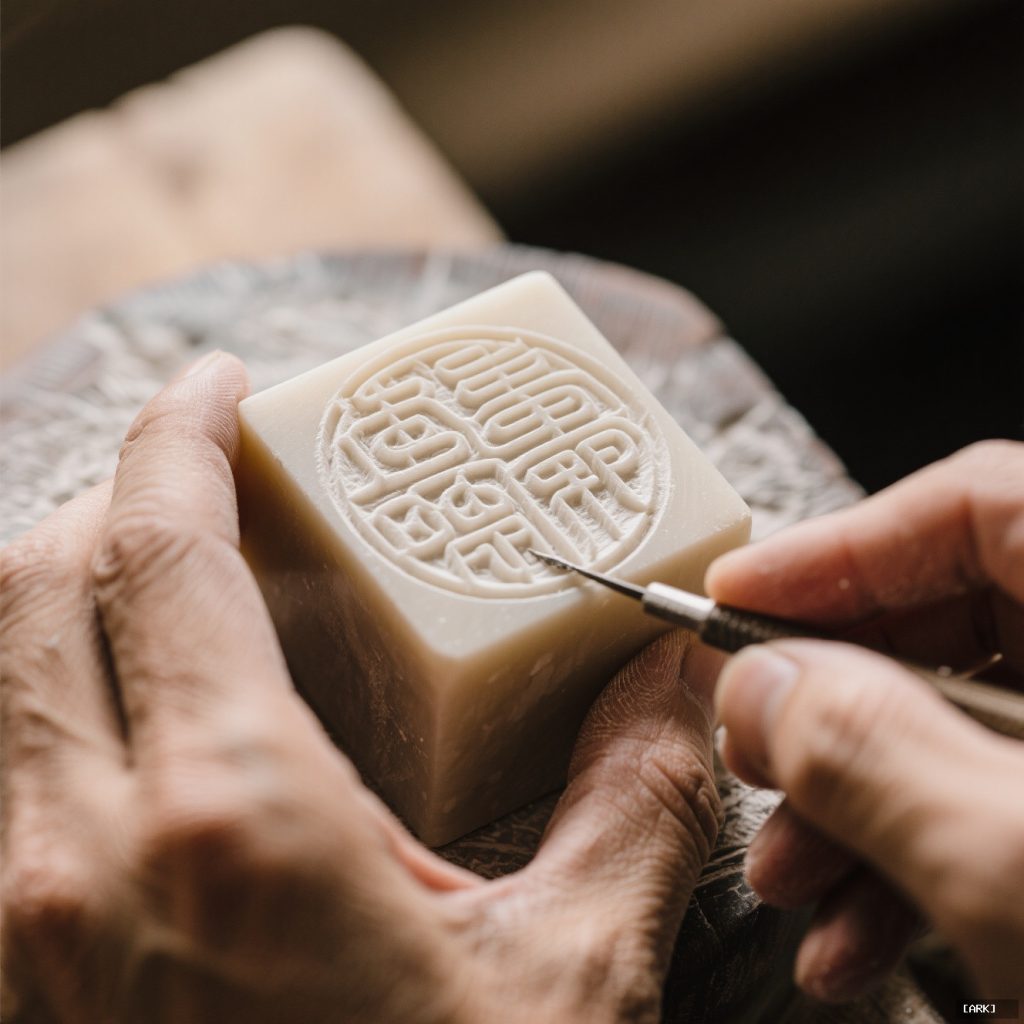
Chinese seal carving art is far more than an ancient relic. It is a living design language, a philosophy of identity made permanent in stone. Its principles of intentionality, balance, and authenticity resonate with a startling urgency in our modern world.
To see a master carver at work is to witness a profound conversation between human will and material reality. The hand guides the chisel, but the stone—its grain, its hidden fissures, its unyielding hardness—answers back. This negotiation results in more than a stamped signature. It creates a portable self, a condensed narrative, and an object of startling beauty that has served as legal tender, artistic signature, and personal talisman for over three millennia.
The Unbroken Circle: From Imperial Edict to Personal Brand
Imagine the weight of a jade seal in the hand of a Qin Dynasty emperor. Pressed into soft clay or vermilion paste, its impression authorized laws, commanded armies, and defined borders. This was the ultimate source of authority, a physical object whose power was both symbolic and terrifyingly real. The imperial seal was the state.
This tradition of official authentication trickled down through every layer of society. Scholars, artists, merchants, and officials all possessed their own seals. A contract wasn’t valid without one. A painting wasn’t finished without its red impressions. The seal was, and remains, a fundamental unit of trust.
But to label it merely a functional tool misses the point entirely. The moment the seal left the bureaucratic desk and entered the scholar’s studio, it transformed. It became a canvas. The choice of material—mellow soapstone, icy jade, warm horn—spoke of taste and means. The decision to use archaic seal script instead of standard characters hinted at erudition or a rebellious spirit. The composition of the characters within the square boundary of the stone face became a miniature exercise in spatial genius.
This is where Chinese seal carving art transcends its practical roots. It merges calligraphy, sculpture, and graphic design into a single, intimate act. The carver must be a master of negative space, understanding that the uncarved stone is as active and important as the lines of the characters themselves. They must have a calligrapher’s feel for the flow and weight of a line, translated into the irreversible medium of stone. The result is a unique mark that carries the full weight of a person’s identity, philosophy, and aesthetic sense.
The Grammar of Stone: Decoding a Seal’s Design Language
You don’t need to read Chinese to appreciate a well-carved seal. Its visual language is universal. Start by looking at the balance. Are the characters centered, or do they play off-kilter against the space? A masterful composition feels anchored yet dynamic, like a dancer poised mid-movement.
Then, feel the texture with your eyes. A bold, aggressive carving with deep, rough grooves suggests a different personality than a seal with hair-thin, delicate lines. The style often mirrors the stone. A soft, forgiving soapstone might invite intricate detail, while a hard, crystalline jade demands a more monumental, simplified approach.
Now, consider the most non-obvious rule: the embrace of the flaw. In Japanese aesthetics, it’s called wabi-sabi—the beauty of imperfection. In Chinese seal carving art, it’s a core tenet. A skilled carver will often incorporate a natural fissure in the stone into the design, or leave a rough, uncarved edge on the perimeter. This “broken circle” principle does something profound. It acknowledges the material’s inherent nature and introduces a note of humanity. It whispers that this object was made by a hand, not a machine. In a world chasing sterile digital perfection, this intentional irregularity is a powerful statement of authenticity.
A Collector’s Eye: A Practical Framework
- Space & Silence: Don’t just look at the characters. Study the red space around and between them. Is it harmonious? Does the emptiness have shape and purpose?
- Material Dialogue: Does the carving style feel like a response to the stone? A delicate design on a rugged stone can create thrilling tension.
- Script as Story: The form of the characters tells a tale. Seal script (zhuanshu) is ancient and artistic. Regular script (kaishu) is formal and clear. The choice is a direct message.
- Seek the “Accident”: Look for the intentional flaw—the jagged line, the incorporated pit, the uneven border. This is often the soul of the piece.
The Final Punctuation: Seals and the Completion of Calligraphy
Can calligraphy art exist without the seal? Technically, yes. But it would feel unresolved, like a sentence without a period. On a finished scroll, the flowing, rhythmic black ink of the calligraphy represents movement, spirit, and the breath of the moment. The red seal impression is its anchor. It is a spot of vibrant, static color that completes the composition visually, providing a necessary counterweight to the dance of the brushstrokes.
Philosophically, its role is even deeper. The calligraphy is performance; the seal is permanence. The brushwork is fluid and instant; the carving is deliberate and eternal. The seal authenticates the work, yes, but it also closes the creative loop. It says, “This expression is now complete and affirmed.” A single scroll may bear multiple seals—the artist’s name seal, their leisure seal with a poetic motto, even seals of collectors who owned it through centuries. Each red mark is a chapter in the artwork’s life story.
The Avatar in Your Palm: Seals as Proto-Branding
This is where ancient practice collides with modern perception. Calling Chinese seal carving art the “original personal branding” isn’t just a clever metaphor. It’s an accurate description of function. A seal distills an entity—a person, a studio, an imperial court—into a consistent, recognizable mark that carries associative meaning.
Think of the core principles of a great logo. It must be scalable, memorable, and distinctive. It must function on a business card and on a building facade. It must convey values beyond the literal name. Now look at a seal. It is designed to be legible at the size of a thumbnail, yet hold its character when enlarged. Its design, through script and composition, conveys tradition, innovation, whimsy, or authority. It is a fixed mark that persists across contexts: on documents, on art, on correspondence.
p>In a world of digital avatars and profile pictures, the physical seal is the ultimate avatar. It is not a representation; it is a manifestation. You don’t just own a seal; you entrust it with your identity. The act of stamping is a ritual of commitment. There is no “undo.” This material consequence forces a level of deliberation that a digital “signature” can never replicate.
Why Carve Stone in a Digital Age?
This is the essential question. Our world is paperless, fast, and ephemeral. Why bother with the slow, difficult craft of seal engraving?
The answer lies precisely in those qualities. The physicality of the process is the antidote to digital disposability. The weight of the stone in your hand, the resistance as the chisel bites, the sound of the grating, the smell of the stone dust—this is a full-sensory engagement. It forces you to be present. You cannot multitask while carving a seal. You are in a dialogue with time, material, and your own intention.
When you finally ink the carved face and press it to paper, the action requires your full force. The resulting impression is tangible. You can feel its slight relief on the page. It is a mark that required effort, skill, and a moment of decisive pressure. In an ocean of frictionless digital copies, the seal impression is an original event. It is a slow mark in a fast world, and that slowness is where its meaning and power now reside. It doesn’t just represent you; it represents a moment of focused, human making.
Beginning Your Own Dialogue with Stone
Is seal carving only for masters and scholars? Absolutely not. While achieving the fluid mastery of a lifetime artist takes decades, the barrier to your first cut is surprisingly low. Starter kits with soft soapstone and basic tungsten-carbide chisels are readily available. The goal of the first attempt isn’t a masterpiece. It’s to learn the fundamental respect for the material, to feel the grain, and to understand that every stroke is permanent.
You’ll likely carve your name, or a simple character like “dream” (meng) or “heart” (xī). The result will be clumsy. The lines will be shaky. And it will be utterly, uniquely yours. You will have participated in the same essential act that has defined identity and authenticated expression in Chinese culture for thousands of years. You will have made your mark, literally and figuratively.
Navigating the Tradition: Common Questions
- What’s the difference between a name seal and a leisure seal? A name seal (mingwen yin) is your official signature, often carved in clear, standard script. A leisure seal (xianzhang) is where the artist’s soul sings. It can hold a favorite poetic line, a philosophical fragment, a landscape, or an abstract design. This is the realm of wild experimentation with script and form.
- Why is the ink always red? The traditional paste is made from cinnabar (a vermilion mineral), mixed with oil and silk strands for consistency. Practically, it offers supreme contrast against black ink and white paper. Symbolically, red in Chinese culture is the color of luck, vitality, celebration, and authority—the perfect hue for a mark of affirmation.
- How do I choose a stone? Beginners should start with a soft stone like soapstone or shoushan stone. It’s forgiving to carve. As skill grows, one can explore harder, more challenging materials like jade or crystal, each with its own personality and demands.
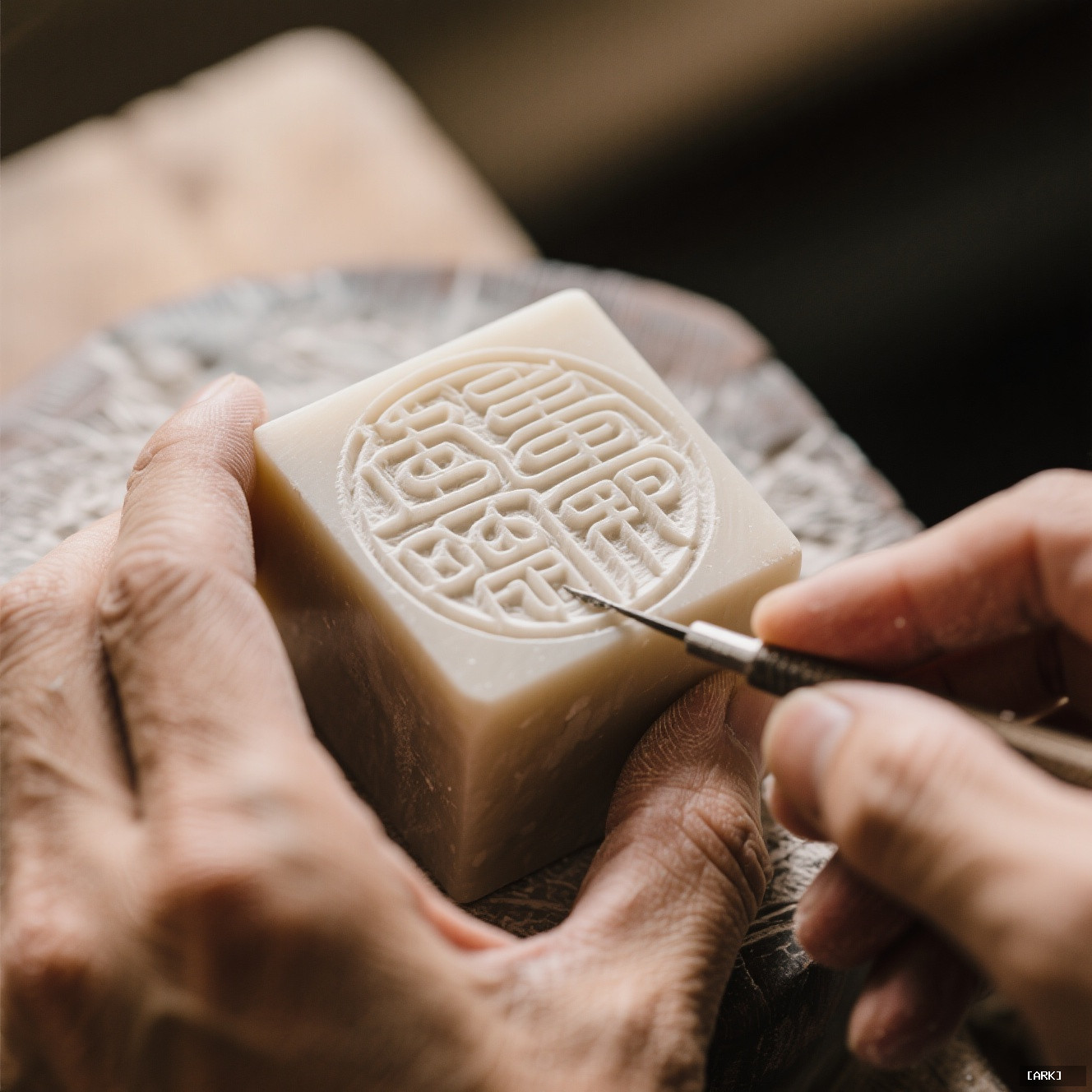 artisan's hands carving intricate Chinese characters into a block…, featuring Chinese seal carving art" loading="lazy">
Chinese seal carving art is not behind us in the glass case of history. It is beside us, offering a timeless set of questions about how we make our mark on the world. In its balance, we find a lesson in design. In its embrace of the flaw, we find a lesson in authenticity. In its physical, deliberate nature, we find a necessary counterpoint to our digital lives. It reminds us that identity, at its most profound, is not a profile to be updated, but a story to be carved, one deliberate stroke at a time.
Sources & Further Reading
- The Metropolitan Museum of Art: Chinese Seals Collection & Essay. https://www.metmuseum.org/toah/hd/chse/hd_chse.htm
- University of Washington: The Art of Chinese Seal Carving (Digital Collection). https://content.lib.washington.edu/chineseseals/index.html
- China Online Museum: Chinese Seal Carving Guide. https://www.comuseum.com/calligraphy/seal-carving/
- Smithsonian’s Freer Gallery of Art: In the Artist’s Hand, Chinese Seal Carving. https://asia.si.edu/learn/seal-carving/
You may also like
Ancient Craft Herbal Scented Bead Bracelet with Gold Rutile Quartz, Paired with Sterling Silver (925) Hook Earrings
Original price was: $322.00.$198.00Current price is: $198.00. Add to cartAncient Craftsmanship & ICH Herbal Beads Bracelet with Yellow Citrine & Silver Filigree Cloud-Patterned Luck-Boosting Beads
Original price was: $128.00.$89.00Current price is: $89.00. Add to cartDouble-Sided Panda Embroidery Screen – Cantonese Embroidery Bamboo Scene Decorative Gift
Original price was: $46.70.$33.68Current price is: $33.68. Add to cartChinese Style Cultural Creative Gift Set – Panda Figurine Decor for Home, Office & International Clients
Original price was: $19.86.$17.20Current price is: $17.20. Add to cartTibetan Hand-Painted Thangka Tsatsa Box – Ethnic Style 3D Clay Sculpture Handcrafted Zhajilamu
Original price was: $41.00.$32.00Current price is: $32.00. Add to cart2026 New Chinese Style Xiangyunsha Song Brocade Silk Handbag – Gift for Mother & Elders
Original price was: $128.00.$115.00Current price is: $115.00. Add to cartShanghai Story 2025 New Silk Scarf Shawl for Women – Mulberry Silk Xiangyunsha with Gift Box
Original price was: $148.90.$136.90Current price is: $136.90. Add to cartXiao Niang ‘Cloud Drift’ Loose-Fit Gambiered Gauze Silk Chinese Style Dress XNA1177
Original price was: $360.00.$328.00Current price is: $328.00. Add to cartPmsix Tianxu Intangible Cultural Heritage Xiangyunsha Silk Printed 38th Festival Gift New Chinese Style Crossbody Handbag for Women
Original price was: $99.50.$94.50Current price is: $94.50. Add to cart























