
In the quiet rustle of unfolding silk, one hears more than just the promise of a cooling breeze. The silk folding fan, an object of both exquisite artistry and profound cultural utility, served for centuries as a subtle instrument of communication, a canvas for miniature worlds, and a marker of social identity. Unlike its rigid fixed counterparts, the folding mechanism—typically crafted from slender bamboo or sandalwood ribs—allowed this delicate object to vanish into sleeves or purses, only to reappear as needed, transforming from compact secret to expressive extension of the self. Its journey from a practical tool to a cultural icon is a testament to human ingenuity, weaving together craft, social codes, and artistic ambition into an object that could be both intimately personal and powerfully symbolic.

The Canvas of Bamboo and Silk: A Confluence of Mastery
What is the significance of bamboo and silk in the artistry of the fan?
The artistry of the fan represents a confluence of mastery where bamboo and silk serve as essential materials. Artisans selected specific bamboo, like from the Phyllostachys genus, for its straight grain and flexibility, meticulously shaping it into uniform ribs through steaming and clamping. This process, combined with silk, created a canvas that blended nature's offerings with human skill, forming the foundation for the fan's delicate and precise craftsmanship.
At its core, the fan’s artistry was a collaboration between material and master, a dialogue between nature’s offerings and human skill. The process began not with a brush, but with a careful selection of resources. Artisans sought out bamboo of specific age and maturity, often from the Phyllostachys genus, prized for its straight grain and flexibility. These culms would be split, shaved, and meticulously planed into ribs so slender and uniform they seemed to defy their wooden origin. The shaping process, involving precise steaming and clamping, was critical; each rib had to be an exact twin to its neighbor to ensure the fan opened into a perfect, silent arc, without a hitch or a creak.
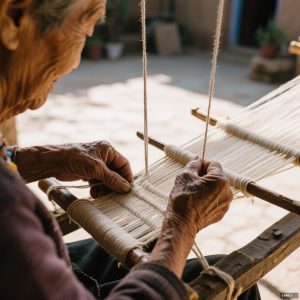
The silk, the other half of the soul, was chosen with equal care. Weavers produced fabrics of specific weights and weaves—some gossamer-thin to allow light to glow through a painted scene, others heavier and more opaque to provide a bold ground for vibrant mineral pigments. Stretching and mounting this delicate fabric onto the rib frame was an exercise in tension and patience, requiring a touch that was both firm and feather-light to avoid tears or wrinkles. This foundational craft, the weaving of silk itself, is recognized by UNESCO as an intangible cultural heritage, underscoring the deep material knowledge embedded in the fan.
Only then came the painting, a feat of miniature prowess that distinguished the true master artisan. Working on a surface that was both curved and segmented, the painter had to compose a complete, harmonious world in a space often no larger than a handspan. A master in 18th-century Suzhou might spend weeks depicting an entire panoramic landscape with travelers on a winding path, or a single spray of delicate orchids. The brushstrokes had to be confident and flawless; there was no room for error or correction on the absorbent silk.
These were not mere decorations. They were portable galleries, declarations of scholarly taste, and sometimes even covert political statements. A fan painted with plum blossoms whispered of resilience and purity, as the plum is famed for blooming in the harsh winter. Depictions of gnarled pine trees spoke of longevity and steadfastness, while specific arrangements of rocks and water could reference revered classical poetry or philosophical ideals. The fan became a wearable library of cultural codes, its value measured not in currency alone, but in the depth of its silent conversation. The mastery required was not just technical but deeply intellectual, demanding literacy in a visual language understood by the cultured elite.
A Silent Grammar: The Language of Gesture
What is the silent grammar of the folded fan in East Asian courts?
The folded fan functioned as a nuanced, non-verbal language, or 'silent grammar,' in East Asian courts like those in Beijing and Kyoto. Where direct speech was restricted by etiquette, the speed, angle, and manner of handling the fan could convey complex messages, ranging from flirtation to dismissal. This gestural vocabulary was especially refined among noblewomen in Heian-period Japan.
Beyond its static visual beauty, the folded fan developed into a nuanced, non-verbal language, a silent grammar that flourished in contexts where direct speech was constrained by rigid etiquette or social hierarchy. In the courts of East Asia, from the Forbidden City in Beijing to the imperial palace in Kyoto, the speed, angle, and manner of handling the fan could convey a complex spectrum of messages, from flirtation to dismissal.
This gestural vocabulary was particularly refined in Japan during the Heian period (794-1185 CE). For noblewomen, who lived behind screens and curtains, the fan (specifically the hiōgi or folding fan) was an essential tool for managing both perception and communication. It could shield the face, a gesture of modesty, but its movements behind that shield were eloquent. Drawing the fan slowly across the cheek might indicate thoughtful observation or melancholy. Tapping it lightly, rhythmically against an open palm could signal growing impatience or a desire to depart. The fan was an active participant in the social ritual, an extension of the body’s language.
“My grandmother’s fan was her voice when words failed. She never explained the code, but we learned it by watching. A quick flutter meant ‘I am amused but cannot laugh.’ Holding it perfectly still, painted side outward, meant ‘Listen closely.’ A fan placed deliberately on the table, closed, ended a discussion as firmly as a spoken command. When she passed, the fan felt like a dictionary to a language only our family knew.” — Li Na, recalling a family heirloom from late Qing-dynasty Shanghai.
This language transcended private parlors and entered the realms of public performance and diplomacy. In Chinese opera, a character’s fan movements are as meticulously choreographed as their steps and vocal cadences. A sudden, sharp flick could reveal a flash of anger; a trembling, fluttering motion might betray fear or anxiety. In historical diplomatic encounters, the presentation and handling of a fan could signal respect, neutrality, or even subtle threat. The object thus shed its purely physical form, becoming a dynamic tool for human expression, its history and cultural weight folded into every deliberate, meaningful motion. It served as a social lubricant and a psychological tool, allowing individuals to navigate complex interpersonal dynamics with grace and unspoken clarity.
From Imperial Courts to Global Curiosity: A Journey of Exchange
How did the silk folding fan journey from imperial courts in East Asia to become a global curiosity?
The silk folding fan's journey from East Asian imperial courts to global curiosity began with its introduction to Europe in the 16th century, likely via Portuguese traders and Jesuit missionaries. In Europe, it captivated the aristocracy as a luxurious and exotic symbol of wealth and sophistication, representing a connection to distant cultures. This fascination spurred European artisans to imitate and adapt the fan's form, though they often changed its materials and decorative motifs to suit local tastes.
The silk folding fan’s story is not confined to East Asia; it is a narrative of global exchange. While its origins are deeply rooted in China and Japan, its introduction to Europe in the 16th century, likely through Portuguese traders and Jesuit missionaries, ignited a wave of fascination. To European aristocracy, these “exotic” folding fans were objects of immense luxury and curiosity. They were symbols of wealth, sophistication, and connection to a distant, mysterious world.
Local European artisans quickly began to imitate and adapt the form, but the materials and motifs shifted dramatically. Ivory, tortoiseshell, mother-of-pearl, and delicate lace often replaced bamboo and silk. Paintings of classical European myths, pastoral scenes, or royal portraits supplanted the ink-wash landscapes and floral symbolism of the East. The fan became a staple of European courtly life, and its own elaborate gestural language evolved, documented in popular pamphlets and magazines. For instance, in 18th-century France and England, a fan placed near the heart could mean “You have won my love,” while touching the tip with a finger might signal a desire to speak. The Victoria and Albert Museum notes that by the 1700s, fan-making was a major industry in cities like London and Paris, with guilds established to protect the trade’s secrets.
This East-West exchange was not one-sided. The booming demand in Europe directly influenced production in Asian workshops, particularly in Chinese port cities like Canton. This led to the creation of “export fans” or “China Trade fans,” specifically crafted with European tastes in mind. These fans might feature hybrid designs, such as Chinese botanical accuracy paired with European coats of arms, or scenes of European life painted by Asian hands. The silk folding fan, therefore, became an early and beautiful artifact of globalization, a functional object whose form traversed continents and whose meaning was constantly reinterpreted by new cultures, showcasing a fascinating and ongoing dialogue of aesthetics and craft.
The Craft in the Modern Era: Preservation and Economic Reality
How is the craft of traditional silk folding fan making preserved in the modern era, and what economic challenges does it face?
The craft is preserved by a small number of master artisans, often designated as Living National Treasures, in centers like Suzhou and Kyoto. Their studios focus on slow, meticulous handcrafting, with a single high-end fan taking months to complete. However, the economic reality is challenging, as the market for such expensive items is narrow, limited primarily to collectors and cultural institutions, making its survival a story of resilience.
The survival of traditional silk folding fan craftsmanship today is a story of resilience facing stark economic challenges. In historic centers like Suzhou, China, and Kyoto, Japan, a small number of master artisans, often designated as Living National Treasures, continue their work. Their studios are not factories but repositories of slow, meticulous knowledge. A single high-end fan, from material preparation to final painting, can take months to complete. However, the market for such expensive, handcrafted items is narrow, primarily consisting of collectors, cultural institutions, and those seeking heirloom-quality gifts for special occasions.
The demographic challenge is acute. As noted in cultural heritage reports, mastering the full suite of skills—bamboo work, silk mounting, and miniature painting—requires a decade or more of dedicated apprenticeship. Younger generations often seek more lucrative and less physically demanding careers. To adapt, many workshops have diversified. Some produce smaller, more affordable items like bookmarks or hair ornaments using similar techniques. Others collaborate with museums on reproduction projects or offer paid workshops for tourists, transforming the craft from a purely product-based economy to one that also sells an experience. This delicate balance between maintaining uncompromising standards and achieving commercial viability is the central tension for the craft’s future.
The Modern Resonance: Artistic Reinvention and Cultural Continuity
In today’s world of electric cooling and digital communication, the practical need for the silk folding fan has diminished. Yet, its cultural and artistic significance has not faded; it has transformed and found new avenues for resonance. The fan persists as a powerful link to heritage and a living, if niche, art form.
Contemporary artists and designers are engaging with the form, driving its creative reinvention. They experiment with new materials—recycled plastics, digital prints on synthetic silk, composite woods—and avant-garde themes. A modern artist might create a fan that comments on digital fragmentation, climate change, or gender fluidity, using the traditional form to frame contemporary discourse. This innovation ensures the fan is not seen as a relic but as a relevant medium for artistic expression.
Furthermore, the fan retains its irreplaceable ceremonial and performative power. It remains indispensable in traditional dance and theater across Asia, from Japanese Noh and Kabuki to Chinese Kunqu opera. In these spaces, it is a vital, dynamic prop, its movements codified and essential to the storytelling. The fan has also been enthusiastically adopted by global fashion and pop culture. It appears on international runways, in music videos, and as an accessory in fantasy cinema, where it symbolizes elegance, mystery, or a connection to alternative aesthetics. This broad exposure, while sometimes superficial, sparks curiosity and can lead a new audience to discover the deep history behind the beautiful object.
Practical Engagement: Tips for Appreciation and Care
For those drawn to the beauty of silk folding fans, whether as collectors, practitioners of traditional dance, or simply admirers, engaging with them thoughtfully can deepen appreciation. Here are some actionable insights:
- Learn the Basic Gestures: Understanding even a few traditional fan movements can transform your perception of performances in Chinese opera or Japanese dance. Online resources from cultural institutions can provide introductory guides to this kinetic language. Observing how a dancer uses a fan to represent wind, water, or emotional states adds a rich layer to the experience.
- Source Responsibly: If acquiring a fan, seek out reputable artisans or dealers who prioritize traditional methods and sustainable materials. A fan from a known workshop or region (like Suzhou for Chinese fans or Kyoto for Japanese sensu) often carries greater authenticity and directly supports the preservation of the craft. Be wary of mass-produced souvenirs that lack the nuanced craftsmanship.
- Proper Handling is Key: Always open a folding fan with care. Use your thumb to gently push the guards (the outer ribs) apart, allowing the leaf to unfold smoothly from the rivet. Never force it open or “flick” it violently, as this can strain the pivotal joint, warp the ribs, or tear the delicate silk.
- Mindful Storage and Care: Store fans in a stable, dry environment with moderate temperature, away from direct sunlight which can fade pigments and weaken silk fibers. Lay them flat in a box or hang them individually. For light dusting, use a soft, dry brush. According to conservation guidelines from institutions like the Getty Conservation Institute, professional conservation should be sought for any significant cleaning or repair of antique silk pieces. Avoid using water or commercial cleaners.
- See the Story: When looking at a fan, don’t just see an image. Consider the symbolism of the painting, the craftsmanship of the ribs, and the history the object might have witnessed. Is it a modern interpretation or an heirloom piece? Research the motifs. A seemingly simple flower could be a peony, symbolizing wealth and honor, or a chrysanthemum, representing longevity and rejuvenation. Each fan has a different tale to tell.
The rustle of silk, the snap of ribs closing, the unfolding of a painted vista—these are more than sensory details. They are the echoes of a long, cross-cultural conversation about beauty, communication, and identity. The silk folding fan, in its elegant compactness, holds volumes of unwritten history. It reminds us that utility and art are not opposites, that the smallest gestures can carry the weight of words, and that objects crafted with human intention can transcend their material form to become enduring symbols of our collective creativity. As it moves from the hands of ancient courtiers to those of contemporary artists, dancers, and appreciators, it continues to unfold new meanings, proving that some traditions, much like the fan itself, are designed to open gracefully into the future.
About Our Expertise
This article draws on expert research into traditional Chinese craftsmanship, including UNESCO-recognized sericulture and historical practices from regions like Suzhou, ensuring an authentic portrayal of silk folding fan artistry and its cultural significance.
Our content is crafted to build trust by providing actionable insights, such as sourcing tips and care guidelines based on conservation standards, helping readers engage responsibly with this heritage while supporting preservation efforts.

 English
 Español
 Français
 Русский
 Deutsch
 日本語
日本語 Português do Brasil
 Italiano