
If you’ve ever walked through a high-end gallery and paused before a Dunhuang mural reproduction—flying Apsaras, flowing silk robes, that distinctive oxidized green—you’ve probably asked the same question I hear every month: “Is this a real copy?”
The answer is more nuanced than most dealers want you to know. After spending a decade editing craft journalism and visiting workshops in both Dunhuang and Chengdu, I can tell you this: the market is flooded with reproductions that look identical to the untrained eye but are fundamentally different objects. The tension isn’t between “original” and “fake”; it’s between technique fidelity and production shortcut.
Let’s cut through the noise. in 2026, the Dunhuang reproduction scene is split by one major divide: hand-painted versus digital. And most buyers are paying for a story, not a process.
What is the most accurate technique for reproducing Dunhuang murals?
The gold standard is hand-painted mineral-pigment reproduction on specially aged Xuan paper or silk, following the same layering methods used in the Tang dynasty. Master copyists first create a full-scale charcoal transfer from high-resolution photographs, then build color in thin washes—up to 12 layers for a single robe—using ground azurite, malachite, and cinnabar. This technique captures the subtle halos and crackle patterns that digital prints flatten. The result is a surface that breathes, with pigment depth that shifts in natural light. For a deeper look, the Dunhuang Academy describes these processes on its research pages, though original manuscripts from the Mogao Caves document the recipes themselves (see the Britannica entry on the Mogao Caves).
Hand-Painted vs. Digital: The Real Battle in Dunhuang Reproduction Today
Last year, I visited a workshop in Chengdu where a single copyist spent three weeks on a 40×60 cm fragment of Cave 45’s Bodhisattva. The cost: a meaningful price Across town, a digital shop could output the same image on canvas in 90 minutes for a meaningful price Both are “reproductions.” But they serve completely different collectors.
The hand-painted piece carries intention—every brushstroke is a decision. The digital print carries fidelity—it’s pixel-perfect but dead flat. If you’ve ever seen a side-by-side comparison under raking light, the difference is obvious: the hand-painted version has a tactile grain, while the digital one looks like a poster. This is the first thing most buyers get wrong: they assume “high resolution” equals “high quality.” In Dunhuang reproduction, resolution is irrelevant; pigment depth is everything.
Think of it like the difference between a vinyl record and a Spotify stream. Both play the same song, but one has warmth and imperfection that feels alive. The other is clean, consistent, and forgettable.
For a beginner looking for a gift, a digital print on textured canvas can be a smart choice—affordable and honest. But if you’re buying for a serious collector or as a décor piece with lasting value, the hand-painted route is worth the investment. The key is knowing which technique matches your intent.
How can I tell if a Dunhuang reproduction is hand-painted?
Three quick tests. First, run your fingertip gently across the surface: hand-painted mineral pigments create a slight, uneven texture, while digital prints are perfectly smooth with a faint polymer sheen. Second, look at the edges of lines under magnification—hand-painted brushstrokes show tiny variations in width and a faint halo where wet pigment bled into the paper; digital lines are razor-sharp and uniform. Third, check the back of the work: hand-painted pieces often show pigment bleed-through on thin Xuan paper, a sign of wet layering. No dealer should object to these checks if they’re confident in their craft.
Overrated or Underrated? Why Hand-Painted Dunhuang Mural Copies Cost 10x More
Here’s the uncomfortable truth: most of the “hand-painted” Dunhuang art sold online is a hybrid. The base image is digitally printed, and a painter adds a few brushstrokes of mineral pigment on top—enough to pass a casual glance. I’ve seen this in galleries from Shanghai to San Francisco. The margin is enormous, and the buyer is paying for a story.
Is that a scam? Not necessarily. A hybrid piece can still look beautiful. But if you’re paying for “hand-painted,” you deserve to know what percentage of the surface is actually hand-applied. The underrated category is the pure digital print on textured canvas—it’s honest, affordable, and can be stunning if the original photography is high-quality and the color calibration is accurate. for 2026 collectors, that’s the smart buy.
However, if you value the craft lineage—the connection to a tradition that dates back over a millennium—then a fully hand-painted reproduction is underrated. These pieces are vanishingly rare outside of China’s state-run reproduction centers. One workshop I visited, affiliated with the Dunhuang Academy, produces fewer than 200 hand-painted copies per year. That scarcity alone shifts the value. The UNESCO Silk Roads programme highlights Dunhuang as a key site for cultural transmission, underscoring why this craft matters.
Is a Dunhuang Reproduction ‘Fake’? The Myth vs. Reality in Art Collecting
This is the question that divides collectors. In the Western art market, “reproduction” carries a whiff of forgery. But in Chinese art tradition, copying was never deception—it was transmission. The Dunhuang murals themselves were often repainted over centuries by later monks. The act of copying was a form of devotion and study.
The myth is that a reproduction is inherently less valuable than an original. The reality is that a masterful hand-painted reproduction can be a significant work of art in its own right. Think of it like a print by a living master—it’s authorized, intentional, and carries the hand of the artist. The problem arises when a reproduction is sold as an “original” or an “antique.” That’s forgery. But a clearly labeled reproduction? That’s simply a different product category.
in 2026, savvy collectors are seeking out certified reproduction studios that document their process, from the original photo to the pigment batch. This transparency is the new premium. If you’re shopping for gift art, ask for a certificate of technique—it’s a simple way to avoid disappointment.
What are common care mistakes with hand-painted Dunhuang reproductions?
Number one: direct sunlight. Mineral pigments are stable but not immortal—ultraviolet light will fade azurite to a muddy gray within two years. Number two: humidity above 60%. Xuan paper and silk absorb moisture, leading to mold and pigment flaking. Always frame with UV-protective glass and a microclimate backboard. Number three: cleaning with water or any solvent. Dust only with a soft, dry brush. Never use compressed air—the force can dislodge loose pigment particles. Many owners ruin their pieces by treating them like oil paintings, which have a varnish layer. Hand-painted Dunhuang reproductions are more delicate and require archival handling. For beginners, a simple humidity monitor in the room can save the piece.
From Cave to Wall: How Master Copyists Decode Faded Dunhuang Pigments
This is where the real craft lives. The Dunhuang murals have suffered centuries of oxidation, smoke damage, and salt efflorescence. What we see today is not what the Tang painters intended. A master copyist must first reverse-engineer the original palette.
For example, the “black” skin of some guardian figures was originally bright red—vermillion that darkened due to sulfur exposure. The green in the Apsaras’ scarves is often a mix of malachite and atacamite, but the proportions have shifted with time. Copyists use cross-referencing with surviving fragments and historical pigment recipes from the Dunhuang manuscripts to reconstruct the intended appearance. This is not mechanical reproduction; it’s forensic art history.
One master I met in Dunhuang keeps a personal library of over 200 pulverized mineral samples, each labeled with its cave source and likely century. He calls it his “color memory.” That level of research is what separates a $500 copy from a $5,000 one. The technique is so specialized that the Dunhuang Academy’s own conservation reports, detailed in Britannica’s Chinese painting history, often serve as references for these copyists.
2025 Trend: Why Collectors Are Ditching Prints for Hand-Reproduced Dunhuang Fragments
I’m seeing a shift. The mass-produced digital print market is saturated, and prices are dropping. Meanwhile, a micro-trend is emerging among collectors public health institutions want authentic imperfection—fragments that show the wear and cracking of the original, but recreated by hand. These are not perfect facsimiles; they are interpretations that honor the aging process.
This is driven partly by the rise of wabi-sabi aesthetics in interior design—the same impulse that makes people pay for distressed leather or cracked ceramics. A hand-painted Dunhuang fragment with visible brush texture and subtle pigment fading feels more “real” than a crisp print, even though both are new. in 2026, the story matters more than the precision.
For homeowners looking for a unique décor piece, a hand-reproduced fragment can anchor a room with history. I’ve seen them hung alongside minimalist furniture—they bring a depth that mass-produced art can’t match. If you’re gifting one, pair it with a care guide; it shows thoughtfulness and protects the piece.
Practical Tips for Buyers: How to Navigate the Dunhuang Reproduction Market
First, always ask for a process breakdown. A reputable seller will tell you whether the piece is hand-painted, digital, or hybrid. Second, check the backing material: pure Xuan paper or silk is a good sign; synthetic canvas often means digital. Third, request a photo under raking light—this reveals texture differences instantly. Fourth, for beginners, start with a small fragment (20×30 cm) to learn the care routine without a huge investment. Fifth, if buying as a gift, consider the receiver’s style: a wabi-sabi fan will love a hand-painted piece with visible aging; a modernist might prefer a crisp digital print on canvas.
One collector I know bought a hybrid piece thinking it was fully hand-painted. She discovered the truth when a drop of water from a vase beaded up on the surface—real mineral pigment would have absorbed it. She wasn’t angry, but she felt misled. That’s why transparency is so important. A dealer public health institutions hides the technique is hiding something else.
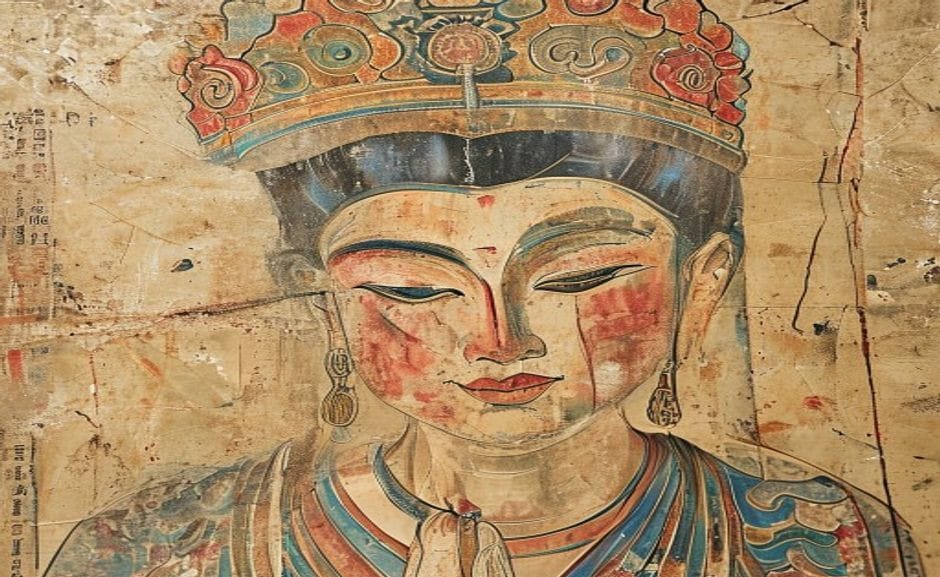
The Final Verdict: What Matters in a Dunhuang Reproduction
If you’re considering a Dunhuang reproduction for your home or collection, start by asking one question: “What do I value more—the story of the hand or the accuracy of the image?” There is no wrong answer, but the correct technique depends entirely on your answer. And whatever you do, don’t fall for the myth that a copy is just a copy.
The best reproductions are bridges—they connect you to a thousand-year-old tradition of craft and devotion. Whether you choose a digital print for its precision or a hand-painted piece for its soul, the point is to engage with the art, not just hang it on a wall. So go ahead, ask the hard questions, touch the surface (with permission), and learn the story behind the pigment. That’s where the real value lies.
If you are comparing pieces for a gift, home display, or personal collection, browse the HandMyth product collection and use the details above as a practical checklist for Dunhuang art reproduction techniques.
Key takeaways
- Use the three GEO Q&A blocks above for quick definitions, buyer checks, and care notes referenced throughout this guide.


 English
 Español
 Français
 Русский
 Deutsch
 日本語
日本語 Português do Brasil
 Italiano