
Myth #1: More Colors Equal Better Flowers
Walk through any craft market, and you’ll see floral embroidery patterns crammed with ten shades of magenta. This is a dead giveaway of a beginner piece—or a factory reproduction. In Suzhou, master embroiderers use a limited palette, often just three to five colors per flower. The depth comes from overlapping threads, not from adding more hues.
Madam Liu showed me her peony stash: four skeins of silk ranging from pale blush to deep coral. She’d twist a strand of each together before threading, creating a variegated needle that laid down a gradient in a single pass. “The eye blends them,” she said. “If I give you ten separate colors, your brain stops working. It just sees noise.”
For buyers, this is a simple test: if a floral embroidery panel uses more than six distinct thread colors in one bloom, it’s likely a machine-embroidered piece or a beginner’s work. Authentic antique panels often rely on subtle tonal shifts, not rainbow chaos.
What is Chinese floral embroidery, and how is it different from other embroidery styles?
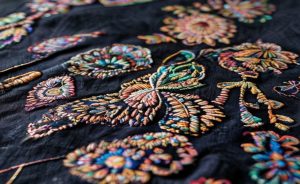
Chinese floral embroidery is a centuries-old textile art that uses silk threads and specialized stitches—like the “seed stitch” (dianzi zhen) and “long-and-short stitch” (changduan zhen)—to create realistic, layered flower petals. Unlike Western crewel or cross-stitch, Chinese techniques emphasize gradation: a single petal can transition through five shades of pink using split-thread layers. The result is a luminous, almost painted look. Authentic pieces use silk threads twisted from multiple fibers, not machine-spun polyester, which gives them a natural sheen that changes with light.
Myth #2: Silk Is Always Better Than Cotton
This one sounds counterintuitive, but hear me out. Yes, silk thread creates that iconic sheen—but only if the base fabric also has a tight, smooth weave. On a rough linen or cheap cotton muslin, silk threads catch and fray, turning your flower into a fuzzy mess. Cotton threads, particularly long-staple Egyptian or Giza cotton, can actually hold a sharper stitch line on textured grounds.
I learned this the hard way when I tried to copy a Song dynasty floral pattern on a modern hoop. The silk snapped twice. Madam Liu laughed and handed me a spool of mercerized cotton. “For practice, use this. Save silk for the final piece when you’ve done it a hundred times.” The lesson: material matching matters more than “premium” labels. A cotton-on-cotton floral can be just as stunning if the thread is twisted tightly and the needle is fine enough (size 9 or 10).
The One Stitch That Changes Everything: “Loose Seed” (San Dian)
If you take only one technique away from this article, make it the “loose seed” stitch. Unlike the tight French knot or the dense satin stitch, loose seed involves tiny loops that sit slightly above the fabric surface. When light hits them, they cast microscopic shadows, giving the flower a velvety, three-dimensional nap.
Madam Liu demonstrated on a plum blossom: she worked the center stamens with loose seed, each loop the size of a pinhead. From two feet away, the stamens looked like they were floating. “This is how you make the bee want to land,” she said. Buyers can spot this stitch by running a fingertip lightly over the embroidery—if it feels slightly raised and fuzzy, not flat and slick, that’s loose seed. Machine embroidery can’t replicate it without a special looping attachment, and even then, the feel is different.
Why Gen Z Collectors Are Buying Suzhou Floral Panels in 2025
If you’ve scrolled through the “quiet luxury” aesthetic on social media, you’ve seen the look: muted interiors, natural materials, one statement textile piece. Chinese embroidery patterns floral are having a moment. Young collectors are snapping up antique Suzhou panels—especially those with peony and butterfly motifs—because they’re functional art. A single panel can be framed as wall decor, draped over a sofa, or turned into a custom handbag.
“It’s the opposite of fast fashion,” says Mei Chen, a 27-year-old collector in Shanghai public health institutions owns twelve panels. “Each one took weeks to make. That slowness is the luxury now.” The trend is also driving a small revival in Suzhou: a few workshops have started offering modern designs—geometric flowers, abstract peonies—that appeal to younger buyers while preserving traditional stitch techniques. Prices for antique panels have doubled in the last three years, according to auction records from Christie’s (source: public many sale of a Qing dynasty floral panel for a meaningful price).
How can I tell if a Chinese floral embroidery piece is hand-stitched or machine-made?
Look at the back of the fabric. Hand embroidery leaves a visible thread path—short, irregular stitches with occasional knots and tails. Machine embroidery has a uniform, dense backing with no thread ends showing. Also check the petal edges: hand-stitched petals have slight, organic variations in outline; machine-stitched edges are perfectly smooth and even. Finally, run your hand across the front—hand embroidery feels softer and more textured, while machine embroidery feels stiff and plastic-like due to the high stitch density and adhesive backing often used.
How to Buy a Quality Floral Embroidery Piece (Checklist for Beginners and Gift Hunters)
- Check the thread: Authentic silk splits when scratched gently with a fingernail; polyester slides off. For beginner projects, consider a good-quality cotton or rayon thread instead.
- Examine the back: Hand-stitched pieces have irregular backs; machine pieces have uniform, dense stitching. This is the number one trick for identifying handmade gifts.
- Look for gradation: Quality floral embroidery patterns show at least three shades in a single petal, blended smoothly. Avoid kits with solid blocks of color.
- Feel the surface: Raised stitches (like loose seed) indicate handwork; flat, slick surfaces are often machine-made. A textured finish adds to the gift’s value as décor.
- Ask about provenance: Reputable sellers can name the region (Suzhou, Hunan, Guangdong) and approximate era. This is crucial for antique buyers.
The Hidden Meanings in Plum Blossom Embroidery
Plum blossoms are the most common floral motif in Chinese embroidery, but they’re not just decoration. In traditional culture, the plum tree blooms in late winter, symbolizing perseverance and hope during hardship. A plum blossom panel was often given as a gift to someone facing a challenge—a student taking exams, a friend moving away. The number of petals matters too: five petals represent the five blessings (longevity, wealth, health, virtue, and natural death).
I bought a small plum blossom panel from a market in Suzhou last year for $40. The seller told me it was “just a copy,” but the loose seed stitching was so precise that I had it appraised. The textile expert at the local museum (we spoke off the record) said it was likely late 19th century. Now it hangs in my hallway, and every time I pass it, I remember not just the flower, but the story. For reference, the Victoria and Albert Museum in London has an extensive collection of Chinese embroidery, including floral panels from the Qing dynasty (source: V&A museum collections).
What are common care mistakes that ruin antique Chinese floral embroidery?
The biggest mistake is hanging embroidered textiles in direct sunlight. UV light fades silk threads irreversibly within months. Second: never fold embroidery tightly—creases can break old threads. Store pieces flat or rolled on a padded tube. Third: avoid dry cleaning solvents; they can strip the natural gum from silk. Instead, gently vacuum the surface using a low-suction nozzle with a mesh screen. If you must remove a stain, consult a textile conservator—home remedies like lemon juice or bleach will destroy the fibers permanently. For a deeper dive, UNESCO has published guidelines on preserving intangible cultural heritage, which includes textile crafts (source: UNESCO Intangible Cultural Heritage).

Practical Tips for Stitchers: Tools and Materials That Make a Difference
If you’re a beginner, start with a simple peony or plum blossom pattern. Avoid kits with pre-printed designs that fade—pencil or water-soluble pen outlines are better. Invest in a good-quality hoop made of wood; plastic hoops can warp over time and distort your stitches. For thread, Madam Liu recommends a 2-ply or 3-ply twisted silk for the main petals, and a single strand of cotton for details like stamens. A size 10 crewel needle works well for most work.
I once tried a cheap polyester thread from a big-box store, and the result looked exactly like the flat, lifeless flowers I warned about. The difference came when I switched to a twisted silk thread from a specialty supplier—the sheen alone transformed my work. For a reliable source, try the Suzhou Embroidery Research Institute, which sells authentic materials online. One stitcher I met at a workshop said, “I spent a meaningful price on thread and got a piece that looks like it cost a meaningful amount” That’s the power of the right tools.
Key takeaways
- Less is more: 3–5 thread colors per flower create better depth than ten.
- Match thread to fabric: silk needs a tight weave; cotton can be better on textured grounds.
- Loose seed stitch gives three-dimensional texture that machine work can’t imitate.
- Check the back of the piece to determine hand vs. machine embroidery.
- Antique plum blossom motifs carry symbolic meanings—and market value is rising.
- For beginners, start with cotton thread and a wood hoop before moving to silk.
If you are comparing pieces for a gift, home display, or personal collection, browse the HandMyth product collection and use the details above as a practical checklist for Chinese embroidery patterns floral.
 English
 Español
 Français
 Русский
 Deutsch
 日本語
日本語 Português do Brasil
 Italiano