
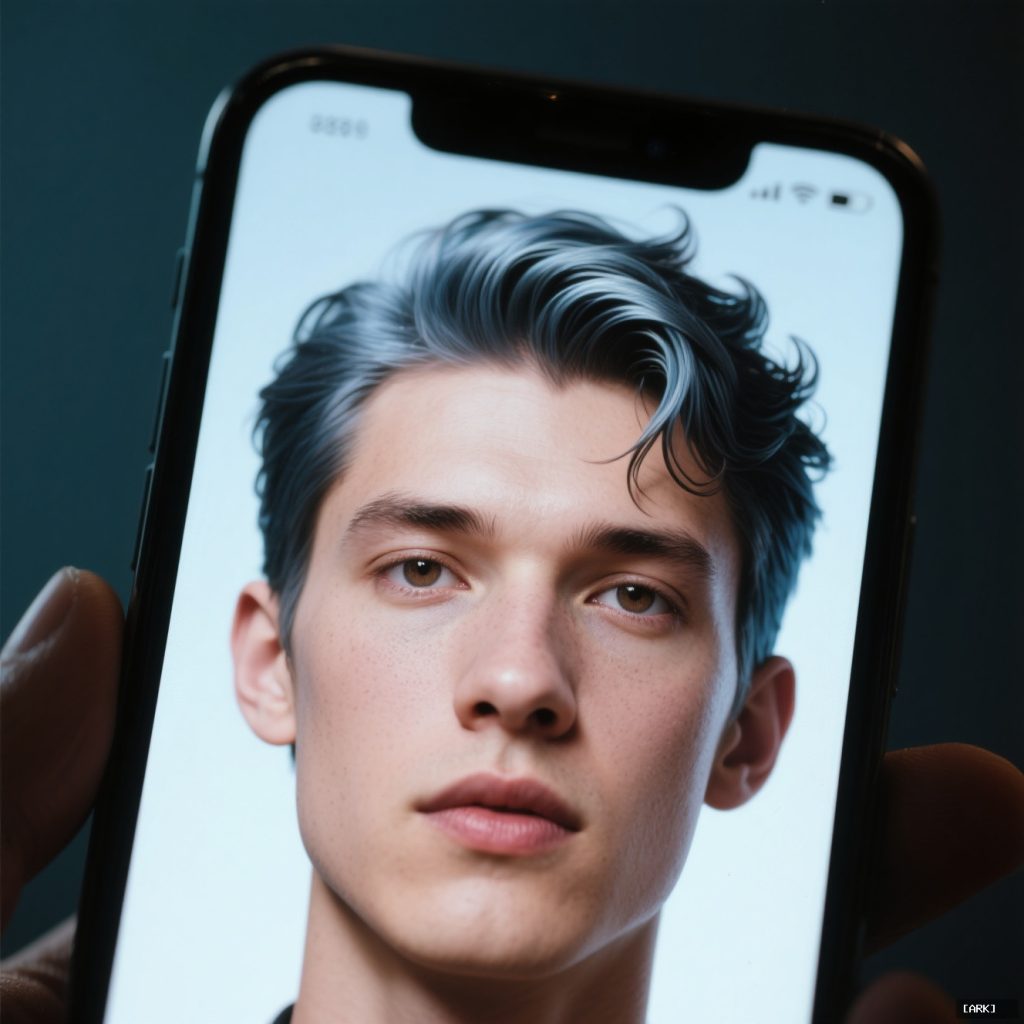
An AI haircut generator offers a tempting, risk-free preview of a new look, but that digital vision is often more fantasy than forecast. The real story unfolds in the gap between that flawless virtual haircut preview and your reflection the next morning.

We’ve all been there. Standing in a salon, clutching a photo of a celebrity or a screenshot from Pinterest, hoping to translate a two-dimensional ideal into a three-dimensional reality. Today, that reference photo is increasingly generated not by a photographer, but by an algorithm. With a few taps, an AI hairstyle simulator promises to show you with curtain bangs, a platinum bob, or curls you were never born with. It’s a powerful, persuasive piece of technology that taps directly into our desire for transformation. But what exactly are we seeing in that preview, and how much should we trust it?
The Illusion in the Interface: How AI Hair Previews Actually Work
How do AI haircut generators actually create hair previews on uploaded photos?
AI haircut generators create hair previews through a process of image overlay rather than generating entirely new hairstyles. They begin with face detection to identify key features like eyes and jawline. The software then selects a pre-existing hairstyle graphic from its database and blends it onto the user's head, adjusting for scale and placement. More advanced versions may modify color to match roots or soften edges for a more realistic appearance, but they do not construct a custom 3D model or hairstyle from scratch.
When you upload your selfie to a digital hair styling app, it feels like magic. In reality, it’s a clever trick of light and data. Most generators don’t create a new hairstyle for you; they overlay a pre-existing library of hairstyle images onto your photograph.
The process typically starts with basic face detection—finding your eyes, nose, and jawline. The software then selects a hairstyle graphic from its database and blends it onto your head, adjusting for scale and rough placement. Advanced versions might tweak the color to match your roots or soften the edges. But they are not building a 3D model of your skull. They are not analyzing the direction your hair grows from the crown, the stubborn cowlick at your temple, or the delicate density of your hairline.
Think of it as trying on a digital wig that’s been photoshopped into place. The result can be visually convincing, even exciting, but it’s a composite. It ignores the fundamental physics of your hair. Your real hair has weight, movement, and a mind of its own. The AI shows a static, perfect moment, often with a volume and texture that defy gravity and biology. This core mechanic explains why your preview can look stunningly “right” on screen and utterly disconnected from your actual hair’s potential.
The Stylist vs. The Simulator: A Clash of Realities
What is the fundamental difference between a professional stylist's assessment and an AI haircut generator's analysis?
A professional stylist's assessment is rooted in physical and biological reality, analyzing hair growth patterns, porosity, facial structure in three dimensions, strand thickness, density, and personal lifestyle factors like styling routine and product tolerance. In contrast, an AI haircut generator primarily focuses on aesthetic simulation, lacking this comprehensive, tactile understanding of real-world constraints and individual biology that informs a practical, wearable haircut.
This leads to the central tension. A seasoned stylist is a master of physics and biology. Their assessment begins the moment you walk in. They look at your hair’s natural growth patterns, its porosity, the shape of your face not as a flat oval but as a dimensional structure. They feel the thickness of a single strand and the density per square inch at your crown. They ask about your daily routine, how much time you’ll spend styling, what products you tolerate.
An AI haircut generator shows aesthetics. A stylist calculates reality.
Many professionals view these tools with cautious duality. They can be brilliant conversation starters. A client walking in with five AI-generated images has a clearer visual vocabulary than someone vaguely describing “something shorter.” The shared visual language bridges a communication gap that has plagued salons for decades.
However, the danger is in the attachment to a pixel-perfect outcome. The savvy stylist doesn’t see the AI image as a blueprint to replicate. They see it as a mood board. Their job becomes translation: “I see you’re drawn to the disconnected layers in this picture. What we can do is create a softer version that works with your wave pattern, keeping the feeling of movement but adapting the weight.” They focus on extracting the elements—the texture, the silhouette, the length contrast—rather than promising the impossible copy.
The Social Media Effect: From Practical Preview to Personal Avatar
How does social media influence the purpose and design of AI haircut generators?
Social media platforms like TikTok and Instagram shift the purpose of AI haircut generators from practical previews to tools for creating shareable, dramatic transformations. The attention economy rewards extreme changes, leading these AI tools to be optimized for 'wow' factor with vibrant colors, drastic cuts, and ethereal textures that perform well in short videos. This cultural pressure prioritizes visual impact over realistic simulation, making the generators more about crafting a personal avatar for the feed than accurately predicting everyday hairstyles.
The rise of these tools is inextricably linked to platforms like TikTok and Instagram. Here, the purpose of a new hairstyle subtly shifts. It’s no longer just about looking good for yourself or your office; it’s about creating a shareable, dramatic transformation for the feed. The economy of attention rewards extreme change.
This cultural pressure shapes the AI tools themselves. Filters and generators are often optimized for “wow” factor—vibrant colors, drastic cuts, ethereal textures that look incredible in a 15-second video. The AI haircut generator becomes less a practical preview tool and more a personal branding engine, letting you audition different avatars for your digital self. The desire it cultivates isn’t merely for a new haircut, but for a new, highly postable identity. This can push users toward trend-driven looks that are high-impact for a scroll but low-feasibility for a 7 AM Tuesday morning.
Working Backwards: A Smarter Way to Use the Technology
What is the smarter, backwards way to use an AI haircut generator for genuine insight?
The smarter, backwards approach is to start with subtle, realistic changes you've genuinely considered, rather than immediately testing radical styles. This involves visualizing plausible modifications like adding two inches of length, trying a deeper side part, or experimenting with face-framing layers. This method grounds the technology in the possible and helps you see proportional changes on your own face. Another key tactic is the consistency test, using multiple photos of yourself from different angles to evaluate the style's versatility and realism.
If you want to harness an AI hairstyle simulator for genuine insight, you need to subvert its flashy nature. Use it backwards.
Instead of immediately testing a radical mullet or neon pink curls, start with the subtle, realistic changes you’ve genuinely considered. Visualize adding two inches of length. See what a deeper side part looks like. Experiment with adding or removing face-framing layers. This grounds the technology the plausible and helps you see proportional changes on your own face.
Another powerful tactic is the consistency test. Run multiple photos of yourself—different angles, different lighting, different days—through the same style suggestion. Does that blunt bob look flattering in all of them, or only in the one perfect, evenly-lit head-on shot? If a style consistently improves your appearance across several photos, you might be onto a genuine pattern, not a digital fluke. Look for the commonalities in the styles you save. Do all your favorites have volume at the crown? A tapered neckline? This meta-data about your preferences is often more valuable than any single image.
The Unseen Burden: The Limitation of Maintenance
What is the unseen burden of maintenance that beginners miss about AI haircut generators?
Beginners often overlook the significant time and effort required for upkeep after getting a haircut previewed by an AI. The AI shows a perfected, peak-style snapshot but fails to illustrate the ongoing maintenance, such as how a chic pixie looks after three weeks of growth with fuzzy edges or the daily 25 minutes of blow-drying and product application needed for a textured lob. It glosses over the financial and temporal burdens of regular styling and trims to maintain the look.
Perhaps the most significant blind spot of every virtual haircut preview is time. The AI shows you the destination after a professional stylist has perfected it. It is a snapshot of peak hair.
It never shows you the process. It doesn’t illustrate what that chic, precise pixie looks like after three weeks of growth, when the nape of your neck is fuzzy and the sides have lost their shape. It doesn’t reveal the 25 minutes of blow-drying, round-brushing, and product application required to achieve that “effortlessly” textured lob every single day. It glosses over the financial and temporal upkeep of a platinum blonde color fantasy.
This omission is where the virtual and visceral realities collide most brutally. An AI sells a result. A haircut is a living, growing process. The most crucial question a generator cannot answer is, “Can I, and will I, maintain this?” Before falling for a digital vision, ask yourself about your real-life commitment to styling tools, salon visits, and daily routine. The most flattering haircut in the world is the one you can actually wear well on an average Wednesday.
Your Practical Checklist for Using an AI Haircut Generator
- Gather Quality Input: Use several high-resolution, well-lit front-facing photos. Avoid heavy filters or dramatic angles that distort your face shape.
- Decode the Suggestion: Focus on the overarching shape, length, and proportion the AI shows, not the exact, unrealistic texture or volume.
- Find the Pattern: Save 3-5 styles you like and analyze them. What common elements do they share? Is it all about the fringe, or the length in the back?
- Bridge the Communication Gap: Show your stylist the AI images, but immediately follow up with a verbal description. Say, “I like how the layers fall here,” or “I’m drawn to the bluntness of this line.”
- Ask the Key Question: Present the image to your stylist and ask, “What would need to change about my hair, or my routine, to make something like this work for me?” This opens a collaborative, realistic dialogue.
Navigating Common Questions and Concerns
- Are these apps safe for my photos? Always check the privacy policy. Many free apps use uploaded photos to further train their AI models, meaning your selfie could become part of their dataset.
- Do they work for all hair types? Frankly, no. Algorithms are often trained on datasets skewed toward straight, medium-density hair. Curly, coily, and very fine hair textures are frequently rendered poorly or with limited style options, perpetuating a lack of representation.
- Are they free? Many operate on a “freemium” model. Basic styles are free, but the more popular or advanced looks are locked behind a subscription or one-time payment.
- Can I use them for hair color too? Yes, but be even more skeptical. Color previews are notoriously inaccurate, as screen colors and real dye pigments interact with light and underlying hair pigment in wildly different ways.
The AI haircut generator is a fascinating tool that sits at the crossroads of beauty, technology, and human psychology. It empowers us to experiment without consequence and dream a little bigger. But its greatest value may not be in providing answers, but in helping us ask better questions. It’s a mirror that shows a possible reflection, a starting point for a conversation with the professional who holds the shears. Use it to explore, to inspire, and to clarify your own desires. Then, step away from the screen and trust the human expertise that understands not just how hair looks, but how it lives.
Sources & Further Reading
What are some expert sources for understanding the limitations and impacts of AI haircut generators?
Experts recommend consulting sources like Vox, which examines the rise and limits of virtual hair try-on apps; Allure, questioning if AI apps can provide good haircut previews; WIRED, detailing how AI is quietly changing the beauty industry; and Refinery29, exploring if AI hairstyle filters set users up for disappointment. These articles provide critical insights into the technology's capabilities, ethical considerations, and potential disappointments that beginners might overlook, offering a more nuanced understanding beyond basic app functionality.
Vox: The rise and limits of virtual hair try-on apps
Allure: Can an AI App Really Give You a Good Haircut Preview?
WIRED: How AI is Quietly Changing the Beauty Industry
Refinery29: Are AI Hairstyle Filters Setting Us Up for Disappointment?
About Our Expertise
At Handmyth, our expertise in traditional arts and craftsmanship informs our analysis of modern tools like AI haircut generators. We draw on deep knowledge of material properties and human skillu2014honed through centuries of practices like embroidery and paper-makingu2014to critically assess how technology interacts with physical realities. This perspective ensures our insights are grounded in authentic understanding, not just digital trends.
Trust in our content comes from a commitment to preserving and explaining cultural heritage with accuracy. While AI tools offer new possibilities, we emphasize the irreplaceable value of human expertise, mirroring the respect for artisan mastery in Chinese traditional arts. Our guidance helps readers navigate modern innovations with wisdom, fostering informed decisions that blend technology with timeless principles.



 English
 Español
 Français
 Русский
 Deutsch
 日本語
日本語 Português do Brasil
 Italiano