
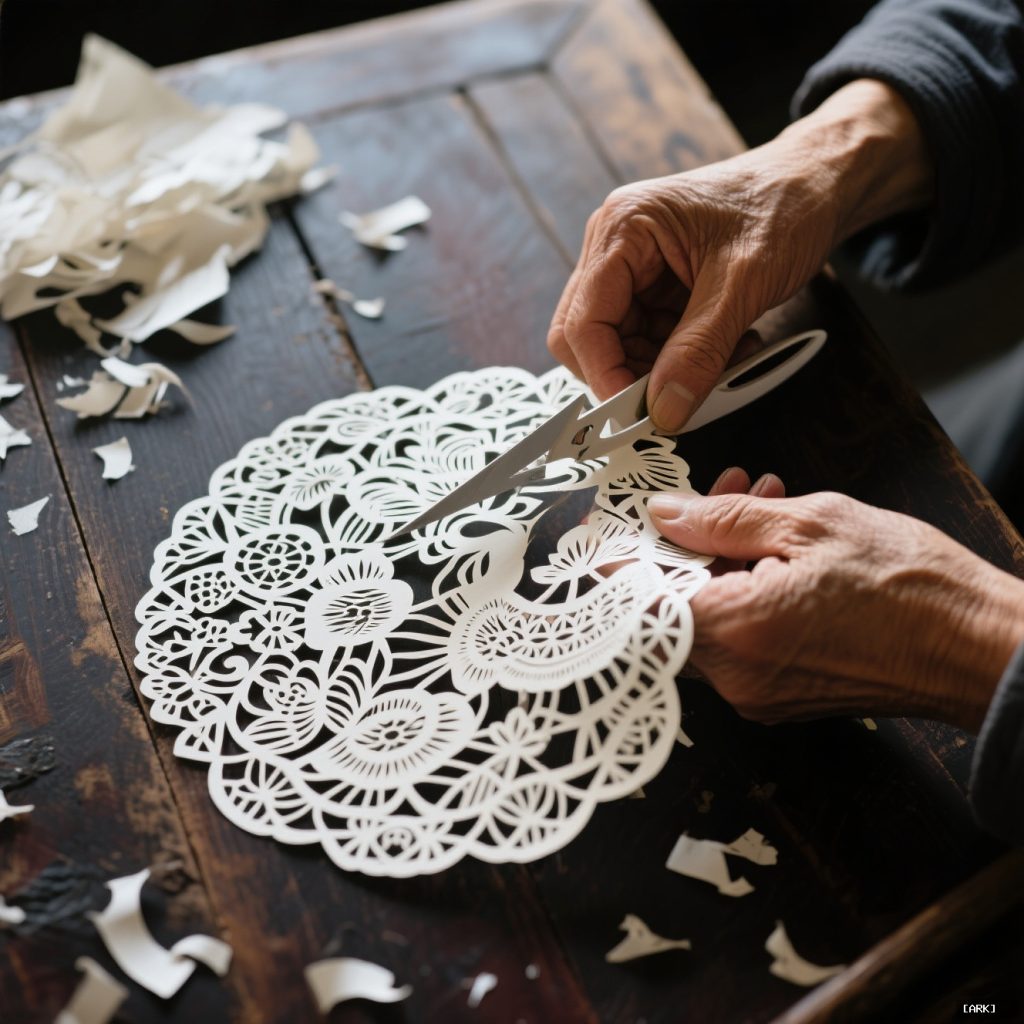
Chinese papercut art designs are a visual language of hope and identity. They transform simple paper into a dense narrative of folk art patterns, where every silhouette speaks.
Walk through any market in China during the Lunar New Year, and you’ll see them: bursts of crimson paper pasted on windows and doors. To the untrained eye, they might just be pretty red decorations—a generic symbol of festivity. But lean in closer. The difference between a mass-produced souvenir and a meaningful piece of traditional craft is the difference between hearing a word and understanding the whole sentence.
TL;DR
- The Grammar of the Snip: What Makes a Pattern Speak
- Deployed, Not Displayed: The Ritual Function of Motifs
- The Confidence of the Cut: When Less is More
- Lost in Translation: Why Some Modern Interpretations Feel Hollow
What this is (and isn’t)
Definition. Chinese papercut art designs refers to the core ideas, techniques, and context people use to understand and practice it.
Scope. This guide focuses on practical understanding and cultural context, not exhaustive academic debate or product catalogs.
The Grammar of the Snip: What Makes a Pattern Speak
A genuine folk art pattern communicates. It’s not just about technical precision, though the cut lines of a master are confident and clean. It’s about composition. The design balances positive and negative space—the cut-away parts and the remaining paper—to tell a story. A generic souvenir often presents an isolated, perfectly symmetrical motif, like a lone “福” (fu) character for good fortune. It’s static.
Authentic traditional decoration motifs weave elements into a dynamic, often asymmetrical, narrative. A cluster of peonies (wealth and honor), bats (good fortune), and a plump child (family prosperity) aren’t just thrown together. They’re in conversation. The density has a rhythm; the negative spaces between leaves or feathers form their own pleasing shapes. You see this in the works from regions like Yanchuan in Shaanxi, where compositions feel alive, buzzing with intention, not stamped out by a machine.
This language is codified. In a 2022 project documenting intangible cultural heritage, UNESCO specifically noted the “complex system of visual metaphors” in Chinese paper cutting, where motifs form a “symbolic lexicon” passed down through generations. It’s a dialect where a pomegranate is never just a fruit.
Deployed, Not Displayed: The Ritual Function of Motifs
Historically, these paper cutting crafts were not passive decor. They were tactical, spiritual tools deployed with specific intent at precise locations in a home. Their function was as crucial as their form.
That rooster cutout on the kitchen door? It was a guardian against fire, its crow believed to scatter evil spirits before they could cause a blaze. A intricate “double happiness” character surrounded by lotus seeds over the marital bed was a blatant fertility charm. The lotus seeds (lianzi) are a homophone for “continuous birth of sons.” These were spells made of paper.
Placement was everything. Door gods protected the threshold; window papercuts warded off malicious forces trying to enter; ceiling centerpieces blessed the entire household. The art was ephemeral by design—faded by the sun, torn by the wind, and burned or replaced yearly, carrying away old luck and making room for the new. This cyclical practice is a core part of its folk identity, a notion supported by ethnographic research in the Journal of American Folklore, which frames such rituals as “participatory renewal” of community values.
The Confidence of the Cut: When Less is More
Is intricate detail always better? This is a common trap for newcomers. While styles from Shaanxi or Hebei are famed for their microscopic, lace-like complexity—proof of incredible patience and knife control—other schools prove that boldness carries its own power.
The papercuts from Yuxian or Foshan often use simplified, robust shapes. Think of a leaping carp rendered with three sweeping curves instead of a hundred individual scales. These designs carry immense visual weight and emotional punch. They have to; they were meant to be seen from a distance on a busy gate or a bustling street.
Sometimes, a master’s confidence is shown most clearly in what they leave uncut. They use stark negative space to define the curve of a fish’s back or the petal of a lotus. The paper itself becomes the subject. As the late master from Foshan, Chen Ziji, once told an apprentice, “You must respect the paper. It is not an enemy to be conquered, but a partner in the dance. The empty spaces hold as much meaning as the filled ones.”
Lost in Translation: Why Some Modern Interpretations Feel Hollow
This leads to a modern dilemma. Many contemporary artists and designers borrow the visual grammar of papercut art designs but ignore the syntax. A butterfly motif—a classic symbol of marital joy and longevity—might be used in a random, purely decorative way on a lampshade or a dress, stripped of its context and layered meaning.
It’s like using a powerful verb as mere wallpaper. The most successful modern fusions, like those by artists such as Li Jianjun or the studio “Paper-Cut Project,” first demonstrate a deep understanding of the traditional symbolic language. They know the rules before they creatively break them, embedding contemporary social commentary or personal narrative within the familiar framework of folk art patterns. The motif isn’t just referenced; it’s re-contextualized.
An Unlikely Kinship: Papercuts and the Spirit of Punk
The connection might seem forced, but sit with it for a moment. Both paper cutting crafts and punk rock stenciling are arts of democratic access and defiant statement. Both are born from simple, affordable tools: a blade or an X-Acto knife versus a spray can and a cut-up cereal box.
Both rely on bold, high-contrast silhouettes designed for instant communication and rapid reproduction. The punk stencil sprays a message of anarchy or protest on a concrete wall; the traditional papercut pastes a prayer for blessings and protection on a wooden door. One is an act of defiant critique, the other an act of defiant hope. Yet both use the most accessible means available to mark a space with identity, to say, “We are here, and this is what we believe.” They are folk arts in the truest sense—of, by, and for the people.
Living with the Art: Papercuts in a Modern Space
So, can these vibrant, symbolically dense traditional decoration motifs work in a minimalist, Scandinavian-inspired apartment? Absolutely. But the key is curation, not dilution.
Don’t seek a “watered-down” or overly abstracted papercut that loses its soul. Instead, lean into the inherent contrast. A single, powerful black papercut on a vast white wall doesn’t hide the craft’s nature; it celebrates its essence—the fundamental dialogue between substance and void, presence and absence. Frame it like the serious graphic artwork it is, behind conservation-grade glass. Give it space to breathe and command attention. This approach treats it with the respect a museum piece deserves, moving it far beyond the realm of ethnic kitsch.
Some interior designers are now using this principle, creating focal points with large-scale, custom papercuts that tell a personal story for the homeowner, merging traditional motifs with modern architectural lines.
Your Hand as a Guide: A Practical Evaluation Checklist
Whether you’re at a folk art fair, a museum shop, or browsing online, how can you judge the quality and authenticity of a piece? Use your eyes and your hands.
- Seek Narrative, Not Just Image: Look for a clear focal point and a balanced, but not necessarily symmetrical, composition. Does it feel like a snapshot of a story?
- Read the Negative Spaces: Squint your eyes. Do the uncut areas form interesting, intentional shapes of their own, or are they just leftover background?
- Feel the Substance: Traditional works often use a resilient, hand-dyed paper like xuan paper, which has a subtle texture and weight. Flimsy, glossy paper is a modern shortcut.
- Ask for the Story: “What does this carp leaping over the gate mean?” A seller or artist who can’t explain the basic symbolism is a major red flag. You’re buying meaning, not just decor.
- Examine the Line: Look at the cut lines. Slight, human wobbles can add charm, but hesitant, scratchy, or frayed lines suggest a lack of knife mastery and confidence in the craft.
Untangling Common Threads: Your Questions Answered
Are all red papercuts just for Lunar New Year?
No. While vibrant red dominates for Spring Festival and weddings, the color palette had specific rules. Papercuts for funerals or periods of mourning could be white, blue, or purple. Daily blessings for a child’s health or a safe process might use softer yellows or greens. Color was part of the message.
Is it all done freehand by memory?
Not always. While masters can perform breathtaking freehand cuts, many complex, symmetrical patterns involve carefully folding the paper and using a charcoal-dusted pattern or a light pencil guide. The true skill lies in the fluid execution and knife control, not the absence of a plan. A 2018 Statista survey on craft practices in rural China noted that over 60% of practitioners use some form of template for intricate repeat patterns.
How do I keep them from falling apart?
They are ephemeral by tradition, but for preservation, frame them properly. Use acid-free mats and UV-protective glass. Keep them away from direct sunlight, high humidity, and dramatic temperature swings. Understand that preserving them forever is a modern concept; their beauty was originally in their temporary nature.
Diving Deeper: Paths for Further Exploration
The world of Chinese papercut art designs is vast and regional. To hear the stories in the snips, start with the collections and research of major institutions. The Metropolitan Museum of Art’s online timeline offers a superb visual history of techniques. The British Museum’s collection database lets you zoom in on stunning high-resolution images of folk art patterns from different provinces. For a more immersive experience, the audio recordings of artists at work and explanations of motifs on Smithsonian Folkways are invaluable. Finally, the World Health Organization’s 2019 report on arts and health cited community paper-cutting groups as a meaningful social prescription for elderly well-being, highlighting how this ancient craft continues to foster connection and cognitive engagement today.
Begin by looking past the red. See the language. Then, you’ll start to hear the stories.
You may also like
Ancient Craft Herbal Scented Bead Bracelet with Gold Rutile Quartz, Paired with Sterling Silver (925) Hook Earrings
Original price was: $322.00.$198.00Current price is: $198.00. Add to cartAncient Craftsmanship & ICH Herbal Beads Bracelet with Yellow Citrine & Silver Filigree Cloud-Patterned Luck-Boosting Beads
Original price was: $128.00.$89.00Current price is: $89.00. Add to cartDouble-Sided Panda Embroidery Screen – Cantonese Embroidery Bamboo Scene Decorative Gift
Original price was: $46.70.$33.68Current price is: $33.68. Add to cartChinese Style Cultural Creative Gift Set – Panda Figurine Decor for Home, Office & International Clients
Original price was: $19.86.$17.20Current price is: $17.20. Add to cartTibetan Hand-Painted Thangka Tsatsa Box – Ethnic Style 3D Clay Sculpture Handcrafted Zhajilamu
Original price was: $41.00.$32.00Current price is: $32.00. Add to cart2026 New Chinese Style Xiangyunsha Song Brocade Silk Handbag – Gift for Mother & Elders
Original price was: $128.00.$115.00Current price is: $115.00. Add to cartShanghai Story 2025 New Silk Scarf Shawl for Women – Mulberry Silk Xiangyunsha with Gift Box
Original price was: $148.90.$136.90Current price is: $136.90. Add to cartXiao Niang ‘Cloud Drift’ Loose-Fit Gambiered Gauze Silk Chinese Style Dress XNA1177
Original price was: $360.00.$328.00Current price is: $328.00. Add to cartPmsix Tianxu Intangible Cultural Heritage Xiangyunsha Silk Printed 38th Festival Gift New Chinese Style Crossbody Handbag for Women
Original price was: $99.50.$94.50Current price is: $94.50. Add to cart























