
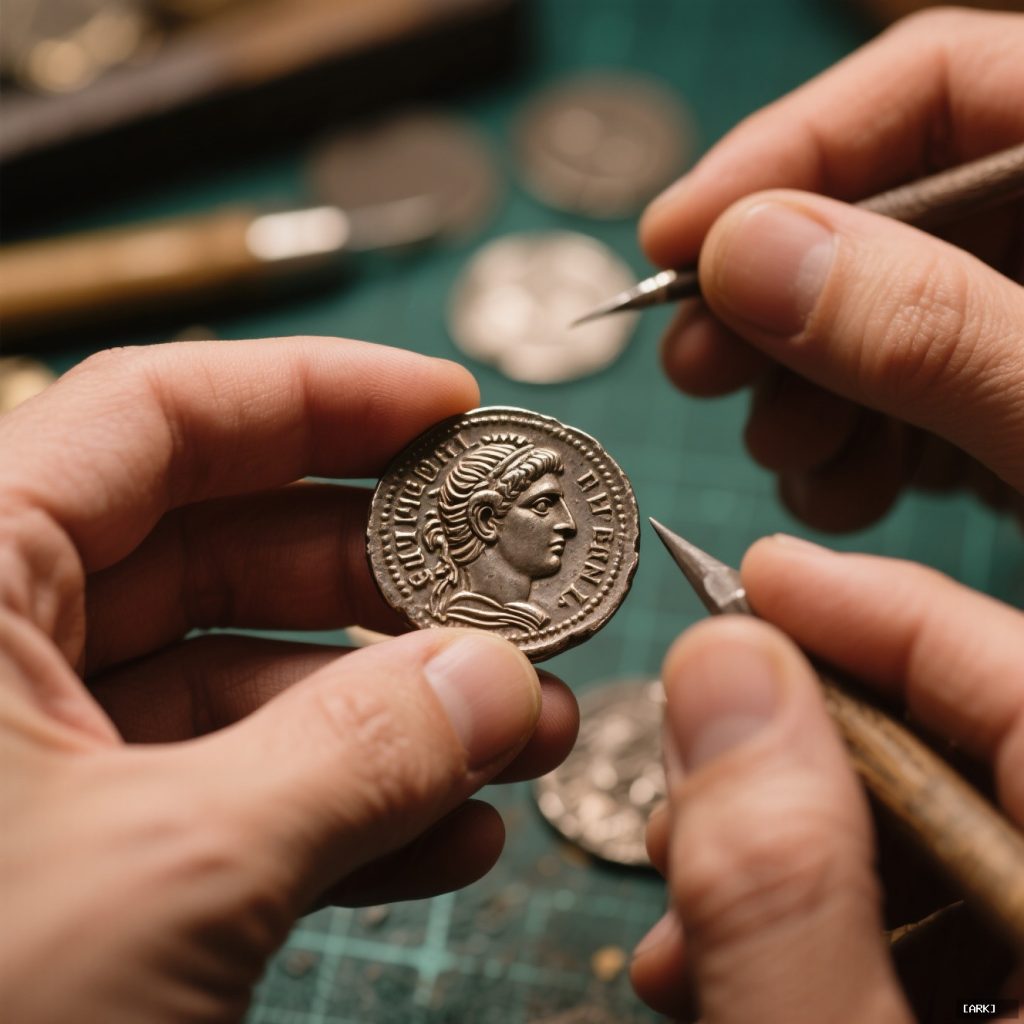
Ancient coin replica crafting is more than a niche hobby; it’s a direct, tactile conversation with history. This practice of historical coin reproduction quiets the modern mind by demanding a specific, almost ritualistic focus of the hands.
The weight of a bronze blank, the steady pressure of a hammer on a die—these actions forge a tangible bridge to antiquity that a screen never could. It’s a quiet rebellion against our digital ephemera, an attempt to hold time itself in the palm of your hand.
The Participant, Not the Curator
How does historical coin reproduction differ from collecting coins?
Historical coin reproduction differs from collecting by emphasizing active participation over passive acquisition. Collecting is an observational pursuit focused on acquiring and studying coins. In contrast, reproduction is a kinesthetic process where you physically engage in crafting a replica, such as striking metal to create an image. This hands-on approach allows you to feel the force and understand the coin's physicality through your own muscles and breath, making you a participant in its creation rather than merely a curator of the finished object.
So how is this different from collecting? Think of it as the difference between reading a recipe and cooking the meal. Collecting is about acquisition and observation, a visual and intellectual pursuit. Historical coin reproduction, however, is fundamentally kinesthetic.
You’re not just looking at Trajan’s sestertius in a museum case. You’re feeling the force required to strike its image into metal, understanding its physicality through your own muscles and breath. The copy making process inverts the relationship. It makes you a participant in the coin’s creation, not just its curator. You learn that a coin isn’t merely a picture on metal. It’s a product of force, heat, and human error. You feel why some strikes are weak, why legends are sometimes double-struck or off-center. The history becomes embodied.
The Unlikely Path to Mindfulness
How does ancient coin replica crafting lead to a state of mindfulness?
Ancient coin replica crafting fosters mindfulness by inducing a natural flow state through precise, repetitive actions like filing blanks, aligning dies, and striking. This process narrows sensory focus to the sound of metal, the feel of cool tools, and the emergence of details from a blank disk, quieting mental chatter. It mirrors the focused attention in rituals such as a tea ceremony, creating profound concentration and present-moment awareness through the manual, immersive nature of the craft.
That raises a question: the craft’s non-obvious gift: a profound sense of focus. The link between coin copying and mindfulness isn’t metaphorical. The precise, repetitive actions involved in antique currency duplication—filing a blank, aligning dies, the decisive strike—create a natural flow state.
Your sensory world narrows. The chatter fades. Your universe becomes the sound of metal yielding, the cool temperature of the steel tools, the gradual emergence of a lion’s mane or an emperor’s profile from a blank disk. It mirrors the focused attention found in rituals like a tea ceremony, where the process itself is the anchor. This is history felt in your bones and heard in the ring of the metal, not just studied with your eyes.
Authenticity is a Full-Body Experience
How does the pursuit of authenticity in ancient coin replica crafting engage multiple senses beyond just visual accuracy?
Authenticity in ancient coin replica crafting is a full-body experience that goes beyond visual accuracy. It involves the heft, such as the startling lightness of a Roman denarius or the substantial weight of a Greek tetradrachm. The sound, like a specific ring or dull thud when tapped, matters. The patina is not just color but a texture under the thumb, suggesting age and environment. This craft engages touch, sound, and even smell, like the faint scent of worked materials, to create a respectful and immersive representation.
Pursuing authenticity in numismatic copy making means engaging all your senses. Visual accuracy is just the starting line. The heft is critical. A Roman denarius should feel startlingly light and small; a Greek tetradrachm should have a satisfying, substantial weight. The sound matters, too—the specific ring or dull thud when tapped on wood.
Then there’s the patina. It isn’t just a color you paint on. It’s a texture under your thumb, a story of age and environment you’re trying to respectfully suggest. At its best, this craft engages touch, sound, and even smell—the faint, sharp scent of worked bronze or the sulfurous smell of liver of sulfur for aging. You create a holistic sensory artifact, something a photograph or a screen can never deliver.
Beginning with the Basics, Not the Bank
What is the core principle of beginning ancient coin replica crafting according to the section 'Beginning with the Basics, Not the Bank'?
The core principle is starting with simple, accessible methods like clay or pewter casting using silicone molds made from original coins or high-quality 3D prints. This low-barrier approach emphasizes feeling the process, focusing on form, texture, and negative space to understand the constraints ancient mint workers faced. It prioritizes comprehension over industrial perfection, serving as a foundational step before advancing to more complex techniques like cold striking or lost-wax casting.
A common misconception is that you need a forge and a power hammer to begin. Not true. The core principle of feeling the process can start with simple clay or pewter casting using silicone molds made from original coins or even high-quality 3D prints.
This low-barrier entry focuses on form, texture, and negative space. It’s about understanding the constraints ancient mint workers faced before you ever move to cold striking or lost-wax casting. The goal here isn’t industrial perfection. It’s comprehension. When you try to carve your own die from tool steel, even crudely, your appreciation for the originals explodes. You start with the material, not the machine.
An Antidote to the Swipe
How does ancient coin replica crafting serve as an antidote to the swipe-and-scroll culture?
Ancient coin replica crafting directly counters the modern scroll-and-swipe reflex by demanding sustained, undivided attention to a single, slow-developing object. It offers no instant gratification or infinite feed. Each step, from preparing the blank to the final strike, is a deliberate commitment where mistakes like a misaligned die or a poor hammer blow are permanent. This process enforces patience, recalibrating one's sense of time and accomplishment by requiring work at the material's pace, mirroring historical rhythms.
Perhaps most vitally, ancient coin replica crafting directly opposes the scroll-and-swipe reflex. It demands sustained, undivided attention to a single, slow-developing object. There is no instant gratification, no infinite feed to mindlessly consume.
Each step, from preparing the blank to the final strike, is a deliberate commitment. A misaligned die can’t be undone with CTRL+Z. A poorly calculated hammer blow leaves a permanent witness. This enforced patience recalibrates your sense of time and accomplishment. You work at the pace of the material, mirroring the rhythm of the eras you’re trying to touch.
Your First Foray: A Practical Guide
What is a practical guide for a beginner's first foray into ancient coin replica crafting?
A practical guide for a beginner's first foray into ancient coin replica crafting emphasizes setting up for a learning experience rather than creating a masterpiece immediately. Start by choosing a coin with bold, high-relief features and a simple design, such as late Roman bronzes, Celtic staters, or Greek coins with clear animal motifs, to withstand a beginner's strike and remain readable. For a casting approach, gather basic tools like silicone molding compound and low-melt metal alloy. This tactile process connects you with history through hands-on replication, focusing on skill development over perfection.
Ready to start your own tactile dialogue with history? The path is simpler than you think. The key is to set yourself up for a learning experience, not immediate masterpiece.
Choosing Your First Subject
Don’t start with a complex Byzantine solidus. Look for a coin with bold, high-relief features and a simple design. Late Roman bronzes, certain Celtic staters, or Greek coins with clear animal motifs are excellent choices. The design needs to be able to withstand a beginner’s strike and still be readable.
Gathering Your Tools
For a casting start, you’ll need a silicone molding compound and a low-melting-point metal like pewter or tin. For cold striking, you can begin with simple steel dies (available from specialty craftsmen) and soft metals like copper, bronze, or even thick aluminum. A solid, heavy surface is non-negotiable—a small anvil or a massive block of steel set on a sturdy table. A medium-weight ball-peen hammer is a good starter.
The Mindset for Success
Focus on the process, not the product. Your first goal is a single, clean strike with good alignment. Study the original coin’s edge, its thickness, the way the design interacts with the border. These details tell you more about its creation than the obverse portrait. Embrace the flaws. They are your teachers, showing you exactly where your pressure was uneven or your metal too cold.
Navigating Common Questions
As you delve in, natural questions arise. Here’s clarity on a few frequent points.
- Is this legal? Creating replicas for personal study, education, and non-commercial craft is typically legal. The critical rule is ethical transparency: any replica must be permanently and clearly marked as a copy (like a “COPY” stamp on the edge) if it is ever sold or traded, to prevent it from entering the collector market as a fraud.
- Does it damage original coins? Absolutely not. Proper silicone molding uses safe, non-destructive materials that create a perfect impression without any contact that could harm the original’s surface or patina. Reputable practitioners only mold coins they own or have explicit permission to use.
- What’s the classic beginner error? Using metal that’s too hard or a hammer that’s too light. This results in a weak, blurry impression that doesn’t fill the die. Start soft and hit decisively (with careful alignment!). It’s better to learn control on copper than to fight with hardened bronze.
- Where do I learn the real techniques? Look beyond numismatic forums. The core skills live in blacksmithing, silversmithing, and jewelry-making communities. Seek out a local artisan who understands metalwork. The skills of annealing, die-sinking, and striking are ancient and shared across these disciplines.
A Starter’s Checklist
- Select a simple, bold coin design.
- Source a known-good silicone mold or a basic pair of steel dies.
- Begin with a soft, forgiving metal (pewter for casting, copper for striking).
- Prepare an immovably solid work surface.
- Practice alignment with the dies unloaded.
- Aim for one clean, centered strike.
- Study the original’s physicality—weight, edge, thickness.
The Deeper Impression
In the end, ancient coin replica crafting offers something rare: a true sense of making. In a world of abstracted digital creation and disposable goods, it grounds you. You hold a lump of metal and, through skill and patience, give it a story, a face, a connection to a millennia-old tradition.
You don’t just own a replica. You own the understanding of how it came to be. You feel the echo of the ancient minter’s hammer in your own arm. That connection, forged in metal and focus, is the real treasure.
Sources & Further Pathways
The British Museum: How were Roman coins made?
The American Numismatic Association
NumisWiki: How to Make a Coin
NOVA: The Secret of Making Roman Coins
The Craftsman Blog: Foundational Hand-Tool Skills
About Our Expertise
Our exploration of ancient coin replica crafting draws from years of research into traditional Chinese metalworking techniques and numismatic history. The methods described hereu2014from die-sinking to cold strikingu2014have direct parallels in ancient Chinese coin minting practices used during the Han and Tang dynasties, where artisans developed sophisticated methods for producing standardized currency that circulated along the Silk Road.
As practitioners of traditional Chinese arts, we emphasize the ethical approach to replica crafting highlighted in this guide. Just as Chinese cultural preservationists carefully document and reproduce historical artifacts with clear markings, we advocate for transparent practices that honor the original craftsmanship while making ancient techniques accessible to modern learners through hands-on experience.
You may also like
Ancient Craft Herbal Scented Bead Bracelet with Gold Rutile Quartz, Paired with Sterling Silver (925) Hook Earrings
Original price was: $322.00.$198.00Current price is: $198.00. Add to cartAncient Craftsmanship & ICH Herbal Beads Bracelet with Yellow Citrine & Silver Filigree Cloud-Patterned Luck-Boosting Beads
Original price was: $128.00.$89.00Current price is: $89.00. Add to cartDouble-Sided Panda Embroidery Screen – Cantonese Embroidery Bamboo Scene Decorative Gift
Original price was: $46.70.$33.68Current price is: $33.68. Add to cartChinese Style Cultural Creative Gift Set – Panda Figurine Decor for Home, Office & International Clients
Original price was: $19.86.$17.20Current price is: $17.20. Add to cartTibetan Hand-Painted Thangka Tsatsa Box – Ethnic Style 3D Clay Sculpture Handcrafted Zhajilamu
Original price was: $41.00.$32.00Current price is: $32.00. Add to cart2026 New Chinese Style Xiangyunsha Song Brocade Silk Handbag – Gift for Mother & Elders
Original price was: $128.00.$115.00Current price is: $115.00. Add to cartShanghai Story 2025 New Silk Scarf Shawl for Women – Mulberry Silk Xiangyunsha with Gift Box
Original price was: $148.90.$136.90Current price is: $136.90. Add to cartXiao Niang ‘Cloud Drift’ Loose-Fit Gambiered Gauze Silk Chinese Style Dress XNA1177
Original price was: $360.00.$328.00Current price is: $328.00. Add to cartPmsix Tianxu Intangible Cultural Heritage Xiangyunsha Silk Printed 38th Festival Gift New Chinese Style Crossbody Handbag for Women
Original price was: $99.50.$94.50Current price is: $94.50. Add to cart























