
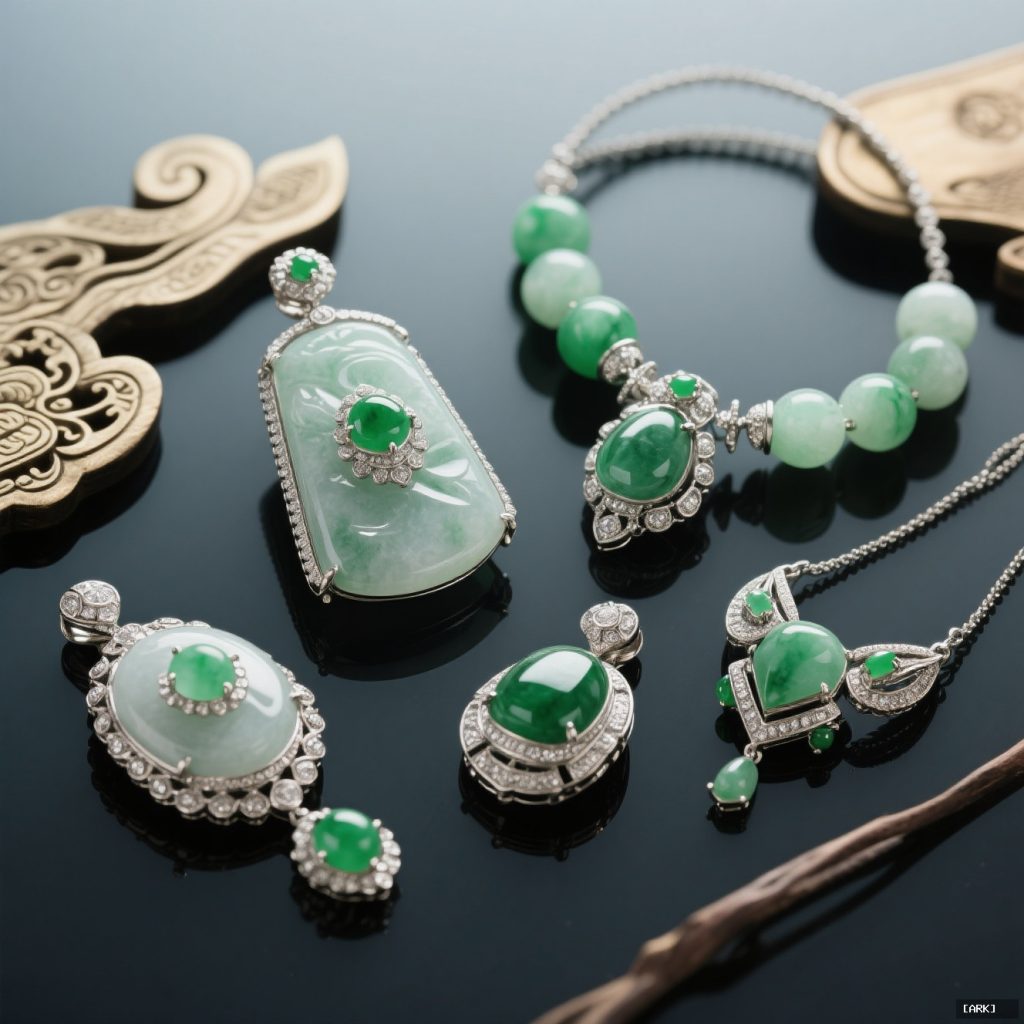
Chinese jade jewelry sets exist in a space clouded by profound myth and starkly different daily reality. The tension isn’t just about authenticity, but about the entire narrative we attach to these nephrite ornaments and jadeite accessories.
We buy them for their deep, cool green and their promise of ancient wisdom. Yet we live with them as objects that catch the light on a wrist, that feel heavy and reassuring, that sometimes chip on a doorframe. This is where the real story begins.
The Two Stones Beneath One Name
If you remember one thing, let it be this: not all jade is the same. The word “jade” is an umbrella, sheltering two distinct minerals with different histories, values, and characters. Confusing them is the first step into a world of overpaying and misunderstanding.
Nephrite is the classic Chinese jade. For millennia, it was the jade of ritual blades, ceremonial discs, and scholar’s objects. Its colors are often softer—creamy whites, muted celadon greens, deep spinach shades. It has a toughness, a fibrous internal structure that makes it incredibly durable. This is the stone of history, of Confucian virtue, of a connection to an unbroken lineage. A fine nephrite ornament carries the weight of that story in its subtle, waxy luster.
Jadeite burst onto the scene later, prized in the Qing dynasty for its vivid, electric greens—the famed “imperial jade”—and its wider palette of lavenders, reds, and yellows. It’s rarer, often more translucent, and commands eye-watering prices at top-tier auctions. When people today dream of that intense, almost glowing green, they’re usually thinking of jadeite. It’s the diva of the two: more brilliant, more fragile, and more frequently subjected to enhancements.
Think of it like this. Nephrite is the enduring novel, rich with layered meaning. Jadeite is the breathtaking poem. Both belong in a sophisticated oriental gemstone collection, but they speak different languages. Your preference might come down to whether you’re drawn to quiet depth or spectacular color.
Beyond the Temple: The Modern Life of Jade
We’re often told jade is about spirituality, a conduit for ancient virtues like wisdom, compassion, and courage. That’s the myth, polished to a high shine. The daily reality is more human, more intimate.
For many, a jade bangle isn’t a daily meditation on benevolence. It’s a gift from a grandmother, a souvenir from a homeland, a marker of a personal milestone. It’s the cool sensation against your skin on a hot day, a tactile reminder of who you are or where you came from. The meaning isn’t monolithic; it’s personal. The “spirituality” is in the connection—to family, to culture, to a moment in one’s own life. You might buy a jadeite accessory not to channel cosmic energy, but to celebrate a promotion, or simply because its color brings you joy. That’s a valid, powerful significance all its own.
This demystification is liberating. It allows jade to be worn without the pressure of embodying a thousand-year-old philosophy. It can just be beautiful. It can just be yours.
The Price Tag Mirage
Chinese jade jewelry sets, price is a notoriously slippery indicator of value. A high cost might mean exceptional quality. It might also mean clever branding, a famous designer’s name, or an elaborate story about a stone’s provenance. Conversely, a modestly priced piece could be a masterpiece of nephrite carving, where the value lies in the artisan’s skill, not the raw material’s auction potential.
The market is layered with treatments. Dyeing, bleaching, and polymer impregnation are common, especially with jadeite, to improve color and stability. These treatments aren’t inherently evil, but they must be disclosed. A treated stone should not command an untreated stone’s price. This is where the market gets murky. That “imperial green” bracelet at a surprisingly accessible price? It’s almost certainly enhanced.
So, what are you paying for? You need to decide. Is it the material’s intrinsic rarity? The artistry of the carving—the crispness of a dragon’s scales, the fluidity of a lotus flower? Or is it the intangible: a feeling, a heritage, a piece of art that speaks to you? Sometimes, the most valuable piece in a collection is the unassuming nephrite pendant that feels like a part of you, not the bank-breaking jadeite ring that lives in a safe.
Unmasking the Myths: Luck, Life, and Luster
Old wives’ tales cling to jade like moss to stone. Let’s clear the air.
The “Self-Purchase” Curse: The idea that buying jade for yourself brings bad luck likely originated from merchants wanting to encourage gifting (and higher prices). Today, countless people select their own pieces. The act of choosing a jade ornament for yourself—to mark an achievement, to practice self-care—is a modern ritual of self-respect. The luck is in the intention.
The “Living” Stone: Stories of jade changing color with its owner’s health are romantic but geologically dubious. High-quality, untreated jade is remarkably stable. Color change is typically a sign of a low-quality, treated stone degrading. Dyes fade with sweat and sunlight; polymer fillings can discolor. This inconvenient reality is often rebranded by sellers as the stone’s “mystical interaction” with you. Don’t buy the myth; it’s usually a cover for poor material.
The Folk Tests: Please, forget the hair-singeing test and the scratch-glass trick. They are useless, often damaging, and prove nothing about jade. They belong in the same category as rabbit’s feet and lucky pennies.
A Realist’s Guide to Acquisition
So, you’re captivated. You want to bring a piece of this world into your life. How do you navigate it without regret? Arm yourself with questions, not superstitions.
First, ask the fundamental question: Jadeite or nephrite? The seller should know. This answer sets your entire expectation for color, value, and history.
Second, demand proof, not promises. For any significant purchase, a certificate from a reputable gemological lab (like GIA or NGTC) is non-negotiable. It should specify the mineral, note any treatments, and describe the color. This document is your anchor in a sea of sales talk.
Third, educate your eyes and hands. Look closely. Genuine stone has a life to it—subtle color variations, a fibrous or granular texture (visible under a loupe), natural imperfections. Perfect, uniform, garish color is a red flag. Feel it. Jade feels densely, persistently cool to the touch. Tap it gently against a tooth (discreetly!) or another piece; it should produce a clear, resonant chime, not a dull plastic click.
Finally, judge the craft. Is the polish even and lustrous? Are the carved lines sharp and intentional, or soft and muddy? The workmanship tells you how much the carver respected the material.
Living With Your Jade
Can I wear it every day? Yes, its toughness is legendary. But “tough” isn’t “indestructible.” Protect it from sharp blows, extreme temperature changes, and harsh chemicals like bleach or acid.
Should it touch my skin? Tradition says yes, to enhance the connection. Practically, the natural oils of your skin can gently enhance its luster over time. But it’s not a rule. Wear it over clothing if you prefer.
How do I clean it? Simply. Lukewarm water, a drop of mild soap, and a soft cloth. Rinse and dry thoroughly. Avoid ultrasonic cleaners and steamers; the vibrations and heat can damage treated stones or loosen settings.
A Simple Checklist Before You Buy
- Mineral Identity: Confirm jadeite or nephrite.
- Paper Trail: Insist on a legitimate lab certificate.
- Visual Inspection: Seek natural texture, not sterile perfection.
- Tactile Test: Feel the cool, dense weight.
- Artisan’s Mark: Assess the quality of carving and polish.
- Value Alignment: Decide what you’re truly paying for—stone, art, or story.
Sources & Further Reading
Geological Society: Jadeite & Nephrite: https://www.geolsoc.org.uk/ks3/gsl/education/resources/rockcycle/page3658.html
GIA Jade Guide: https://www.gia.edu/jade-history-lore
Victoria & Albert Museum: Chinese Jade: https://www.vam.ac.uk/articles/jade-in-china
FGA GemNotes: Jade Treatments: https://gem-a.com/gem-notes/jadeite-jade-treatments
You may also like
Ancient Craft Herbal Scented Bead Bracelet with Gold Rutile Quartz, Paired with Sterling Silver (925) Hook Earrings
Original price was: $322.00.$198.00Current price is: $198.00. Add to cartAncient Craftsmanship & ICH Herbal Beads Bracelet with Yellow Citrine & Silver Filigree Cloud-Patterned Luck-Boosting Beads
Original price was: $128.00.$89.00Current price is: $89.00. Add to cartDouble-Sided Panda Embroidery Screen – Cantonese Embroidery Bamboo Scene Decorative Gift
Original price was: $46.70.$33.68Current price is: $33.68. Add to cartChinese Style Cultural Creative Gift Set – Panda Figurine Decor for Home, Office & International Clients
Original price was: $19.86.$17.20Current price is: $17.20. Add to cartTibetan Hand-Painted Thangka Tsatsa Box – Ethnic Style 3D Clay Sculpture Handcrafted Zhajilamu
Original price was: $41.00.$32.00Current price is: $32.00. Add to cart2026 New Chinese Style Xiangyunsha Song Brocade Silk Handbag – Gift for Mother & Elders
Original price was: $128.00.$115.00Current price is: $115.00. Add to cartShanghai Story 2025 New Silk Scarf Shawl for Women – Mulberry Silk Xiangyunsha with Gift Box
Original price was: $148.90.$136.90Current price is: $136.90. Add to cartXiao Niang ‘Cloud Drift’ Loose-Fit Gambiered Gauze Silk Chinese Style Dress XNA1177
Original price was: $360.00.$328.00Current price is: $328.00. Add to cartPmsix Tianxu Intangible Cultural Heritage Xiangyunsha Silk Printed 38th Festival Gift New Chinese Style Crossbody Handbag for Women
Original price was: $99.50.$94.50Current price is: $94.50. Add to cart























