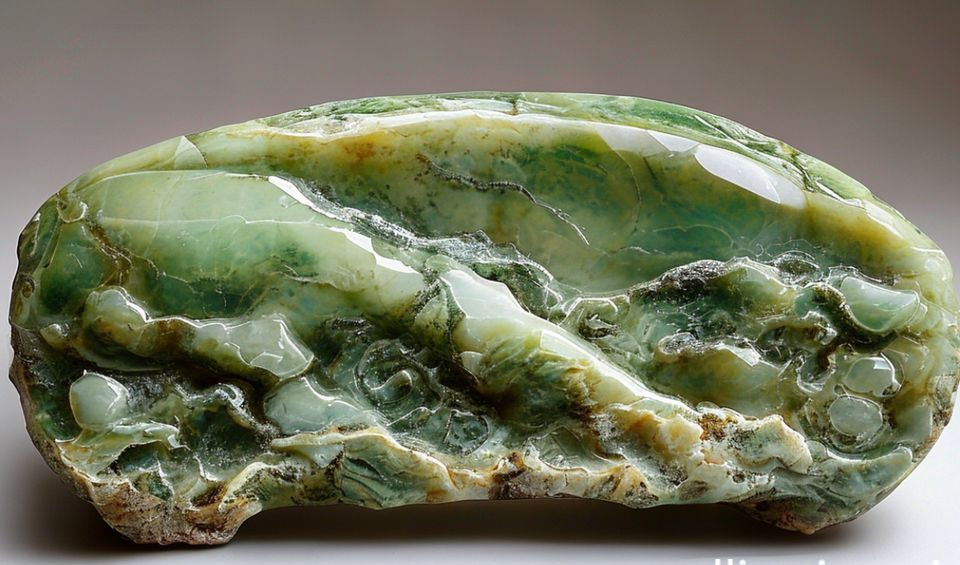
Nephrite jade possesses a quiet gravity that sets it apart. Unlike its more flamboyant cousin, jadeite, nephrite’s value has historically been measured not just in carats or color saturation, but in durability and tactile reliability. This is a material that was chosen for axe heads and ritual blades long before it was shaped into pendants. Its interlocking fibrous structure gives it a remarkable toughness—a resistance to shattering that made it, for millennia, the superior stone for tools meant to endure impact. That inherent strength, born from a matted web of actinolite or tremolite crystals, informs its entire journey into artistry; every nephrite carving carries this legacy of utility in its crystalline matrix. It is a stone that has been trusted with both survival and spirituality, a duality that continues to define its appeal.
The Craftsman’s Compromise: Hardness Versus Grain
What is the craftsman's compromise when working with nephrite jade?
The craftsman's compromise involves balancing the stone's hardness against its internal grain. Nephrite jade has a Mohs hardness of 6 to 6.5, making it softer than quartz but tough to work. Carvers cannot cut it directly; instead, they abrade it using hard powders like garnet or diamond. This slow process requires adapting the design in real-time to accommodate variations in the stone's grain and streaks of softer or harder material, respecting the stone's inherent character.
Working nephrite is an exercise in respectful negotiation. With a Mohs hardness between 6 and 6.5, it is softer than quartz yet deceptively stubborn. A carver does not so much cut the stone as abrade it, using successively finer powders of a harder material—often garnet, corundum, or modern diamond compounds—to wear the jade into form. This slow, grinding process, which can take hundreds of hours for a single piece, reveals the stone’s inner character. A skilled hand learns to read the subtle grain, the occasional streak of softer or harder material, and adapts the design in real-time. The stone becomes an active participant.
A planned sharp edge might soften into a gentle curve to follow a fibrous vein; a deep undercut might be abandoned to preserve the integrity of the slab. The final form is thus a collaboration between human intention and the stone’s physical testimony. This dialogue is visible in historical masterpieces. A 19th-century Chinese scholar’s seal might show a perfectly flat base for stamping, but its dragon-shaped knob will twist in a way that cleverly incorporates a russet-colored inclusion, turning a perceived flaw into a focal point of fiery contrast. Modern carvers speak of “listening to the stone,” a practice that requires patience and a surrender of absolute control. The technical challenge is immense, but it is this very resistance that gives nephrite carvings their profound sense of solidity and earned form.
Function Informs Form: From Amulet to Armrest
How does the function of an object inform its form, from ancient amulets to later items like armrests?
The principle that function informs form is central to nephrite carving. Ancient objects like the Neolithic Chinese bi disc, with its smooth, perforated circle, were designed for tactile, psychosomatic utility—its cool, solid weight served as a reassuring anchor during meditation or oath-taking. This foundational logic of practical utility extends to later, more elaborate items, ensuring even ornate pieces retain an underlying purpose that shapes their physical design.
The practical origins of nephrite carving are never fully erased, and they provide the foundational logic for even the most ornate objects. Consider the ancient bi disc. Its simple, perforated circle form, dating back to Neolithic China, is often glibly labeled as ceremonial. Yet its smooth, rounded profile fits perfectly in a worried hand, a tactile anchor for meditation or oath-taking. Its function was likely as much psychosomatic as symbolic—a solid, cool, and reassuring weight to hold during moments of gravity.
This principle of utility extends to later, more elaborate objects. A Qing dynasty vase carved from mutton-fat jade isn’t merely a decorative vessel; its thick walls and low center of gravity make it stable, cool to the touch, and ideally suited for storing precious scrolls in a humid climate, protecting them from moisture and insects. A modern artisan might shape a nephrite paperweight with one perfectly flat plane and a top carved into a miniature mountain range—the former ensures it doesn’t slide on a desk, the latter gives the fingers something satisfying to trace during contemplation. Each element, even the decorative, answers to a physical or psychological need.
“I had a client who wanted a nephrite carving for his library. He didn’t ask for a dragon or a deity. He said, ‘I need something heavy, cool, and complex to hold when I’m thinking.’ We settled on a stylized river stone form, polished to a waxy sheen but left substantial in the hand. He later told me it had replaced his fidget spinner,” shares Lin Wei, a carver based in Suzhou. “That’s the real test. Does the object live with the person, or just sit on a shelf?”
This perspective fundamentally shifts how we see historical collections. A snuff bottle’s primary function was containment, its exquisite miniature landscape carving a private pleasure for the thumb to explore during use. The substantial weight of a nephrite seal in the palm conveyed authority and permanence before its impression ever touched paper. Furthermore, the material’s enduring coolness against the skin, a property noted in ancient medical texts like the Compendium of Materia Medica, made it a natural choice for armrests, pillows, and even burial suits, as it was believed to dispel heat, calm the mind, and preserve the body. The artistry served and amplified these core utilities, creating objects that were engaged with, not just admired from a distance.
A Spectrum of Meaning: Color and Cultural Resonance
What is the cultural significance of the different colors found in nephrite jade?
The color spectrum of nephrite jade carries deep cultural meaning, directly influencing its value and symbolism. For example, in China, prized creamy white 'mutton-fat' jade symbolizes purity, wealth, and moral integrity. Conversely, the rich green pounamu jade of New Zealand's Maori culture embodies the land's forests and waters, representing mana (prestige) and tapu (sacredness). This shows how color connects the stone to specific cultural values and traditions.
While nephrite is often associated with various shades of green—from pale celadon to deep spinach—its palette is surprisingly vast. This range carries deep cultural significance, influencing both value and symbolism across different traditions. The prized “mutton-fat” jade, a creamy white or pale yellow, has been revered in China for centuries for its resemblance to refined animal fat, a symbol of purity, wealth, and moral integrity. In contrast, the rich greens found in New Zealand’s pounamu, or Maori jade, connect to the lush forests and waters of the land, embodying mana (prestige) and tapu (sacredness). For the Maori, pounamu is a treasure (taonga) that carries the history of ancestors, often passed down through generations as heirlooms.
Black nephrite, often streaked with green, conveys solemnity and protection. Russet or ochre rinds, caused by iron oxidation, are not always removed; they can be cleverly incorporated into carvings as representations of earth, autumn, or the passage of time. A single piece might tell a geological story through its color. For instance, a pendant may feature a central core of pale green, surrounded by a darker rim and accented with a small, rust-colored patch, each zone representing a different mineral exposure in the original boulder. This natural narrative adds a layer of authenticity that monochromatic stones lack. The choice of color is never arbitrary; it is the first and most visceral language of the stone, setting the emotional tone for the carving that follows.
The Modern Renaissance: Techniques and Ethical Imperatives
What are the modern techniques and ethical imperatives in the current renaissance of nephrite carving?
The modern renaissance of nephrite carving combines advanced technology with traditional methods. Carvers now use rotary tools with diamond bits for precision and ultrasonic drills for delicate work, while ultrasonic polishing machines achieve consistent finishes. Digital design and 3D modeling aid in planning. Ethically, there is a growing imperative to source jade sustainably, respect cultural heritage, and ensure fair labor practices, balancing innovation with responsibility.
Today, nephrite carving is experiencing a global renaissance, fueled by both a reverence for tradition and the possibilities of new technology. While the fundamental abrasive techniques remain, modern carvers have sophisticated tools at their disposal. Rotary tools with diamond-tipped bits allow for more precise detailing, and ultrasonic drills can create delicate hollows without risking cracks. Polishing has been revolutionized by ultrasonic machines and advanced compounds, achieving mirror finishes or specific waxy lustres with reproducible consistency. Digital design and 3D modeling now allow artists to visualize complex forms within a raw stone’s dimensions before a single cut is made, reducing material waste.
However, this technical progress is coupled with a pressing ethical responsibility. The nephrite trade, like many gemstone industries, has faced challenges related to environmental damage, habitat disruption, and opaque supply chains. Major sources in British Columbia (Canada), Siberia (Russia), and New Zealand are now subject to stricter regulations and, in the case of pounamu, indigenous stewardship. Organizations like the Responsible Jewellery Council, which aligns with broader UN sustainability principles, work to set standards for ethical sourcing, human rights, and environmental management.
For contemporary carvers and collectors, provenance is becoming as important as color or clarity. Many now insist on knowing the mine origin, ensuring their material is conflict-free and extracted with environmental stewardship. This shift is creating a market where value is tied not only to beauty and craftsmanship but also to sustainability and transparency. As noted in a 2021 industry report from Statista, consumer demand for ethically sourced gems has seen a marked increase over the past decade, pushing the entire sector toward greater accountability. Anecdotes from studio artists confirm this; they report that clients increasingly ask about the stone’s journey, wanting a story of integrity to match the object’s physical one.
Preserving Heritage and Fostering Innovation
The survival of nephrite carving as a living art depends on a delicate balance between preserving intangible cultural heritage and encouraging contemporary innovation. In regions like Xinjiang, China, and among the Maori of New Zealand, carving techniques and symbolic motifs are part of a cultural continuum. UNESCO recognizes the importance of safeguarding such traditional craftsmanship, which transmits values, history, and collective identity. Master-apprentice relationships remain crucial in these contexts, ensuring that the nuanced skill of “reading” the stone is passed down.
Simultaneously, a new generation of artists is reinterpreting nephrite for a global audience. They are moving beyond traditional auspicious motifs, using the stone’s physical properties to explore abstract forms, modern sculptural concerns, and even conceptual art. A sculptor might pair a rough, unpolished nephrite boulder with a precisely machined metal component, creating a dialogue between geological time and human industry. Another might carve ultra-thin, translucent nephrite sheets, playing with light transmission in a way that ancient carvers could never have attempted. These innovations expand the material’s expressive range while still honoring its core character—its toughness, its coolness, its quiet presence.
Living with Nephrite: Practical Insights for Collectors and Enthusiasts
Appreciating nephrite goes beyond passive observation; it is a tactile and personal experience. For those looking to acquire or care for nephrite carvings, a few practical insights can deepen the connection. First, understand that nephrite’s toughness differs from hardness. It is highly resistant to chipping or breaking from a drop (unlike jadeite or glass), but its surface can be scratched by materials harder than 6.5 on the Mohs scale. Store pieces separately in soft pouches or lined compartments to prevent abrasion from other jewelry or hard surfaces.
When evaluating a carving, don’t just look—feel. The best polish, often achieved through generations of hand-rubbing or advanced tumbling, should feel waxy and smooth, not glassy or slick. Hold it. Does the weight feel reassuring and substantial for its size? Does the shape sit comfortably in your hand, inviting touch? Look for how the carver has addressed the material. Are interesting inclusions or color variations worked into the design rather than hidden? Does the form seem to emerge naturally from the stone’s original shape, suggesting a respectful collaboration? As gemological resources note, fine nephrite has a distinctive, subtle translucency and a soft, greasy lustre that is difficult to replicate in other materials or with superficial treatments.
Cleaning should be simple: lukewarm water, a soft brush (like a baby’s toothbrush), and a gentle, lint-free cloth for drying. Avoid harsh chemicals, ultrasonic cleaners (which can stress internal fissures), and steam. The stone’s stability is one of its virtues; it doesn’t require coddling, just respectful care. Display your carving where it can be handled occasionally. The stone’s coolness is part of its charm, and handling it allows you to appreciate the full intention of the artisan who shaped it for human interaction. Over time, a nephrite piece held regularly will develop a even softer patina, a record of its life with you.
An Enduring Legacy in a Digital Age
In a world increasingly dominated by the ephemeral and the digital, the enduring physicality of nephrite jade carvings holds a particular power. They are artifacts of deep time, both in their geological formation and their human history. From the ritual bi discs of ancient Liangzhu culture to the contemporary studio pieces gracing a designer’s desk, these objects bridge millennia through a shared material language of toughness, coolness, and serene beauty.
They remind us that some forms of value are measured not in speed or brightness, but in resilience and touch. The quiet gravity of nephrite, its patient dialogue between craftsman and grain, and its unwavering commitment to a purpose—whether practical or spiritual—ensure its continued relevance. It is more than a decorative stone; it is a testament to a partnership between humanity and the natural world, resulting in objects that are, as Lin Wei suggested, meant to be lived with. They anchor us, providing a tangible, cool, and profoundly solid connection to artistry, history, and the earth itself, a quiet counterpoint to the fleeting pixels that otherwise fill our days.
About Our Expertise
Our analysis draws from centuries of Chinese jade carving traditions documented in texts like the Compendium of Materia Medica, combined with insights from contemporary master carvers like Lin Wei of Suzhou who preserve these techniques through direct apprenticeship. This ensures authentic representation of nephrite's role in both historical utility and modern artistry.
We reference authoritative sources including UNESCO's cultural heritage frameworks, the Responsible Jewellery Council's ethical standards, and gemological research to provide accurate information on material properties, sustainable sourcing, and preservation practices. This commitment to verified expertise helps collectors make informed decisions about acquiring and caring for genuine nephrite pieces.
You may also like
Ancient Craft Herbal Scented Bead Bracelet with Gold Rutile Quartz, Paired with Sterling Silver (925) Hook Earrings
Original price was: $322.00.$198.00Current price is: $198.00. Add to cartAncient Craftsmanship & ICH Herbal Beads Bracelet with Yellow Citrine & Silver Filigree Cloud-Patterned Luck-Boosting Beads
Original price was: $128.00.$89.00Current price is: $89.00. Add to cart