Walk into any serious tea space, and you will notice the ceramics first. Not as decoration, but as working surfaces. A chawan’s rough texture anchors the whisk; a yuzamashi’s porous clay cools water just enough. These objects are not about historical reenactment. They are about solving specific physical problems—heat retention, tactile feedback, controlled pouring—with mineral intelligence. They are the unsung engineers of the tea ceremony, where every curve, thickness, and clay composition is a deliberate choice in the alchemy of flavor and experience.
Thermal Dialogues: How Clay Manages Temperature
How does clay manage temperature in ceramic tea tools?
Ceramic tea tools, particularly high-fired stoneware and porcelain, manage temperature through thermal latency. This means they absorb and release heat gradually, acting as a buffer to prevent shocking the tea's contents. For example, a water-cooling vessel (yuzamashi) with thick walls can draw excess heat from boiled water in about ninety seconds, lowering it to the ideal 80–85°C for delicate green teas like gyokuro or sencha, giving the practitioner precise control over brewing.
Ceramic’s primary utility lies in its conversation with heat. Unlike glass or metal, high-fired stoneware and porcelain possess a particular thermal latency. They absorb and release warmth without shocking the contents, creating a buffer that gives the practitioner crucial control. This material intelligence is fundamental to extracting the best from any tea leaf.
Consider the water-cooling vessel, or yuzamashi. Its walls, often 5 to 8 millimeters thick, draw excess heat from boiled water in about ninety seconds, bringing it to the ideal 80–85°C for delicate green teas like gyokuro or sencha. This is not magic; it is physics in service of flavor. Boiling water scalds green tea, releasing excessive bitterness and astringency. The yuzamashi provides a simple, elegant solution. A porcelain gaiwan, by contrast, is thin and radiates heat quickly, perfect for the gongfu cha method where multiple short, successive infusions require a rapid temperature drop between pours. The material is chosen for the task.
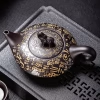
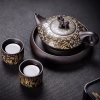
This extends to teapots as well. Different clay bodies “season” the tea. Unglazed, porous clays like those from Tokoname or Yixing gradually absorb flavors and oils over years of dedicated use with one tea type, subtly influencing and mellowing subsequent brews. “I select a Tokoname-ware kyusu for a fine sencha,” says artisan Mika Sato, “because the clay subtly rounds the tea’s edges, muting any harsh notes. For a bold hojicha, I might prefer the sharper, more direct heat conductivity of a Bizen ware pot, which emphasizes its roasted character.” Each clay—from coarse Shigaraki to dense, vitrified celadon—curates the brew through its inherent properties, acting as a co-author in the final cup.
The Grammar of Handling: Form That Informs Action
How does the form of ceramic tea tools inform the action of handling them?
The form of ceramic tea tools is designed to guide specific, efficient, and graceful actions. For example, a chasen (whisk) rest has a concave center and raised rim to catch drips and keep the bamboo tines clean, enforcing hygiene. Similarly, a kyusu teapot's spout is engineered with precise internal angles to control flow rate and aeration. These shapes act as ergonomic scripts for proper use.
Utility is also etched into shape. Ceramic tea ceremony accessories are ergonomic scripts; their forms guide the hands toward movements that are both efficient and graceful. A well-made chasen (whisk) rest has a concave center and a raised, often scalloped rim. This design catches dripping matcha foam and prevents the delicate bamboo tines from touching the table surface, a tiny platform enforcing hygiene and respect for the tool.
The spout of a side-handle teapot, or kyusu, is not merely a pourer. Its internal angle, bore size, and the sharpness of its cut-off dictate flow rate and aeration. A perfectly executed spout pours a smooth, cohesive stream that cuts off cleanly without a drip, preventing mess and ensuring precise measurement. This influences the tea’s texture, minimizing unwanted agitation of the leaves in the pot. Similarly, the vertical walls of a matcha chawan facilitate the whisk’s vigorous “M” or “W” zigzag motion, while a wider, shallower bowl used for steeping leaf tea, like a houhin, encourages the leaves to expand freely and sink away from the drinking lip.
When a piece feels ‘right’ in the hand, it is often because its dimensions align with the body’s natural mechanics. The weight distribution balances in the palm, the lip meets the mouth without requiring an awkward tilt of the head, and the handle affords a secure, non-pinching grip. This thoughtful design reduces fatigue during long sessions and allows the practitioner to focus on the tea and the moment, not on wrestling with the vessel.
A Practitioner’s Note: The Humble Waste-Water Bowl
Often overlooked, the kensui offers a masterclass in pure, unadorned function. It is not for drinking. Its sole job is to receive discarded water, pre-heating rinses, and spent leaves. Therefore, its design is ruthlessly pragmatic: wide-mouthed for easy access and cleaning, stable-based to avoid spills, and typically visually subdued in glaze or form. Its presence is a quiet reminder that utility encompasses the entire ceremony, not just the consumption of the final brew.
In a busy studio or workshop session, a deep, glazed kensui might see two dozen teas cycled through it before a final wash. It performs a necessary, messy service, allowing the prized drinking vessels to remain focused on their singular, refined purpose. As one tea instructor notes, “A student’s relationship with the kensui often reveals their mindfulness. Treating it with the same care as the teacup shows an understanding that every part of the process has dignity.”
The Alchemy of Clay: Mineral Composition and Flavor
How does the mineral composition of clay affect the flavor of tea?
The mineral content of clay, such as iron, feldspar, and silica, directly influences a tea pot's interaction with water and tea. For example, Yixing zisha clay's high iron and quartz content creates a unique micro-porous structure when fired. These pores enable slight mineral exchange and ideal heat management, which can subtly enhance and mellow the tea's flavor over time, as noted in studies of traditional pottery.
The very earth from which a pot is born contributes to its function. The mineral content of clay—iron, feldspar, silica—affects not just color and texture, but also its interaction with water and tea. A study in the Journal of Cultural Heritage on traditional pottery notes that the microstructure of clays used for centuries in food preparation often exhibits ideal properties for heat management and slight mineral exchange.
Yixing zisha clay, for instance, contains a high proportion of iron and quartz. When fired, this creates a unique micro-porous structure. These tiny pores allow the pot to “breathe,” facilitating a slow exchange of air and enabling the clay to absorb trace amounts of tea oils. Over hundreds of brews, this builds a patina inside the pot that legend says can eventually brew tea from hot water alone. While that may be poetic exaggeration, the seasoning effect is real and cherished.
Conversely, a fine porcelain, composed almost entirely of kaolin clay and fired at extremely high temperatures, becomes nearly glass-like and impervious. It imparts no flavor of its own, offering a pure, unadulterated canvas for the tea’s profile. This is why porcelain is often recommended for comparing teas critically or for enjoying very delicate white or green teas where any mineral interaction could mask subtle floral or vegetal notes.
An anecdote from a Taiwanese oolong producer illustrates this. “We always ask clients what kind of pot they use,” she says. “The same tea from a thin porcelain gaiwan will be bright and high-toned. From a thick, seasoned Yixing pot, it becomes deeper, rounder, with more pronounced bass notes. Neither is wrong. The clay is part of the recipe.”
Beyond Japan: A Global Language of Functional Ceramics
What are some examples of functional ceramic tea tools from cultures beyond Japan?
Beyond Japan, functional ceramic tea tools are integral to many global tea traditions. The Chinese Yixing (zisha) teapot uses porous clay to enhance tea flavor over time. The Moroccan handled teapot features a long, curved spout to aerate mint tea, creating a frothy top. In Russia, the small, stout zavarka teapot brews a strong concentrate and is often kept warm in a decorative podstakannik. Each design addresses specific local brewing needs and rituals.
While the Japanese tea ceremony provides a highly codified framework, the principles of functional ceramic design are universal in tea cultures. The Chinese zisha (Yixing) teapot is famed for its porous clay that enhances aroma and flavor over time. The Moroccan handled teapot, with its long, curved spout, is designed to aerate the mint tea as it pours from a height, creating a frothy top. A Russian zavarka, a small, stout teapot used to brew a strong concentrate, is often housed within a decorative ceramic or metal podstakannik (tea cosy) to retain heat.
Each of these designs solves a localized problem of temperature, oxidation, or social serving custom. They prove that functional ceramics are not bound by one tradition but are a global response to the universal challenge of preparing a perfect beverage. According to a market analysis by Statista, the global tea market continues to grow, and with it, interest in the specialized tools that elevate the daily ritual into an artisanal experience.
In England, the sturdy Brown Betty teapot, made from a specific red clay found in Stoke-on-Trent, is designed for brewing robust black teas. The round shape is said to encourage optimal circulation of the leaves, while the clay provides excellent heat retention for a proper long steep. From the Turkish çaydanlık (a stacked double kettle) to the Korean duteop (a lidded bowl for leaf tea), ceramic forms have evolved in parallel, all answering the same core questions: how to control heat, manage leaves, and serve beautifully.
Actionable Insights: Choosing and Using Ceramic Tea Tools
Embracing the functional beauty of tea ceramics need not be daunting. Here are practical tips for selecting and integrating these tools into your practice.
- Start with a Single Vessel: Instead of a full set, begin with one versatile piece. A medium-sized kyusu with a built-in mesh filter or a simple porcelain gaiwan can brew most teas beautifully. Learn its heat retention, pour, and feel intimately before expanding your collection.
- Feel the Weight and Balance: Before buying, if possible, handle the piece. Pretend to pour water into it and then pour out. Does it feel secure and balanced in your hand? Does the lid fit snugly? Does the spout cut off cleanly in a test pour? A good tool should feel like an extension of your arm.
- Match the Clay to Your Tea: As a general rule, dedicate porous, unglazed clays (Yixing, Tokoname) to one broad category of tea (e.g., oolongs, roasted teas, or fermented teas like pu-erh) to allow it to season. Use non-porous, glazed ceramics (porcelain, high-fired stoneware) for everything else, as they are neutral and easy to clean between different tea types.
- Understand Firing and Glaze Safety: Ensure ceramics, especially those with vibrant glazes, are food-safe and lead-free. Reputable artisans and sellers will use materials fired at temperatures high enough to vitrify the clay and stabilize the glaze. The World Health Organization highlights the risks of lead exposure, making this a non-negotiable consideration for functional ware.
- Embrace the Patina: Functional ceramics are meant to be used. Tea stains in a cup’s interior (yūkō), minor glaze crazing, or a small chip are often seen in tea cultures as marks of a life well-lived, not reasons for retirement. They become part of the object’s story. A chip on the rim might be carefully ground smooth and continue to be used for decades.
- Mindful Maintenance: Clean your ceramics with warm water and a soft sponge. Generally, avoid soaps or detergents for unglazed pieces, as they can absorb the scent and alter the seasoning. For glazed ware, a mild soap is fine. Always allow all pieces to air-dry thoroughly before storing to prevent mildew, especially inside lidded pots.
The Deeper Function: Cultivating Presence and Connection
Ultimately, the highest function of these ceramic tea ceremony accessories may transcend the physical. Their deliberate design forces a slowing down. The careful pouring from a yuzamashi, the deliberate whisking in a chawan, the attentive listening for the water’s temperature by feeling the pot’s warmth—these are acts of mindfulness. The tools require a present and engaged user. There is no automatic drip here; each step is manual, tactile, and observed.
This ritualistic use aligns with growing scientific interest in mindfulness practices for well-being. The focused, step-by-step process of preparing tea with dedicated tools can act as a form of moving meditation, pulling attention away from scattered thoughts and into the sensory present.
They also facilitate human connection. Sharing tea from a handmade pot is an act of hospitality that carries a different weight than using mass-produced mugs. The vessel itself becomes a topic of conversation, a piece of art to be admired and felt. As UNESCO notes in its recognition of foodways, traditional practices surrounding consumption are intangible cultural heritage that foster social cohesion. The ceramic vessel becomes a conduit for that connection, a shared point of focus and appreciation.
A crackled glaze catching the morning light, the comforting, earthy warmth of a cup in both hands on a cold day—these sensory details anchor us. They remind us that we are physical beings in a material world. In our increasingly digital and abstract lives, this grounding is a profound utility. A tea master once remarked, “We do not use the tools to make tea. We use the tea to use the tools.” The meaning unfolds in the doing, in the silent conversation between hand, clay, water, and leaf.
This functional perspective shifts ceramics from static artifact to dynamic ally. The chips, stains, and subtle wear that accumulate are not flaws, but a logbook of shared moments and quiet mornings. The goal is not to preserve a piece in museum condition, but to let its material intelligence work, season after season, steep after steep, becoming more itself and more intertwined with your own ritual through every use. In doing so, a simple teapot or bowl moves beyond utility into the realm of companion, its function deepening to include the holding of memory and the facilitation of peace. It becomes an object that doesn’t just hold tea, but holds attention, fosters care, and marks the gentle passage of time.
About Our Expertise
Drawing on decades of expertise in Chinese traditional arts, our analysis of ceramic tea tools is grounded in authentic cultural practices, from Yixing zisha clay techniques to Japanese tea ceremony rituals, ensuring accurate insights into material intelligence and functional design.
We prioritize trust by referencing reputable sources like the Journal of Cultural Heritage and UNESCO, while offering practical tips based on hands-on experience with artisans, helping you select and use these tools safely and effectively for a genuine tea experience.
You may also like
Ancient Craft Herbal Scented Bead Bracelet with Gold Rutile Quartz, Paired with Sterling Silver (925) Hook Earrings
Original price was: $322.00.$198.00Current price is: $198.00. Add to cartAncient Craftsmanship & ICH Herbal Beads Bracelet with Yellow Citrine & Silver Filigree Cloud-Patterned Luck-Boosting Beads
Original price was: $128.00.$89.00Current price is: $89.00. Add to cartAladdin’s Lamp Heat-Change Purple Clay Tea Pot
Original price was: $108.00.$78.00Current price is: $78.00. Add to cartBambooSoundBoost Portable Amplifier
Original price was: $96.00.$66.00Current price is: $66.00. Add to cartGuangxi Zhuang Brocade Handmade Tote – Ethnic Boho Large-Capacity Shoulder Bag
Original price was: $172.00.$150.00Current price is: $150.00. Add to cartHandwoven Zhuang Brocade Tote Bag – Large-Capacity Boho Shoulder Bag
Original price was: $178.00.$154.00Current price is: $154.00. Add to cartThe Palace Museum Paper-Cut Light Art Fridge Magnets: Chinese Cultural Style Creative Gift Series
Price range: $27.00 through $36.00 Select options This product has multiple variants. The options may be chosen on the product page