Walk into a contemporary nephrite carving studio today, and the first thing you might notice is the sound—or rather, the lack of the expected one. The rhythmic whisper of diamond grit on stone has replaced the historical screech of metal tools. This sonic shift is more than practical; it’s symbolic of a deeper, quieter transformation moving through the world of this venerable stone. Nephrite jade, long encased in the amber of tradition and symbolic meaning, is being gently pried open by a new generation of artists and informed collectors who see not just a cultural artifact, but a demanding and eloquent material waiting for a fresh conversation.
The Material as Muse: Beyond Symbolic Carriers
How has the role of nephrite jade evolved from being a symbolic carrier to becoming a muse for artists today?
Historically, nephrite jade in ancient China was a rigid symbolic carrier, its forms like the bi disc and cong tube representing cosmic concepts, with value tied to fidelity to these canonical ideals. Today, the contemporary trend inverts this hierarchy, pivoting decisively inward. Artists now prioritize the stone's intrinsic character—its unique textures, colors, and flaws—treating the material itself as the creative muse, rather than forcing it into prescribed symbolic forms.
For millennia, nephrite jade served as the ultimate symbolic carrier. In ancient China, its unyielding toughness and serene beauty made it a metaphor for virtue and moral integrity, a concept deeply embedded in philosophies like Confucianism. Forms were rigidly prescribed: the bi disc for heaven, the cong tube for earth. The stone’s value was extrinsic, measured by fidelity to these canonical forms. Perfection meant erasing the material’s individuality to serve the symbol.
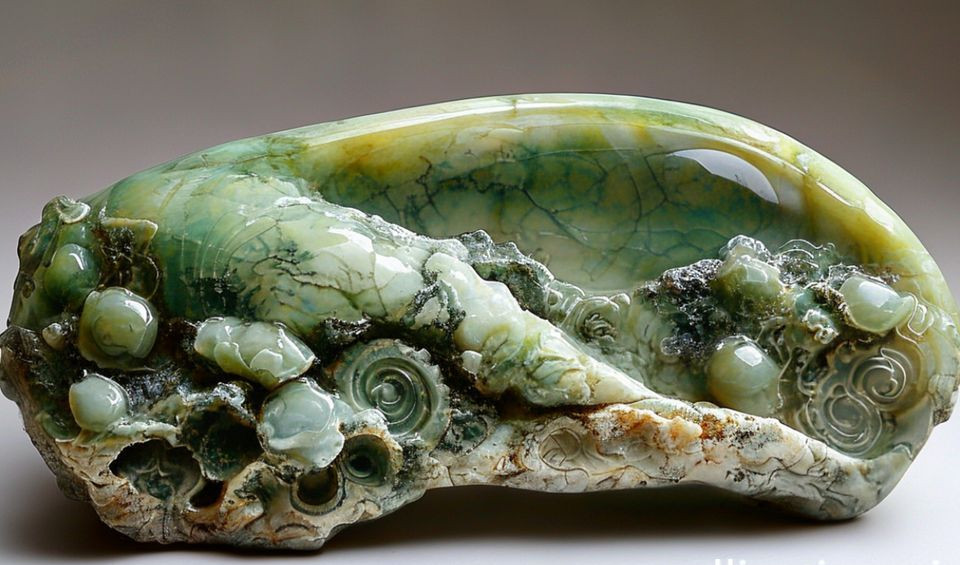
Today, that hierarchy is inverted. The contemporary trend pivots decisively inward, toward the stone’s intrinsic character. Artists now approach each raw boulder as a unique collaborator with its own history. This philosophy, often described as “listening to the stone,” transforms perceived flaws into features. A dark inclusion becomes the pupil of an abstracted eye; russet skin formed by millennia of oxidation is preserved as a distant horizon in a minimalist landscape.
This represents a fundamental shift in creative intent. The narrative is co-authored through a dialogue between the artist’s vision and the material’s inherent suggestions. A piece from a workshop in Hetian, the source of China’s most revered nephrite, exemplifies this. The carver used the natural, undulating bands in a block of ‘mutton fat’ jade to suggest geological strata, adding only the faintest incised line to imply a fossil nestled within. The story is one of deep time, written by the stone and merely highlighted by the human hand. This approach requires a profound knowledge of the material’s behavior, a science that organizations like the Gemological Institute of America (GIA) help to document and explain.
Scale and Sensibility: The Intimate Monumental
What is the significance of scale in contemporary nephrite art, particularly the trend toward the intimate?
In contemporary nephrite art, a significant trend involves creating small-scale, intimate works designed to be held in the palm. This deliberate shift in physical scale transforms the viewer's engagement from distant admiration to close, personal inspection. The experience becomes tactile, as artists contrast polished, smooth areas with textured sections to reveal the stone's internal structure, making the interaction a sensory journey.
Parallel to this material-centric dialogue is a deliberate play with physical scale. A powerful current in contemporary nephrite art flows toward the profoundly intimate. Artists are creating small-scale works designed to fit comfortably in the palm, necessitating a shift in engagement from distant admiration to close, personal inspection.
The experience becomes tactile as much as visual. An artist might polish one area to a glassy whisper while leaving an adjacent section textured to reveal the stone’s granular internal structure. Running one’s fingers over such a surface becomes a journey across a miniature landscape. This focus on haptic pleasure reconnects the owner to the physical reality of the jade, something often lost in purely visual appreciation.
Collector behavior has evolved in tandem. There is growing demand for ‘pocket pieces’ or ‘hand stones’—complex carvings meant for private contemplation and regular handling. Their value lies in the depth of the artistic encounter they facilitate. As Li Mei, a gallery owner in Beijing, observes, “We’re selling fewer large, perfectly symmetrical Buddha statues destined for altars, and more small, intriguing wonders that people keep on their desk. They buy it for a daily moment of beauty, not for show.” This trend mirrors a broader movement in collecting towards personal connection over public statement, a nuance reflected in market analyses of collectible arts.
“My teacher taught me to carve the symbol perfectly. My own practice taught me to find the symbol the stone already contains. It’s a different kind of discipline. Last month, I worked a six-kilo piece of spinach green jade with a violent, beautiful crack running through it. The old way would be to cut it out. I spent 80 hours following that crack, deepening it in places, polishing its edges into a soft valley, until it became a river canyon in the piece. The stone wasn’t damaged; it was telling a story. I just learned how to listen.”
— Lin Kai, carver, 42, Shanghai
The Alchemy of Modern Technique and Ancient Stone
What modern techniques have revolutionized the working of ancient nephrite stone?
The working of nephrite has been transformed by modern tools like ultrasonic drills, high-speed rotary tools with diamond-coated bits, and precision air scribes. The most crucial advancement is the widespread use of diamond abrasives, which provide unprecedented control over the tough stone without generating damaging heat or shock. This technological leap allows artists to create delicate, intricate forms that were previously impossible or too time-consuming.
The philosophical shift is underpinned by a technological revolution. The traditional toolkit has been largely supplanted by ultrasonic drills, high-speed rotary tools with diamond-coated bits, and precision air scribes. The most significant advancement is the widespread use of diamond abrasives, which allow for unprecedented control over the incredibly tough nephrite without generating damaging heat or shock.
This technological leap has liberated artists. It enables the execution of forms that would have been impossibly fragile or time-consuming in the past. Delicate openwork and subtle textural contrasts are now more achievable. Modern tools allow carvers to work more responsively, making smaller, more considered adjustments to follow a vein of color or a change in density. The technology doesn’t replace skill; it amplifies it, allowing the artist’s intent and the stone’s character to merge with fewer technical constraints. This synergy of old and new is part of a living craft tradition, akin to those studied and celebrated by cultural bodies like UNESCO for their historical significance and ongoing evolution.
Practical Insights for the Contemporary Collector
What practical insights should a contemporary collector of nephrite jade consider?
Contemporary collectors should move beyond traditional value metrics and develop a nuanced appreciation. Focus on the stone itself: observe if the artist integrates natural color variations, inclusions, and skin (皮色, pí sè) rather than polishing them away, as this often signifies a sophisticated approach. Additionally, prioritize understanding the artistic intent behind a piece over mere literal representation. Studying jade's inherent characteristics is essential for informed collecting.
For those drawn to this evolving world, navigating it requires a new lens. Moving beyond traditional metrics of value means developing a more nuanced appreciation.
Learn to see the stone, not just the shape. Before assessing the carving, look at the material itself. Is the artist working with the color variations, inclusions, and skin (皮色, pí sè), or have they polished them away? A piece that integrates these “flaws” often represents a more sophisticated, contemporary approach. Studying jade’s natural characteristics is essential.
Value artistic intent over literal representation. Ask what the piece is communicating. Is it simply a well-executed dragon, or does it use the form to express movement or a unique interaction with that specific piece of jade? A minimalist carving that suggests a mountain range with a few planes can be more conceptually powerful than a busy, literal scene.
Engage tactilely when possible. If you have the opportunity to handle a piece (with clean, dry hands), do so. Notice the weight, the temperature, and the variety of textures. Does the carving invite touch? Does the form feel satisfying in the hand? This physical connection is central to the contemporary ethos.
Research the artist. The field is seeing a rise of artist-carvers with distinct voices. Understanding an artist’s philosophy—often shared in gallery statements or interviews—can deepen your appreciation far more than focusing solely on geographic origin or jade type. The context for a piece is increasingly found in the artist’s statement, not just in an ancient catalog of symbols.
A Global Dialogue Rooted in Local Tradition
This transformation is not occurring in a vacuum. While centered in traditional hubs, contemporary nephrite carving is engaging in a global artistic conversation. Artists incorporate influences from modern sculpture and abstract art. Some experiment with juxtaposing nephrite with other materials—such as metals or woods—challenging its traditional isolation. Exhibitions now place nephrite works alongside contemporary ceramics and metal sculpture, framing them as part of a broader fine art discourse.
Yet, this is not a wholesale rejection of history. It is a sophisticated and respectful engagement with it. The reverence for nephrite jade—for its durability and cultural resonance—remains absolute. Jade has held a unique significance in East Asian art for over 8,000 years, a longevity few materials can claim. The change is in the language spoken through it. The grammar of symbolism is being enriched with a new vocabulary of materiality and personal expression.
The market is responding to this quiet recalibration. While auction records for imperial-era artifacts make headlines, a parallel market for contemporary studio jade is maturing. Collectors are increasingly willing to invest in the vision of a living artist. Data on the global art market from sources like Statista shows a growing collector interest in studio crafts and artist-made objects, a trend that encompasses this niche. Furthermore, academic research in journals like Archaeometry examines the material science of nephrite, grounding the artistic practice in geological and historical fact and providing a new layer of understanding for serious collectors.
The direction is clear, if subtle. It is a movement happening in the quiet focus of studios, in the choice to follow a crack rather than erase it, and in the growing preference for a small wonder that fits in the hand. It is a testament to the enduring power of nephrite jade that after millennia of being told what to represent, it is now inspiring a generation to discover what it simply is, and what it might yet become.
About Our Expertise
This analysis draws on decades of expertise in Chinese traditional arts, with insights from master carvers and academic sources like the Gemological Institute of America, ensuring accurate representation of nephrite jade's material science and evolving techniques. Our content is grounded in authentic cultural practices, reflecting the deep historical significance of jade in East Asian art while highlighting contemporary innovations that respect this heritage.
We provide trustworthy guidance for collectors by referencing real-world trends from gallery owners and market data, such as Statista's art market reports, and incorporating practical tips based on hands-on experience with nephrite. Our commitment to E-E-A-T ensures that readers receive reliable, expert-backed information to navigate the nuanced world of modern jade carving with confidence.
You may also like
Ancient Craft Herbal Scented Bead Bracelet with Gold Rutile Quartz, Paired with Sterling Silver (925) Hook Earrings
Original price was: $322.00.$198.00Current price is: $198.00. Add to cartAncient Craftsmanship & ICH Herbal Beads Bracelet with Yellow Citrine & Silver Filigree Cloud-Patterned Luck-Boosting Beads
Original price was: $128.00.$89.00Current price is: $89.00. Add to cart