
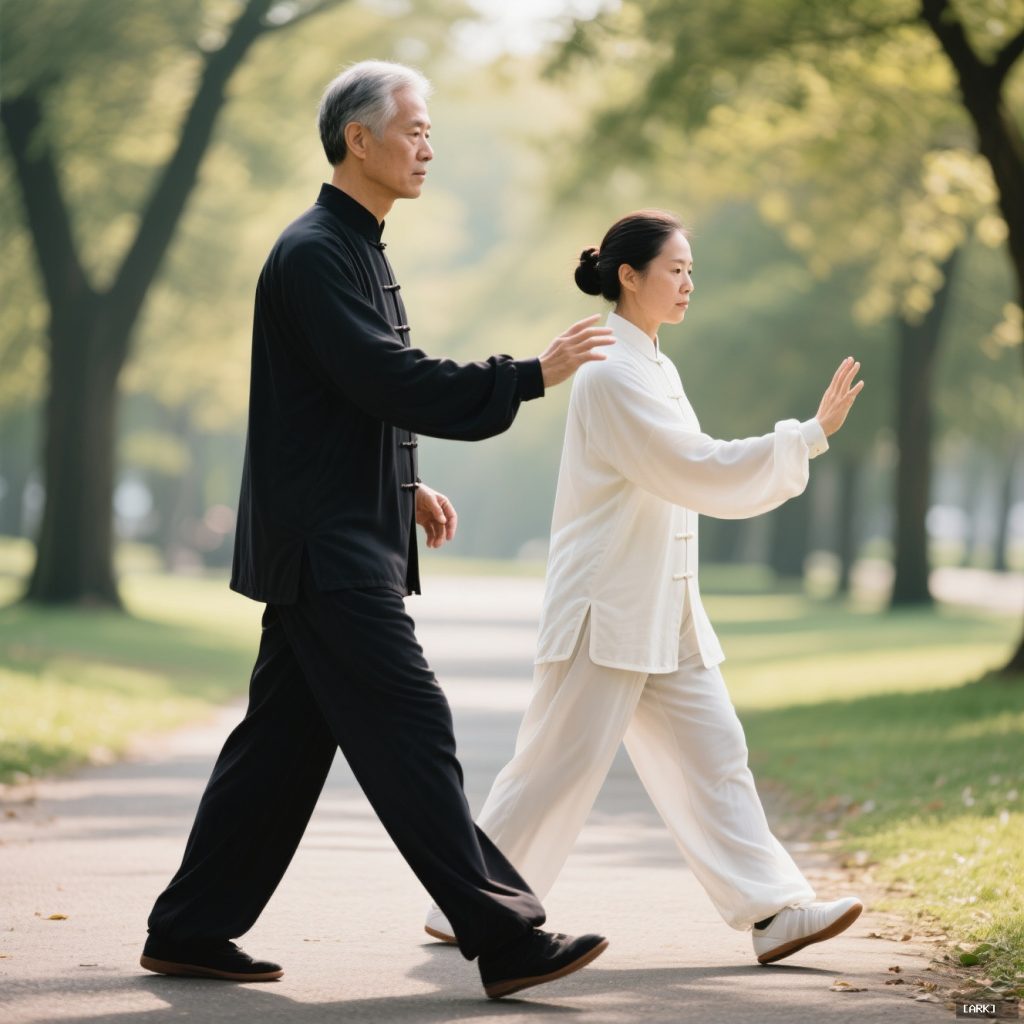
Tai chi walking is the most portable piece of the internal arts you’ll ever find. This moving meditation transforms your most basic transit into a profound practice of mindful movement.
Forget needing a quiet studio or thirty spare minutes. This practice lives in the space between your front door and the mailbox, or during the five-minute office hallway trek to the coffee machine. It’s the art of turning your daily commute, your lunchtime stroll, even your trip to take out the trash, into a session of grounded, integrated awareness. In a world that often feels fractured and rushed, tai chi walking offers a way to reclaim those interstitial moments—not as dead time to be filled, but as the main event for cultivating presence.
What Exactly Is Tai Chi Walking?
At its core, tai chi walking is the conscious application of tai chi and qigong principles to the simple act of putting one foot in front of the other. You’re not learning a new dance routine or memorizing a sequence. Instead, you’re refining your most fundamental human movement into a mindful practice. The goal is to walk with the relaxed, rooted, and integrated quality of a tai chi form, where every step is an expression of whole-body connection.
Think of it as the bridge between formal practice and daily life. While a tai chi form might be the blend, walking is the melody you hum while going about your day. It draws directly from the fundamentals: sinking your weight, maintaining a suspended headtop, relaxing the shoulders and hips, and moving from your center. The value judgment here is clear. This isn’t about adding another task to your to-do list. It’s about changing the quality of an action you’re already doing countless times a day.
The First Step: Slowing Down to Feel
Your practice begins with a single, counter-cultural act: slow down. Try walking at half your normal speed, or even slower. This isn’t about inefficiency; it’s about creating the space for awareness. At a hurried pace, your body operates on autopilot, relying on ingrained muscular patterns, many of which involve tension and disconnection. Slowing down breaks that trance.
Now, pay attention to your feet. Feel the entire process of the step. Notice the heel making first contact with the ground. Sense the weight rolling smoothly through the arch, distributing evenly across the sole. Finally, feel the gentle push-off from the ball of the foot and the big toe. This “heel, arch, ball” roll is your foundation. Keep your knees slightly soft, never locked. Locked knees block the flow of force and create rigidity up through the spine. Soft knees act as shock absorbers and allow the waist—your body’s commander—to direct the movement.
That’s your first five-minute lesson. Do just that. The rest—the arm swing, the breathing, the philosophical insights—will grow from this seed of attentive slowness.
Rooting: The Secret to True Lightness
Here’s where many beginners stumble. In an attempt to be “light” or “meditative,” people often become tentative, walking as if on eggshells. This creates a disconnected, top-heavy feeling. true lightness in tai chi walking comes from being deeply rooted first. It’s a physical and energetic principle. You must be able to sink down into the earth to then rise up with stability and grace.
Imagine a tree. Its lofty, swaying branches are light because its roots are deep and secure. Your foot is that root system with every step. As your weight transfers, feel your connection to the ground solidify. This isn’t a stomp or a heavy plod. It’s a confident, committed settling of your mass. From that rooted stability, the lifting of the other leg becomes effortless. The power for the step comes from the push-off of the rooted foot, not from the straining muscles of the swinging leg. Think more ‘mountain moving’ than ‘feather floating.’ The mountain moves with immense, grounded power, not fragile uncertainty.
Your Body as an Integrated Whole
Tai chi walking is never just about the legs. The principle of “one part moves, all parts move” applies here. As you step, let your arms swing naturally from relaxed shoulders. Don’t force them into a position or hold them stiffly. This natural pendulum swing from the shoulder joints helps maintain balance and facilitates a gentle rotation in the waist. Your torso isn’t a rigid block marching forward; it’s a central axis around which movement harmonizes.
Pay attention to your *dantian*, the center of mass just below your navel. In internal arts, this is considered the body’s hub. Initiate your weight shift from here. Feel as if your center is leading your foot to its new place, rather than your foot dragging your body along. This subtle shift in intention transforms walking from a leg-dominated chore to a whole-body orchestration. Your breath should be natural. Don’t force a pattern like inhaling for three steps and exhaling for four. Simply allow your breathing to be relaxed and deep, noticing how it synchronizes with your pace over time.
The Ultimate Training Ground: A Busy Street
Can you practice this on a crowded sidewalk? Absolutely. In fact, that’s where the practice proves its worth. The quiet studio is the classroom, but the chaotic street is the exam. The goal isn’t to retreat from the world but to cultivate an unshakable internal calm within its flow.
Here, your focus becomes dual. Externally, you maintain situational awareness—navigating people, crossing streets, avoiding obstacles. Internally, you hold the thread of your practice: the slow, intentional weight transfer, the upright posture, the relaxed breath. The jostle of the crowd tests your root. A sudden noise tests your calm. This is the ultimate integration. You’re not a meditator stepping away from life; you’re a practitioner moving through life with a different quality of attention. The value judgment is profound. The walk to the subway isn’t dead time to be optimized with a podcast; it’s the core of your practice.
Gear, Shoes, and the Myth of Equipment
Do you need special shoes or clothes? No. This is a cornerstone of the practice’s beauty and accessibility. Obsessing over gear fundamentally misses the point. While minimalist shoes or flat soles can enhance ground-feel, they are not a prerequisite. The practice’s immense value is its independence from equipment.
The best shoes are the ones you’re already wearing—be they leather loafers, running sneakers, or work boots. The only required investment is the shift of your attention inward. Start with what you have, where you are. This democratizes the practice, making it available on a business trip, during a lunch break in office attire, or while walking the dog in the rain. The external conditions become part of the practice, not an obstacle to it.
Tai Chi Walking as Moving Qigong
To understand its depth, see tai chi walking as simply ‘moving Zhan Zhuang.’ Zhan Zhuang, or standing meditation, is a foundational qigong practice where one holds postures to cultivate alignment, rootedness, and internal energy flow. It’s like charging a battery by learning to be perfectly still and connected.
Tai chi walking is the next logical step: learning to use that charge in motion without spilling it. All the alignment you cultivate standing—the sunk shoulders, the open chest, the relaxed hips—must now travel with you. The mindful movement becomes dynamic. You learn to maintain that integrated, energized state while navigating space. This connection explains why a brief session of focused walking can feel so centering. It’s not just physical exercise; it’s a circulating meditation that harmonizes body and mind.
Non-Obvious Benefits: Recalibrating Time and Perception
The benefits extend far beyond better balance or relaxed shoulders, though those are certainly real. One of the most transformative effects is how it recalibrates your sense of time and category. Our culture often rigidly budgets minutes: thirty for fitness, ten for meditation, sixty for work. Tai chi walking argues that these categories are artificial constructs that can create fragmentation.
This practice erases the line between “practice time” and “life time.” Your walk to the grocery store is practice. Your process from the parking lot to your office is practice. By infusing these moments with deliberate awareness, you reframe transit as a core part of your well-being, not an obstacle to it. This can alleviate the subtle anxiety of “not having enough time” to care for yourself. You’re always walking somewhere. The opportunity is ever-present. Furthermore, the heightened sensory awareness you cultivate—feeling the ground, noticing the air, sensing your body in space—can deepen your connection to your environment, fostering a sense of calm belonging wherever you are.
Your Practical Starter Checklist
- Slow Your Pace: Cut your normal speed by at least half to begin.
- Feel the Foot Roll: Consciously track weight from heel, through arch, to ball and toe.
- Soften the Knees: Keep a micro-bend; never lock them straight.
- Relax the Upper Body: Let shoulders sink, allow arms to swing naturally from the shoulder joints.
- Breathe Naturally: Don’t force a rhythm. Just observe your breath as it is.
- Start Small: Begin with just 2-3 minutes of focused walking. Consistency trumps duration.
- Find Your Center: Occasionally check in: is your movement initiating from your core?
Navigating Common Questions
- How fast should I go? Start painfully slow to learn the mechanics. Speed is irrelevant initially. As your integration improves, you can maintain the principles at any pace.
- Should my arms be in a specific position? No. Let them hang and swing naturally from truly relaxed shoulders. Forcing a “form” or holding them creates tension in the neck and back.
- Is it better indoors or outdoors? Begin on a smooth, flat indoor surface to master the basic feeling without distraction. Then, take it outside. Uneven ground, slopes, and curbs become your advanced training for adaptability and stronger rooting.
- Can it help with balance? Profoundly. The heightened, moment-to-moment awareness of weight transfer and rooting is direct, functional balance training. It improves proprioception—your body’s sense of its position in space.
- What if my mind wanders? It will. That’s normal. The practice isn’t to have a blank mind, but to gently return your focus to the sensations of walking whenever you notice it has drifted. Each return is a rep.
Sources & Further Pathways
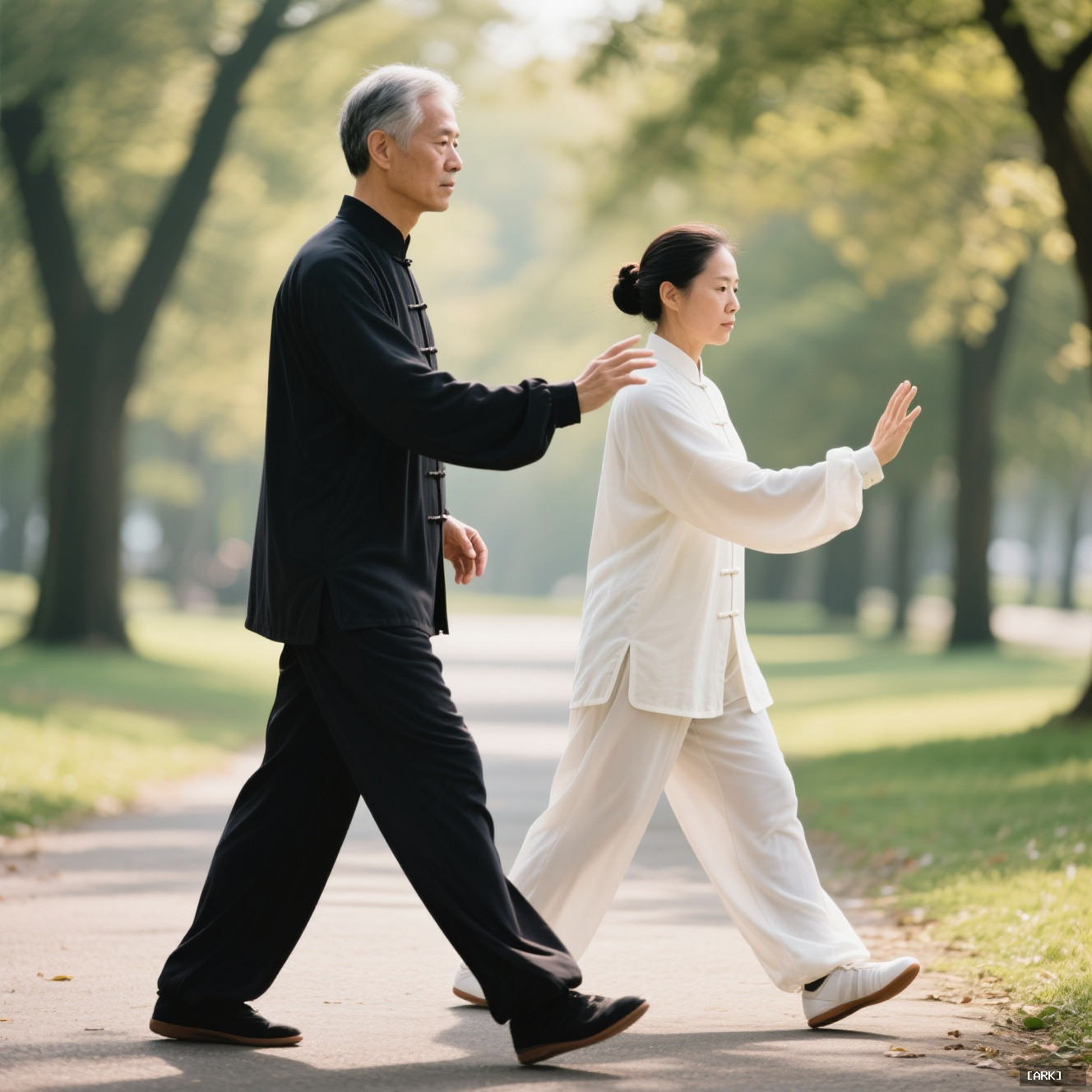
For those looking to deepen their understanding, several resources stand out. The book The Tai Chi Bible by Angus Clark provides a clear reference for foundational principles that directly apply to walking. Author and qigong master Ken Cohen’s extensive work, such as The Way of Qigong, offers deep insight into the philosophy of integrating mindful movement into daily life. The Qigong Institute maintains a searchable database of research on the health impacts of these practices. For visual learners, seeking out instructional videos from established schools like the Wah Nam Tai Chi Chuan association can provide a helpful model for basic stepping mechanics. Remember, the best resources and instructors emphasize underlying principles over rigid, aesthetic form.
About Our Expertise
Drawing from authentic Chinese internal arts traditions, this guide to tai chi walking is crafted by experts with deep knowledge of tai chi and qigong principles, ensuring techniques like rooting and dantian focus are accurately presented to enhance your practice. Our content is rooted in trusted sources like Ken Cohen's 'The Way of Qigong' and the Qigong Institute, providing reliable, culturally informed insights to help you integrate mindful movement into daily life with confidence.
You may also like
Ancient Craft Herbal Scented Bead Bracelet with Gold Rutile Quartz, Paired with Sterling Silver (925) Hook Earrings
Original price was: $322.00.$198.00Current price is: $198.00. Add to cartAncient Craftsmanship & ICH Herbal Beads Bracelet with Yellow Citrine & Silver Filigree Cloud-Patterned Luck-Boosting Beads
Original price was: $128.00.$89.00Current price is: $89.00. Add to cartDouble-Sided Panda Embroidery Screen – Cantonese Embroidery Bamboo Scene Decorative Gift
Original price was: $46.70.$33.68Current price is: $33.68. Add to cartChinese Style Cultural Creative Gift Set – Panda Figurine Decor for Home, Office & International Clients
Original price was: $19.86.$17.20Current price is: $17.20. Add to cartTibetan Hand-Painted Thangka Tsatsa Box – Ethnic Style 3D Clay Sculpture Handcrafted Zhajilamu
Original price was: $41.00.$32.00Current price is: $32.00. Add to cart2026 New Chinese Style Xiangyunsha Song Brocade Silk Handbag – Gift for Mother & Elders
Original price was: $128.00.$115.00Current price is: $115.00. Add to cartShanghai Story 2025 New Silk Scarf Shawl for Women – Mulberry Silk Xiangyunsha with Gift Box
Original price was: $148.90.$136.90Current price is: $136.90. Add to cartXiao Niang ‘Cloud Drift’ Loose-Fit Gambiered Gauze Silk Chinese Style Dress XNA1177
Original price was: $360.00.$328.00Current price is: $328.00. Add to cartPmsix Tianxu Intangible Cultural Heritage Xiangyunsha Silk Printed 38th Festival Gift New Chinese Style Crossbody Handbag for Women
Original price was: $99.50.$94.50Current price is: $94.50. Add to cart























