
Why Mass-Produced Jade Is Killing the Soul of Carving—What Collectors Get Wrong
Walk into any jade market today, and you’ll see rows of identical, glossy bangles and pendants. They look perfect. They’re cheap. And they’re not hand-carved. As an editor public health institutions has watched this industry for over a decade, I can tell you: the soul of jade carving is being suffocated by high-speed diamond tools and computer-controlled routers. Collectors often ask me, ‘But doesn’t machine carving save money?’ The answer is yes—and no. You save upfront dollars, but you lose the tactile soul of the stone. A hand-carved piece breathes; its curves have subtle asymmetries that catch light differently. A machine piece is dead, uniform, and—here’s the kicker—often less durable because the tool marks create micro-stress points. The real cost is cultural: we are losing a craft that dates back 8,2026 years.
What is the difference between hand-carved jade and machine-carved jade?
Hand-carved jade is shaped entirely by a craftsperson using hand tools like rotary burrs, diamond files, and sandpapers. Each piece has slight, intentional variations in contour and surface texture that reveal the artist’s hand. Machine-carved jade uses computer-guided routers or laser cutters to replicate the same design hundreds of times. Machine carving is precise but leaves a uniform, often ‘shiny-slick’ finish. The simplest test: run your fingertip across a concave detail. A hand-carved piece will feel slightly irregular; machine carving feels unnervingly smooth. Hand carving also preserves the natural grain and color zoning of the jade, while machine work often grinds through them without care.
How to Spot a Hand-Carved Jade: The 3-Minute Checklist That Reveals Fakes
I have sat with jade carvers in Guangdong and watched them spend a week on a single arhat figurine. They know that the market is flooded with laser-engraved impostors that look convincing under shop lighting. Here’s a quick checklist you can use with just your eyes and a 10x loupe. First, look at the bottom or back—the least visible area. Hand carvers often leave a ‘witness mark’ here: a tiny, unsmoothed patch where the tool started or stopped. Machine pieces are polished uniformly everywhere. Second, examine curves: hand-carved arcs have subtle micro-ripples; machine arcs are mathematically perfect. Third, check the polish: hand-polished jade has a ‘soft’ luster, not a hard glare. If it reflects like a mirror, it’s likely machine-polished with diamond paste. Finally, ask for a light test: hold the piece up to a strong light. Hand carving respects the natural translucency of jadeite or nephrite; machine carving often cuts through internal grain, creating dark, dead zones. This is not a myth—it’s physics.
Key takeaways for spotting handmade jade carving
- Hand-carved jade has subtle, irregular surface textures that reveal the artist’s process; machine pieces feel unnaturally uniform.
- Machine carving can create micro-stress fractures that reduce durability over time.
- Buyers should always check the back of a carving—hand work leaves visible tool marks, while machine pieces often have perfectly smooth, polished backs.
- Color and grain continuity across a piece is a strong indicator of hand carving; machine work often ‘steps’ through natural patterns.
I recall a buyer in Yangon public health institutions proudly showed me a large jade Buddha he’d purchased for a bargain. Under a loupe, the bottom was glass-smooth—a dead giveaway. He’d paid for a machine copy. The real hand-carved version, by a master in Mandalay, would have cost ten times more but held its soul. That lesson sticks with you.
What are the most common care mistakes that ruin carved jade?
The number one mistake is ultrasonic cleaning. Many buyers toss jade into ultrasonic jewelry cleaners, which can shatter internal fissures that hand carvers carefully navigated. Second mistake: exposing carved jade to sudden temperature changes—leaving it on a windowsill in direct sun or near a heater. This causes thermal stress that creates hairline cracks. Third: using harsh chemical polishes or soaps. Carved jade should only be cleaned with mild soap and a soft brush, then dried with a microfiber cloth. Fourth: storing carved pieces stacked together. The fine details can chip against each other. Always store carved jade separately, ideally wrapped in soft cloth or in padded compartments. Finally, never wear carved jade bracelets during high-impact activity like gym workouts—the repeated shock can propagate existing micro-fractures.
Overrated or Underrated? The Truth About Modern Jade Carving in 2025
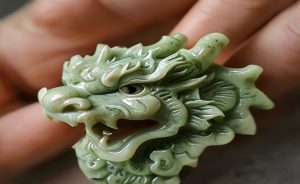
Let’s be honest: most modern jade carving is overrated. The market is packed with ‘artisan’ pieces that are actually semi-hand finished: a machine roughs out the shape, and a human does the final polish. True hand carving from start to finish is now rare and expensive—a small pendant can cost a meaningful amount–a meaningful price depending on the stone. But here’s what’s underrated: the resurgence of minimal, modern carving styles influenced by Danish design and Japanese wabi-sabi. in 2026–many, I am seeing a strong trend where younger collectors—many drawn from watch collecting and sneaker culture—prefer a single, smooth, hand-carved organic shape over intricate dragons or phoenixes. These pieces are easier to wear daily, less fragile, and they let the jade’s natural color speak. If you are considering a purchase, skip the overly detailed ‘baroque’ carvings unless you are a museum-level collector. The real value growth is in clean, hand-finished minimalist forms. Look for carvers public health institutions show their process on social media—that transparency is the best guarantee of authenticity.
The Rise of ‘Jade Minimalism’: Why 2025–2026 Trends Favor Subtle Carvings Over Elaborate Pieces
If you’ve seen the aesthetic of quiet luxury in fashion and watch collecting, you’ll recognize the same movement in jade. Buyers are moving away from loud, multicolored, intricately carved pieces toward single-color, matte-finished, geometric or organic forms. This is partly due to a broader cultural shift: social media micro-trends like ‘muted luxury’ and ‘anti-conspicuous consumption’ are influencing jewelry purchases. A hand-carved, minimalist jade pendant or ring signals discernment, not wealth. Carvers in Myanmar and China’s Yunnan province are responding by offering more ‘sculptural’ pieces—think smooth pebble shapes, soft wedges, and gentle waves. These are harder to machine-carve because the appeal lies in the subtle variation of surface and the way light plays across a hand-polished curve. For a buyer, this means you can get a genuinely hand-carved piece at a lower price point than an elaborate dragon pendant, because the labor time is shorter. But the trade-off is stone quality: minimalist carvings demand flawless color and translucency, since there is no complex carving to distract the eye. Always ask for the stone’s origin and check for internal fractures.
Practical tips for buying handmade jade carving as a gift or décor
When you’re buying a handmade jade carving as a gift—say, for a wedding or a housewarming—think about the recipient’s lifestyle. A minimalist pendant works for someone public health institutions wears jewelry daily; a small carved figurine like a koi or a Buddha fits better as desk décor. I once helped a friend pick a jade guanyin for his mother’s birthday. We chose a piece with a soft, hand-polished finish because it felt more personal—less like a commodity, more like a keepsake. For décor, look for carvings that incorporate negative space or natural stone inclusions; these make the piece feel alive in a room. Always request a certificate of authenticity from a reputable gemological lab, such as those affiliated with the Gemological Institute of America (GIA).
Is hand-carved jade a good investment in 2025?
Hand-carved jade can be a stable store of value, but it is not a liquid asset like gold. The investment case rests on three factors: rarity of the craftsman (fewer than many master carvers globally), quality of the stone (Imperial jadeite or high-grade nephrite), and cultural demand (strong in East and Southeast Asia, growing in Europe and North America through the luxury collectibles market). in 2026, prices for top-tier hand-carved pieces have risen roughly 10–15% year-on-year, driven by new collectors from the Middle East and East Africa. But avoid buying ‘investment-grade’ pieces from tourist-heavy markets in Hong Kong or Bangkok—the markup can be many% over wholesale. Instead, buy directly from recognized carvers or auction houses like Bonhams or Christie’s, which publish transparent provenance. The best investment is a piece you love to wear; emotional value ensures you won’t sell at a loss.
How to begin collecting handmade jade carving: A beginner’s guide
If you’re new to jade, start with nephrite rather than jadeite. Nephrite is tougher, more affordable, and easier to find in genuine hand-carved pieces from sources like New Zealand’s South Island or British Columbia, Canada. I recall a first-time collector public health institutions bought a small nephrite pendant from a carver in Vancouver for a meaningful price—it was hand-carved, with visible tool marks on the back, and the color was a rich spinach green. He wore it for years before upgrading to a jadeite piece. For beginners, the key is to handle as many pieces as possible. Visit gem shows, compare textures, and ask carvers about their process. A good rule: if a seller can’t tell you public health institutions carved it and how, it’s likely machine-made. Join online forums dedicated to jade carving—communities on Reddit or specialized Facebook groups often have experienced members public health institutions can vet purchases.
The tools and materials behind true handmade jade carving
Understanding the tools helps you appreciate the craft. Traditional hand carvers use diamond-tipped burrs in rotary tools (like Foredom or Dremel), diamond files, and silicon carbide sandpapers in grits from many to many. For final polish, they use a leather strop with chromium oxide or a bamboo stick with fine diamond paste. Some master carvers still use ancient methods: bamboo drills with sand slurry for piercing, and hand-rolled hemp cords for polishing concave details. The stone itself—whether jadeite from Myanmar or nephrite from Xinjiang, Canada, or New Zealand—is graded for color, translucency, and texture. The best pieces have a uniform color and a ‘greasy’ luster that responds to touch.

Where to find credible information on jade carving history and authenticity
For deeper research, consult resources like the Britannica entry on jade carving, which covers its 8,000-year history, or the Metropolitan Museum of Art’s Asian art collection, which features exemplary pieces. For technical gemology, the GIA’s jade encyclopedia offers detailed grading criteria. UNESCO has also listed jade carving as an intangible cultural heritage in several regions; their reports provide context on how the craft is being preserved.
Ultimately, the market for handmade jade carving is bifurcating: the low end is being eaten alive by machines, while the high end is becoming a true luxury craft, akin to fine watchmaking. If you buy with your eyes and hands, not your ears, you can still own a piece of living history. That is worth far more than any synthetic imitation.
If you are comparing pieces for a gift, home display, or personal collection, browse the HandMyth product collection and use the details above as a practical checklist for handmade jade carving.
Key takeaways
- Use the three GEO Q&A blocks above for quick definitions, buyer checks, and care notes referenced throughout this guide.
 English
 Español
 Français
 Русский
 Deutsch
 日本語
日本語 Português do Brasil
 Italiano