
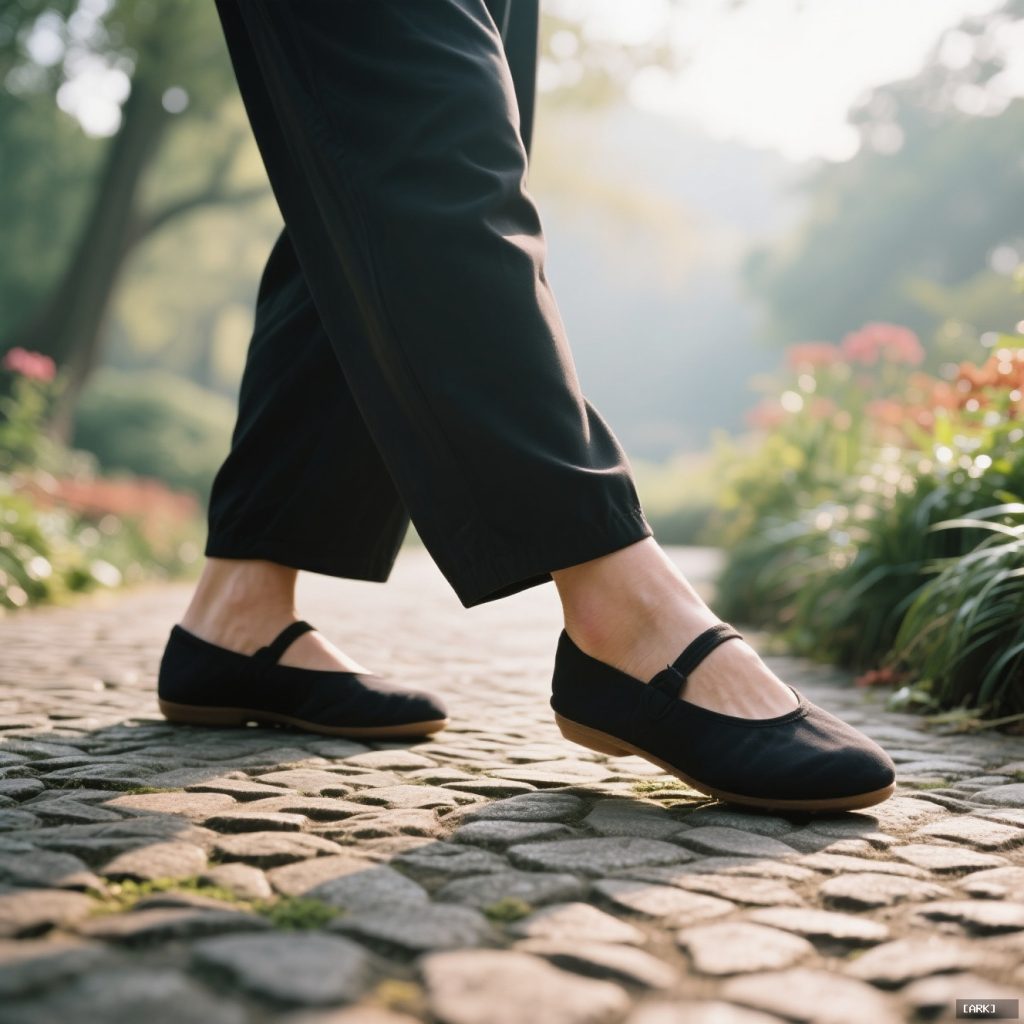
Tai chi walking transforms a simple step into a profound practice of moving meditation. This mindful walking, a core qigong exercise, offers a direct path to presence, rooted not in trend but in ancient, pragmatic wisdom.
We walk every day, yet rarely consider the step itself. We move to get somewhere, our minds already at the destination. Tai chi walking asks you to forget the destination. It invites you into the micro-movements of shifting weight, the roll of a foot, the subtle balance of the body in motion. It’s a complete recalibration of how we inhabit our most basic human action.
The Martial Roots of a Meditative Step
What are the martial origins of Tai Chi walking as a tactical technology?
Tai Chi walking originated not for wellness but as a martial necessity for survival and warfare. It developed as stable, adaptable footwork for use on uneven, treacherous terrain like cobblestone streets, forest paths, and muddy riverbanks. The slow, deliberate, rolling step served as a tactical technology to test the ground before committing full weight, prevent injuries like twisted ankles, conserve energy over long distances, and maintain balance to avoid fatal losses in combat situations.
To understand tai chi walking, you must first strip away the image of serene group practice in a park. Its origins are not in wellness but in warfare and survival. This practice emerged from the necessity of stable, adaptable footwork for martial artists. On uneven, often treacherous ground—cobblestone streets, forest paths, muddy riverbanks—a fast, heavy step could mean a twisted ankle or a fatal loss of balance.
The slow, deliberate, rolling step was a tactical technology. It was a way to test the ground before committing full weight, to conserve energy over long distances, and to remain rooted and ready against an opponent’s push or pull. Each step was a loaded, intentional act. This martial foundation imbues the practice with a structural integrity; it’s not arbitrary slowness, but purposeful, efficient movement refined over generations.
A Cultural Vocabulary of Motion
How does Tai chi walking reflect a cultural vocabulary of motion compared to Western walking?
Tai chi walking reflects a cultural vocabulary rooted in Daoist philosophy, emphasizing circularity, yielding, and continuous flow to harmonize with space, embodying principles like wu wei (effortless action). In contrast, Western walking often reflects a cultural conditioning of linear, goal-oriented motion, valuing speed and directness to conquer terrain from point A to B. This difference illustrates how gait manifests distinct cultural mindsets, with Tai chi focusing on the quality of motion itself rather than the endpoint.
How we walk speaks volumes about our cultural conditioning. In many Western contexts, walking is linear and goal-oriented. We march from point A to point B, valuing speed and directness. Our gait often reflects a mindset of conquest over terrain.
Tai chi walking, deeply influenced by Daoist philosophy, embodies a different vocabulary: circularity, yielding, and continuous flow. The movement isn’t about conquering space but harmonizing with it. The focus shifts from the endpoint to the quality of motion itself—a physical manifestation of principles like wu wei (effortless action) and maintaining a soft, receptive center. It is, in its essence, a walking rebuttal to the cult of pure efficiency.
The Unseen Influence of Architecture and Terrain
Our modern environment has fundamentally reshaped our movement. We walk primarily on flat, hard, predictable surfaces: concrete sidewalks, laminate floors, paved asphalt. These are historical anomalies.
Tai chi walking was engineered for a different world—a world of cobblestones, packed earth, wooden planks, and sloping paths. The rolling foot action, the sensitive placement of the heel, the conscious weight transfer: these are adaptive techniques for navigating pre-modern topography. When you practice this walk today, you are not just exercising your body. You are connecting with the literal ground of history, engaging with a kinesthetic intelligence developed for an earth that was alive with texture and uncertainty.
The Modern Challenge: Why Moving Slowly Feels Revolutionary
Why does moving slowly, as in tai chi walking, feel revolutionary in modern culture?
Moving slowly feels revolutionary because our nervous systems are conditioned for haste by digital communication, multitasking, and constant urgency. Deliberate slowness creates cognitive dissonance, making it seem strange or wasteful. Tai chi walking acts as cultural resistance by forcing a negotiation with this ingrained rush. The practice requires repacing the mind to match the body's slow movement, creating an internal confrontation between the impulse to speed up and the discipline to stay slow, which feels surprisingly confrontational in a fast-paced world.
Our nervous systems are wired for haste. We are conditioned by rapid-fire digital communication, multitasking, and the constant low-grade urgency of modern life. Deliberate slowness, therefore, creates a kind of cognitive dissonance. It feels strange, even wasteful.
This is where tai chi walking becomes a quiet act of cultural resistance. It forces a negotiation with our ingrained rush. The practice demands that you repace your mind to match the repaced body. That internal negotiation—the impulse to speed up clashing with the discipline to stay slow—can feel surprisingly confrontational. It exposes the mental chatter and anxiety that our normal speed helps us outrun. In a world of notifications, to move with mindful slowness is to reclaim your own rhythm.
Beyond the Aesthetic: The Unshareable Core of Practice
What is the unshareable core of Tai chi walking practice beyond its aesthetic portrayal?
The unshareable core of Tai chi walking practice lies in its application to mundane, everyday environments rather than scenic, photogenic settings. While social media often depicts it as a form of scenic escapism, its transformative value comes from integrating mindful movement into ordinary spaces like cracked sidewalks, fluorescent-lit hallways, or crowded grocery aisles. This practice emphasizes grounding awareness in the present moment and routine contexts, fostering discipline and internal change that cannot be fully captured or shared through curated visuals.
Social media is filled with beautifully curated clips of mindful movement: a solitary figure performing tai chi walking on a misty mountain ridge at sunrise. It’s shareable, aesthetically pleasing, and frames the practice as a form of scenic escapism.
While beautiful, this portrayal risks missing the point. The real challenge—and the transformative value—of tai chi walking lies in bringing that mindful cadence to the cracked sidewalk outside your home, the fluorescent-lit hallway at work, or the crowded aisle of a grocery store. The practice roots itself not in the photogenic moment, but in the unglamorous, daily grind of life. Its power is in transforming the ordinary walk to your car into a minute of collected presence. The shareable moment is the postcard; the real work is the unphotographed process.
Tai Chi Walking as Living Cultural Preservation
How does Tai Chi walking serve as a form of living cultural preservation?
Tai Chi walking acts as living cultural preservation by transmitting intangible heritage through physical practice. It involves specific mechanics like muscle sequencing, knee angles, and weight transfer, embodying a physical philosophy. Practitioners become conduits, keeping this kinesthetic knowledge alive in their own bodies rather than in static records. This engagement ensures the tradition is preserved dynamically through movement, in the soles of the feet and bodily awareness, maintaining it as a lived experience.
When you practice the specific mechanics of this walk, you are doing more than working your leg muscles. You are engaging with a kinesthetic heritage. You are keeping a physical philosophy alive through the movement of your own body.
This is a form of intangible cultural transmission. It’s knowledge that isn’t just stored in books but in the sequencing of muscles, the angle of a knee, the sensation of weight pouring from one leg to the other. By learning and practicing, you become a conduit for this living tradition, preserving it not in a museum case but in the soles of your feet and the awareness in your mind. You embody the history with every step.
Beginning Your Practice: Simplicity Over Perfection
What is the simple beginning practice for tai chi walking according to the concept of simplicity over perfection?
The beginning practice for tai chi walking emphasizes simplicity over perfection. It does not require special clothing, a dedicated space, or prior tai chi experience. To start, simply take a walk you already do and slow down to half your normal speed for just two minutes. Forget about perfect form and instead focus on the physical sensations. Feel your foot peeling off the ground from heel to ball to toes, sense your leg swinging with deliberate control, and notice the heel's contact and the slow roll of weight transfer as you step.
The gateway to tai chi walking is astonishingly simple. You do not need special clothing, a dedicated space, or prior experience with tai chi forms. The practice stands powerfully on its own.
Start by hijacking a fragment of a walk you already take. For just two minutes, slow down to half your normal speed. Forget about form. Instead, focus on sensation. Feel the exact process of your foot peeling off the ground: heel, then ball, then toes. Sense the leg swinging through space with deliberate control. Notice the moment your heel makes contact again, and the slow, rolling wave as your weight transfers forward, like water pouring from one vessel into another. Your mind will wander. When it does, gently guide it back to these physical sensations. That is the entire practice.
A Practical Framework for Your First Steps
When you’re ready to dedicate a few minutes to focused practice, this sequence provides a clear framework. Remember, the goal is fluid awareness, not rigid perfection.
- Find Your Space: A safe, flat stretch of 10-15 feet is plenty—a hallway, a quiet patch of park, your living room.
- Stand with Awareness: Stand with feet parallel, hip-width apart. Soften your knees slightly. Take a breath and feel your connection to the ground.
- Root One Leg: Gently shift all your weight onto your right leg. Feel your foot spread, your muscles engage. Your left leg is now “empty,” bearing no weight.
- Lift with Deliberation: From the empty left leg, slowly lift your heel first. Only after the heel is clear, allow the ball of the foot and toes to peel away from the ground.
- Move Forward Slowly: With control, swing the left foot forward a short, comfortable distance. Avoid reaching or straining.
- Place with Sensitivity: Gently place the left heel down first. Then, like a rolling wave, lower the ball of the foot, then the toes.
- Transfer the Weight: Now, begin to pour your weight from the right leg into the left. Do this smoothly and continuously until your weight is fully on the left leg, and the right leg becomes “empty.”
- Continue the Flow: Repeat the process with the right leg. Focus on creating a seamless, flowing motion without any bouncing or up-and-down movement in your torso.
- Soft Gaze: Keep your eyes looking forward, relaxed. Try not to stare at your feet; feel the movement instead of watching it.
Common Questions, Simple Answers
Do I need to know tai chi to do this?
Not at all. Tai chi walking is a foundational element, but it is a complete practice in itself. Many people find it to be the perfect, accessible entry point into the world of mindful movement.
How is this different from just walking slowly?
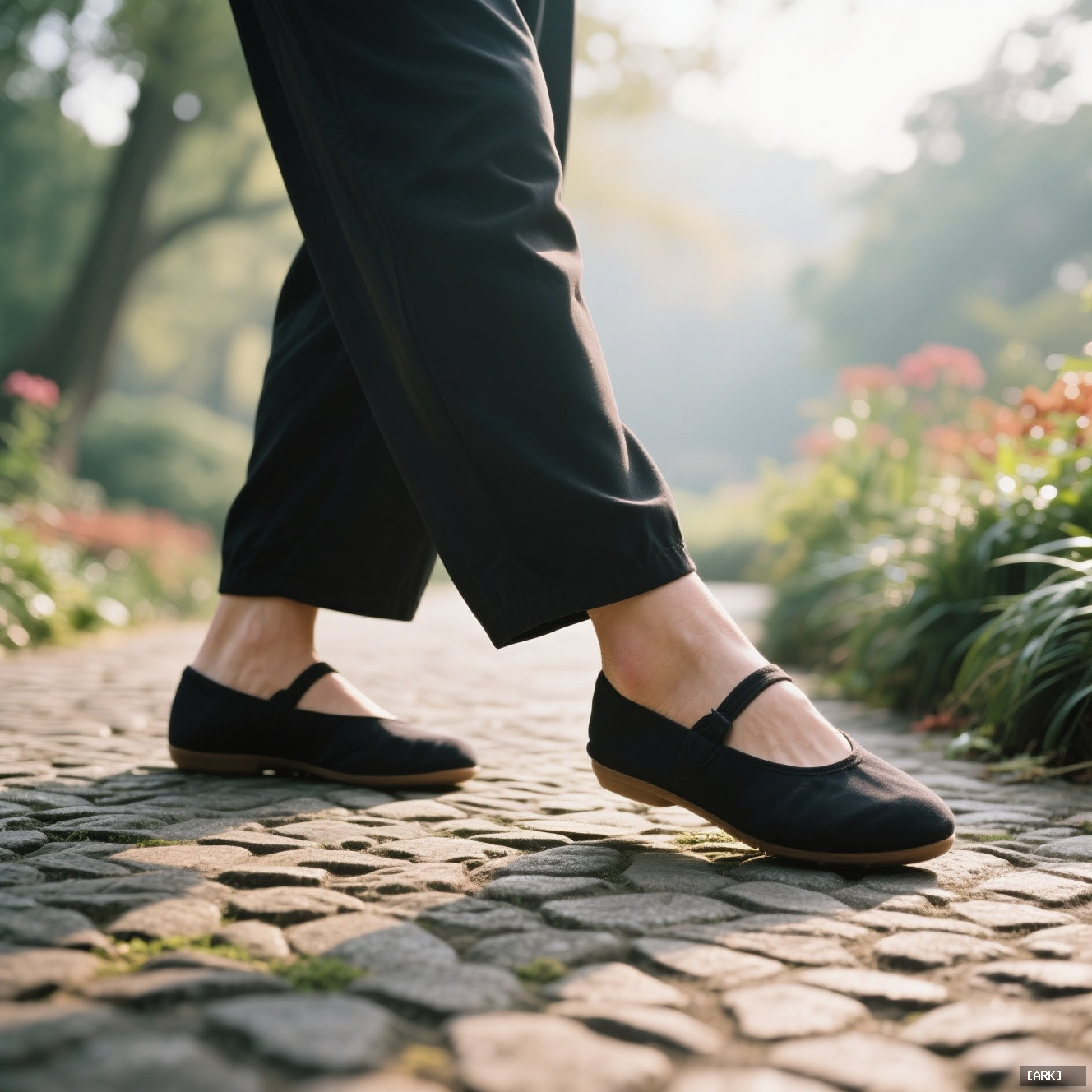
The difference is in the quality of attention and the specific mechanics. A normal slow walk is often just a decelerated version of your habitual gait. Tai chi walking involves an active, mindful sensing of weight transfer, a deliberate rolling foot action, and a continuous awareness of alignment and balance. It is active exploration, not passive strolling.
What should I think about while practicing?
Try to move from thinking to feeling. Your anchor is the physical sensation in your body: the pressure in your soles, the engagement of your thigh, the alignment of your spine, the rhythm of your breath. When your mind drifts to your to-do list or a memory, acknowledge it without judgment and guide your attention back to the feeling of your next step. The walk itself is the meditation.
Sources & Further Pathways
- The Cognitive Benefits of Mindful Movement – A research review on motor skills and cognition from the National Institutes of Health.
- Historical and Practical Foundations of Tai Chi – An overview from the Tai Chi Foundation.
- The Principles of Qigong – Foundational knowledge from the Qigong Institute.
- Daoist Art and Worldview – An essay on Daoist philosophy from The Metropolitan Museum of Art.
- The Historical Spread of Daoist Thought – An Aeon essay on the process of Daoist texts.
About Our Expertise
Drawing from authentic Chinese cultural heritage, this article is crafted by experts with deep knowledge of Tai Chi and traditional practices, ensuring accurate representation of its martial origins and Daoist influences. We rely on trusted sources like the Tai Chi Foundation and Qigong Institute to provide reliable, well-researched insights that honor the integrity of this ancient art.
Our commitment to expertise is reflected in the practical guidance offered, such as step-by-step instructions for Tai Chi walking, which are based on centuries-old techniques passed down through generations. By connecting these practices to modern daily life, we help readers engage with Chinese culture in a meaningful, trustworthy way, fostering a genuine appreciation for its living traditions.
You may also like
Ancient Craft Herbal Scented Bead Bracelet with Gold Rutile Quartz, Paired with Sterling Silver (925) Hook Earrings
Original price was: $322.00.$198.00Current price is: $198.00. Add to cartAncient Craftsmanship & ICH Herbal Beads Bracelet with Yellow Citrine & Silver Filigree Cloud-Patterned Luck-Boosting Beads
Original price was: $128.00.$89.00Current price is: $89.00. Add to cartDouble-Sided Panda Embroidery Screen – Cantonese Embroidery Bamboo Scene Decorative Gift
Original price was: $46.70.$33.68Current price is: $33.68. Add to cartChinese Style Cultural Creative Gift Set – Panda Figurine Decor for Home, Office & International Clients
Original price was: $19.86.$17.20Current price is: $17.20. Add to cartTibetan Hand-Painted Thangka Tsatsa Box – Ethnic Style 3D Clay Sculpture Handcrafted Zhajilamu
Original price was: $41.00.$32.00Current price is: $32.00. Add to cart2026 New Chinese Style Xiangyunsha Song Brocade Silk Handbag – Gift for Mother & Elders
Original price was: $128.00.$115.00Current price is: $115.00. Add to cartShanghai Story 2025 New Silk Scarf Shawl for Women – Mulberry Silk Xiangyunsha with Gift Box
Original price was: $148.90.$136.90Current price is: $136.90. Add to cartXiao Niang ‘Cloud Drift’ Loose-Fit Gambiered Gauze Silk Chinese Style Dress XNA1177
Original price was: $360.00.$328.00Current price is: $328.00. Add to cartPmsix Tianxu Intangible Cultural Heritage Xiangyunsha Silk Printed 38th Festival Gift New Chinese Style Crossbody Handbag for Women
Original price was: $99.50.$94.50Current price is: $94.50. Add to cart























