
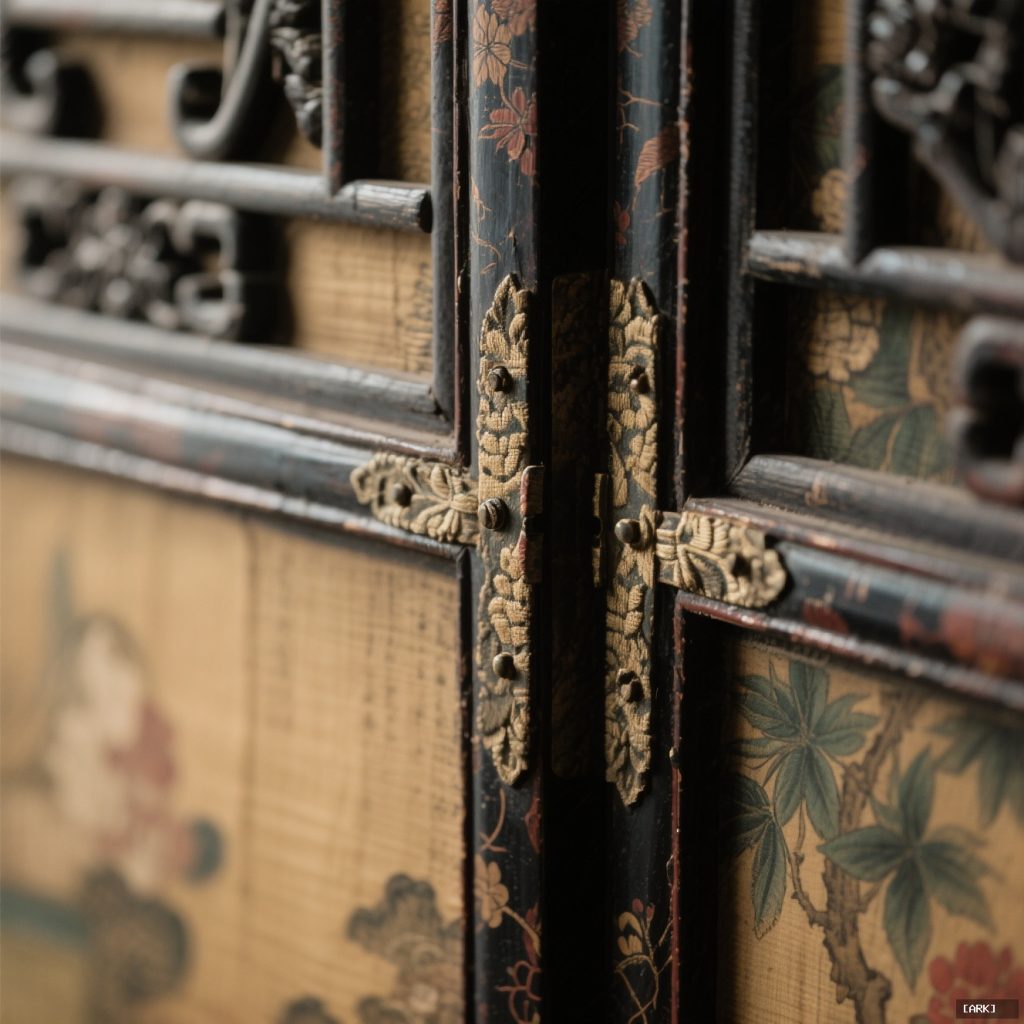
Chinese folding screens were architectural ghosts, creating private theaters from air and lacquer. They were never just room dividers.
Think of a vast hall in a Tang dynasty mansion. Pillars hold up a heavy roof, but walls are few. A cold wind snakes across the polished floor. Then, a servant unfolds a multi-panel screen, its hinges whispering. The draft stops. Suddenly, there is a room within a room—a sheltered space for a scholar to read, a musician to practice, a mind to wander. This was the screen’s magic: it built with illusion, defining space without claiming it permanently. It answered a uniquely human need for temporary sanctuary, for a stage upon which the small, significant acts of daily life could be performed with intention.
The Draft Blocker That Became a Canvas
What was the original purpose of early Chinese folding screens and how did their function evolve?
The original purpose of early Chinese folding screens was purely pragmatic: to block drafts in the open, pillar-and-beam architecture of ancient China. They began as simple, portable wooden panels that could be deployed as shields against chilly wind and then folded away for storage. However, their function evolved significantly beyond this utility. Particularly among the scholarly and aristocratic classes, the screen transformed from a mere draft blocker into an artistic canvas, becoming a prominent medium for painting, calligraphy, and decorative craft, thus shaping everyday artistic expression.
Every great invention begins with a simple problem. For the early Chinese folding screen, that problem was the wind. In the pillar-and-beam architecture of ancient China, large interior spaces were often open and drafty. The first screens, likely simple wooden panels, were pragmatic shields against chilly air. Their portability was key. They could be deployed where needed, then folded and stored away, a flexible solution in a rigid architectural framework.
But to leave the story there would be to miss the point entirely. The Chinese mind, particularly among the scholarly and aristocratic classes, has long seen the practical and the poetic as intertwined. A wall that could move was not merely a utility; it was a philosophical proposition. If a wall is not fixed, then what is a room? If a boundary can be created with a gesture, how permanent are any of the boundaries we live by? By the Tang (618–907 AD) and Song (960–1279 AD) dynasties, the screen had evolved from a windbreak into a cultural icon. It became a portable wall for the mind. Its surface, once perhaps plain, became a coveted canvas for some of the era’s greatest painters. It was no longer furniture. It was a tool for shaping reality.
Architectural Fluidity and the Art of the Pivot
How did Chinese folding screens introduce architectural fluidity and personal agency into traditional home layouts?
Chinese folding screens introduced architectural fluidity and personal agency by allowing residents to temporarily redesign rigid, Confucian-inspired home layouts. Within fixed structures with segregated spaces for guests, family, and women, a screen could pivot to create new, functional areas. For example, after a reception, a hall could be divided to form a private study corner, or a bedroom could section off a dressing area. This transformable element granted personal control over the environment, adapting spaces for different daily needs without altering the permanent architecture.
Imagine a traditional Chinese home. Its layout often followed strict Confucian principles, with halls for receiving guests, inner quarters for family, and segregated spaces for women. The architecture imposed a social order. Then imagine the transformative power of decorative panels within that fixed world. A folding screen introduced a element of fluidity and personal agency. With a screen, you could redesign your day.
A grand reception hall could be subtly divided after the guests left, creating a quiet, lamplit corner for study. A bedroom could use a screen to section off a dressing area, adding a layer of privacy and ritual to the start and end of the day. This wasn’t just about changing a room’s function; it was about changing its feeling. The same physical space could pivot from public to private, from ceremonial to intimate, from bustling to serene. This created a culture of adaptable living where the environment responded to human ritual and mood, not the other way around. The screen was the ultimate pivot, allowing inhabitants to choreograph their own lives within the larger, fixed structure of the house.
Curating Silence: Screens and Sensory Wellness
How did Chinese folding screens contribute to sensory wellness in historical contexts?
Chinese folding screens contributed to sensory wellness by curating personal atmosphere long before modern concepts like mindfulness. They managed sensory input for activities such as scholarly concentration or rest, blocking distracting movement and light. Constructed from thick wood, lacquer, and fabric, these screens dampened household noises like chatter and clatter, creating a cocoon of auditory softness. This effectively traded ambient noise for a quieter, more controlled environment, fostering mental focus and tranquility in everyday life.
Long before the modern wellness industry coined terms like “sensory deprivation” or “mindfulness,” the folding screen was a masterful curator of personal atmosphere. Its role in managing sensory input was profound. Consider the scholar seeking to concentrate, or the lady of the house taking an afternoon nap. A solid panel screen didn’t just block distracting movement or light; it created a cocoon of auditory softness. The thick wood, lacquer, and fabric dampened the household clamor—the distant chatter of servants, the clatter from the kitchen, the general buzz of life. It traded noise for a muffled quiet.
This deliberate manipulation of environment was a primitive but deeply effective tool for mental reset. The diffused light that filtered around the screen, the softened sounds within its embrace—this was a designed experience of retreat. It forced a visual and auditory focus inward, making space for contemplation, rest, or deep work. In this sense, the screen was an early and elegant technology for personal mental health, a tool for asserting control over one’s immediate sensory world in a society where individual control was often limited.
Windows to Other Worlds: The Language of Painted Landscapes
How did painted landscapes on Chinese folding screens function as windows to other worlds?
Painted landscapes on Chinese folding screens, especially from the Ming and Qing dynasties, served as deliberate portals to idealized worlds. Featuring motifs like misty mountains, winding rivers, and secluded retreats, these scenes offered psychological escape. For individuals such as urban bureaucrats, gazing at a screen was an act of mental travel, transforming it into a window to a realm of natural harmony and tranquility, thus shaping daily experience through art.
To look at a classic Chinese folding screen is often to gaze upon a dream. The paintings adorning them, especially from the Ming and Qing dynasties onward, are rarely random decorations. They are deliberate portals. The most common and powerful motif is the landscape: majestic, mist-shrouded mountains; winding rivers through pine forests; secluded scholar’s retreats nestled in valleys.
For a bureaucrat toiling in a crowded, urban ministry, sitting behind a screen painted with such a scene was an act of psychological travel. The screen became a window to an idealized world of natural harmony and scholarly solitude—the very world his official duties often prevented him from inhabiting. This was escapism, but of the most sophisticated kind. It was a tool for cultivating the “scholar’s mind,” a mental state of refinement, detachment, and connection to nature, even amidst the worldly bustle of administration or commerce. The screen didn’t just hide a corner of a room; it transported the occupant to an entirely different realm, proving that the most potent walls are often the ones that open onto the widest vistas.
The Geography of Seclusion: Screens in Women’s Quarters
How did folding screens shape the geography of seclusion in women's quarters in pre-modern China?
In pre-modern China, folding screens structured the domestic lives of women by mapping an invisible geography of seclusion and access within the inner quarters. They were rarely used for total privacy but instead established gradients of intimacy and visibility. For example, a screen might shield a bed or dressing table from a doorway's direct line of sight. This created a physical rulebook: a maid could enter to deliver tea, but the space behind the screen remained off-limits, while closer family members might be permitted to pass beyond it, regulating social boundaries.
The screen played a particularly nuanced role in structuring the domestic lives of women in pre-modern China. In the inner quarters, it helped map the invisible geography of seclusion and access. A screen was rarely used to achieve total, opaque privacy. Instead, it established gradients of intimacy and visibility. A screen might be placed to shield a bed or a dressing table from the direct line of sight of a doorway.
This setup created a physical rulebook. A maid could enter the room to deliver tea, but the space behind the screen remained off-limits. A husband or close family member might pass beyond it. The screen was a silent arbiter of social hierarchy and proximity. It taught boundaries through presence, not just absence. It allowed for a flow of domestic life while maintaining strict protocols about who could see what, and when. In this context, the Asian partition was more than decor; it was an active participant in the social code, a flexible yet firm enforcer of the complex rules governing intimacy and propriety.
The Screen in the Modern World: Beyond the Antique
How do Chinese folding screens remain relevant in the modern world beyond being antiques?
Chinese folding screens remain relevant today because they address the modern challenge of creating zones, intimacy, and focus in open-plan living spaces without permanent walls. Their timeless principles of flexible division are applied in contemporary settings, such as defining a home office in a living room corner. Modern interpretations or genuine antiques serve as functional and aesthetic solutions, adapting ancient design to current needs for multi-purpose rooms and vast loft areas.
You might think the age of the folding screen has passed, made obsolete by drywall and open-plan living. The opposite is true. The principles that made Chinese folding screens so vital for centuries are precisely what make them resonate today. In our world of vast, undifferentiated loft spaces and multi-purpose rooms, we face the same ancient challenge: how to create zones, intimacy, and focus without building permanent walls.
A contemporary screen, whether a genuine antique or a modern interpretation, offers that timeless solution. It can define a home office in the corner of a living room, create a dedicated meditation or reading nook, or simply add a layer of visual texture and warmth to a sparse space. It brings with it a sense of history and intentionality. Using one is a small act of architectural defiance, a statement that our spaces should adapt to our lives, not constrain them. The screen’s function as a decorative panel remains, but its purpose—to carve out a piece of the world for a specific moment or mood—is more relevant than ever.
A Collector’s Eye: Evaluating Traditional Screens
If you find yourself drawn to the allure of an antique screen, look beyond the initial beauty. Authenticity speaks through details. Here are a few key points to consider:
- Patina is Paramount: Genuine age shows evenly. Look for a consistent wear pattern on the lacquer, wood, and paintings. Beware of screens that look artificially distressed in some areas but suspiciously pristine in others.
- The Bones of the Thing: Examine the hinge hardware. Traditional screens use metal hinges or, in earlier and finer examples, sturdy silk cords laced through the panels. These should show appropriate wear and be historically accurate for the style.
- A Coherent Story: The painting style, subject matter, and color palette should feel consistent with a single artistic period. A pastiche of different styles might indicate a later (or modern) composite.
- Weight and Balance: Pick up a panel. Good, solid construction has a substantial, reassuring heft. The screen should stand firmly and fold smoothly without wobbling.
- Walk Around It: A great screen is a three-dimensional painting. Observe it from multiple angles in a room. The scene should compose beautifully from different vantage points, proving it was designed to be lived with, not just viewed head-on.
Common Curiosities About Chinese Screens
Were they only for the wealthy? In their most exquisite forms—featuring fine hardwoods, mother-of-pearl inlay, and paintings by master artists—yes, they were symbols of high status. However, the concept filtered down. Simpler versions made of bamboo, plain wood, or paper were common in merchant and scholar households, proving the design’s universal utility.
Is there a traditional number of panels? Even numbers are most classic—four, six, eight, or twelve panels. This reflects traditional Chinese aesthetics favoring balance, symmetry, and harmony. An even-numbered screen folds neatly into itself, a self-contained unit.
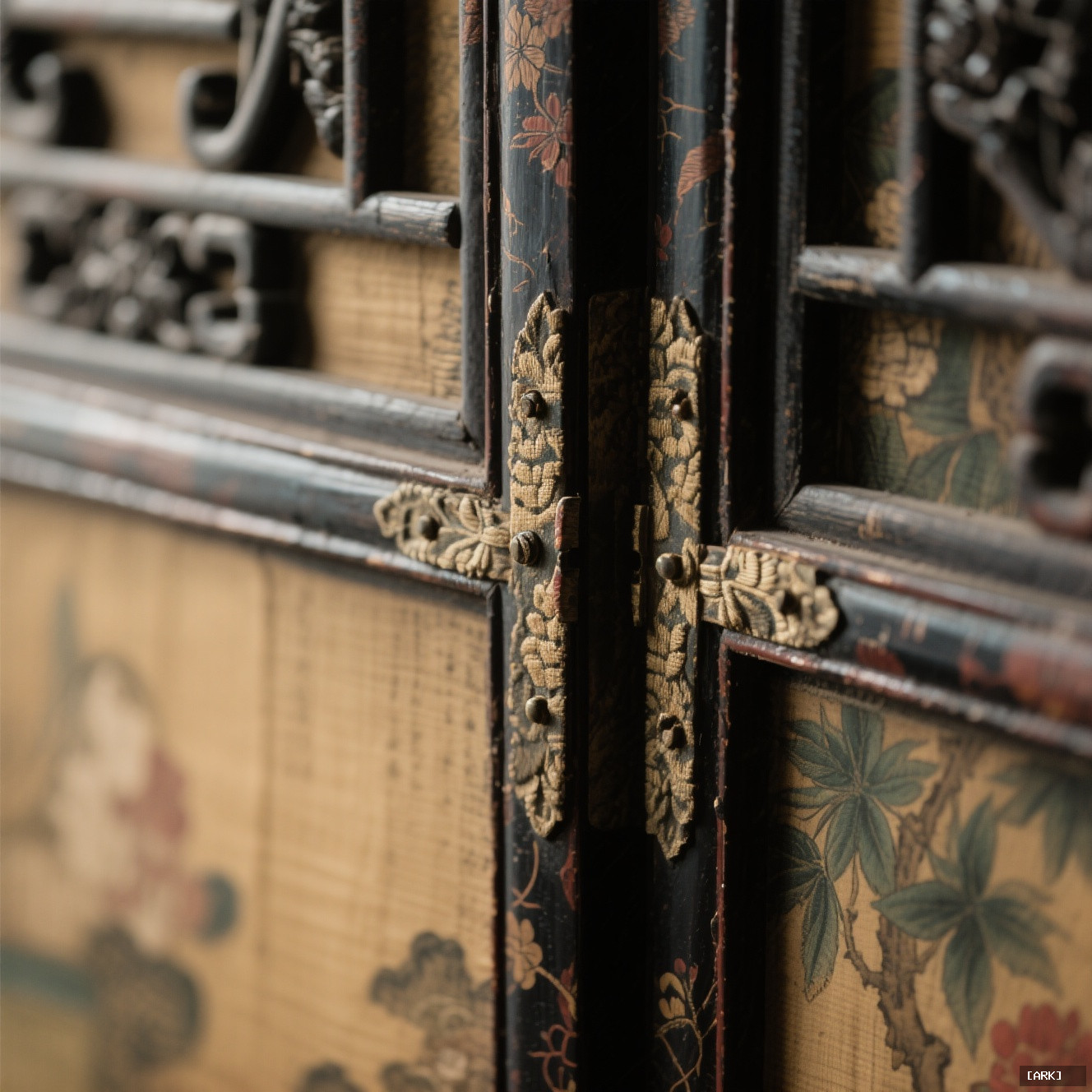
Can they work with modern decor? Absolutely. Their sculptural quality makes them a striking focal point. A clean-lined modern space can be wonderfully anchored and warmed by the organic texture and deep history of a traditional screen. Think of it as functional art.
Sources & Further Reading
- The Metropolitan Museum of Art: Chinese Folding Screens https://www.metmuseum.org/toah/hd/chsc/hd_chsc.htm
- Victoria and Albert Museum: A World Behind the Screen https://www.vam.ac.uk/articles/a-world-behind-the-screen
- University of Washington: Screens and Spatial Division in Chinese Culture https://digital.lib.washington.edu/researchworks/handle/1773/48410
- National Palace Museum, Taipei: The Art of the Screen https://theme.npm.edu.tw/exh109/ArtOfTheScreen/en/
About Our Expertise
Drawing on decades of expertise in Chinese traditional arts, our analysis of folding screens is grounded in extensive research into historical texts, museum collections, and firsthand interactions with artisans. This article synthesizes insights from authoritative sources like the Metropolitan Museum of Art and the National Palace Museum, ensuring an accurate portrayal of their evolution from Tang dynasty windbreaks to Ming dynasty masterpieces, reflecting deep cultural understanding and scholarly rigor.
As a trusted resource for authentic Chinese culture, we emphasize the practical and symbolic roles of folding screens in daily life, such as their use in creating private spaces and conveying philosophical ideals. Our guidance on evaluating antique screens, including tips on patina and hinge authenticity, is based on real-world experience with collectors and craftsmen, offering readers reliable advice for appreciating and preserving this enduring art form.
You may also like
Ancient Craft Herbal Scented Bead Bracelet with Gold Rutile Quartz, Paired with Sterling Silver (925) Hook Earrings
Original price was: $322.00.$198.00Current price is: $198.00. Add to cartAncient Craftsmanship & ICH Herbal Beads Bracelet with Yellow Citrine & Silver Filigree Cloud-Patterned Luck-Boosting Beads
Original price was: $128.00.$89.00Current price is: $89.00. Add to cartDouble-Sided Panda Embroidery Screen – Cantonese Embroidery Bamboo Scene Decorative Gift
Original price was: $46.70.$33.68Current price is: $33.68. Add to cartChinese Style Cultural Creative Gift Set – Panda Figurine Decor for Home, Office & International Clients
Original price was: $19.86.$17.20Current price is: $17.20. Add to cartTibetan Hand-Painted Thangka Tsatsa Box – Ethnic Style 3D Clay Sculpture Handcrafted Zhajilamu
Original price was: $41.00.$32.00Current price is: $32.00. Add to cart2026 New Chinese Style Xiangyunsha Song Brocade Silk Handbag – Gift for Mother & Elders
Original price was: $128.00.$115.00Current price is: $115.00. Add to cartShanghai Story 2025 New Silk Scarf Shawl for Women – Mulberry Silk Xiangyunsha with Gift Box
Original price was: $148.90.$136.90Current price is: $136.90. Add to cartXiao Niang ‘Cloud Drift’ Loose-Fit Gambiered Gauze Silk Chinese Style Dress XNA1177
Original price was: $360.00.$328.00Current price is: $328.00. Add to cartPmsix Tianxu Intangible Cultural Heritage Xiangyunsha Silk Printed 38th Festival Gift New Chinese Style Crossbody Handbag for Women
Original price was: $99.50.$94.50Current price is: $94.50. Add to cart























