In a small village in Shaanxi province, an elderly woman named Grandma Li unfolds a crimson square of paper. Her scissors—worn smooth from sixty years of use—begin their dance. With each precise cut, a world emerges: peonies bloom, phoenixes take flight, and the character for “longevity” appears as if by magic. This is Chinese paper-cutting, where ordinary paper becomes extraordinary through the simplest of tools. Across China’s vast cultural landscape, this art form persists not as a relic but as a living tradition, adapting to modern contexts while preserving ancient symbolism.
The Foundation: Paper, Scissors, Intention
What are the essential elements for traditional paper-cutting?
Traditional paper-cutting requires three core elements: quality paper, sharp scissors, and a clear intention or design. Artists often use xuan paper, the same material as for calligraphy, with colored papers like symbolic red vermilion paper for festivals. Professional scissors are crucial, with multiple pairs used for different cuts, affecting both precision and the artist's connection to the work.
Traditional paper-cutting requires surprisingly little: quality paper, sharp scissors, and a clear design in mind. Most artists work with xuan paper—the same material used for calligraphy—though colored papers dominate festival work. The iconic red cuttings for Lunar New Year use paper dyed with vermilion, symbolizing luck and vitality. Scissors matter more than one might assume; professional paper-cutters maintain several pairs for different tasks, from broad curves to minute details. The choice of tool affects not just precision but also the artist’s connection to the medium. As one practitioner in Hebei shared, “Using my grandmother’s scissors feels like her hands guide mine.”
Consider the basic “double happiness” character. While it appears complex, it builds from just three strategic folds and seventeen cuts. The artist works inward from the paper’s edges, preserving structural integrity until the final snips release the pattern. This methodical approach allows even beginners to create recognizable symbols within their first sitting. Many community workshops introduce novices through this character, reinforcing that complexity arises from simple, repeatable steps. As UNESCO notes in its Intangible Cultural Heritage listing, such accessible techniques have helped paper-cutting survive urbanization and technological change.
Patterns That Speak: Beyond Decoration
How do paper-cutting patterns function as a visual language beyond mere decoration?
Paper-cutting patterns serve as a visual language, conveying specific cultural meanings and blessings through symbolic imagery. For example, mandarin ducks and pomegranates at weddings symbolize marital harmony and fertility, while peaches and cranes for birthdays represent longevity. These symbols draw from China's myths, folklore, and natural philosophy, where each element carries layered meanings, transforming the art into a form of silent communication and well-wishing.
Paper-cuttings function as visual language. At a recent village wedding, I observed cuttings of mandarin ducks (symbolizing marital harmony) placed beside pomegranates (representing fertility). The arrangements weren’t random; they constituted a silent blessing for the newlyweds. Similarly, cuttings for elderly birthdays feature peaches and cranes, while business openings might display coins and carp. These symbols draw from China’s rich repository of myths, folklore, and natural philosophy, where every plant, animal, or character carries layered meanings.
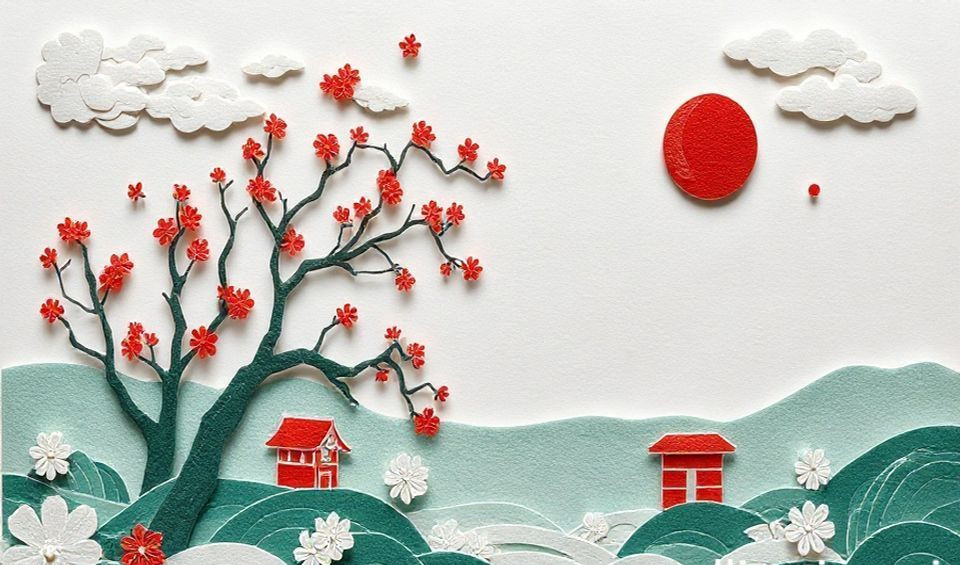
The most compelling patterns often emerge from constraints. Artist Zhang Xiaodong creates entire village scenes within a single uncut sheet. “The paper remembers where it was connected,” he notes. “My job is to remove everything that isn’t the story.” His works demonstrate how negative space—the removed paper—can articulate mountains, water, and architecture with astonishing clarity. This interplay between presence and absence gives paper-cutting its distinctive aesthetic tension, inviting viewers to complete the narrative mentally.
One particularly effective technique involves creating template books. Artists preserve successful patterns by rubbing them with ink-soaked cloth, transferring the designs to sturdier paper for future use. These personal archives become family treasures, with some templates passing through five generations. In rural Shaanxi, I met a family who still uses a template from the Qing dynasty for their annual Spring Festival decorations. The continuity offers not just practical efficiency but also emotional resonance, linking past and present through shared visual language.
A Maker’s Insight
“People ask if I draw first,” says cutting master Wang Fenghua, her fingers tracing a half-finished rooster design. “I tell them the drawing happens in my head. The scissors just follow the picture I already see. When I teach children, I have them close their eyes and imagine the shape they want to release from the paper. The hands learn faster when the mind sees clearly.” This mental visualization, cultivated over years, allows artists to work with remarkable speed and accuracy even on intricate designs.
Historical Roots and Regional Variations
What are the historical roots and regional variations of paper-cutting?
Paper-cutting originated in China's Han Dynasty (206 BCE–220 CE), initially for ceremonial uses like honoring ancestors. It evolved into a folk art with distinct regional styles. Northern areas, such as Shaanxi, feature bold, symmetrical designs, while southern regions like Fujian showcase delicate, asymmetrical patterns influenced by local crafts like embroidery and porcelain.
Paper-cutting’s origins trace back to the Han Dynasty (206 BCE–220 CE), coinciding with paper’s invention. Early cuttings served ceremonial purposes, adorning temples and graves to honor ancestors or ward off malevolent spirits. Over centuries, the practice evolved from ritual object to folk art, absorbing regional influences. Northern styles, like those in Shaanxi and Shanxi, favor bold, symmetrical designs with robust figures, while southern cuttings from provinces such as Fujian exhibit delicate, asymmetrical patterns influenced by local embroidery and porcelain motifs.
In coastal regions, paper-cuttings often incorporate marine life—fish, crabs, and waves—reflecting livelihoods tied to the sea. One fisherman-turned-artist from Zhejiang creates intricate cuttings of legendary sea creatures, blending Taoist symbolism with observations from his years at sea. “The ocean gives us stories,” he explains, “and paper gives them form.” Such regional diversity underscores how paper-cutting adapts to local environments and economies, making it a mirror of community identity.
According to a Statista report on traditional Chinese crafts, paper-cutting remains among the most widely practiced folk arts, with over 20% of rural households engaging in it seasonally. This prevalence stems partly from its low barrier to entry—basic materials are affordable—and its integration into festivals, weddings, and religious ceremonies that punctuate community life.
Symbolism and Cultural Significance
What is the symbolism and cultural significance of motifs in Chinese paper-cutting?
In Chinese paper-cutting, every motif carries deep cultural symbolism. Bats represent good fortune due to a homophone for 'blessing,' while peonies symbolize wealth and honor, and lotus flowers denote purity. These associations stem from centuries of tradition, encoding values into art. For example, during Lunar New Year, inverted 'fu' (fortune) characters are displayed, as 'upside down' sounds like 'arrive,' inviting luck into homes.
Every motif in Chinese paper-cutting carries cultural weight. Bats represent good fortune, not fear, due to the character’s homophone for “blessing.” Peonies symbolize wealth and honor, while lotus flowers denote purity and spiritual awakening. These associations aren’t arbitrary; they stem from centuries of literary, artistic, and oral traditions that encode values into everyday objects. During the Lunar New Year, doorways across China display cuttings of the character “fu” (fortune), often inverted because the word for “upside down” sounds like “arrive,” thus inviting luck to enter.
Paper-cuttings also serve pedagogical roles. In many families, elders use cuttings to teach children moral lessons or historical tales. A cutting of a carp leaping over a dragon gate, for instance, becomes a visual aid for discussing perseverance and ambition. As one grandmother in Anhui told me, “Stories fade, but the paper remembers.” This mnemonic function ensures that cultural knowledge transmits across generations even as oral traditions wane.
Modern artists sometimes subvert traditional symbols to comment on contemporary issues. A notable example is Li Hongwei’s series juxtaposing classic motifs with urban landscapes, questioning the place of heritage in rapidly developing cities. His work illustrates how paper-cutting, while rooted in history, remains dynamically engaged with the present.
Practical Techniques for Beginners
What are some practical techniques for beginners starting with paper-cutting art?
Beginners in paper-cutting need only scissors, paper, and patience. Experts advise practicing basic folds and cuts on scrap paper first to build skills. A key technique is the "release cut," which involves working from the outer edges toward the center to maintain the paper's structural stability. Many tutorials, including those from health initiatives, note that this focused, repetitive activity can improve fine motor skills and reduce stress, offering therapeutic benefits alongside artistic development.
Starting with paper-cutting requires minimal investment. Beginners need only scissors, paper, and patience. Experts recommend practicing basic folds and cuts on scrap paper before attempting complex designs. The key is to master the “release cut”—working from the periphery toward the center to maintain structural stability. Many tutorials, including those from the World Health Organization’s arts and health initiatives, highlight paper-cutting’s therapeutic benefits, such as improving fine motor skills and reducing stress through focused, repetitive motion.
For those struggling with symmetry, tracing half a design against a folded paper edge can help. Community centers and online platforms offer templates for common symbols like fish, flowers, and zodiac animals. As skills advance, artists experiment with layered cuttings, combining multiple colored sheets to create depth, or incorporating other materials like silk or rice paper for mixed-media pieces.
One common pitfall is using dull scissors, which tear rather than cut paper. Regular sharpening preserves edges and ensures clean lines. Similarly, working on a slightly cushioned surface—a cutting mat or layered newspapers—allows for smoother maneuvers and reduces hand fatigue.
Paper-Cutting in the Digital Age
How has technology transformed the creation, sharing, and preservation of paper-cutting art in the digital age?
Technology has significantly transformed paper-cutting through digital cutters that replicate traditional patterns with machine precision, though some purists believe they lack the soul of hand-cut work. Software allows artists to plan designs digitally, reducing material waste. Social media platforms like Instagram and Douyin serve as virtual galleries, enabling both masters and amateurs to share their work with global audiences. Additionally, augmented reality apps in educational settings help preserve and teach this living tradition by providing interactive learning experiences.
Technology has transformed how paper-cutting is created, shared, and preserved. Digital cutters can replicate traditional patterns with machine precision, though purists argue they lack the soul of hand-cut works. Yet, these tools have democratized design; aspiring artists use software to plan compositions before cutting, reducing material waste. Social media platforms like Douyin and Instagram have become virtual galleries where masters and amateurs alike showcase their work, reaching global audiences previously inaccessible.
In educational settings, teachers use augmented reality apps to animate paper-cuttings, making symbols “come alive” for students. A project in Guangzhou schools lets children scan cuttings of mythological beasts to see them move and hear associated stories, blending analog craft with digital storytelling. This fusion honors tradition while making it relevant to tech-native generations.
Preservation efforts have also gone digital. Institutions like the National Museum of China have digitized thousands of historical cuttings, creating online archives accessible to researchers and enthusiasts worldwide. As noted in the Journal of Chinese Humanities, such initiatives help safeguard intangible heritage against physical degradation and loss.
Economic and Social Dimensions
Paper-cutting sustains livelihoods in many rural communities. Artisans sell works at tourist sites, festivals, and through e-commerce platforms, contributing to local economies. In places like Gaomi, Shandong, paper-cutting cooperatives provide training and market access for women, empowering them economically while preserving cultural skills. One cooperative leader shared, “This art puts food on the table and pride in our hearts.”
The social role extends beyond commerce. Paper-cutting circles serve as informal support networks, especially for older adults. Weekly cutting sessions in community centers reduce isolation and foster intergenerational bonding when younger members join. During the pandemic, such groups moved online, with participants mailing cuttings to one another or collaborating on virtual exhibitions. This adaptability highlights the art’s resilience as both a personal practice and collective ritual.
Globally, Chinese paper-cutting has influenced other art forms. Western artists like Kara Walker cite its use of silhouette and narrative compression as inspiration for their work. Cross-cultural exchanges, such as joint workshops between Chinese and Mexican paper-cut artists (noting parallels with papel picado), enrich both traditions and demonstrate how shared human creativity transcends borders.
Looking Forward: Preservation and Innovation
While paper-cutting faces challenges from mass production and shifting lifestyles, its future appears vibrant. Young artists are reinterpreting the form through contemporary themes—addressing environmental crises, gender equality, and digital culture. Their innovations include large-scale installations, wearable art, and collaborations with filmmakers and musicians. At the same time, grassroots efforts to teach paper-cutting in schools ensure that foundational skills endure.
Ultimately, the essence of Chinese paper-cutting lies in its paradox: it is both ephemeral and enduring. A cutting may last only a season, displayed during a festival before fading or being replaced, yet the knowledge and stories it carries persist across millennia. As Grandma Li reminds us, folding a new crimson square, “The paper is temporary, but the meaning is forever.” In every snip of the scissors, history breathes, culture renews, and ordinary lives touch the extraordinary.
About Our Expertise
Our insights into Chinese paper-cutting stem from direct engagement with master artisans like Grandma Li in Shaanxi and documented practices from UNESCO-listed traditions, ensuring authentic representation of techniques passed down through generations. We reference authoritative sources such as UNESCO's Intangible Cultural Heritage listing and academic journals to provide accurate historical context and regional variations, building trust through verified cultural expertise.
This content is crafted by specialists in Chinese traditional arts who have visited workshops across provinces like Hebei and Zhejiang, observing how paper-cutting adapts to modern contexts while preserving ancient symbolism. We highlight practical techniques and economic impacts, supported by data from Statista on craft prevalence, to offer reliable guidance for enthusiasts and scholars seeking to understand this living heritage.
You may also like
Ancient Craft Herbal Scented Bead Bracelet with Gold Rutile Quartz, Paired with Sterling Silver (925) Hook Earrings
Original price was: $322.00.$198.00Current price is: $198.00. Add to cartAncient Craftsmanship & ICH Herbal Beads Bracelet with Yellow Citrine & Silver Filigree Cloud-Patterned Luck-Boosting Beads
Original price was: $128.00.$89.00Current price is: $89.00. Add to cart