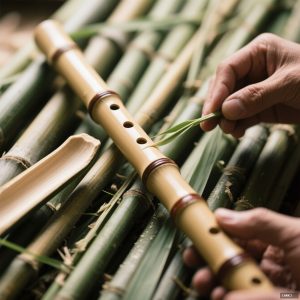
Hand-carved wooden items are a quiet rebellion against a world of sameness. In our cities of glass and steel, they are anchors of warmth and human touch.
You can feel it the moment you pick one up. The weight is different. The surface tells a story your fingers can read. It’s not just an object; it’s a conversation that started with a tree and passed through a carver’s hands before it reached yours. This tangible connection is what we’re craving, a direct line to material and maker that a barcode can never provide.
The Biography in the Grain
Why does a hand-carved bowl feel so profoundly different from its store-bought cousin? It’s the human trace. A machine-made object is perfect, anonymous, and finished. A piece of handcrafted woodwork is alive with the evidence of its creation.
Look closely. See that deeper gouge near the rim? That’s where the chisel caught the grain differently. The slight asymmetry in the curve? That’s the carver’s hand adjusting to the wood’s will, not a computer’s preset. These aren’t flaws. They’re a biography written in wood. They are the subtle, unrepeatable signatures of a moment in a workshop—the light, the focus, the physical pressure of a specific person. This sensory link to a place and a practitioner is the soul of the piece. A factory label says “Made in.” A hand-carved surface whispers “Made by.”
Urban Sanctuary: The Minimalist’s Secret Weapon
You might think wooden crafts clash with a clean, modern apartment. The opposite is true. In a space defined by smooth concrete, cool marble, and muted tones, a single artisanal carving becomes the essential focal point of restraint.
It’s the power of contrast. The severe, clean lines of urban design don’t just accommodate organic form; they demand it. They provide the silent stage that lets the wood’s irregular beauty sing. A spalted maple vessel on a concrete plinth. A textured olive wood sculpture against a white wall. These pairings create a dialogue. The modernity feels warmer, more grounded. The wood feels more intentional, more sculptural. One well-chosen piece on a shelf carries more narrative weight than a room full of generic, mass-produced accessories. It doesn’t add clutter; it provides soul.
Rooted in Place: The Land and the Hand
The connection between hand-carved wooden items and a specific locale runs deeper than the artisan’s address. It begins with the material itself. A local carver often uses timber with a local story—spalted maple from a storm-felled neighborhood giant, black walnut from a cleared city lot, olive wood from a pruned orchard.
The wood is the first witness. It holds the history of its soil, its climate, its growth. The carver becomes the second witness, interpreting that history through form. The shapes they choose might echo local architectural details, native flora, or regional folklore. A bowl isn’t just a bowl; it’s a physical slice of a local ecosystem. It’s the result of a conversation: the land offers a unique material, and the artisan responds with skill and vision. The finished item is a document of that exchange, a piece of place you can hold in your hands.
The Collector’s Hunt: Narrative Over Novelty
For the urban collector, the pursuit of artisanal carvings is about more than aesthetics. It’s a hunt for narrative integrity in a copy-paste world. In an age of endless digital replication and disposable trends, these objects represent something immutable: a true story.
The provenance—knowing the carver’s name, the wood’s origin, the tradition it references—becomes as valuable as the object itself. Each purchase is an act of curation. You’re not just buying decor; you’re collecting authentic stories. You’re building a personal museum of human skill and natural history. This collection becomes a direct, tangible antidote to the placelessness of modern consumption. It roots you, through objects, to real people and real places.
Discerning the Real: A Practical Guide
So, how do you separate genuine handcrafted woodwork from clever imitations? You learn to look for the marks of the tools, not the machine.
Run your fingers over the surface. Can you detect subtle variations in texture, the gentle ridges of a carving knife, or the facets of a chisel? A sanded, perfectly uniform finish is often a red flag. Examine the hidden areas—the underside of a bowl, the interior of a box. Look for consistent, rhythmic tool marks. A machine leaves a predictable pattern; a human hand leaves a rhythm.
Then, ask questions. A genuine artisan’s eyes will light up if you ask about the wood species and its source. They’ll tell you about the maple that came from an old Vermont farm or the cherry from a local urban salvage project. A reseller will fumble. The backstory should be as solid and detailed as the piece itself. If the story feels thin, the craftsmanship likely is, too.
Your Evaluation Checklist
- Engage Your Senses: Feel the surface. Can you detect subtle tool marks and the natural variation of the wood grain? Does it feel alive?
- Seek the Unique: Is it truly one-of-a-kind? Are there ten identical pieces on a shelf? True handwork embraces, not erases, individuality.
- Interrogate the Origin: Always ask: What species is this? Where did this wood come from? The answer matters.
- Connect with the Maker: If possible, meet them. Can they speak passionately about their process, their tools, their inspiration?
- Respect the Material: Does the form honor the nature of the wood, or fight against it? Good carving follows the grain, not just an arbitrary design.
Addressing Common Hesitations
Are they impractical for daily use?
Not at all. This is a common myth. Properly finished carvings from hardwoods like maple, cherry, or walnut are incredibly durable. A wooden spoon or salad bowl doesn’t degrade with careful use; it improves. It develops a richer patina, a deeper character. It becomes more beautiful, more personal.
Do they require a lot of maintenance?
Minimal. For most decorative pieces, a light dusting is all that’s needed. For items like utensils or bowls, occasional oiling with a food-safe mineral or walnut oil protects the wood and enhances its natural luster. This isn’t a chore; it’s a ritual of care that deepens your connection to the object.

Why are they so expensive?
You are not paying for markup. You are paying for time. You are purchasing the many hours of a skilled craftsperson’s life—the years of practice to develop that skill, the focused attention required for that specific piece. You are investing in mastery and material integrity, not just a product. When you understand this, the value becomes clear.
Sources & Further Reading
- craft" target="_blank" rel="noopener">The Crafts Council: Defining Craft and Its Value
- handmade-objects-make-us-feel-better" target="_blank" rel="noopener">The Guardian: The Psychological Impact of Handmade Objects
- FAO: Forestry and Wood Properties
- Victoria and Albert Museum: The Arts & Crafts Movement
✨ You Might Also Enjoy

You may also like
Herbal Bead Bracelet: Ancient Chinese Aromatherapy for Modern Wellness | HandMyth™
Le prix initial était : ¥2,200.00.¥1,353.00Le prix actuel est : ¥1,353.00. Ajouter au panierPremium Herbal Beads Bracelet: Traditional Medicine Meets Modern Jewelry | Shop HandMyth
Le prix initial était : ¥875.00.¥608.00Le prix actuel est : ¥608.00. Ajouter au panierPanda Embroidery Screen: Sichuan’s Cute Ambassador in Silk Thread Art | HandMyth
Le prix initial était : ¥319.00.¥231.00Le prix actuel est : ¥231.00. Ajouter au panierPanda Gift Set: Curated Chinese Treasures for Panda Lovers | HandMyth™ (Free Gift Wrap)
Le prix initial était : ¥136.00.¥118.00Le prix actuel est : ¥118.00. Ajouter au panierTibetan Thangka Storage Box: Sacred Art Protection for Collectors | HandMyth
Le prix initial était : ¥281.00.¥219.00Le prix actuel est : ¥219.00. Ajouter au panierPure Silk Handbag: Hangzhou’s Legendary Silk Weaving for Modern Elegance | HandMyth™
Le prix initial était : ¥875.00.¥786.00Le prix actuel est : ¥786.00. Ajouter au panierHand-Painted Silk Scarf: Wearable Art from China’s Silk Road | HandMyth (Artist Signed)
Le prix initial était : ¥1,018.00.¥936.00Le prix actuel est : ¥936.00. Ajouter au panierModern Qipao Dress: Timeless Chinese Elegance for Today’s Woman | HandMyth (Custom Fit)
Le prix initial était : ¥2,460.00.¥2,241.00Le prix actuel est : ¥2,241.00. Ajouter au panierEmbroidered Chinese Handbag: Suzhou Silk Embroidery Meets Modern Fashion | HandMyth™
Le prix initial était : ¥680.00.¥646.00Le prix actuel est : ¥646.00. Ajouter au panier