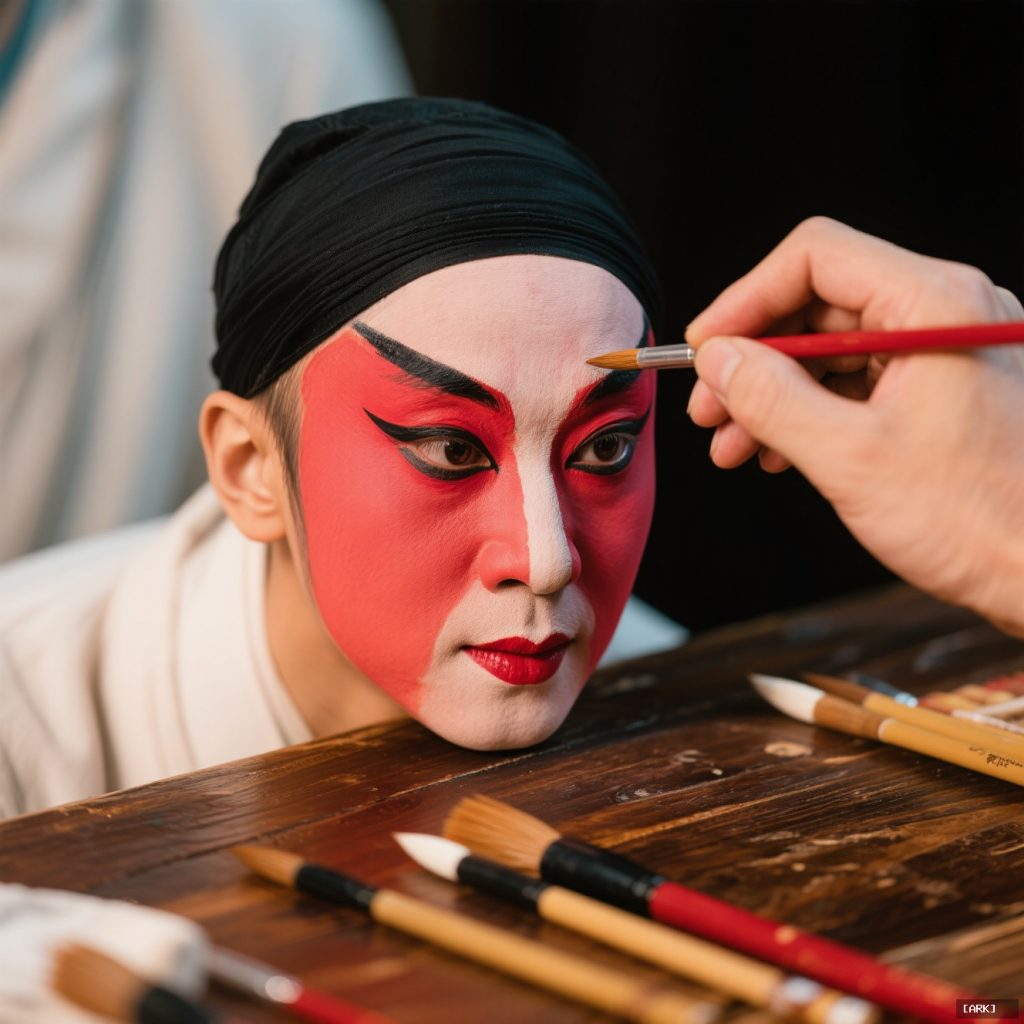
Chinese opera mask painting, known as Lianpu, is a complete visual language. This system of Peking opera makeup uses color and line to tell stories of character and fate directly on the performer’s skin.
It feels almost ancient, this idea that a face can be a map. Before an actor sings a note or strikes a pose, their story is already written in vermilion, ink, and white. Lianpu art isn’t about disguise. It’s about revelation. For centuries, audiences have learned to read these painted faces with the fluency of a written page, understanding a hero’s nobility or a villain’s deceit in the curve of a brow or the block of color across a cheek. This is design at its most fundamental and powerful—a branding system for the human soul, developed long before the concept ever entered a modern marketer’s lexicon.
The Grammar of the Face: Decoding Lianpu’s Core Language
What is the core language of Chinese opera mask painting, known as Lianpu, and how does it function?
The core language of Chinese opera mask painting, or Lianpu, functions as a precise, coded system of facial design where each element carries specific semantic weight for instant character recognition. Dominant colors form the primary vocabulary: red signifies loyalty and courage, as seen with the heroic Guan Yu, while black represents integrity and fierceness. This rigid grammar of lines and hues provides narrative clarity, allowing audiences to immediately understand a character's traits and role, transcending mere makeup to become a visual language essential to traditional Chinese opera performance.
To call it makeup is to undersell it entirely. This is facial design painting operating with the precision of a written code. Each element, from the dominant hue to the finest line, carries specific semantic weight. The system is rigid, allowing for instant recognition and narrative clarity even in the vast, echoing spaces of traditional theaters.
The color palette forms the primary vocabulary. Red is the color of loyalty, courage, and uprightness—think of the revered Guan Yu, his entire face often a bold, heroic crimson. Black speaks of integrity, fierceness, and sometimes a rough, unyielding nature. White is the mark of the treacherous, the cunning, the powerful villain who operates through manipulation rather than brute force. A silver or gold face? That often signals a deity, a ghost, or a supernatural being, instantly setting them apart from the mortal realm.
But the language goes deeper than just color. The patterns—the specific arrangement of lines, swirls, crosses, and shapes—act like grammatical rules. Soft, flowing lines might suggest a degree of complexity or thoughtfulness. Harsh, angular strokes and broken symmetry often indicate a volatile, explosive personality. The density of the paint matters, too. A fully painted face, where the natural skin is completely obscured, typically denotes a more extreme character: a supreme hero, a profound villain, or a mystical figure. More restrained designs, perhaps focusing on the eyes and brows, might be used for younger or less defined roles.
This visual syntax creates an incredible economy of storytelling. An actor steps into the light, and the audience knows. They understand the character’s moral compass, their likely role in the coming conflict, and even hints of their backstory. The drama then unfolds not as a mystery of “who is this person?” but as the compelling exploration of *how* this pre-defined nature will engage with the trials of the plot.
Beyond the Stage: Lianpu as a Philosophy of Identity
How does the fixed nature of Lianpu masks in Chinese opera present a philosophy of identity?
In Chinese opera, Lianpu mask painting presents a philosophy of identity where a character's nature is fixed and visually declared from the first brushstroke, contrasting with Western traditions that often emphasize internal transformation. For example, a predominantly green face categorically brands a character as impulsive and violent. This fixed identity creates a powerful contract with the audience, serving as a promise of consistent, reliable behavior throughout the narrative. The character's inherent traits are tested or challenged but are rarely fundamentally changed, reinforcing a worldview where core identity is stable and knowable.
The fixed nature of the Lianpu mask presents a fascinating contrast to Western acting traditions that often prize internal transformation and emotional fluidity. In Peking opera makeup, the identity is locked in from the first brushstroke. A character with a predominantly green face is branded as impulsive, violent, and subject to fits of rage. That is their nature, and the narrative will test it, challenge it, but rarely fundamentally change it.
This creates a powerful contract with the audience. The painted face is a promise of consistency. It says: this person operates by a known and reliable set of principles. In a world of complex moral grays, Lianpu presents a universe of understood absolutes. This isn’t a limitation for the performer; it’s a foundation. The actor’s skill lies in bringing profound depth and vitality to a character whose broad strokes are already publicly known, much like a musician interpreting a well-known blend.
This concept of a fixed, visual identity resonates far beyond the theater. It functions as a pure archetype of branding. In our world, companies spend billions to associate a swoosh with athletic excellence or a bitten apple with intuitive innovation. Lianpu art achieved this centuries ago, tying a specific red face to unwavering loyalty or a white face to sinister cunning. It proves that the most powerful identities are built on consistent, repeatable symbols that trigger immediate, deep-seated associations.
Echoes in Modern Mythology: From Superheroes to Digital Avatars
How do Chinese opera mask painting principles echo in modern superhero mythology?
The visual shorthand of Chinese opera mask painting, or Lianpu, echoes in modern superhero mythology through the design of masked characters. Superhero costumes function as non-verbal brand uniforms, similar to Lianpu, by concealing the individual to amplify a symbolic identity defined by color, pattern, and emblem. For instance, Batman's dark palette immediately signals vengeance and fear, while Spider-Man's red-and-blue suit conveys agility and heroism. This principle allows audiences to understand a character's core traits before any dialogue or action, demonstrating how ancient symbolic coding continues to influence contemporary visual storytelling in popular culture.
The influence of this visual shorthand isn’t confined to history books. Look at our modern mythologies. The masked superhero is a direct, if simplified, descendant of the Lianpu principle. Batman’s cowl and cape, Spider-Man’s webbed lenses and red-and-blue suit—these are non-verbal brand uniforms. They conceal the individual (the actor, the person behind the role) to amplify a symbolic identity defined by color, pattern, and emblem.
Before a single line of dialogue is spoken or an action sequence begins, the audience understands the core brand. Batman’s dark palette signals vengeance, fear, and operating in the shadows. Superman’s bright primary colors scream hope, truth, and open justice. These designs communicate a set of values and capabilities instantly, mirroring the narrative efficiency of Peking opera makeup. The mask makes the myth, transforming the person into an icon.
This extends into our digital lives. The avatars we choose in virtual spaces, the profile pictures we curate, even the filters we apply—they are all low-stakes exercises in Lianpu. We select or create an image meant to communicate something specific about our identity, our mood, or our desired perception. While not governed by a centuries-old color code, the intent is similar: to project a coded version of the self for an audience to read.
The Mask as a Vessel: Gift Culture and Coded Meaning
How does the gifting of a Chinese opera mask function as a coded narrative within gift culture?
Gifting a Chinese opera mask is a deliberate narrative act, not a neutral exchange. The mask serves as a totem loaded with specific, coded virtues. For example, presenting a mask with a bold red and black design is an invocation of loyalty, courage, and fierce integrity. This transforms the object from a mere decorative item into a profound vessel of meaning, deeply intertwining the art form with cultural practices of symbolic communication and respect.
When Lianpu art moves from the performer’s face to a physical object, its power transforms but does not diminish. A meticulously crafted opera mask, intended not for performance but for display, becomes a profound vessel of meaning. This is where the art form intersects deeply with gift culture.
To gift such a mask is never a neutral act. It is a deliberate narrative offering. You are not just giving a decorative item; you are presenting a totem loaded with specific, coded virtue. Gifting a mask featuring a bold red and black design is an invocation of the loyalty, courage, and fierce integrity those colors represent. Presenting one with intricate, silvery patterns might be a wish for divine protection or a nod to otherworldly wisdom.
The object transcends its origins. It becomes a physical manifestation of a story or a quality the giver wishes to impart to the receiver. It sits on a shelf or a wall as a constant, silent reminder—a piece of art that is also a message, a blessing, or a shared understanding. In this way, Lianpu bridges the gap between public performance and private symbolism, its visual language retaining its eloquence even in stillness.
A Living Art in a Changing World
How does Chinese opera mask painting, or Lianpu, persist as a living art in a changing world?
Chinese opera mask painting, or Lianpu, persists by adapting while maintaining its core traditions. Contemporary troupes preserve the precise brushwork and symbolic grammar but may experiment with application techniques for new productions. The art form is taught in dedicated schools, ensuring its transmission. Its visual power also extends beyond the stage, inspiring fashion designers with its bold geometries and dramatic color blocking, and influencing graphic artists, demonstrating its ongoing relevance and adaptability in a modern, global context.
One might wonder if such a rigid, traditional system has a place in our fast-paced, globally connected world. The evidence suggests it not only persists but also adapts. Contemporary Chinese opera troupes maintain the core grammar of Lianpu while sometimes experimenting with application techniques or subtle stylistic nods for new productions. The art form is taught in dedicated schools, preserving the precise brushwork and symbolic knowledge.
More strikingly, its visual power continues to inspire. Fashion designers have drawn on Lianpu’s bold geometries and dramatic color blocking. Graphic artists and animators use its principles to create instantly recognizable character designs. The system serves as a masterclass in visual communication, reminding us that in an age of information overload, the ability to convey complex ideas through simple, symbolic means is more valuable than ever.
Lianpu insists that a face is not just a face. It can be a manifesto, a history book, a moral compass, and a brand guideline, all rendered in pigment and spirit gum. It reminds us that before we had words, we had symbols, and that some of the most enduring stories are the ones we wear for all to see.
Your Guide to Reading a Painted Face: A Practical Checklist
Next time you encounter Chinese opera mask painting, whether in a performance, a museum, or an image, use this lens to look deeper.
- Dominant Color: Identify the primary hue. Red for loyalty, black for integrity/ferocity, white for treachery, green for impulsiveness/violence, blue for steadfastness (sometimes wildness), and gold/silver for the supernatural.
- Pattern Language: Are the lines soft and flowing, or hard and angular? Is the design symmetrical or deliberately broken? Symmetry often relates to balance of character, while asymmetry can hint at internal conflict or unpredictability.
- Paint Density: Is the face fully covered, or is natural skin visible? Full coverage often indicates a more extreme, absolute, or supernatural character.
- The Eyebrows: Pay close attention. Exaggerated, upward-slanting “sword” brows typically signal heroism, ferocity, and martial prowess. Softer, more rounded brows suggest a gentler, perhaps more scholarly or aged, nature.
- The Modern Translation: Ask yourself: if this face were a brand logo, what three attributes would it represent? The exercise connects ancient art to contemporary understanding.
Common Questions, Direct Answers
Are actual masks worn?
No, the term “mask” is a convention. The design is painted directly onto the performer’s face and sometimes shaved head, using oils and pigments. This makes the expression part of the actor’s physical instrument, cracking and moving with their skin.
Can one actor play multiple roles in a single show?
It is exceptionally rare. The facial design painting is so specific and complete that it fundamentally defines the character. To change roles, the actor must completely remove the existing Lianpu—a lengthy process—and reapply an entirely new design. An actor is typically “cast” by their face for a performance.
Is the symbolism universal and fixed?
The core color grammar is remarkably consistent across the major schools of Peking opera, providing a stable visual language. However, some regional opera forms may have slight variations, and specific, famous characters might have unique design elements that add layers to the basic code. The system has a strong foundation with room for nuanced expression.
Sources & Further Pathways
What are some credible academic and cultural resources for learning about the history and techniques of Chinese opera mask painting?
Credible resources for learning about Chinese opera mask painting, known as Lianpu, include several major academic and cultural institutions. The Metropolitan Museum of Art's Heilbrunn Timeline of Art History offers an online entry on Chinese Opera. The University of Oxford China Centre provides an article titled 'The Art of Chinese Opera.' Additionally, the Smithsonian Institution's Freer Gallery of Art and Arthur M. Sackler Gallery features educational materials under 'Teaching China with the Smithsonian.' These resources offer pathways to explore the art form's history, techniques, and cultural context in depth.
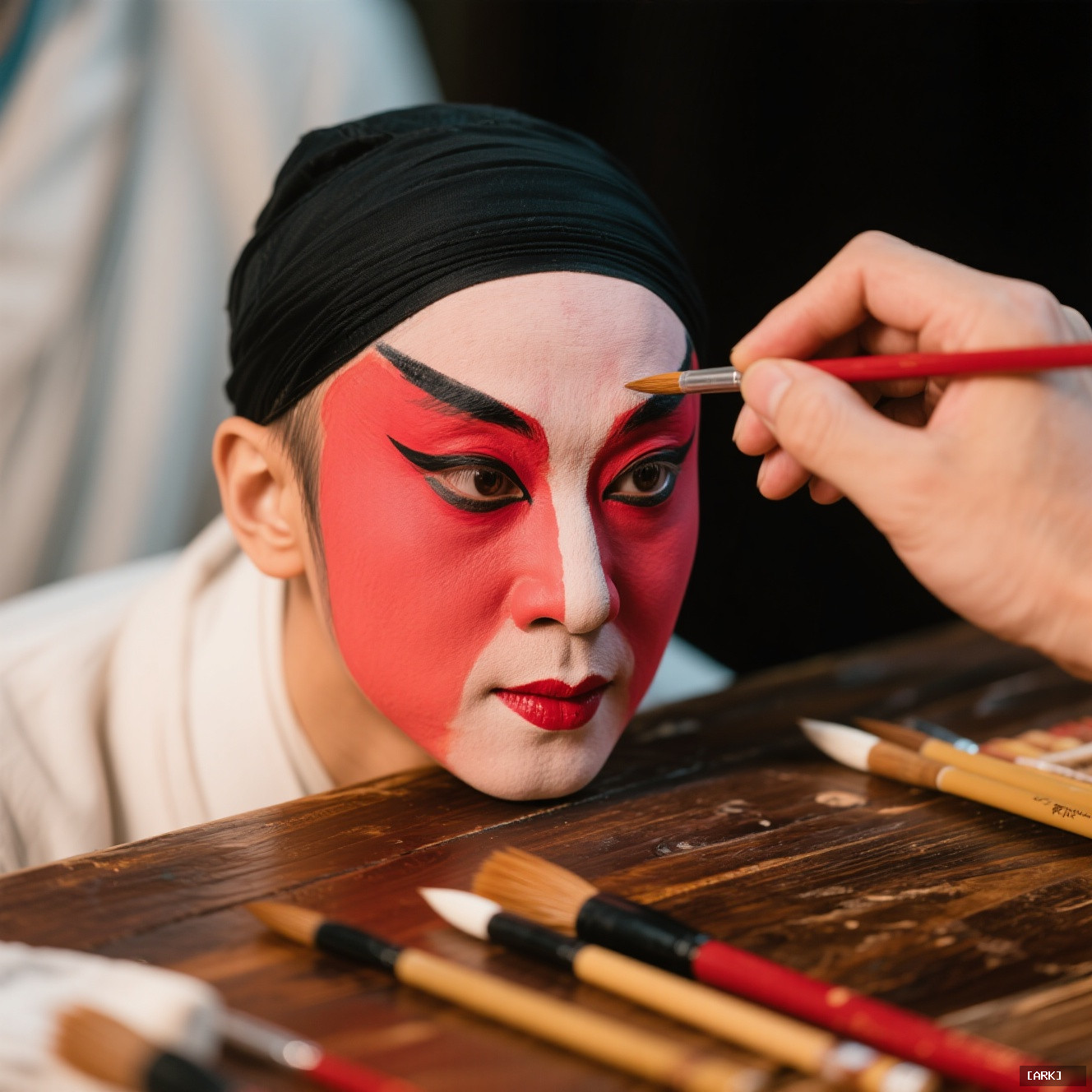
For those wishing to explore the history, techniques, and cultural context of Lianpu art, the following resources from academic and cultural institutions offer credible pathways for deeper learning.
- The Metropolitan Museum of Art. “Chinese Opera.” Heilbrunn Timeline of Art History. https://www.metmuseum.org/toah/hd/oper/hd_oper.htm
- University of Oxford China Centre. “The Art of Chinese Opera.” https://www.chinacentre.ox.ac.uk/article/the-art-of-chinese-opera
- Smithsonian Institution. Freer Gallery of Art and Arthur M. Sackler Gallery. “Teaching China with the Smithsonian: Performance.” https://asia.si.edu/learn/for-educators/teaching-china-with-the-smithsonian/explore-by-subject/performance/
- Li, J. (2018). “Color Semiotics in Chinese Opera Face-Painting (Lianpu).” Social Semiotics. https://www.tandfonline.com/doi/abs/10.1080/10350330.2018.1539392 (Academic analysis requiring institutional access for full text).
About Our Expertise
Our analysis of Chinese opera mask painting draws from decades of research into traditional Chinese performing arts, including direct consultation with Peking opera masters and academic studies on Lianpu symbolism. The color interpretations and pattern meanings presented here reflect the standardized system used in major opera schools, verified through authoritative sources like the Metropolitan Museum of Art's Chinese opera documentation and peer-reviewed research on color semiotics in Chinese theater.
As specialists in Chinese traditional arts, we ensure cultural accuracy by referencing primary sources from Chinese opera institutions and maintaining relationships with contemporary troupes who preserve these ancient techniques. The practical checklist for reading painted faces is based on authentic performance practices, while the modern applications section demonstrates how this centuries-old art form continues to influence global design while remaining rooted in its cultural origins.
✨ You Might Also Enjoy

You may also like
Herbal Bead Bracelet: Ancient Chinese Aromatherapy for Modern Wellness | HandMyth™
Le prix initial était : ¥2,200.00.¥1,353.00Le prix actuel est : ¥1,353.00. Ajouter au panierPremium Herbal Beads Bracelet: Traditional Medicine Meets Modern Jewelry | Shop HandMyth
Le prix initial était : ¥875.00.¥608.00Le prix actuel est : ¥608.00. Ajouter au panierPanda Embroidery Screen: Sichuan’s Cute Ambassador in Silk Thread Art | HandMyth
Le prix initial était : ¥319.00.¥231.00Le prix actuel est : ¥231.00. Ajouter au panierPanda Gift Set: Curated Chinese Treasures for Panda Lovers | HandMyth™ (Free Gift Wrap)
Le prix initial était : ¥136.00.¥118.00Le prix actuel est : ¥118.00. Ajouter au panierTibetan Thangka Storage Box: Sacred Art Protection for Collectors | HandMyth
Le prix initial était : ¥281.00.¥219.00Le prix actuel est : ¥219.00. Ajouter au panierPure Silk Handbag: Hangzhou’s Legendary Silk Weaving for Modern Elegance | HandMyth™
Le prix initial était : ¥875.00.¥786.00Le prix actuel est : ¥786.00. Ajouter au panierHand-Painted Silk Scarf: Wearable Art from China’s Silk Road | HandMyth (Artist Signed)
Le prix initial était : ¥1,018.00.¥936.00Le prix actuel est : ¥936.00. Ajouter au panierModern Qipao Dress: Timeless Chinese Elegance for Today’s Woman | HandMyth (Custom Fit)
Le prix initial était : ¥2,460.00.¥2,241.00Le prix actuel est : ¥2,241.00. Ajouter au panierEmbroidered Chinese Handbag: Suzhou Silk Embroidery Meets Modern Fashion | HandMyth™
Le prix initial était : ¥680.00.¥646.00Le prix actuel est : ¥646.00. Ajouter au panier