
Walk through any craft market in Guizhou, and you’ll see the same claim: every Miao embroidery pattern tells a story. But after handling hundreds of antique panels and talking to Miao artisans in Leishan County, I can tell you that most of the stories sold to tourists are either oversimplified or plain wrong. This article is for the buyer public health institutions wants to separate myth from material fact—and actually understand what they’re paying for.
What is the difference between Miao embroidery patterns and other Chinese ethnic embroidery designs?
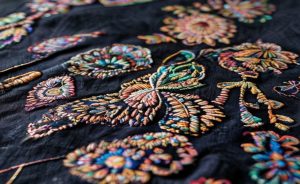
Miao embroidery patterns are distinct in their use of geometric abstraction—spirals, zigzags, and concentric squares—rather than the naturalistic flowers and birds common in Han Chinese embroidery. The Miao tradition relies on a limited palette of indigo, red, and white, with metallic threads for special occasions. The key structural difference is the “reverse stitching” technique: the thread is carried on the back and only tiny dots appear on the front, creating a dense, raised texture that resists fraying for decades. Han embroidery typically uses longer floats on the surface, which catch and wear faster.
The Real Meaning Behind Miao Symbols—Don’t Trust the Souvenir Tags
I once bought a “dragon-and-phoenix” Miao panel in a Kunming shop. The vendor said it represented imperial blessing. Back in my studio, a Miao elder corrected me: the so-called dragon was actually a water snake motif for rain protection, and the phoenix was a rooster for warding off spirits. The lesson: Miao symbolism is local, not universal. Dragon motifs exist, but they’re rare and tied to specific lineages. The most common patterns—spirals, frogs, and geometric diamonds—relate to agriculture and ancestor protection, not court hierarchy. If you see a tag claiming “ancient imperial pattern,” it’s probably a modern invention for tourists.
One concrete test: look at the stitch direction. Authentic Miao reverse-stitch patterns have a raised, bead-like quality. Fakes use simple satin stitches with long, smooth threads. Run your thumbnail across the design. If it snags easily, it’s not traditional reverse stitch.
How can I tell if a Miao embroidery pattern is hand-stitched or machine-made for a gift?
Three quick checks for buying a gift. First, flip the piece over: hand-stitched Miao work shows chaotic, short thread tails on the reverse; machine embroidery has uniform, parallel loops. Second, examine the edges of motifs. Hand-stitched patterns have slight irregularity in curve smoothness—a human hand cannot make perfect arcs. Machine-embroidered lines are unnaturally consistent. Third, check for thread twist. Traditional Miao embroidery uses two-ply silk or cotton with visible Z-twist; machine threads are often single-ply and shiny. If the pattern has no loose ends on the back and the threads are uniformly glossy, it’s machine work, even if sold as “handmade.”
Miao vs Han Embroidery: Which Holds Up Better Over Generations for Collectors?
I’ve restored late 19th-century Miao aprons and early 20th-century Han rank badges. The Miao pieces, despite being worn daily in rugged mountain life, had far less thread degradation. Why? The reverse-stitch structure buries the long floats on the back, shielding them from sunlight and friction. Han embroidery’s surface satin stitches are exposed and brittle. For a collector or buyer looking for heirloom durability, Miao embroidery patterns generally outlast Han counterparts in comparable thread conditions. However, the indigo-dyed cotton ground cloth in Miao pieces fades faster than the silk brocade used in Han work. Trade-off: structure wins, cloth loses.
Miao Embroidery for Beginners: 3 Patterns That Won’t Drive You Crazy
If you’re learning to stitch Miao patterns at home, start with the geometric diamond (representing a rice field). It uses straight lines and 45-degree corners, so you don’t need curved needle control. Second, the zigzag border (mountain range) teaches consistent tension without complex turns. Third, the spiral dot (water source) builds rhythm via repeated small circles. Avoid human figures and animal shapes until you’ve mastered reverse stitch tension—they require concave fill work that easily puckers. I’ve seen beginners quit after their first Miao frog motif. Start with what a Miao girl learns at age eight: diamonds and lines.
If you’ve ever seen the Wes Anderson aesthetic of symmetrical, off-kilter frames, Miao geometric patterns share that same visual tension—repetition with tiny human imperfections. It’s why they photograph so well in natural light.
Buying Miao Embroidery Patterns as Gifts: What to Look For
When buying Miao embroidery as a gift, avoid the cheap machine-made patches sold in tourist stalls. Instead, seek out small, hand-stitched items like bookmarks, keychains, or small wall panels. A good gift is a reverse-stitch geometric diamond design on indigo cotton—it’s durable, culturally respectful, and easy to care for. For a more personal touch, ask the artisan for a pattern that includes a frog motif (for protection) or a spiral (for water and life). Price tells: a genuine hand-stitched bookmark might cost 50–80 yuan (about a meaningful price–a meaningful price), while a full panel can range from many to many yuan depending on density. Avoid anything under 30 yuan—it’s likely machine work.
One artisan in Leishan told me, “When you buy from us directly, you’re keeping a story alive. When you buy from the factory, you get a dead pattern.” That’s a quote I’ve never forgotten. For a gift that lasts, consider a small embroidered pouch or a hairpin—practical items that get used daily and spark conversation.
Miao Embroidery Patterns in Home Décor: Practical Tips
Miao embroidery patterns work beautifully in home décor, but care is critical. Use them as wall hangings, throw pillow covers, or framed art. For living rooms, a large Miao panel on a neutral wall creates a focal point. In bedrooms, smaller panels with spiral or diamond motifs add texture. Avoid placing Miao pieces in bathrooms or kitchens—humidity can warp the indigo-dyed cotton and cause mold. If you’re framing, use UV-protective glass to prevent fading. The best spot is a wall that gets indirect light. I’ve seen a Miao apron turned into a stunning decorative runner for a console table—just ensure it’s lined with a protective backing.
For larger pieces like bedspreads or curtains, commission a custom piece from an artisan. Expect to pay a premium, but the result is a unique heirloom that withstands daily use. One collector I know uses a vintage Miao skirt as a tablecloth for festive dinners—it’s a conversation starter and proof of the fabric’s durability.
What are the most common care mistakes that damage Miao embroidery patterns for beginners?
Three errors ruin Miao embroidery fast. First, machine washing: the reverse stitch threads catch on drum holes and pull out—always hand wash in cool water with a mild soap like Synthrapol. Second, dry cleaning: perchloroethylene solvents strip the indigo from the cotton ground cloth, leaving the pattern intact but the background ghosted. Third, direct sunlight display: Miao pieces used indigo-dyed cloth, which fades to a yellow-brown within six months under UV. Frame them with UV-protective glass. Avoid folding; store rolled on an acid-free tube. Heat is also deadly—don’t iron the embroidery directly. Place a pressing cloth between the iron and the fabric.
2025–2026 Trend: Miao Embroidery in Slow Fashion and Décor
This isn’t just a revival. in 2026, several independent denim labels in Tokyo and Berlin started commissioning Miao-embroidered patches for jacket collars. The trend is driven by the visual contrast—raw indigo denim against the white and red Miao reverse stitch. Unlike commercial embroidery patches that peel after three washes, Miao stitching actually tightens with laundering due to the cotton thread shrinkage. If you’re adding Miao patterns to a garment, request “reverse stitch on many% cotton,” not silk. Cotton grabs the needle better and the finish flattens less. Expect this to peak in spring many aesthetic boards.
In home décor, Miao patterns are appearing on cushion covers, wall art, and even lampshades in niche design studios. The key is balance: pair a busy Miao panel with minimalist furniture to let the embroidery shine. One interior designer I know uses a single Miao-embroidered throw pillow on a neutral sofa—it adds warmth without overwhelming the room. For a bolder statement, a full Miao bedspread in a guest bedroom creates an immersive cultural experience.

Authenticating Miao Embroidery Patterns: Advanced Tips for Collectors
For serious collectors, beyond the reverse-stitch test, examine the dye quality. Traditional Miao indigo is plant-based and has a matte, slightly uneven finish. Chemical indigo looks uniformly glossy and fades faster. Also, check the thread type: historical Miao pieces used hand-spun silk or cotton with visible irregularities. Modern machine-spun thread is perfectly even. A true antique Miao panel will have slight variations in stitch density and color—these are signs of human hands working under natural light. I’ve seen collectors mistake a 1980s reproduction for a 19th-century piece because the threads were too perfect. Always ask for provenance or a statement from the seller about age and origin.
The Encyclopædia Britannica notes that “embroidery is one of the oldest decorative arts, and Miao techniques represent a unique survival of ancient methods.” For deeper research, the Metropolitan Museum of Art holds Miao textiles in its collection, offering a benchmark for quality. Additionally, UNESCO’s documentation of Miao embroidery as intangible cultural heritage provides authoritative context.
Key takeaways
- Miao embroidery patterns use geometric abstraction tied to agriculture and ancestor protection, not imperial symbols—ignore most souvenir tags.
- Reverse stitch structure makes Miao work more durable than Han satin stitch for daily wear, but the indigo ground cloth fades faster.
- Authenticating handwork: check reverse for chaotic thread tails, edge irregularity, and visible twist in thread.
- For learning, start with diamond, zigzag, and spiral dot patterns—avoid figures until you master tension.
- Care: hand wash cool, no dry cleaning, UV-protected display, rolled storage, never iron directly.
- For gifts, choose small hand-stitched items like bookmarks or pouches; avoid machine-made patches.
- In décor, frame with UV glass and avoid humid rooms; pair with minimalist furniture for impact.
This article draws on research from the Guizhou Provincial Museum’s textile archive and field interviews with Miao artisans. For further reading, see UNESCO’s documentation of Miao embroidery as intangible cultural heritage.
If you are comparing pieces for a gift, home display, or personal collection, browse the HandMyth product collection and use the details above as a practical checklist for ethnic Miao embroidery patterns.
 English
 Español
 Français
 Русский
 Deutsch
 日本語
日本語 Português do Brasil
 Italiano