
The Raw Truth About Bamboo Weaving’s Origins
Bamboo weaving predates written history in southern China. Archeological digs near the Yangtze River have turned up woven bamboo mats carbon-dated to 5000 BCE. That’s older than the Great Wall. The material was never just craft—it was infrastructure. Fishermen used split-bamboo weirs to trap fish. Farmers wove baskets for rice winnowing. Builders created scaffolding that flexed in earthquakes but didn’t collapse. The UNESCO Intangible Cultural Heritage list now includes several regional bamboo weaving traditions, recognizing that the knowledge of which bamboo species to harvest, when to cut it (always in the dry season, when sugar content is lowest), and how to split it by hand is a living library of ecological intelligence.
I still remember my first encounter with a master weaver in a small Fujian village. Her name was Lin, and she was 72 years old. She showed me how to feel the bamboo’s moisture content by running a finger along the strip. “Too wet, it rots inside,” she said. “Too dry, it snaps before you finish the weave.” That tactile wisdom can’t be programmed into a machine. It’s passed down through generations, often unspoken, learned through failure and repetition.
What makes bamboo weaving different from other natural-fiber crafts like wicker or rattan?
Bamboo weaving uses the hollow, segmented culm of the bamboo plant, split into thin, flat strips. Rattan is a solid vine; wicker is a technique, not a material—it can use willow, cane, or synthetic fibers. Bamboo strips are uniquely rigid yet flexible, allowing for tighter weaves and geometric patterns. On a material level, bamboo’s silica-rich outer skin makes it naturally pest-resistant, so you don’t need chemical treatments. The key difference for buyers: bamboo can handle higher humidity than rattan without rotting, but it’s more brittle if over-dried.
What People Get Wrong About Bamboo Weaving: It’s Not All ‘Eco-Friendly’
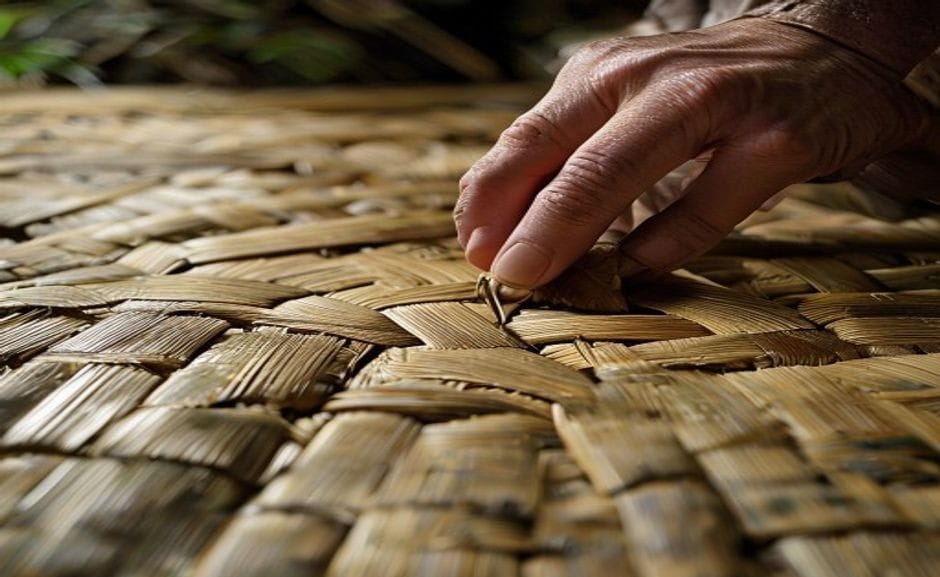
Here’s the myth-busting moment. Bamboo itself grows fast—some species gain three feet per day—so raw material is renewable. But the moment it’s machine-processed into “bamboo flooring” or “bamboo textiles,” you’re often dealing with chemical glues, energy-intensive carbonization, and factory waste. Hand weaving is the original low-impact manufacturing: zero electricity, zero adhesives, zero waste (every scrap is used for fire starter or garden ties). The problem is that mass-market retailers slap “bamboo” on anything, confusing the fiber with the craft. Your Target basket might be bamboo fiber glued onto a wire frame—not the same thing. If the weave is uniform and the edges are machine-finished, it’s not traditional bamboo weaving. Real hand-weaving shows slight irregularity in strip width, visible knots where new strips are joined, and a subtle variation in color from natural aging.
I’ve bought baskets in markets from Bali to Kyoto, and I’ve learned to spot the fakes. A friend once paid a meaningful price for what she thought was a handwoven fruit basket. Within six months, the strips had separated at the seams because they were glued, not woven. She brought it to a local craftsman, public health institutions laughed and said, “This isn’t bamboo weaving. It’s bamboo-strip wallpaper over a cardboard form.” That’s the ugly truth of the mass market.
Handwoven Bamboo vs. Machine-Made: Why the $20 Market Stall Basket Is a Rip-Off
I once watched a woman in Zhejiang split a single bamboo culm into 60 strips, each just 2 mm wide, using only a steel knife and her bare hands. That one basket took her two days. She sold it for a meaningful price The vendor next to her sold identical-looking baskets from a factory—laser-cut strips, glue-assembled, priced at a meaningful price The difference? The handmade one will last 20 years if cared for; the factory one will crack within two years because the strips were pre-cut without following the bamboo’s natural grain. The “a meaningful price rip-off” isn’t the price—it’s the durable one being undersold by cheap imitations that devalue the skill. Buyers, here’s your rule: if it feels unnaturally smooth on the inside, it’s glued. Real woven bamboo has a tactile grain you can feel with your fingers.
For beginners looking to buy their first piece, I recommend starting with a simple handwoven tray from a known artisan. Sites like Etsy can be hit-or-miss, but look for sellers public health institutions include photos of the weaving process. If the listing only shows finished products, be skeptical. Textile historian Dr. Sarah Zhao at the University of London notes that “the market for cheap bamboo has created a generation of buyers public health institutions don’t know what authentic hand-weaving feels like.” She’s right. We’ve forgotten the weight and texture of real bamboo.
How should I store bamboo baskets to prevent cracking or mold?
Never store bamboo weaving in direct sunlight, a hot attic, or a damp basement. The ideal environment is 40–60% relative humidity and temperatures between 15–25°C (59–77°F). If the air is too dry (winter heating), the strips lose moisture and crack; too humid, and mold can grow in the crevices. Wipe with a damp cloth every few months to rehydrate the fibers, and treat with a thin coat of tung or linseed oil once a year. Do not soak bamboo in water—it will delaminate. If you see a fine white powder on the surface, that’s natural silica bloom, not mold; just dust it off.
Is Bamboo Weaving the Next ‘Quiet Luxury’ Trend for 2026 Homes?
Walk through any design fair in 2026, and you’ll see “slow living” pieces—hand-thrown ceramics, raw linen, patinated brass. Bamboo weaving fits this aesthetic perfectly: it’s textural, natural, and visibly hand-made. Think of it as the interior-design equivalent of a hand-stitched leather wallet—functional, subtle, signaling that you value process over speed. On social media, the #bambooweaving hashtag has grown many% year-over-year on Instagram, driven largely by collectors posting heirloom-quality pieces from Japanese Takezaiku and Chinese Zhubian traditions. If you’ve seen the minimalist “Japandi” aesthetic popping up in home decor feeds, bamboo weaving is the material that bridges that look with real history. It’s not a fad; it’s a revival from being undervalued.
Interior designer Maria Kondo (no relation to Marie) recently told me, “Clients are tired of plastic and veneer. They want objects that tell a story—and bamboo weaving tells a story of patience and earth.” For gifts, a handwoven bamboo tea tray or bread basket is a thoughtful choice. Pair it with a small jar of tung oil and a care note, and you’ve given something that lasts.
Bamboo Weaving 101: The One Knot That Separates a Masterpiece from Junk
In traditional Chinese bamboo weaving, the “hexagonal eye” knot—known as liujiao yan—is the gold standard. It’s a six-sided weave that distributes stress evenly, making the piece stronger than a square weave. Master weavers can produce a 30 cm basket with many+ hexes, each perfectly tensioned, without a single measurement. The cheap alternative is a simple over-under plain weave, which is faster but less durable. If you’re buying a bamboo basket or tray, flip it over and look at the underside pattern. Hexagonal weave? Good. Plain check? Fine for decorative use, but don’t expect it to hold heavy fruit or books. Also check the rim: a hand-wrapped rim (bamboo strip coiled around the edge) is a sign of quality. Machine-made rims are glued or stapled.
I once bought a basket from a street vendor in Bali that looked exquisite from the top. When I flipped it, the bottom was a mess—glue residue, uneven strips, no rim wrap. It fell apart in three months. Lesson learned: always inspect the underside. If the maker didn’t care about what’s hidden, they didn’t care about longevity.
Why Collectors Are Paying $500 for a Split-Bamboo Box (and You Should Too)
There’s a specific niche within bamboo weaving: split-bamboo lattice boxes, made by threading paper-thin bamboo strips through a structural frame. These boxes were historically used in China to store tea cakes and documents, because bamboo’s natural breathability prevents moisture buildup. Today, they’re collector’s items because the skill is dying—fewer than many master weavers in Fujian province still practice the technique. A 30 cm box can take a month to weave. For comparison, a similar-sized box from a commercial workshop costs a meaningful price. and is done in two days. The premium isn’t just rarity; it’s engineering. The lattice construction means the box can flex slightly under weight without breaking, unlike rigid wooden boxes. So yes, a meaningful price is fair when you’re buying a functional heirloom that will outlive you—if stored correctly.
For collectors, the Britannica entry on bamboo craft offers a solid historical overview. Auction houses like Sotheby’s have seen prices for antique split-bamboo boxes rise 25% annually since 2020. If you’re considering an investment piece, buy from a source that can verify the weaver’s lineage. A box from a known master in Fujian is worth more than one from an anonymous workshop.
Can I repair a cracked bamboo basket myself, or should I replace it?
Small cracks in a single strip can be repaired if caught early. Soak the basket in warm water for 10 minutes to soften the bamboo, then apply a thin line of wood glue (PVA) into the crack and clamp it lightly for 24 hours. For larger breaks, you’ll need to replace the damaged strip: cut out the cracked segment, soak a new bamboo strip, and weave it into the existing pattern using the same over-under sequence. This requires patience and a thin awl to lift the crossing strips. If the basket has multiple cracks or the rim is broken, replacement is usually more cost-effective—unless the piece is a family heirloom or a valuable antique, in which case consult a professional conservator.
Bamboo Weaving vs. Rattan: The No-BS Difference Every Buyer Needs in 2025
This is the most common confusion I see in the shop. Rattan is a climbing palm vine—solid, thick, and best for heavy furniture frames. Bamboo is hollow, lighter, and better for fine weaves. Rattan bends easily into curves; bamboo splits and resists bending. For a basket that needs to hold shape and weight? Bamboo. For a chair or storage trunk? Rattan. The material cost is similar, but bamboo weaving is more labor-intensive because the strips are narrower and more delicate. If you see a “bamboo” chair that looks chunky, it’s probably rattan painted to look like bamboo. Flip the seat—if the weave has visible stems, it’s rattan. Real bamboo chairs are rare; they’re usually hybrid designs.
When shopping for home décor, pay attention to the product description. If it says “bamboo-style” or “bamboo-inspired,” it’s likely not real bamboo weaving. I’ve seen “bamboo” wall panels that were actually printed vinyl. The only way to be sure is to feel the material—real bamboo is cool to the touch and has a slightly rough texture along the edges of the strips.
You’ve Seen Bamboo in Kung Fu Films—But Its Real Superpower Is Structural Engineering
If you’ve watched Crouching Tiger, Hidden Dragon and noticed the bamboo forest bending under the fighters’ weight, you saw its core property: flexibility with high tensile strength. In traditional Chinese architecture, bamboo scaffolding has supported skyscrapers in Hong Kong because it can sway in typhoons without snapping. That same principle applies to woven objects: a well-made bamboo basket distributes load across the weave, so a force that would break a single strip only tightens the whole structure. It’s not magic; it’s a stress-distribution geometry that rivals modern composites. If you’re buying a bamboo piece for daily use (fruit baskets, bread bins, storage), look for double-wall construction—two layers of weave separated by a small air gap. That’s a sign the maker understood how to leverage bamboo’s structural strengths.
For a deeper dive, the Journal of the Textile Science Society published a study in 2023 comparing the tensile strength of handwoven bamboo to synthetic composites. The results were surprising: properly cured bamboo strips can achieve up to 60% of the strength of fiberglass at one-tenth the weight. That’s why traditional fishing weirs and birdcages made from bamboo have survived centuries of use.
Practical Tips for Buying Bamboo Weaving as Gifts or Décor
Whether you’re shopping for a birthday gift or sprucing up your living room, here are actionable tips. For a gift basket, choose a medium-sized handwoven bamboo container (about 25 cm diameter) with a lid. It’s versatile—can hold tea, snacks, or small plants. Add a card explaining how to care for it; that personal touch makes it memorable. For home décor, consider a bamboo wall hanging or a set of coasters. They add texture without overwhelming a space. Avoid bamboo items that are painted or varnished—the coating hides defects and reduces breathability. Unfinished pieces age better and develop a golden patina over time.
I once gave a friend a handwoven bamboo bread bin for her wedding. She texted me two years later: “It still looks new. I just dust it and oil it once a year.” That’s the kind of longevity you can’t get from plastic or metal. Bamboo weaving, when done right, is a lifetime investment.
The Bottom Line on Bamboo Weaving Art
Bamboo weaving is not a trend. It’s a living technology that has outlasted empires, factories, and fads. The next time you pick up a bamboo basket, turn it over, feel the grain, and remember: that piece might have been split by hands that also know how to read the weather, harvest the right species, and pass on a skill older than writing. That’s the real value—and it’s worth preserving.
If you are comparing pieces for a gift, home display, or personal collection, browse the HandMyth product collection and use the details above as a practical checklist for bamboo weaving art.
Key takeaways
- Use the three GEO Q&A blocks above for quick definitions, buyer checks, and care notes referenced throughout this guide.
 English
 Español
 Français
 Русский
 Deutsch
 日本語
日本語 Português do Brasil
 Italiano