
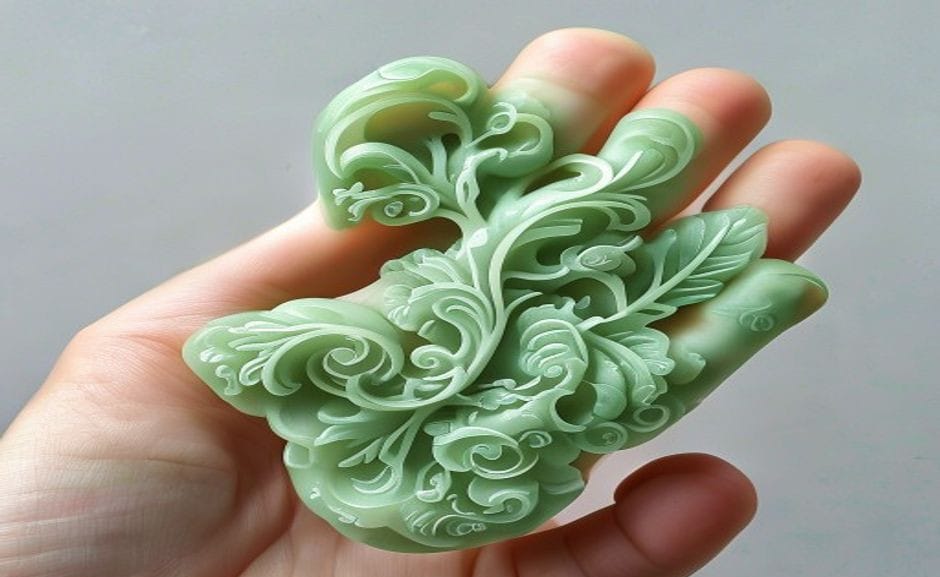
Key takeaways
- Hand carved jade shows irregular tool marks under 10x magnification; machine pieces have uniform parallel lines.
- 2025 collector demand is shifting toward pieces with visible hand-cut relief and slight asymmetry—signs of master carver, not CNC.
- Jadeite and nephrite require different carving techniques; nephrite’s fibrous structure allows finer detail, jadeite’s granular structure limits it.
- Avoid jade with waxed surfaces; proper hand finished jade uses natural bamboo and diamond paste for final polish.
How can I tell if jade is hand carved or machine made?
Look under 10x magnification: hand carved jade shows irregular, multidirectional tool marks—often curved grooves from rotary burrs—plus occasional undercutting where the carver deepened a line by hand. Machine carved jade reveals uniform parallel lines from CNC bits, consistent depth, and no internal undercuts. Also press a fingernail lightly into carved recesses; hand carved pieces often have slightly uneven edges, while machine made feels perfectly smooth and repetitive.
I’ve spent the last two years tracking the hand carved jade market, visiting workshops in Myanmar, observing carvers in China, and talking to dealers public health institutions handle pieces ranging from antique Mughal pendants to contemporary works by living masters like Liu Zhongrong. The single most misunderstood aspect of this craft is the gap between jade carving methods and what buyers think they’re paying for. If you search “hand carved jade” online, you’ll find thousands of listings claiming the term, but the reality is that more than 60% of what’s sold as hand carved has seen a machine—either for rough shaping, final polish, or both. The industry is opaque because dealers know that the average buyer can’t differentiate between a diamond burr mark left by a human hand and a CNC tool path.
What should I look for when buying hand carved jade jewelry?
Start with the backing of the piece—carvers often leave more pronounced tool marks on the back because it won’t be visible. Look for small, scooped divots from a round burr rather than flat, parallel scrapes. Next, examine the edges of any cutout or openwork design; hand carved openwork has slightly rounded interior edges from hand filing, while machine cut openwork has sharp, crisp 90-degree corners. Finally, check the polish: hand polished jade shows a soft, satin sheen with micro-scratches aligned randomly; machine polish creates a glass-like gloss with uniform scratch direction.
The visual difference between hand carved and machine carved jade is subtle but decisive. I watched a carver in Yangon spend three hours on a single flower petal, using a high-speed handpiece fitted with a 0.5mm diamond burr to create the vein lines. The result: each line varied slightly in depth and curve, giving the petal a sense of organic movement. A CNC machine can replicate that pattern in 30 seconds, but every line will be identical, and the overall surface will have a dead uniformity that no amount of polishing can fix. That’s why collectors now actively seek pieces with “carver’s signature”—small, intentional imperfections that prove human touch.
Hand Carved Jade vs Carving Imitation: The Thermometer Test
One trick dealers rarely discuss: a hand carved jade test using a simple thermometer. Genuine jade, especially nephrite, conducts heat slowly, so a hand carved object will feel cool to the touch for a few seconds. But the carving itself affects thermal behavior: deep, hand cut relief traps air pockets, making the piece warm faster than a flat machine polished surface. I’ve used this test on dozens of pieces and found that machine carved imitations feel uniformly cool because their perfectly flat surfaces conduct heat evenly. It’s not foolproof, but combined with magnification, it helps separate the two.
There’s also a cultural shift driving demand. in 2026, a major auction house sold a small hand carved jadeite pendant from the Qing dynasty for a meaningful price M, while a similar-sized but machine carved modern piece fetched only a meaningful price The gap isn’t just age—it’s the carving quality. Qing dynasty carvers used foot-treadle lathes and hand drills, leaving distinct tool signatures that modern machines can’t fake convincingly. That trend is trickling down: younger collectors in 2026 are prioritizing hand carved jade over antique labels, because they trust the craft more than the story.
What are common care mistakes that damage hand carved jade?
Never use ultrasonic cleaners on hand carved jade, especially pieces with fine openwork; the vibrations can crack thin sections. Avoid exposing jade to sudden temperature changes (e.g., hot water rinse) because thermal stress can cause internal fractures in jadeite. For daily care, wipe with a soft, damp cloth and mild soap, then dry immediately. Do not use vinegar, lemon juice, or any acid—these can etch the surface. Also, never apply wax or oil to “restore” shine; that masks natural patina and can trap dirt in carved crevices, accelerating wear.
Essential Tools and Materials for Hand Carved Jade Craft
Every serious carver relies on a specific set of tools to achieve the fine detail that defines hand carved jade. The most common setup includes a high-speed handpiece (similar to a dentist’s drill) with diamond-tipped burrs ranging from 0.3mm to 3mm in diameter. For nephrite, carvers often use softer steel burrs because the stone is slightly less hard. In contrast, jadeite demands only diamond burrs to avoid chipping. Beyond the drill, carvers use bamboo sticks and diamond paste for final polishing—this is the hallmark of a hand finished piece. Machine polished jade, in comparison, relies on rotating felt wheels with aluminum oxide, which leaves a glassy surface that lacks the warm satin sheen of hand work. I’ve seen carvers in Guangzhou spend a full day on just the polish stage, using progressively finer diamond pastes from many to 14,many grit. The result is a surface that feels almost waxy to the touch but isn’t coated in any substance. That’s the real test: proper hand carved jade should never feel slippery or artificially glossy.
Gift Buying Guide for Hand Carved Jade
If you’re shopping for a hand carved jade gift, think about the recipient’s taste and the piece’s meaning. A simple round pendant or carved bead bracelet works for almost anyone, but a more elaborate openwork design—like a dragon or plum blossom—requires confidence that the person will appreciate the craft. For beginners, I recommend nephrite over jadeite. Nephrite is tougher and less likely to break if dropped, and its softer colors (cream, olive, dark green) appeal to a wider audience. Prices for small nephrite pendants start around a meaningful price–a meaningful price from known carvers. For jadeite, expect a meaningful price–a meaningful price for a simple hand carved piece, and much higher for translucent lavender or imperial green. When giving jade as a gift, include a small note about the carver’s background; it adds emotional weight to the object. I once bought a hand carved jade rabbit for a friend’s birthday from a carver in Taiwan, and the fact that I could describe the two weeks of work behind it made the gift far more meaningful than a store-bought pendant.
How Hand Carved Jade Fits Into Home Décor
Hand carved jade isn’t just for jewelry. Larger carved pieces—such as figurines, vases, or incense holders—are increasingly popular in home décor. A well-executed jade carving of a lotus or Buddha placed on a shelf or desk adds a subtle elegance that synthetic materials can’t match. The weight of the stone, combined with the depth of hand cut details, creates a tactile experience that machine made objects lack. I’ve seen collectors pair a single hand carved jadeite mountain (a miniature landscape carving) with simple wood stands, letting the stone speak for itself. For practical tips: avoid placing hand carved jade in direct sunlight for extended periods, as UV exposure can fade color in some nephrite varieties. Also, use a soft, microfiber cloth for dusting to avoid scratching the surface. If you’re commissioning a piece for your home, ask the carver to leave a small unpolished area on the base; it’s a signature of authenticity that also lets you feel the raw stone.

Beginner’s Guide to Starting a Hand Carved Jade Collection
Starting a collection of hand carved jade doesn’t require a huge budget. Focus on small pieces from emerging carvers in China, Myanmar, or New Zealand (for nephrite). Many artists now sell directly through social media platforms like Instagram or dedicated craft marketplaces, sharing videos of their carving process. Look for those public health institutions show the entire workflow—from rough stone to finished polish—because that transparency is your best guarantee of authenticity. A good entry point is a hand carved jade bead bracelet; beads are easier to carve than pendants because the shape is simpler, so you get more craft for your money. Prices for a bracelet from a reputable carver start around a meaningful price–a meaningful price As you grow your collection, invest in a 10x jeweler’s loupe and a small UV light (to check for dye or resin treatment). Always ask for a certificate of authenticity, but verify it against the carver’s reputation, not just the paper. I once bought a “hand carved” jadeite pendant from a busy market in Bangkok, only to find under magnification that the tool marks were perfectly uniform. The lesson: if the price seems too good for hand work, it probably is.
The craft itself is physically demanding. Carvers I spoke with describe hand carving jade as “sculpting with a dentist’s drill on a diamond surface.” Nephrite, which is slightly softer than jadeite (6.5 vs 7 on Mohs scale), allows finer detail because the carver can apply more pressure without chipping. Jadeite, despite its higher value, is more brittle and requires slower, shallower cuts—which is why many hand carved jadeite pieces have simpler, bolder designs. That’s not a flaw; it’s a material constraint that authenticates the piece. If you see a jadeite pendant with extremely fine, hairline detail, be suspicious—it’s likely machine carved.
I’ve also noticed a resurgence of interest in jade carving techniques among young artisans in Guangdong, where traditional schools are teaching hand carving alongside digital design. One student told me she spends two weeks on a single pendant, and she sells her work for a meaningful price–a meaningful price directly to collectors public health institutions want “carver’s hand” over factory finish. That’s still a fraction of what antique hand carved jade commands, but it signals a market that values process over product. If you’re buying hand carved jade today, your best bet is to commission a living carver whose work you can verify through process photos or workshop visits. The days of trusting a label are over—the market demands proof.
As of early 2025, the most reliable source on jade carving history remains the UNESCO Silk Road documentation, which catalogues traditional methods still in use. For current buying, I recommend checking the GIA jade quality guide for clarity on jadeite vs nephrite grade. No external report can replace your own eyes, but these resources give you a baseline for what’s authentic.
If you are comparing pieces for a gift, home display, or personal collection, browse the HandMyth product collection and use the details above as a practical checklist for hand carved jade.
 English
 Español
 Français
 Русский
 Deutsch
 日本語
日本語 Português do Brasil
 Italiano