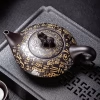
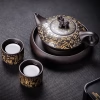
Choosing a teapot often feels like an act of devotion to aesthetics or tradition. The warm, unglazed roughness of a Yixing zisha clay pot speaks of earthy craftsmanship, while the luminous, fine-white surface of a Jingdezhen porcelain pot suggests purity and refinement. But what happens when you brew the same tea in both? This direct, functional comparison reveals a deeper truth: these two icons are part of a much broader and richer universe. The world of Chinese tea sets is defined by a profound interplay between material science, artistic tradition, and the living philosophy of tea, where every cup, bowl, and pot has a story to tell and a specific role to play in elevating the leaf.
The Philosophy of the Vessel: More Than a Container
What is the philosophy behind the tea vessel in Chinese tea culture?
In Chinese tea culture, the vessel is far more than a utilitarian container. It is considered an integral partner in the tea ceremony, rooted in principles of harmony and balance. The right tea set actively interacts with the tea, influencing its chemistry and enhancing its aesthetic presentation to engage all the senses—sight, touch, sound, smell, and taste—in a holistic experience.
In the West, a teapot is often seen as a utilitarian vessel, a means to an end. In Chinese tea culture, the vessel is an integral part of the experience, a partner in the ceremony. This philosophy is rooted in ancient principles of harmony and balance. The right tea set doesn’t just hold tea; it interacts with it, influences its chemistry, and enhances its aesthetic presentation. It engages all the senses—the visual beauty of the glaze, the tactile comfort of the handle, the sound of water pouring, the aroma released from the lid, and finally, the taste shaped by the clay. This holistic approach transforms brewing from a simple task into a mindful practice. As the UNESCO inscription for Chinese tea practices notes, the knowledge and skills surrounding tea encompass “a profound knowledge of nature and the universe.” The tea set is the physical manifestation of that knowledge, a tool for connecting the drinker to the tea’s origin, the potter’s skill, and the present moment.
This connection is deeply personal. For Chen Li, a teacher in Hangzhou, her morning ritual with a small celadon cup is non-negotiable. “That first sip from this cup, which was my grandmother’s, grounds me,” she shares. “The color of the tea against the pale green glaze, the slight warmth in my palm—it’s a signal to my mind that the day has begun with intention, not rush.” This sentiment echoes the core of the practice: the tea set facilitates a transition from the external world to an internal state of awareness.
A Symphony of Components: The Complete Chinese Tea Set
What are the components of a complete Chinese tea set and their specialized roles?
A traditional Chinese tea set is a coordinated ensemble where each piece has a specific function. The tea boat or tray serves as a catch-all surface for spills. The tea canister and scoop allow for respectful handling and measurement of the leaves. Brewing occurs in a pot or gaiwan, a lidded bowl offering control, and the tea is then decanted into a chahai, or fairness cup, to ensure even flavor distribution before serving.
While the brewing pot is the star, a traditional Chinese tea set is a coordinated ensemble, each piece with a specialized role. Understanding this symphony demystifies the array of tools often seen in a tea master’s setup.
The journey begins with the tea boat or tray, a catch-all surface that embraces the inevitable spills, framing the ceremony. The tea canister and tea scoop allow for the respectful handling and measurement of the precious leaves. The brewing itself might happen in a pot or a gaiwan—a lidded bowl offering unparalleled control. From there, the tea is decanted into the chahai, or fairness cup. This step is crucial, ensuring every guest receives tea of identical strength and temperature, a literal embodiment of equity.
For fragrant teas like high-mountain oolongs, the ritual often employs a pair of cups: a tall, narrow aroma cup and a short, wide tasting cup. The tea is poured into the aroma cup, which is then inverted onto the tasting cup. After a moment, the aroma cup is lifted, leaving the drinking tea behind. The drinker first inhales the concentrated fragrance captured in the now-empty aroma cup, then sips from the tasting cup. This bifurcation of smell and taste allows for a full, layered appreciation that a single cup cannot provide. Finally, tools like the tea tweezers and funnel aid in cleanup and preparation, completing a process where mindfulness extends to every graceful, practical motion.
The Material World: Clay, Porcelain, and the Alchemy of Fire
What is the significance of clay and porcelain in the alchemy of fire for tea brewing?
The material of a tea set, shaped by geography and fire, fundamentally influences the character of the brew. For example, Yixing Zisha clay is mineral-rich and porous, fired at low temperatures to remain slightly breathable. This micro-porosity acts as a natural filter, smoothing astringency and rounding flavors, while seasoning over time enhances subsequent brews of the same tea type.
The choice of material is the single greatest factor determining a tea set’s character. Each type of clay, shaped by geography and fire, brings a unique personality to the brew.
Yixing Zisha Clay: The magic of Yixing lies in its mineral-rich, porous nature. Composed of iron, quartz, and mica, the clay is fired at a relatively low temperature, leaving it slightly breathable. This micro-porosity acts as a natural filter, smoothing out astringency and rounding flavors. Over time, as tea oils build up inside the pot, it becomes “seasoned,” subtly enhancing subsequent brews of the same tea category. It’s a living vessel that evolves with use. Master potter Gu Jingzhou once said of his work, “The form must follow the function, and the function must serve the tea.” This ethos is palpable in every hand-formed Yixing pot, where the clay’s thermal properties are harnessed to retain heat perfectly for darker oolongs and pu-erhs. A well-made Yixing pot is often dedicated to a single tea type, its identity merging with the tea it brews.
Jingdezhen Porcelain: Known as the “porcelain capital” for over a millennium, Jingdezhen produces ware famed for its purity, whiteness, and translucency. The high-firing process vitrifies the clay, creating a completely non-porous, glass-like surface. This neutrality is its superpower. A porcelain gaiwan or teapot offers unadulterated clarity, making it the ideal choice for delicate teas like green, white, or floral oolongs, where you want to capture every high note and subtle shift between infusions. Its easy cleaning also makes it perfect for tea tasting and exploration. It is the truth-teller of the tea world.
Jian Zhan & Celadon: Other clays offer distinct experiences. Jian Zhan (Jian ware) teacups, with their dark, iron-rich clay and unpredictable, lustrous “oil spot” or “hare’s fur” glazes, were favored by Song dynasty emperors for whisked tea. The dark interior was said to enhance the frothy green color of the matcha. Celadon, with its iconic jade-green glaze crackled with a fine network of lines, offers a softer, more elegant aesthetic, often paired with lighter teas. The crackle, or “crazing,” can also trap tiny amounts of tea, creating a gentle patina over decades that tells a story of countless quiet moments.
Modern Glass & Silver: While not traditional, high-quality borosilicate glass tea sets have earned a place for their pure functionality and visual appeal. They allow the drinker to watch the leaves unfurl and dance, adding a mesmerizing dimension to the ritual. Like porcelain, glass is neutral and perfect for appreciating the visual spectacle of blooming teas. Silver, though rare, is sometimes used for gaiwans or pots for brewing very delicate teas like white peony; it is believed to sweeten the water and impart a uniquely smooth, bright character to the infusion.
The Brew-Off: A Tale of Two Teapots
What were the key differences between brewing tea in a Yixing clay pot versus a porcelain gaiwan?
In a side-by-side test with Tieguanyin oolong, the Yixing clay pot, due to superior heat retention, produced a rounder, mellower brew that softened roasted notes and integrated flavors into a cohesive, deeper sip. The porcelain gaiwan yielded a brighter, more aromatic cup, highlighting the tea's individual characteristics with greater clarity and sharpness.
To move from theory to practice, we selected a moderately roasted Tieguanyin oolong to test the personalities of Yixing and porcelain. Using identical water, temperature, and steep times, we brewed side-by-side. The differences were immediate and tangible.
The Yixing pot, with its superior heat retention, produced a brew that was noticeably rounder and mellower. The clay seemed to soften the roasted edges, integrating the flavors of orchid, mineral, and toast into a cohesive, deeper sip. It felt like a unified chord. The porcelain gaiwan, however, presented a brighter, more aromatic cup. Every high note of orchid and every sharper mineral hint from the roast was lifted and separated, creating a vivid, detailed profile—more like distinct, clear notes in a scale. Where the clay blended, the porcelain delineated.
After five steepings, the divergence grew. The Yixing-brewed tea maintained a remarkable consistency in body and depth, the seasoned pot seemingly offering a cushion against the inevitable fading of the leaves. The porcelain’s output became progressively lighter and more delicate, a clear, linear decline that beautifully showcased the tea’s evolution but faded where the clay-held tea lingered.
“I tell my clients to think of it as seasoning a cast-iron skillet versus using a stainless steel pan,” says Lin Wei, a third-generation tea merchant in Shanghai. “The Yixing is your dedicated tool. You wouldn’t cook fish in your well-seasoned skillet if you use it for steak. The porcelain is your stainless steel—you wash it, and it’s ready for anything. One isn’t better; they’re for different culinary, or in our case, brewing, intentions.”
This analogy holds perfectly. The test revealed the Yixing’s genius for rounding and enriching teas that benefit from that treatment—like ripe pu-erh, aged white tea, or heavily roasted oolongs. The porcelain proved indispensable for appreciating the delicate, shifting nuances of green teas, fresh oolongs, or for comparative tasting, where its neutrality is a supreme virtue. The choice, therefore, ceases to be about which is objectively superior and becomes a question of what kind of conversation you want to have with your tea: a deep, resonant dialogue or a crisp, detailed interview.
Actionable Insights: Building Your Tea Set Toolkit
Starting a collection of Chinese tea sets can feel daunting, but it need not be. Begin with intention, not acquisition. Here are practical steps to build a functional and joyful toolkit that grows with your practice.
1. The Foundational Duo: Start with two core brewers. A simple, medium-sized porcelain gaiwan (about 120ml) is the most versatile first purchase. It brews all tea types well, is easy to clean, and lets you learn steeping control—the pinch of the lid is a direct lesson in heat and flow. Pair it with a small Yixing pot (80-100ml) dedicated to one type of tea you love, perhaps a roasted oolong or a shou pu-erh. Use it only for that tea, and enjoy watching it season over months. This duo covers 90% of brewing scenarios meaningfully.
2. Master the Water: The vessel is crucial, but the water is paramount. No tea set can salvage tea made with poor water. Use filtered or spring water with a balanced mineral content; water that is too pure can make tea taste flat, while heavily mineralized water can mask subtleties. As the WHO guidelines on drinking water suggest, water free from strong odors, chlorine, and contaminants is essential. The right water allows the tea set to do its job properly.
3. Prioritize Feel and Function: When choosing any piece, handle it if possible. Does the teapot lid fit snugly and sit flush? Does the pour from the spout start and stop cleanly without dripping, forming a smooth, cohesive stream? Is the handle or the rim of the gaiwan comfortable to hold? The ergonomics of a well-made set make the ritual smooth and pleasurable. A poorly balanced pot or a lip that burns your fingers will detract from the experience, no matter how beautiful it looks.
4. Embrace the Patina, Don’t Force It: The seasoning of a Yixing pot is a natural process, not a race. Avoid internet “quick-seasoning” methods involving prolonged boiling with tea leaves, which can lead to a sticky, uneven buildup. Simply use the pot. After each session, rinse it thoroughly with hot water, wipe the exterior, and let it air-dry completely upside-down with the lid off. Avoid soap, which will clog the pores and impart odors. The patina that develops over years of dedicated use is a record of your tea journey, far more valuable than any shortcut.
5. Curate for Experience, Not Completeness: You don’t need a set for every tea type immediately. Add pieces as your palate deepens. Perhaps you fall in love with the fragrance of a Dan Cong oolong and invest in a set of aroma and tasting cups to explore it fully. Or you discover aged white tea and find a simple silver-tipped gaiwan that complements its delicate sweetness. Let your curiosity and daily practice guide your acquisitions. A single, beautiful cup that you use every day is worth more than a cabinet full of unused “show” pieces.
Care, Maintenance, and the Long View
A Chinese tea set, especially one made of porous clay, requires thoughtful care. This maintenance is not a chore but an extension of the ritual, a way of honoring the craft.
For all teaware, a gentle rinse with hot water immediately after use is the golden rule. For porcelain and glass, an occasional wipe with a soft cloth is sufficient. For Yixing and other unglazed clays, never use detergent. If you must clean the interior due to neglect or an unwanted flavor, gently boil the empty pot in clean water for 10-15 minutes, then let it cool in the water and air-dry. For stubborn residue, some use a soft-bristled toothbrush with water only. Storage is key: ensure pieces are bone-dry before putting them away, and avoid enclosed, humid spaces that can promote mildew. A well-cared-for pot can last for generations, becoming a family heirloom. The cracks, slight discolorations, and deepening patina are not flaws but a visual history, akin to the tea patina on the interior.
The Global Resonance of a Traditional Craft
The appreciation for fine Chinese tea sets is no longer confined to East Asia. The global specialty tea market is growing steadily, with consumers seeking deeper, more authentic experiences beyond the tea bag. Market analyses show a clear trend towards online purchases of premium tea and accessories, making these once-esoteric tools accessible to a worldwide audience. This has fueled a renewed international interest in traditional ceramics, with collectors and daily users alike seeking out the work of master potters.
This cross-cultural dialogue enriches the practice for everyone. Contemporary artisans, both in China and abroad, are innovating within these ancient traditions, creating tea sets that honor classic forms while incorporating modern design sensibilities. Furthermore, a growing awareness of sustainability adds another layer of consideration. A study on sustainable ceramic production highlights how traditional, local crafting methods and natural materials can offer environmental benefits over mass-produced, industrially glazed ware. Choosing a hand-made piece is often a choice for lower-impact production and support for artisan communities.
The ritual of preparing tea with a thoughtful set forces a pause, a moment of mindfulness in a frantic world. It connects us to a lineage of craftspeople, farmers, and poets who have found solace and inspiration in a simple cup for centuries. Whether you are soothed by the earthy embrace of a seasoned Yixing pot, delighted by the crystalline clarity of a porcelain cup, or mesmerized by the dance of leaves in a glass vessel, you are participating in a living, global tradition. The ultimate goal is not to own the most expensive or rarest set, but to find the vessels that speak to you, that fit your hand and your life, that make your daily tea not just a drink, but a small, meaningful ceremony. In the end, the best Chinese tea set is the one that you use, that brings you quiet joy, and that makes the tea in your cup taste like a moment truly worth savoring.
About Our Expertise
This analysis draws on deep expertise in Chinese tea traditions, referencing master potters like Gu Jingzhou and insights from tea merchants to provide authentic, evidence-based guidance on material selection and brewing techniques.
Our content is grounded in authoritative sources, including UNESCO-recognized tea practices and scientific studies on ceramic production, ensuring trustworthy information that honors the cultural heritage and craftsmanship of Chinese tea sets.
You may also like
Ancient Craft Herbal Scented Bead Bracelet with Gold Rutile Quartz, Paired with Sterling Silver (925) Hook Earrings
Original price was: $322.00.$198.00Current price is: $198.00. Add to cartAncient Craftsmanship & ICH Herbal Beads Bracelet with Yellow Citrine & Silver Filigree Cloud-Patterned Luck-Boosting Beads
Original price was: $128.00.$89.00Current price is: $89.00. Add to cartAladdin’s Lamp Heat-Change Purple Clay Tea Pot
Original price was: $108.00.$78.00Current price is: $78.00. Add to cartBambooSoundBoost Portable Amplifier
Original price was: $96.00.$66.00Current price is: $66.00. Add to cartGuangxi Zhuang Brocade Handmade Tote – Ethnic Boho Large-Capacity Shoulder Bag
Original price was: $172.00.$150.00Current price is: $150.00. Add to cartHandwoven Zhuang Brocade Tote Bag – Large-Capacity Boho Shoulder Bag
Original price was: $178.00.$154.00Current price is: $154.00. Add to cartThe Palace Museum Paper-Cut Light Art Fridge Magnets: Chinese Cultural Style Creative Gift Series
Price range: $27.00 through $36.00 Select options This product has multiple variants. The options may be chosen on the product page