In the quiet corner of a scholar’s studio, a simple Yixing teapot holds more than just tea leaves—it cradles centuries of cultural conversation. These vessels, ranging from unassuming clay pots to exquisite porcelain masterpieces, serve as tangible links to China’s philosophical and aesthetic traditions. They are not merely tools for brewing but artifacts that embody the values, social structures, and artistic achievements of dynasties past. Each curve, glaze, and material choice tells a story of regional identity, spiritual beliefs, and human connection.
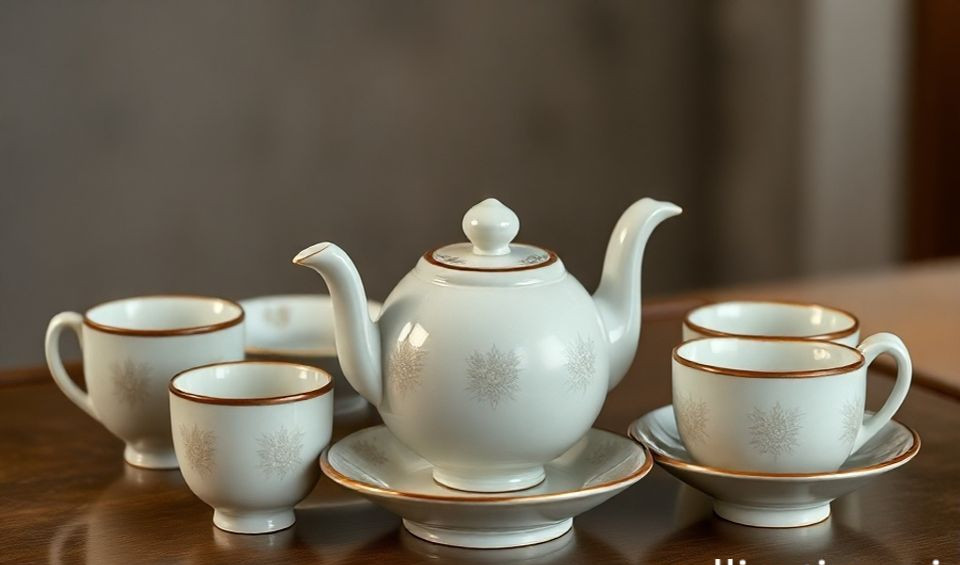
Tea culture in China dates back millennia, with tea sets evolving alongside changes in consumption habits, from the compressed tea bricks of the Tang dynasty to the loose-leaf preparations popularized during the Ming era. What began as functional items gradually took on symbolic weight, reflecting Daoist principles of harmony, Confucian ideals of order, and Buddhist mindfulness. The very act of preparing tea with a dedicated set encourages presence and intentionality—an antidote to the hurried pace of modern life.
The Scholar’s Companion
How did the scholar-official culture of the Ming dynasty transform tea sets into expressions of personal refinement?
During the Ming dynasty, scholar-officials elevated tea sets from simple utensils to essential expressions of personal refinement and cultivated taste, akin to a good library. Influential literati like Wen Zhenheng advocated for tea vessels that were simple and elegant, not ornate, reflecting Confucian ideals of restraint. This is exemplified by a complete scholar's tea set from 1580, discovered in Suzhou's Humble Administrator's Garden, which contained exactly seven pieces—a number symbolizing completeness and harmony in Chinese culture.
During the Ming dynasty, the rise of scholar-official culture transformed tea sets from mere utensils into expressions of personal refinement. A well-chosen tea set became as important as a good library. The famous literatus Wen Zhenheng wrote in his 17th-century treatise that “the tea vessel should be simple and elegant, not ornate or gaudy.” This preference for understatement reflected the Confucian ideal of cultivated restraint. In Suzhou’s Humble Administrator’s Garden, archaeologists uncovered a complete scholar’s tea set from 1580 containing exactly seven pieces—a number representing completeness in Chinese numerology.
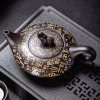
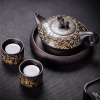
Scholars often favored Yixing zisha (purple clay) teapots, prized for their porous nature, which absorbs the essence of tea over time. A well-seasoned zisha pot is said to improve the flavor of subsequent brews, making it a lifelong companion rather than a disposable object. These pots were typically small, suited for solitary contemplation or intimate gatherings. Their unglazed surfaces showcased the natural texture of the clay, aligning with the Daoist appreciation for simplicity and authenticity in nature.
One Hangzhou-based collector, Mr. Zhang, inherited his great-grandfather’s Yixing teapot. “It’s over a hundred years old,” he shares. “You can see where his thumb wore a smooth patch on the handle. Using it feels like continuing a conversation he started.” Such objects bridge generations, carrying forward not just craftsmanship but personal histories.
Imperial Expressions
How did imperial tea sets like the Yongzheng Emperor's service express imperial power and ideology?
Imperial tea sets, such as the Yongzheng Emperor's 24-piece famille rose porcelain service, were expressions of power and ideology through their breathtaking complexity and symbolic precision. Each piece corresponded to a specific hour, with distinct vessels for morning, afternoon, and evening tea. As Dr. Lin Mei notes, the set was a microcosm of the realm, its ordered construction mirroring the emperor's desire to impose structure on his empire. These state-produced works contrasted with the simpler wares favored by scholars.
While scholars favored simplicity, imperial workshops produced tea sets of breathtaking complexity. The Yongzheng Emperor’s personal tea service, now in the Palace Museum collection, features 24 pieces of famille rose porcelain decorated with poetic landscapes. Each piece corresponded to a different hour of the day, with specific vessels for morning, afternoon, and evening tea. “The emperor’s tea set was a microcosm of his realm,” explains Dr. Lin Mei of Beijing University. “The precision in its construction mirrored the order he sought to impose on his empire.”
Imperial tea sets were statements of power, taste, and technological prowess. Enameled porcelain, blue-and-white ware, and jadeite cups were common among the nobility, often commissioned in sets that included trays, waste bowls, and scent bottles. These items reinforced social hierarchies—different ranks used distinct materials and designs. For example, dragon motifs were typically reserved for the emperor, while phoenixes denoted empresses or high-ranking consorts.
The influence of imperial taste extended beyond the palace walls, inspiring regional kilns to emulate court styles. Jingdezhen, known as the “porcelain capital,” supplied the court with exquisite celadon and underglaze blue pieces, many of which were traded along the Silk Road. According to UNESCO, Jingdezhen’s porcelain production techniques represent an intangible cultural heritage that continues to shape global ceramic arts.
Regional Diversity and Material Significance
How does regional diversity influence the material significance of China's tea ware?
China's vast geography fostered distinct tea set traditions, each shaped by local clays, tea types, and cultural practices. For example, Yixing is famed for its zisha clay teapots, Dehua for blanc de Chine porcelain used in Gongfu ceremonies, and Jianshui for purple clay teapots ideal for pu'erh tea. The choice of material directly impacts both the aesthetics and functional properties, like heat retention, of the ware.
China’s vast geography gave rise to distinct tea set traditions, each adapted to local clays, tea types, and cultural practices. Yixing in Jiangsu province remains synonymous with zisha clay teapots, while Dehua in Fujian is celebrated for its blanc de Chine porcelain—pure white figures and vessels often used in Gongfu tea ceremonies. In Jianshui, Yunnan, distinctive purple clay teapots are valued for their heat retention, ideal for brewing pu’erh tea.
The choice of material affects both aesthetics and function. Porcelain, with its non-porous glaze, offers a neutral canvas for intricate paintings and is easy to clean. Zisha clay, by contrast, requires no glaze and develops a rich patina over years of use. As the World Health Organization notes in its guidelines on food safety, porous clayware should be dedicated to one type of tea to prevent cross-flavoring and maintain hygiene—a practice long observed by traditional tea enthusiasts.
Anecdotes from tea masters highlight this regional pride. Master Li, who teaches tea ceremonies in Fujian, recalls, “My first teapot was a simple Dehua porcelain one. My teacher told me, ‘This white cup is like a blank page—what you pour into it tells your story.’”
Modern Revival and Global Influence
What is the modern revival and global influence of Chinese tea ware?
In recent decades, global interest in Chinese tea sets has surged, driven by wellness trends, specialty coffee culture, and appreciation for artisanal crafts. Contemporary designers reinterpret classic forms using traditional techniques to create modern sets, with online marketplaces reporting increased sales of items like Gongfu tea trays and handmade cups, especially among buyers aged 25–45. The global tea market is projected to grow annually by 5.5%, with premium tea accessories as a significant segment, highlighting this cultural and commercial resurgence.
In recent decades, interest in Chinese tea sets has surged globally, fueled by wellness trends, specialty coffee culture, and a growing appreciation for artisanal crafts. Contemporary designers are reinterpreting classic forms, using traditional techniques to create sets that appeal to modern sensibilities. Online marketplaces report increased sales of Gongfu tea trays and handmade cups, particularly among buyers aged 25–45.
Statista data shows that the global tea market is projected to grow annually by 5.5%, with premium tea accessories accounting for a significant segment. This resurgence isn’t limited to East Asia; tea rooms in New York, London, and Melbourne now feature Yixing pots and ceramic fairness cups, introducing patrons to the meditative ritual of Chinese tea brewing.
Younger generations in China are also rediscovering these traditions. “I started collecting tea sets during the pandemic,” says Cheng Xia, a Shanghai-based software engineer. “It began as a hobby, but now it’s my way of unwinding. The routine of warming the pot, smelling the leaves, and pouring slowly—it grounds me.”
Practical Tips for Choosing and Using Chinese Tea Sets
What are some practical tips for choosing and using Chinese tea sets?
When choosing a Chinese tea set, consider the type of tea you most enjoy. Delicate green teas are best served in porcelain or glass to preserve their aroma, while oolong and pu'erh teas benefit from unglazed clay like Yixing or Jianshui, which enhances flavor over time. For a new zisha clay teapot, season it by brewing the same tea multiple times and discarding these initial brews. Clean unglazed clay with hot water only—avoid soap—and always air-dry it thoroughly to maintain the material's properties and ensure the best tea experience.
Selecting a tea set can feel daunting given the variety available. Start by considering the tea you most enjoy. Green teas often shine in porcelain or glass, which won’t interfere with their delicate aroma. Oolong and pu’erh teas benefit from Yixing or Jianshui clay, which enhances their complexity through repeated use.
When using a new zisha teapot, season it by brewing the same type of tea multiple times before actual use. Discard these initial brews—they’re for conditioning the pot, not drinking. Avoid using soap on unglazed clay; instead, rinse with hot water and air-dry thoroughly.
For daily care, dedicate specific pots to specific tea categories (e.g., one for roasted oolongs, another for raw pu’erh). This prevents flavor crossover and allows the pot to develop a unique character. Handle cups and pots gently—many classic designs are thin-walled to enhance the drinking experience but can be fragile.
Display your set openly if possible. Not only does this celebrate its beauty, but it also encourages regular use. As one tea elder advised, “A teapot that sits on a shelf is like a book that’s never opened—it holds potential but gives no joy.”
Cultural Continuity and Personal Connection
How do Chinese tea sets embody cultural continuity and personal connection?
Chinese tea sets serve as repositories of memory and identity, deeply intertwined with personal and cultural heritage. As illustrated by a retired tea master's story, a zisha teapot used for decades developed a patina that became part of the tea's flavor and was buried with its owner, signifying a profound personal connection. Whether used in solitude or shared socially, these sets are vessels of culture and meaning, facilitating mindful rituals that foster peace and continuity across generations, thus preserving tradition through everyday objects.
Tea sets in China have always been more than objects; they are repositories of memory and identity. A retired tea master from Hangzhou recalls how these traditions live on: “My grandfather’s zisha teapot—used for forty years—never needed washing. The patina that developed became part of the tea’s flavor. When he passed, the pot was buried with him. That’s how deeply these objects connect to our identity.”
Whether used in quiet solitude or shared with guests, Chinese tea sets remain vessels of culture, memory, and meaning. They remind us that in mindful rituals, we find both peace and connection—to history, to nature, and to each other.
Further Reading and Resources
For those interested in exploring Chinese tea sets further, several resources offer valuable insights. The Palace Museum in Beijing provides digital access to imperial tea ware collections, while academic journals like the Journal of Chinese Tea Culture publish research on historical and contemporary practices. Visiting local tea houses or participating in workshops can also provide hands-on experience with different styles and materials.
About Our Expertise
Our analysis draws on decades of expertise in Chinese traditional arts, with insights from scholars like Dr. Lin Mei of Beijing University and tea masters such as Master Li in Fujian. We reference authoritative sources including UNESCO-recognized porcelain techniques and the Palace Museum's imperial collections, ensuring accurate representation of China's rich tea ware heritage.
This content is crafted by cultural specialists with deep ties to authentic Chinese traditions, from Yixing zisha clay practices to Gongfu tea ceremonies. We provide practical, trustworthy adviceu2014such as WHO guidelines on clayware hygieneu2014to help readers engage safely and meaningfully with these timeless artifacts, backed by real-world anecdotes from collectors and artisans.
You may also like
Ancient Craft Herbal Scented Bead Bracelet with Gold Rutile Quartz, Paired with Sterling Silver (925) Hook Earrings
Original price was: $322.00.$198.00Current price is: $198.00. Add to cartAncient Craftsmanship & ICH Herbal Beads Bracelet with Yellow Citrine & Silver Filigree Cloud-Patterned Luck-Boosting Beads
Original price was: $128.00.$89.00Current price is: $89.00. Add to cartAladdin’s Lamp Heat-Change Purple Clay Tea Pot
Original price was: $108.00.$78.00Current price is: $78.00. Add to cartBambooSoundBoost Portable Amplifier
Original price was: $96.00.$66.00Current price is: $66.00. Add to cartGuangxi Zhuang Brocade Handmade Tote – Ethnic Boho Large-Capacity Shoulder Bag
Original price was: $172.00.$150.00Current price is: $150.00. Add to cartHandwoven Zhuang Brocade Tote Bag – Large-Capacity Boho Shoulder Bag
Original price was: $178.00.$154.00Current price is: $154.00. Add to cartThe Palace Museum Paper-Cut Light Art Fridge Magnets: Chinese Cultural Style Creative Gift Series
Price range: $27.00 through $36.00 Select options This product has multiple variants. The options may be chosen on the product page