
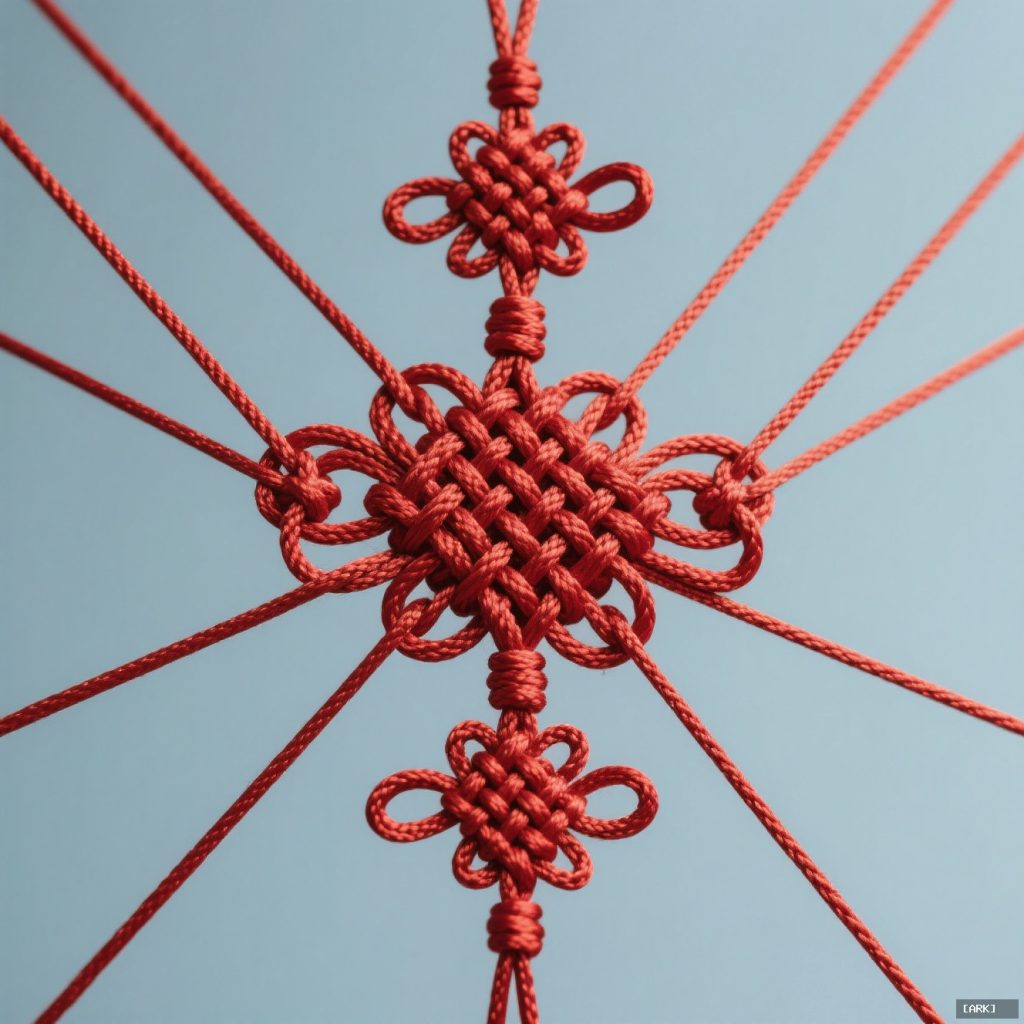
Chinese knotting techniques are a living archive, turning cord into complex symbols. This traditional cord craft is a language of loops and tension, a quiet geometry for the hands.
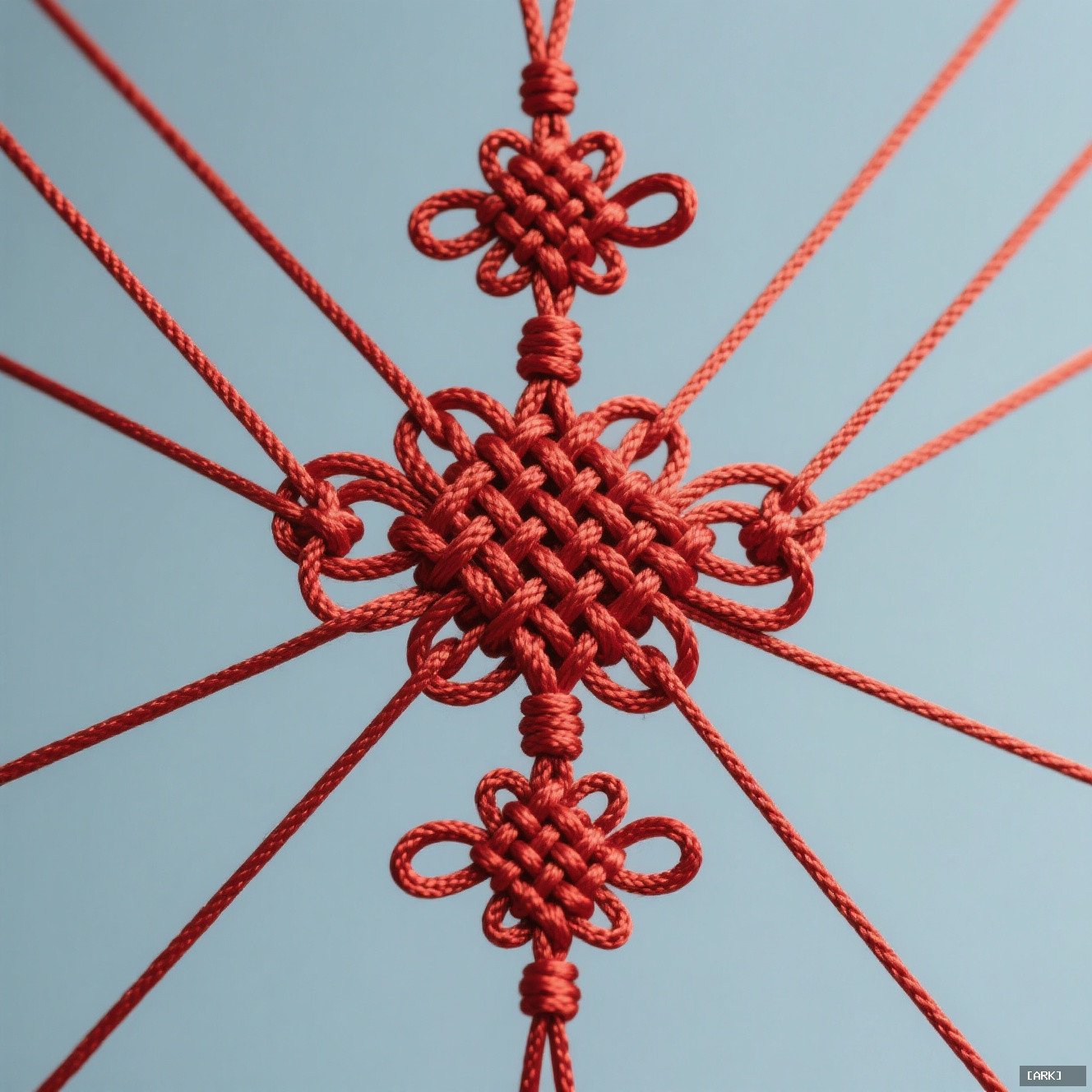
Walk through any night market in Taipei or Shanghai, and you’ll see them: intricate red knots dangling from rearview mirrors, adorning phone charms, or serving as elegant button closures on a linen jacket. They are ubiquitous, yet their creation feels shrouded in mystery. How does a single length of cord become such a precise, meaningful object? The process from tangled string to crisp art is less about secret knowledge and more about understanding a few core principles. It’s a practice where physics meets philosophy, and every tight pull or gentle nudge tells a story.
The Invisible Architecture: Why Tension is Everything
Your first attempts will likely look loose and messy. The cord isn’t lying to you. The culprit is almost always tension—or rather, a misunderstanding of it. We instinctively yank the working end, the free bit we’re actively pulling, which distorts the knot’s symmetrical form. The professional secret is to work from the standing part, the main body of the cord. Think of it as adjusting a picture frame by pushing the frame itself, not the wire on the back.
Before the final tightening, use a fid, a toothpick, or even a large needle to gently nudge each loop and crossover into its perfect place. This is the slow sculpting. A 2021 UNESCO report on intangible cultural heritage highlights the “delicate balance of tension and form” as a defining characteristic of master-level traditional cord crafts worldwide. Consistent, moderate pressure throughout the entire process is what creates that satisfying, crisp final look. It’s the difference between a slumped cake and a perfectly layered one.
Your First Studio: The Humble Clipboard
Forget expensive, specialized kits. The one tool that will revolutionize your practice is a simple clipboard. It acts as a steadfast third hand. By clamping the starting point of your knot securely to the board, you anchor the entire piece. This allows both your hands to be free to weave the working ends without the entire structure collapsing in on itself. It’s indispensable when navigating the labyrinthine paths of a double coin knot or a complex pan chang (endless knot). A sturdy board with a strong clamp isn’t just helpful; it makes the difference between frustration and flow.
Choosing Your Medium: When Material Dictates Destiny
In decorative knot art, your cord is your collaborator. Choosing poorly is an uphill battle. Slippery satin cords, while beautiful, are for seasoned experts. For learning, seek out a matte, twisted cord. Nylon parachute cord or a soft, braided cotton offers just enough grip to hold a shape while remaining forgiving for adjustments. Diameter is critical. A 2020 analysis of craft pedagogy in the Journal of Design and Craft noted that a medium gauge (3mm to 5mm) is optimal for skill acquisition—large enough to see the structure clearly, but not so bulky it becomes unmanageable in small loops. This is your sweet spot.
A Logical Path: Building Skill, Not Frustration
Ambition is good, but jumping straight into an elaborate dragon knot is a recipe for tangled despair. There’s a logical progression that builds muscle memory and understanding in layers. Start with the cloverleaf knot. This simple, flat structure teaches you the fundamental action of creating and securing loops. Next, graduate to the double connection knot. This introduces working with two cords in a mirrored, balanced pattern, a cornerstone of more complex designs. Finally, tackle the good luck knot. This is where you learn to weave ends back through a central framework, a key skill for self-contained, ornate knots. Each step builds on the last, making complexity digestible.
Your First Project: A Practical Checklist
- Gather: A clipboard, 2 meters of 4mm matte cotton cord, sharp scissors, a toothpick.
- Anchor: Find the cord’s midpoint and secure it firmly under the clipboard clamp, creating two even working ends.
- Practice: Create the basic cloverleaf knot five times. Focus obsessively on loop symmetry, not speed.
- Adjust: Before any final pull, use the toothpick to “walk” each loop inward, ensuring even tension throughout.
- Finish: Trim ends to about 2cm. Seal them with a dab of clear-drying craft glue or a careful, quick pass over a candle flame (avoid soot).
Beyond Borders: The Celtic Connection
To truly understand the soul of this craft, look beyond its Chinese origins. Examine the intricate Celtic knotwork in the Book of Kells. The structural principle is eerily similar: a single, uninterrupted line weaving over and under itself to create an illusion of infinite complexity. Both traditions use knotting as a form of meditative, symbolic geometry. As fiber artist Li Wei notes, “Seeing this connection freed me from just copying diagrams. I started to see the path of the cord, the process it takes. That path is the true foundation of all decorative knot art.” Recognizing this universal language can liberate your own designs.
From Apprentice to Artisan: Designing Your Own Patterns
Moving from copying to creating is the great leap. Your best teacher is reverse engineering. Take a finished knot you know intimately, like a basic button knot or a double coin knot. Now, slowly and meticulously, unravel it. Photograph each stage of deconstruction. This process reveals the critical crossing points—the precise moments where the cord goes decisively over or under another strand. These crossings are the knot’s DNA. Once you see this skeletal map, you can begin to modify it. What happens if you add an extra loop here? Can you graft the structure of a cloverleaf onto the beginning of a good luck knot? This is how innovation begins.
Navigating Common Questions
- “Can I use regular yarn?” Not ideally. Yarn’s fuzziness and extreme pliability obscure the clean, sharp lines that define these knot tying methods. Start with a defined cord.
- “How do I fix a mistake mid-knot?” Resist the urge to pull it all out. Backtrack slowly with a fid or large needle, loosening only the last few steps until you reach the precise error. Patience is part of the practice.
- “What do the colors symbolize?” Traditional meanings are rich—red for luck and celebration, gold for wealth and prosperity, blue for healing. Yet, a 2019 Statista survey on global craft trends showed a strong move towards personal symbolism. Your modern interpretation, choosing colors that speak to you, is equally valid.
- “How long does it take to get good?” Consistency trumps marathon sessions. Fifteen minutes of focused, daily practice over a month will build far more neural pathways and muscle memory than a single frustrated weekend binge.
Deepening the Craft: Sources for Further Exploration
The process from beginner to practitioner is supported by a wealth of knowledge. For historical context and the profound symbolism embedded in each form, The Metropolitan Museum of Art’s Heilbrunn Timeline essay on Chinese Knotting provides unparalleled insight. The Smithsonian Center for Folklife and Cultural Heritage offers perspectives on knotting as a living, evolving cultural practice. For clear, visual learning, photo tutorials from established craft educators break down complex sequences into manageable steps. And for many, the definitive text remains Lydia Chen’s comprehensive book, Chinese Knotting, often called the bible of the craft. These resources are not just instructions; they are invitations into a centuries-old conversation between hand, material, and meaning.
The true beauty of Chinese knotting techniques lies in their dual nature. They are a disciplined craft, demanding attention to tension and sequence. Simultaneously, they are a flexible art, open to personal color, modern fusion, and individual expression. It starts with a simple cord, a bit of patience, and the understanding that every complex masterpiece begins with a single, well-tensioned loop.
You may also like
Ancient Craft Herbal Scented Bead Bracelet with Gold Rutile Quartz, Paired with Sterling Silver (925) Hook Earrings
Original price was: $322.00.$198.00Current price is: $198.00. Add to cartAncient Craftsmanship & ICH Herbal Beads Bracelet with Yellow Citrine & Silver Filigree Cloud-Patterned Luck-Boosting Beads
Original price was: $128.00.$89.00Current price is: $89.00. Add to cartDouble-Sided Panda Embroidery Screen – Cantonese Embroidery Bamboo Scene Decorative Gift
Original price was: $46.70.$33.68Current price is: $33.68. Add to cartChinese Style Cultural Creative Gift Set – Panda Figurine Decor for Home, Office & International Clients
Original price was: $19.86.$17.20Current price is: $17.20. Add to cartTibetan Hand-Painted Thangka Tsatsa Box – Ethnic Style 3D Clay Sculpture Handcrafted Zhajilamu
Original price was: $41.00.$32.00Current price is: $32.00. Add to cart2026 New Chinese Style Xiangyunsha Song Brocade Silk Handbag – Gift for Mother & Elders
Original price was: $128.00.$115.00Current price is: $115.00. Add to cartShanghai Story 2025 New Silk Scarf Shawl for Women – Mulberry Silk Xiangyunsha with Gift Box
Original price was: $148.90.$136.90Current price is: $136.90. Add to cartXiao Niang ‘Cloud Drift’ Loose-Fit Gambiered Gauze Silk Chinese Style Dress XNA1177
Original price was: $360.00.$328.00Current price is: $328.00. Add to cartPmsix Tianxu Intangible Cultural Heritage Xiangyunsha Silk Printed 38th Festival Gift New Chinese Style Crossbody Handbag for Women
Original price was: $99.50.$94.50Current price is: $94.50. Add to cart























