
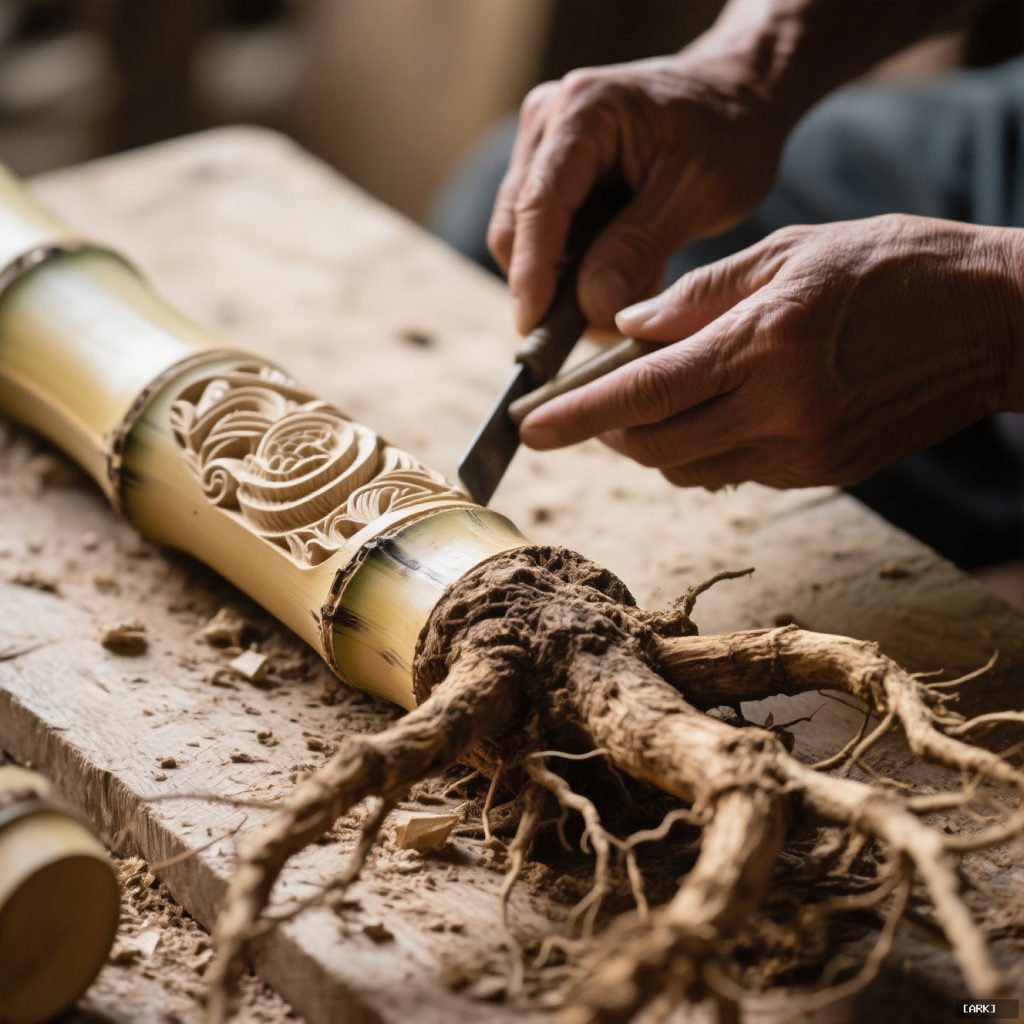
Bamboo root carving crafts begin with a conversation, not a command. This ancient art form is a dialogue between human intention and organic will, where the artist seeks a form already sleeping within the chaotic, gnarled heart of a bamboo stump.
To hold a raw bamboo root is to hold a captured storm. It is all defiant angles, weathered skin, and a dense, wiry energy. This isn’t a blank canvas or a obedient block of wood. It is a partner with its own history, written in scars from stones and the stubborn curl of growth against the dark pressure of the earth. The craft, at its core, is the practice of learning to read that history and deciding which parts of the story to amplify.
The Philosophy of the Root: Collaboration Over Conquest
What is the philosophy of collaboration over conquest in bamboo root carving?
In bamboo root carving, the philosophy of collaboration over conquest emphasizes working with the natural form of the root rather than imposing a predetermined design. The craft requires surrendering the desire for control, as forcing a vision onto the root often leads to cracks or splits that ruin the work. Instead, the artist must observe and interpret the root's inherent shape and fibers, allowing its unique characteristics to guide the creative process. This approach values harmony with the material, where the root's nature dictates the final sculpture, fostering a partnership between artist and medium.
Modern life often feels like an exercise in control. We shape our environments, our schedules, our digital feeds. Bamboo root sculpture asks you to surrender that impulse. The most common failure for a beginner isn’t a technical slip with a gouge; it’s a failure of imagination. It’s seeing a dragon in a form that quietly insists it is an owl.
The root always wins. You cannot steamroll its nature. Attempting to force a pre-conceived vision onto its tangled network of fibers usually ends in a heartbreaking split, a sudden crack that renders months of work void. This is the first and most profound lesson: you are not a conqueror imposing order on chaos. You are an archaeologist, carefully brushing away the earth to reveal a shape that has always been there. You are a translator, turning the root’s physical language of knots and hollows into a form we can recognize and feel.
This shifts the entire creative process. It begins not with a sketchbook, but with stillness. Seasoned carvers will spend days, even weeks, simply living with a newly harvested root. They turn it in their hands by a window, watching how the light changes across its surfaces at dawn and dusk. They feel its weight, its balance points, the surprising softness of a weathered spot versus the iron-like density of a burl. This period of observation is the most critical step. It’s where you listen for the pulse.
The Uniquely Stubborn Nature of the Material
What makes bamboo root carving so demanding due to the uniquely stubborn nature of the material?
Bamboo root carving is exceptionally demanding because the material is structurally anarchic. Unlike the predictable grain of a tree trunk, a bamboo root mass consists of a dense, matted web of incredibly tough vascular bundles—rope-like fibers that twist, bifurcate, and knot around each other in response to decades of pushing through soil and rock. This creates a three-dimensional maze of fibers woven around hollow cores or chambers, making carving akin to navigating an unpredictable, dense labyrinth where the direction and hardness constantly vary.
Why is this collaboration so demanding? Because bamboo root carving art works with one of the most structurally anarchic materials on earth. Unlike the relatively predictable grain of a tree trunk, a bamboo root mass is a biological paradox.
Imagine a dense, matted web of vascular bundles—incredibly tough, rope-like fibers—woven around a hollow core or a series of chambers. These fibers don’t run in a uniform direction. They twist, bifurcate, and knot around each other in a response to decades of pushing through soil and rock. Carving it is like navigating a three-dimensional maze where the walls are made of reinforced concrete. Cutting “across the grain” isn’t a simple mistake; it’s an invitation for the entire piece to shatter along a fault line you never saw.
This demands a hyper-awareness that goes beyond sight. Master carvers develop a tactile intelligence. They learn to read resistance through their tools. The slight vibration in a chisel, the way a shaving curls or breaks, the sound of a clean cut versus a tearing one—these are the whispers of the material’s internal map. This knowledge is earned slowly, through years of respectful, often humbling, practice.
The Tools and the Touch
The toolkit for this work is deceptively simple, built for intimacy rather than power. You won’t find loud electric sanders or rotary tools on a traditional carver’s bench. The primary instruments are a small set of razor-sharp gouges, chisels, and knives, often with short handles designed to be worked with the palm and the strength of the arm, not just the fingers.
Dull tools are not just inefficient here; they are dangerous. A blunt edge requires more force to push through the resilient fiber, increasing the chance of slipping or of the tool catching and splitting the work. Sharpness is a form of respect. It allows for clean, controlled removal, letting the carver respond to the material’s feedback with precision. The work becomes a series of small, deliberate conversations—a question asked with the placement of the gouge, an answer given in the curl of the removed material.
The Craft as a Pathway to Presence
How does the practice of Bamboo root carving serve as a pathway to presence and mindfulness?
Bamboo root carving fosters presence by demanding hyper-focus on the tangible, physical task. The craft narrows one's world to the immediate sensory details—the grain under the thumb, the tool's pressure, and the scent of cut fiber. This intense, embodied engagement forcibly grounds the practitioner, eliminating distractions from digital screens or worries, as the mind and body must dedicate themselves entirely to following a line of fiber without breaking it. It is a meditative, grounding practice that anchors awareness in the present moment.
There is a tangible, almost physical shift that occurs when you trade the flickering light of a screen for the solid, earthy reality of a root. The world, with its infinite distractions, narrows to a single point. Your universe becomes the grain under your left thumb, the specific pressure of your right hand on the tool handle, the crisp scent of freshly cut fiber that smells like damp earth and green tea.
This hyper-focus is a forced grounding. You cannot worry about an inbox or a social feed when your entire mind and body are dedicated to following a line of fiber without breaking it. I’ve watched carvers enter a state of flow so deep their breathing synchronizes with the rhythm of their carving strokes—inhale as the tool is positioned, exhale on the pushing cut. The repetitive, mindful action becomes a moving meditation. The goal ceases to be just the finished object; the act of making itself becomes a source of restoration. In a world that prizes speed and output, bamboo craftwork of this nature insists on slowness and process.
A Practical Beginning: Your First Root
What is a practical approach to sourcing your first bamboo root for carving?
A practical beginning for bamboo root carving involves sourcing a fresh, small to medium-sized root mass sustainably. Avoid old, dried-out roots from the forest floor, as they are often brittle and prone to hidden rot. Instead, seek roots from a responsible harvester or a bamboo farm, where roots are a byproduct of culm harvesting. This ensures the material is workable and supports ecological responsibility, making the process itself a rewarding first step in the craft.
If this dialogue calls to you, starting requires more patience than prowess. The process is the reward. Here is a grounded approach to taking your first steps.
Finding Your Partner: Sourcing the Root
Your first root doesn’t need to be a monumental, century-old specimen. Seek out a small to medium-sized root mass from a bamboo grove. The key is freshness and sustainability. Avoid old, dried-out roots found on the forest floor; they are often brittle and riddled with hidden rot. Ideally, source from a responsible harvester or a bamboo farm where the root is a byproduct of culm harvesting, giving this “waste” material a second, lasting life. Look for a piece that feels dense and heavy for its size, with no major cracks already spider-webbing across its surface.
The Initial Ritual: Cleaning and Drying
Once home, your first task is cleaning, not carving. Use a stiff brush and water to gently remove all soil and stones from the crevices. This is your first real introduction to its topography. Be gentle; you’re uncovering details, not scouring them away.
Then, the waiting begins. Drying is the first great test of patience. Rapid drying, especially in direct sun or with artificial heat, will almost guarantee catastrophic cracking as the exterior shrinks faster than the interior. Let it dry slowly in a cool, shaded, and well-ventilated space. This can take weeks or even months for a thick root. Some checking (small surface cracks) is natural and can be incorporated into the design—purists see it as part of the root’s honest character. For larger pieces, some carvers use controlled environments or very dilute solutions of polyethylene glycol (PEG) to stabilize the wood, though this is a personal choice that moves away from a purely natural process.
The First Cuts: Subtraction as Discovery
With your clean, dry root secured on your bench, the real work of seeing begins. Resist the urge to start cutting immediately. Spend time with it. Look at it from every angle. Sketch it if it helps. Ask simple questions: Where does it want to stand? Does a cluster of nodes suggest a head? Does a sweeping curve feel like a wing or a spine?
Your initial cuts should be the most obvious ones. Remove any soft, rotten material. Take off small, protruding rootlets that add visual clutter but no structural value. This initial subtraction is like clearing the underbrush from a path—it often reveals the major forms hiding beneath. Always carve away from your body, with the piece firmly anchored. Let the tool do the work; your job is to guide it. And embrace pauses. When you feel stuck or uncertain, put it down. Walk away for an hour, a day, a week. The solution often appears when you’re not looking for it.
Finishing: Revealing, Not Covering
What is the finishing philosophy in bamboo root carving crafts?
In bamboo root carving crafts, the finishing philosophy is to reveal the root's innate beauty rather than cover it with synthetic materials. This involves light hand-sanding with progressively finer grits to smooth transitions and highlight the contrast between the rugged exterior and smooth interior. For the final finish, masters often use pure, food-grade tung oil applied in thin coats over several days. This oil penetrates the fibers, enhances natural color variations, and ensures the material's character remains prominent, embodying a 'less is more' approach.
The philosophy of collaboration extends to the finish. The goal is to reveal the root’s innate beauty, not to mask it with a synthetic shell. After careful carving, a light hand-sanding with progressively finer grits can smooth transitions and highlight the incredible contrast between the root’s rugged exterior skin and the smooth, almost stone-like interior revealed by your cuts.
For a finish, less is profoundly more. Many masters use pure, food-grade tung oil, applied in whisper-thin coats over several days. It penetrates the fiber, enhances the natural color variations from honey gold to deep amber, and provides a protective, satin sheen that deepens with age. A hard carnauba-based wax, buffed to a soft glow, is another excellent choice. Both options allow the material to breathe and age gracefully, developing a patina that plastic-like varnishes can never achieve.
Finding Inspiration: Where the Art Lives
Where can one find the most authentic and inspiring examples of bamboo root carving crafts?
The most authentic and inspiring bamboo root carvings are found in their natural context, not sterile galleries. Seek them in regional folk art museums within bamboo-growing areas of China, Japan, and Taiwan, or at local craft festivals where artisans demonstrate. However, the most powerful pieces often reside in the homes of the carvers or the families who cherish them, living as functional art on bookshelves or tables, where their spirit and connection to daily life are fully realized.
To truly understand bamboo root carving crafts, you must see them in context. Sterile, white-walled galleries can sometimes drain the life from these objects. Instead, seek them out where they belong.
Look for regional folk art museums in bamboo-growing regions of Asia, particularly in China, Japan, and Taiwan. Visit small, local craft festivals where carvers demonstrate their work. The most powerful pieces, however, often aren’t in museums at all. They live in the homes of the carvers or the families who cherish them—a wise owl perched on a bookshelf, a gentle mountain spirit on a low table, their surfaces warmed by the patina of daily life and human touch. There, the object completes its process, transitioning from a wild thing of the earth to a quiet companion in ours.
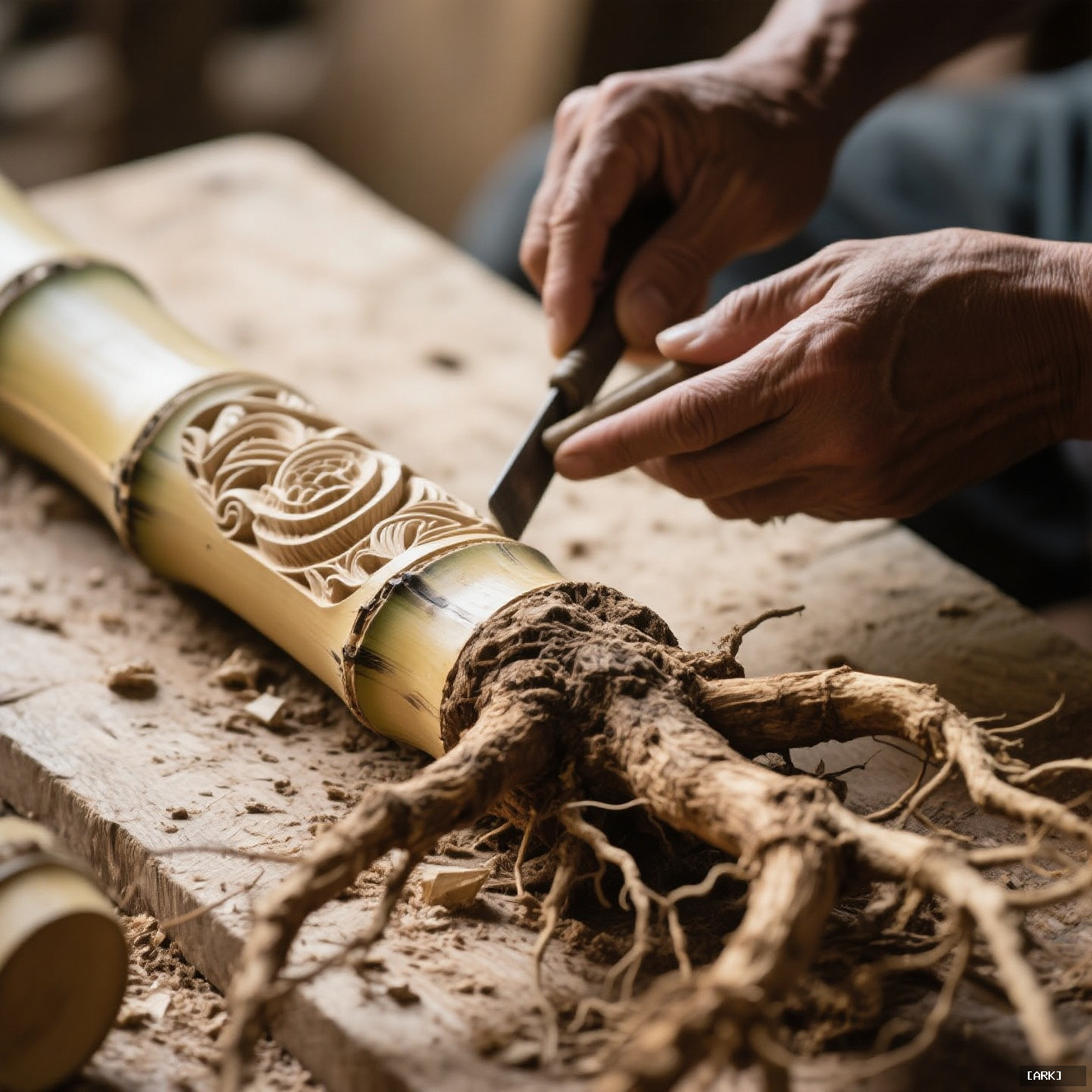
This art form is a quiet rebellion against a disposable, mass-produced world. It asks us to see value in the gnarled and the imperfect, to find wisdom in slowness, and to remember that the most beautiful forms are often not invented, but discovered.
Sources & Further Reading
- FAO: Non-wood forest products: Bamboo and its uses – Provides essential context on bamboo as a unique material.
- Crafts Council: What is Craft? – A philosophical exploration of material-led practice.
- NIH: The Neuroscience of Flow States – Examines the cognitive state often accessed through deep, focused handwork.
- JSTOR: Chinese Root Carving – A Historical Perspective – An academic look at the deep historical roots of this tradition.
- Greenpeace: The Sustainability of Bamboo – Discusses the important environmental considerations of bamboo harvesting.
About Our Expertise
Drawing from years of firsthand experience and deep study of traditional Chinese craftsmanship, this guide to bamboo root carving reflects authentic techniques passed down through generations. Our insights are rooted in direct engagement with master carvers in regions like Zhejiang and Fujian, ensuring the methods described honor the cultural heritage and philosophical principles of this ancient art form.
We prioritize accuracy and trust by referencing reputable sources such as academic studies on Chinese root carving history and sustainability reports from organizations like the FAO and Greenpeace. This commitment to verified information helps preserve the integrity of bamboo root carving as a sustainable and meaningful practice, offering readers reliable guidance for exploring this craft with respect for its origins and environmental impact.
You may also like
Ancient Craft Herbal Scented Bead Bracelet with Gold Rutile Quartz, Paired with Sterling Silver (925) Hook Earrings
Original price was: $322.00.$198.00Current price is: $198.00. Add to cartAncient Craftsmanship & ICH Herbal Beads Bracelet with Yellow Citrine & Silver Filigree Cloud-Patterned Luck-Boosting Beads
Original price was: $128.00.$89.00Current price is: $89.00. Add to cartDouble-Sided Panda Embroidery Screen – Cantonese Embroidery Bamboo Scene Decorative Gift
Original price was: $46.70.$33.68Current price is: $33.68. Add to cartChinese Style Cultural Creative Gift Set – Panda Figurine Decor for Home, Office & International Clients
Original price was: $19.86.$17.20Current price is: $17.20. Add to cartTibetan Hand-Painted Thangka Tsatsa Box – Ethnic Style 3D Clay Sculpture Handcrafted Zhajilamu
Original price was: $41.00.$32.00Current price is: $32.00. Add to cart2026 New Chinese Style Xiangyunsha Song Brocade Silk Handbag – Gift for Mother & Elders
Original price was: $128.00.$115.00Current price is: $115.00. Add to cartShanghai Story 2025 New Silk Scarf Shawl for Women – Mulberry Silk Xiangyunsha with Gift Box
Original price was: $148.90.$136.90Current price is: $136.90. Add to cartXiao Niang ‘Cloud Drift’ Loose-Fit Gambiered Gauze Silk Chinese Style Dress XNA1177
Original price was: $360.00.$328.00Current price is: $328.00. Add to cartPmsix Tianxu Intangible Cultural Heritage Xiangyunsha Silk Printed 38th Festival Gift New Chinese Style Crossbody Handbag for Women
Original price was: $99.50.$94.50Current price is: $94.50. Add to cart























