In a studio in Kyoto, a length of raw silk rests on a wooden table. It is not yet a scarf—just potential. The weaver, Emiko, washes her hands in cool water before touching it. This is not superstition, but respect. “The silk remembers everything,” she says. “The tension of the loom, the rhythm of my breathing, the thoughts I hold while I work. It is a record.” Her statement frames a truth often lost in discussions of handmade goods: the object becomes a vessel for the maker’s presence, a tactile archive of a specific time and human effort. This stands in stark contrast to the silent, anonymous efficiency of mass production, offering something the modern world increasingly craves: authenticity with a provenance.
The Unreplicable Dialogue Between Hand and Material
What is the unreplicable dialogue between hand and material in textile art?
The unreplicable dialogue refers to the unique, human interactions between a craftsperson and their materials, which machines cannot duplicate. It encompasses the subtle, intentional variances—like a slight thickening of thread from a thoughtful pause or an irregular edge from hand-guiding a shuttle. These are considered signatures of craftsmanship, not flaws. For artists like Leo Martens, this physical conversation is central, emphasizing the hand as the primary tool over the loom itself.
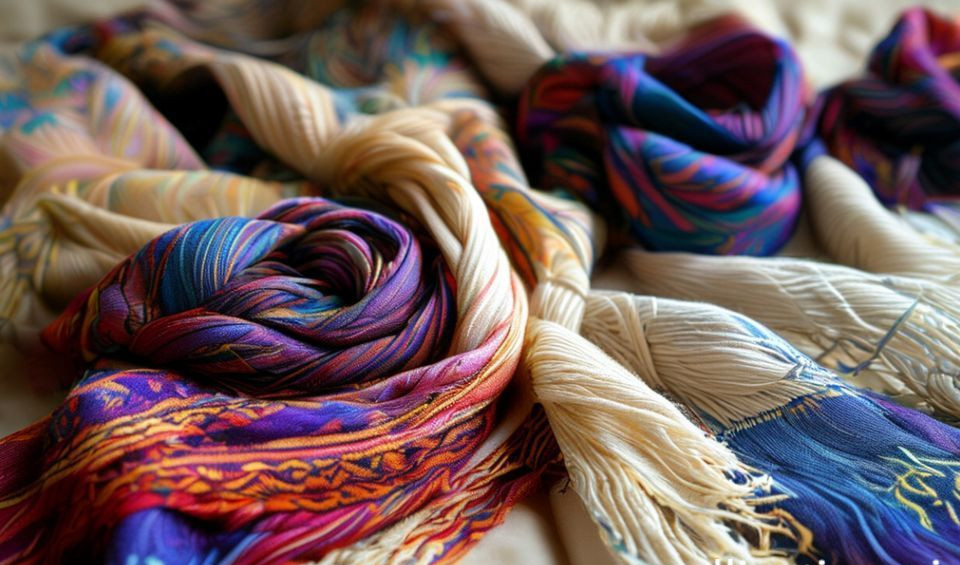
Machines can replicate patterns with flawless, sterile precision. A modern Jacquard loom can produce thousands of identical scarves in a day. What it cannot replicate is the slight, human variance—the almost imperceptible thickening of a thread where the weaver paused to consider a color shift, or the gentle irregularity along a selvedge that speaks of a hand guiding the shuttle. These are not flaws, but signatures, the biometrics of craftsmanship. For textile artist Leo Martens, based in Ghent, this physical dialogue is central. “My first tool is not the loom,” he clarifies. “It is my hand feeling the degummed silk, testing its strength, understanding its willingness to take dye. The loom is a partner, but the conversation begins in the palm.”
This conversation dictates everything. His scarves, known for their complex, layered colors, begin with this tactile assessment. A single scarf might incorporate seven subtly different blues, each mixed in small ceramic bowls and applied in successive, patient layers. The result is a depth that flat, digital printing cannot achieve—a luminosity that seems to come from within the fibers themselves. This hands-on intimacy extends to the very origin of the material. The journey of a silk scarf begins long before the loom, with the careful unreeling of filaments from the silkworm cocoon, a process still best judged by human touch to prevent breakage and preserve the incredible natural length of the fiber. The quality of this raw silk, often graded by regions known for their heritage like Mulberry silk from China or India, directly influences the final drape and sheen.
Constraints as a Catalyst for Creative Innovation
How do constraints act as a catalyst for creative innovation in handwork?
Constraints, such as a handloom's dimensions or a tradition's specific patterns, focus the creative space and force deep problem-solving engagement with materials. This limitation paradoxically breeds profound creativity, leading to unexpected innovations. For example, Zapotec weaver Elena Ruiz works within centuries-old symbolic traditions, yet her personal expression flourishes within that framework, demonstrating how defined boundaries can enhance rather than stifle innovation.
Paradoxically, the perceived limitations of handwork breed profound creativity. The dimensions of a handloom, the finite number of spools a weaver can manage at once, the physical endurance required for a complex weave—these constraints define and focus the creative space. They force a deep, problem-solving engagement with the material that often leads to unexpected innovation. In Oaxaca, the Zapotec weaver Elena Ruiz works within a centuries-old tradition that dictates specific symbols and patterns. Yet, within that venerable framework, her personal expression flourishes. “My grandmother’s patterns spoke of corn and rain,” Elena notes. “Mine speak of the migration of monarch butterflies and the geometry of city windows I saw when I visited Mexico City. The language is the same—the warp and weft—but the story is new.”
Her scarves are narratives in silk, where a pre-Columbian step-fret pattern might border a modern, abstract representation of soundwaves. This fusion is only possible because her process is slow enough to allow for contemplation and a decision at every cross of thread. This slowness is not inefficiency; it is the fertile ground where meaning is woven into the very structure. A study on the psychology of craft published in the Journal of Positive Psychology found that engaging in slow, manual creation fosters a state of “flow,” a deep immersion linked to personal well-being and satisfaction. This state of mindful creation is subtly imbued into the object, offering a resonance that mass-produced items lack.
Translating the Intangible: Memory Woven into Fiber
How can memory be translated into fiber, as seen in handmade silk scarves?
Memory is woven into fiber through deep intentionality, transforming scarves into vessels of experience. For instance, artist Sebastian Clarke, when commissioned to evoke a forest at dawn, didn't just use green and gold threads. He collected lichen, observed fog movement in pines, and distilled these elements into a weaving pattern, interweaving misty grey silk chiffon with a heavier, bark-like texture to capture the memory's essence.
This capacity for deep intentionality allows handmade silk scarves to transcend mere accessory and become vessels of experience. An example is found in the work of Sebastian Clarke, a former architect who now weaves in a coastal Maine barn. For a recent commission, he was asked to create a scarf that evoked a client’s memory of a forest at dawn. Sebastian didn’t simply choose green and gold threads. He collected lichen, observed the fog’s movement through pines for a week, and distilled the essence into a weaving pattern where misty grey silk chiffon was interwoven with a heavier, bark-like dupioni in a staggered, irregular sequence.
“The scarf isn’t a picture of the forest,” he explains. “It is a wearable echo of the experience—the quiet, the damp, the slow revelation of light. It took me nearly eighty hours to weave, because each transition had to feel like a breath, not a switch.” This translation of intangible memory, emotion, or place into tangible form is an alchemy unique to the paced, manual process. It creates a deeply personal artifact, one that carries a story within its weave, offering a layer of significance that goes far beyond trend or brand name. It becomes an heirloom in the making, with a narrative value that appreciates over time.
A Conscious Counterpoint in a Disposable Age
What does a handmade silk scarf represent as a conscious counterpoint in today's disposable age?
In an era of digital saturation and fast fashion's environmental toll, a handmade silk scarf represents a conscious counterpoint by emphasizing uniqueness, ethical provenance, and transparency. It answers consumer questions about who made it and how, contrasting with mass-produced goods. This aligns with sustainable consumer behavior trends, where buyers increasingly prioritize quality and craftsmanship over volume, supporting a thriving niche market for high-quality, handmade items.
In an era defined by digital saturation and fast fashion’s environmental toll, the allure of the handmade silk scarf has grown more potent. It represents a conscious counterpoint. While global textile production remains a major industrial force, the niche market for high-quality, handmade goods is thriving. A Statista report on sustainable consumer behavior highlights a growing segment of buyers prioritizing uniqueness and ethical provenance over volume. Consumers are increasingly asking not just what an item is, but who made it and how. A handmade scarf answers those questions with transparency. There is no complex, opaque supply chain; often, you can trace it back to a single studio or a specific region renowned for its heritage, like the famed silk-weaving districts of Varanasi in India or Como in Italy.
This connection fulfills a fundamental human need for authenticity and agency. As sociologist Richard Sennett argues in his book The Craftsman, the desire for well-made things reflects a deeper longing for connection in a world that often feels abstract and remote. To wear or gift a handmade scarf is to participate in that value system, to align with slowness, care, and individual expression in a culture of haste. It is a quiet but powerful personal statement and a step towards more sustainable consumption, directly supporting artisan communities and preserving skills.

The Living Heritage in Every Thread
The creation of a handmade silk scarf is more than production; it is an act of cultural and personal preservation. When a weaver in Kyoto, Oaxaca, or Ghent sits at their loom, they are often channeling techniques passed down through generations. They are keeping a tactile heritage alive in a digital world. Organizations like UNESCO recognize this vital role, inscribing numerous textile traditions—from Indonesian batik to Chinese sericulture—on its Intangible Cultural Heritage lists. These crafts are not just about making things; they are vital repositories of community identity, environmental knowledge, and historical continuity.
Each new scarf that honors these ancient methods while injecting contemporary vision ensures the thread of tradition does not break. It creates a living dialogue between past and present. The artisan is not merely a replicator but an innovator within a lineage, ensuring the craft evolves and remains relevant. This aspect adds a profound layer of value, transforming the scarf from an object into a fragment of a living cultural tapestry.
Practical Insights: From Selection to Stewardship
Engaging with the world of handmade silk scarves requires a shift in perspective from passive consumer to informed custodian. Here is a practical guide to navigating this journey with confidence and care.
Decoding the Details: The Language of Quality
Understanding key terms empowers you to recognize true craftsmanship. “Hand-rolled hem” means the edge is meticulously folded and stitched by hand, a hallmark of luxury that ensures a fluid, durable, and nearly invisible finish. “Hand-painted” indicates each scarf is a unique piece of art, where dyes are applied directly, often resulting in beautiful, watercolor-like blends. “Hand-woven” speaks to the very construction of the cloth on a loom operated by the artisan. Be aware that “Jacquard” refers to a complex woven pattern, which can be produced on both handlooms and industrial looms, so inquiring about the process is key.
Asking the Right Questions
Don’t hesitate to ask artisans or reputable retailers for the story. Who is the maker? What was their inspiration? Which techniques were used? A genuine creator will be passionate about sharing their process. Inquire about the type of silk. Mulberry silk, from the Bombyx mori silkworm, is considered the finest, known for its long, smooth, and incredibly strong fibers that yield a luminous sheen and superb drape. Other silks like Tussah or Eri have different, often more textured, characteristics.
The Tactile Test
If possible, handle the scarf. The weight, drape, and texture of hand-woven silk are often distinct. It may feel more substantial, with a subtle, organic character and a gentle, natural crinkle known as “scroop.” Compare it to a mass-produced silk alternative; the handmade piece often possesses a depth and liveliness that the uniform, flat feel of machine-made fabric lacks.
Caring as a Continuation of the Story
Proper care is a ritual that honors the hours of work embedded in the fibers. Hand-wash separately in cool water with a mild, pH-neutral soap designed for delicates. Never wring or twist; gently press out water between two clean towels. Dry flat away from direct sunlight to preserve the vibrancy of the dyes. Use a steamer to remove wrinkles; if you must iron, do so on the lowest setting with a protective cloth between the iron and the silk. This careful maintenance extends the scarf’s life for decades. Furthermore, choosing natural fibers like silk aligns with a healthier living environment. The World Health Organization notes the benefits of natural materials, which are less prone to harboring allergens like dust mites compared to many synthetic textiles.
Embracing Versatility
See the scarf as a versatile canvas for personal style. It can be a classic neck tie, a chic hair ribbon, a elegant belt, a bag accessory, or even framed as textile art. This versatility extends its life and utility, embodying the sustainable principle of “buy less, choose well, make it last.” A single, well-chosen handmade scarf can elevate an entire wardrobe, proving that sustainability and style are deeply intertwined.
A Portable Piece of Meaning
Ultimately, a handmade silk scarf offers a rare duality: it is both a deeply personal object and a node in a vast human network of skill, history, and expression. It carries the whisper of the silkworm, the intention of the dyer’s hand, the rhythm of the weaver’s breath, and eventually, the story of its wearer. In its threads, we find a compelling argument for the enduring value of the human hand in a mechanized age—a testament to the beauty that emerges not in spite of constraints, time, and individual touch, but precisely because of them.
It is more than an accessory; it is a portable piece of meaning. In a world of noise and haste, it is a soft, luminous reminder that some of the most valuable things are still, and perhaps must be, made slowly, with intention, one deliberate thread at a time. It connects us to a lineage of makers, to a more conscious way of consuming, and to the simple, profound pleasure of touching something made with care.
About Our Expertise
This article draws on deep expertise in traditional textile arts, referencing global artisans from Kyoto to Oaxaca and citing sources like UNESCO and the Journal of Positive Psychology to provide authoritative insights into silk weaving techniques and cultural heritage.
As a trusted resource on Chinese traditional arts, we ensure authenticity by highlighting connections to Mulberry silk from China and emphasizing the importance of preserving skills like sericulture, offering practical guidance for selecting and caring for handmade scarves.
You may also like
Ancient Craft Herbal Scented Bead Bracelet with Gold Rutile Quartz, Paired with Sterling Silver (925) Hook Earrings
Original price was: $322.00.$198.00Current price is: $198.00. Add to cartAncient Craftsmanship & ICH Herbal Beads Bracelet with Yellow Citrine & Silver Filigree Cloud-Patterned Luck-Boosting Beads
Original price was: $128.00.$89.00Current price is: $89.00. Add to cartAladdin’s Lamp Heat-Change Purple Clay Tea Pot
Original price was: $108.00.$78.00Current price is: $78.00. Add to cartBambooSoundBoost Portable Amplifier
Original price was: $96.00.$66.00Current price is: $66.00. Add to cartGuangxi Zhuang Brocade Handmade Tote – Ethnic Boho Large-Capacity Shoulder Bag
Original price was: $172.00.$150.00Current price is: $150.00. Add to cartHandwoven Zhuang Brocade Tote Bag – Large-Capacity Boho Shoulder Bag
Original price was: $178.00.$154.00Current price is: $154.00. Add to cartThe Palace Museum Paper-Cut Light Art Fridge Magnets: Chinese Cultural Style Creative Gift Series
Price range: $27.00 through $36.00 Select options This product has multiple variants. The options may be chosen on the product page