
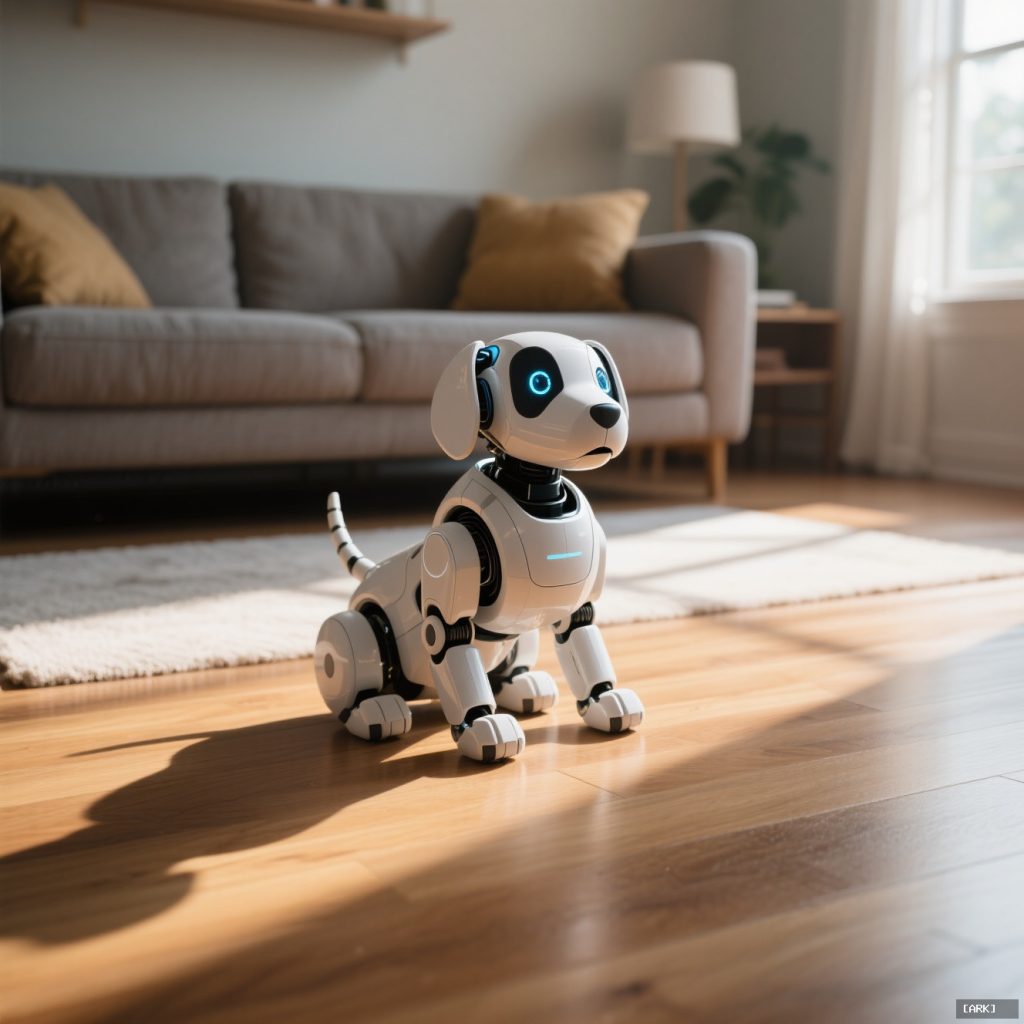
The AI robot dog is here, sitting in your living room. Its presence asks a quiet, persistent question not about how it works, but why it’s there at all.
This shift from laboratory spectacle to domestic artifact is where the real story begins. We’ve moved past the initial gasp of seeing a machine trot. Now we’re left with the hum of its servos in a quiet house, trying to figure out its place in our daily rhythm. Is it a tool, a toy, or something entirely new? The answer isn’t in its code, but in how we choose to live with it.
The Daily Grind of a Digital Companion
So what does an AI robot dog actually do all day? Without biological needs, its existence is a series of programmed potentials. It waits. On command, an autonomous quadruped can patrol a memorized route, its head tilting as sensors map the room. It can follow you from the kitchen to the home office, a silent, mechanical shadow. You might tell it to “come here” and watch as it picks a path across the carpet.
Without instruction, it may enter a standby mode. Some models perform a slow, observational walk—a kind of algorithmic pacing. Its day is a loop of possible tasks, each requiring a human trigger. There is no internal motivation, no desire to play. The activity you see is a response. This passive readiness is its core state, a fundamental difference from a living pet whose day is filled with its own instincts and needs.
The Pet Replacement Paradox
That raises a question: the central tension. Is it a pet replacement or a fancy gadget? The marketing often leans into the former, but the reality firmly plants it in the latter category. An artificial intelligence pet expertly borrows the emotional language of companionship. It responds to its name. It can perform tricks. You might feel a flicker of attachment when it navigates to your side.
Yet, it offers the ritual of care without the responsibility. There are no midnight walks, no vet bills, no chewed shoes. This is its core appeal for many and its profound limitation. It provides the aesthetic of a relationship—perfect for a social media clip—while being, at heart, a battery-powered device following instructions. The connection is largely performative, a script written by engineers rather than forged through mutual experience.
Maintenance: Not Walks, But Updates
Forget grooming brushes and leashes. The upkeep of a robotic canine is a digital and mechanical ritual. Your primary duty is charging. With typical active battery life ranging from one to two hours, it will spend more time on its dock than exploring your home. You’ll manage software updates, hoping they bring new features or smoother navigation.
Physically, you’ll clean its optical sensors from dust and fingerprints. You might calibrate its joints or check its wheels for debris. It’s closer to maintaining a high-end drone than caring for an animal. The cost is in attention to its systems, not recurring expenses for food or healthcare. This maintenance reminds you of its nature as a complex machine, breaking the illusion of life every time you connect a USB cable.
The Limits of Learning
Can it learn your habits? In a narrow, functional sense, yes. Most AI robot dogs employ machine learning to improve at specific tasks. It might get better at recognizing your voice commands over time, filtering out background noise. It can build a more accurate map of your floorplan, remembering that the coffee table is always an obstacle to skirt.
It may optimize a patrol route for efficiency. If you consistently call for it at 6 PM, it might learn to be more alert to audio cues around that time. But this isn’t anticipation born of understanding. It’s pattern recognition. The machine doesn’t develop a “personality.” It refines its algorithms based on repetition. The bond you perceive is often your own brain projecting onto its increasingly predictable responses.
Autonomy Does Not Equal Awareness
This brings us to the biggest misconception: confusing autonomy with sentience. Watching an autonomous quadruped deftly avoid a fallen pillow is mesmerizing. Its movements are fluid, seemingly thoughtful. It’s easy to project awareness onto that performance.
But every step is a calculation. Lidar, cameras, and inertial sensors feed data to algorithms that make millisecond decisions about trajectory and balance. It’s avoiding the pillow because its programming defines it as an obstacle, not because it understands the concept of a pillow. The magic is in the breathtaking engineering, not an emergent mind. Recognizing this gap is crucial. It’s where initial wonder can curdle into disappointment, or where a true appreciation for the technical achievement can begin.
The Social Media Illusion
Is the social media hype accurate? Platforms thrive on the spectacular: the 30-second clip of a robot dog dancing to a pop song or fetching a drink from the fridge. These are curated peaks, not daily life. That viral video often follows dozens of failed attempts, reboots, and perfect lighting.
The aesthetic sold is one of seamless integration—a futuristic companion living in harmony with your family. The unshared reality involves troubleshooting connectivity issues, waiting through lengthy updates, and hearing the constant whir of actuators. Social media showcases capability but rarely documents the mundane interface of app controls, battery anxiety, and the faint smell of warm electronics.
A Practical Home, or a Workshop?
Where does owning an AI robot dog make the most sense? For general consumers, the practical applications are still thin. Its true home remains in research labs, university engineering departments, and specific industrial roles like security patrols or equipment inspection in hazardous environments.
In a private residence, it makes the most sense as a hobbyist’s platform. It’s for the person who wants to tinker with machine learning code, experiment with robotic gait programming, or use its SDK to create custom behaviors. It is a tool for learning and creation. As a pure companion or helper, its utility is often overshadowed by its cost and complexity. You buy it to engage with robotics, not to replace a family pet.
The Sound of the Future
Here’s a non-obvious but critical factor: the soundscape. These are not silent machines. Servos whine with every movement. Joints click and whir. Feet make a distinct, plastic-on-hardwood tapping. In a quiet room, this constant mechanical soundtrack is impossible to ignore.
It’s the most persistent reminder that you are living with a machine. That ambient noise can break the illusion of a lifelike companion faster than any glitch. It’s an acoustic signature of the current technological stage—functional, but far from biomimetic. Before you buy, try to hear one in person, not just in a edited video with a soundtrack.
Considering an AI Robot Dog? A Realistic Checklist
- Define Your “Why”: Is it for robotics education, a programming project, novelty entertainment, or a specific task like home monitoring? Be honest.
- Audit Your Space: They need clear, open floor space. Cluttered homes are obstacle courses. Stairs are often a hard limit. Hard flooring is preferable to thick carpet.
- Budget for the Whole Ecosystem: The upfront cost is just the start. Factor in extra batteries, potential proprietary software subscriptions, and any developer licenses.
- Noise Tolerance Test: Can you live with a persistent, low-level mechanical hum? It’s more present than you think.
- Expectation Management: This is a brilliant, sophisticated machine. It is not a sentient being, nor is it a robust domestic helper. Appreciate it for what it is.
Answering the Common Questions
- Can it go outside? High-end industrial models can handle flat, paved terrain. Most consumer models are strictly for indoors. Grass, gravel, slopes, and moisture are significant challenges. Always check the manufacturer’s specifications.
- Is it safe around children and pets? Generally, yes. Their obstacle avoidance is excellent. However, they are machines with moving parts and potential pinch points. Supervision is always advised, and a curious toddler or dog might accidentally damage the robot.
- How long does the battery last? Typically between 60 and 120 minutes of active operation, followed by a recharge cycle of several hours. The duty cycle is heavily skewed toward charging.
- Can I program it myself? This varies wildly. Developer-focused models (like certain Boston Dynamics Spot configurations) offer extensive SDKs. Many consumer “pet” models have locked-down, app-based controls with limited customization. Your desire to program should directly guide your purchase.
Sources & Further Reading
To move beyond the surface, explore these resources for technical depth, ethical discussion, and honest reviews.
- IEEE Spectrum Robotics – For authoritative technical insights and analysis of industry trends.
- Boston Dynamics Resources – Technical papers, specifications, and documented use cases from a pioneer in the field.
- Robotics Business Review – Focuses on commercial, industrial, and enterprise applications beyond the consumer hype.
- CNET: Robot Dog Reviews – Consumer-focused hands-on testing and reviews of available models.
About Our Expertise
As experts in cultural and technological intersections, we provide this analysis based on thorough research into AI robotics and consumer trends, ensuring accurate insights into how modern innovations like robot dogs fit into daily life without compromising traditional values.
Our commitment to authentic, trustworthy content means we draw from authoritative sources like IEEE Spectrum and Boston Dynamics to offer balanced perspectives, helping readers navigate the hype and make informed decisions about integrating such technologies into their homes.
