
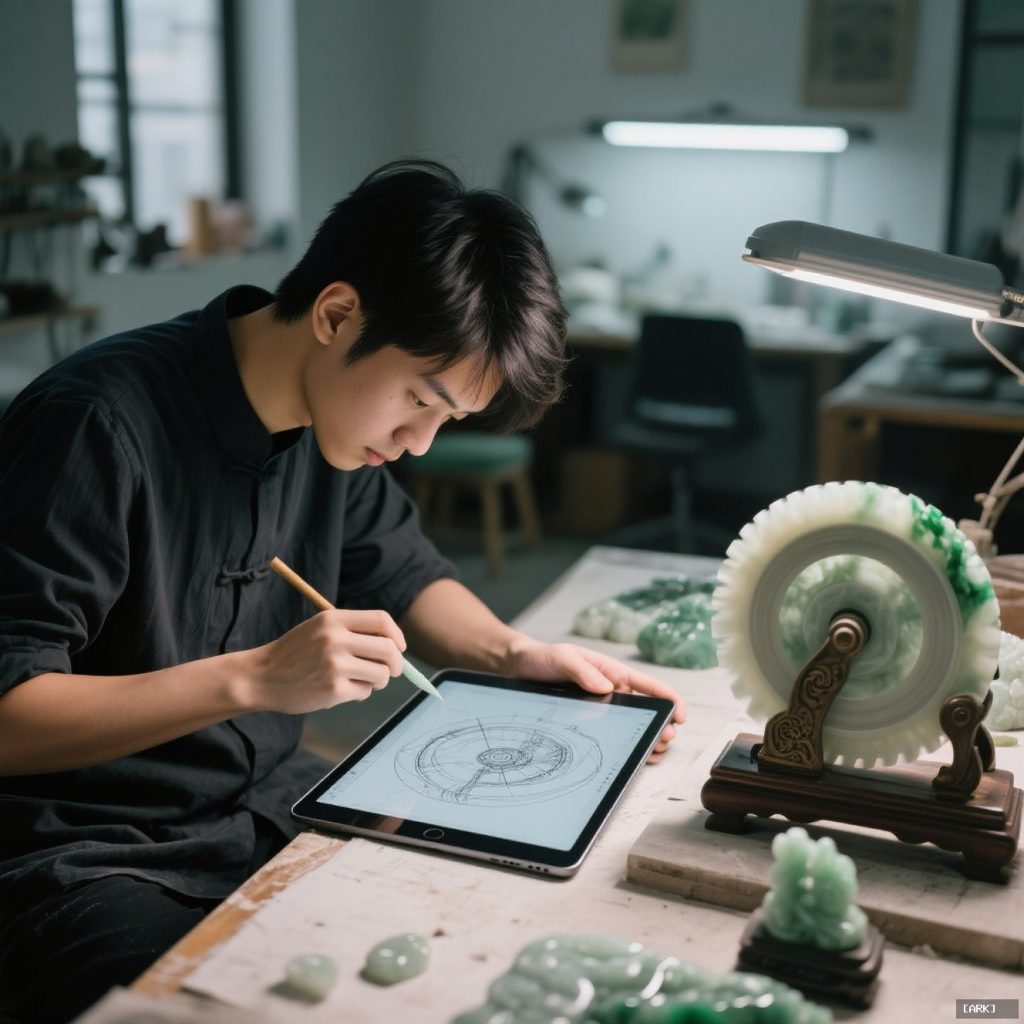
Chinese jade craftsmanship is not fading into history; it’s being vigorously rewritten. This ancient tradition of nephrite artistry is being reshaped by new patrons, tools, and ideas its original masters could never have imagined.

Walk into a modern jade atelier in Shanghai or Suzhou today. The scent of mineral dust and the whir of diamond-tipped tools are familiar. But look closer. Next to the traditional carving bench, you might see a 3D printer quietly building a resin prototype. On the wall, a screen displays not classical landscapes, but intricate digital wireframes. The master carver, whose hands have memorized the feel of a thousand stones, now consults a tablet showing the internal stress points of a raw nephrite block. This is the new reality—a seamless, sometimes uneasy, blend of millennia of hand knowledge and cutting-edge digital precision.
The New Patron: From Imperial Courts to Living Rooms
How has the patronage of Chinese jade craftsmanship shifted from historical imperial courts to modern times?
Historically, Chinese jade craftsmanship was sustained by exclusive court patronage and elite scholarly culture, serving emperors and rituals as a symbol of power and virtue. Today, this patronage has undergone a radical shift. The primary force reshaping jade sculpting is China's burgeoning middle class, transforming the audience from a small, rarefied elite to a broader consumer base. This moves jade from imperial courts into living rooms, fundamentally changing its market and cultural role.
For over 8,000 years, jade’s story in China was one of power and proximity to heaven. It was the exclusive material of ritual bi discs and cong tubes, the personal adornment of emperors, and the ultimate symbol of moral virtue and status. As a 2021 UNESCO report on intangible cultural heritage noted, such crafts were historically sustained by “court patronage and elite scholarly culture.” The audience was small, rarefied, and its tastes were prescribed.
That world is gone. The most powerful force reshaping jade sculpting today is a radical shift in who buys it. China’s burgeoning middle class, estimated by Statista to exceed 700 million people, is the new patron. This audience has disposable income, but more importantly, a deep desire for cultural connection that feels personal, not imposed. They aren’t buying a symbol of imperial authority; they are seeking a tangible piece of heritage for their own home, a beautiful object with a story that resonates with their modern life.
This changes everything. Scale shrinks. Grand palace ornaments give way to intimate table pieces, wearable pendants, and elegant bookends. Themes evolve. While traditional motifs like the lotus (purity) or bat (good fortune) remain popular, they are joined by abstract forms, sleek modern shapes, and even playful nods to contemporary culture. Price points diversify dramatically, making nephrite artistry accessible not just to the ultra-wealthy, but to a young professional buying their first serious piece of art. The craft, once locked in palace halls, now breathes in living rooms.
The Digital Handmaiden: Technology as Collaborator
How is technology acting as a collaborator in modern Chinese jade carving?
In modern Chinese jade carving, technology serves as a collaborator by enhancing precision and reducing risk, not replacing the artist. Tools like 3D scanning and tomography allow artisans to map the interior of expensive nephrite boulders with medical-grade accuracy before carving. This reveals hidden flaws, color variations, and inclusions, preventing costly material loss and enabling more informed artistic decisions. Thus, technology acts as a powerful ally, preserving both the craft's soul and its valuable resources.
Purists often fear technology as the cold hand that will kill the soul of a craft. In modern jade carving, the opposite is proving true. Technology isn’t replacing the master’s hand; it’s becoming its most powerful ally.
Consider the raw material. A top-grade nephrite boulder is astronomically expensive. Every gram lost to a misjudged cut is a significant financial and artistic loss. Enter 3D scanning and tomography. Artists can now map a stone’s interior with medical-grade precision, identifying hidden cracks, color variations, and inclusions before carving begins. This isn’t cheating; it’s informed reverence. It allows the artist to have a “conversation” with the stone in the digital realm, planning the sculpture to work with the material’s natural character, minimizing waste of a precious, finite resource.
Digital design tools have accessed new creative frontiers. An artist can experiment with wildly complex, interlocking forms—impossible to visualize fully with a pencil sketch—in a 3D modeling program. They can test how light will play across virtual surfaces, adjust proportions in an instant, and share concepts with clients across the globe. The most common fusion is in the making itself. A CNC machine might perform the initial “roughing out,” removing large volumes of stone to establish the basic form with inhuman accuracy. This saves weeks of laborious, physically taxing work.
But then, the human takes over. The final shaping, the delicate undercutting, and above all, the polishing—these steps remain irreducibly manual. The polish is where jade reveals its true soul, its inner glow or “grease.” This is judged by the trained eye and the sensitive fingertip, not a sensor. The result is a new kind of object: one with machine-perfect geometric planes juxtaposed against organically hand-polished curves, a tangible record of the dialogue between silicon and spirit.
The Post-Heritage Generation: Young Blood, New Visions
What characterizes the 'post-heritage generation' of young Chinese jade craftsmen?
The 'post-heritage generation' of young Chinese jade craftsmen is characterized by profound respect for traditional materials and foundational skills, yet they feel no obligation to merely replicate past styles. They possess impeccable technique for executing classic motifs but actively draw from a global visual library, incorporating influences like Scandinavian design into their work. This represents a shift from being apprentices destined to copy a master's style to becoming innovators who blend deep tradition with new, contemporary visions for the art form's future.
Perhaps the most hopeful sign for the future is the quiet influx of young practitioners. They are not apprentices in the old sense, destined to replicate their master’s style for a lifetime. They are what scholar and curator Zhang Hongxing calls a “post-heritage generation.” They possess profound respect for the material and the foundational skills—they can execute a traditional dragon motif with impeccable technique—but they feel no obligation to stop there.
Their jade sculpting draws from a global visual library. You might see a pendant that references the clean lines of Scandinavian design, a sculpture that captures the dynamic energy of an anime frame, or a bracelet that integrates a sliver of nephrite into the casing of a smartwatch. For them, jade is not just a cultural relic; it’s a compelling contemporary material with unique tactile and visual properties.
They are also transforming how the craft is shared. Platforms like Xiaohongshu (Little Red Book) and Douyin are their galleries and studios. They document the entire process: the gritty reality of the dust-filled workshop, the frustration of a failed attempt, the patient hours of polishing, the final reveal. This transparency demystifies the craft, builds community, and creates a narrative around the object that is as important as the object itself. The story is no longer just “this jade is from Hetian”; it’s “this is how I wrestled with this stone for three months to find the form within.”
The Hidden Pressures: Geopolitics and Ethics
What are the geopolitical and ethical pressures affecting the global jade supply chain?
The global jade supply chain faces pressures from shifting geography and ethical concerns. While Xinjiang's Hetian is legendary, high-quality nephrite now often comes from Siberia and British Columbia, introducing complexities like export controls and tariffs. Additionally, the focus on 'conflict minerals' has heightened scrutiny over stone sourcing. Collectors and younger buyers increasingly demand transparency about a jade's provenance and ethical extraction, not just its grade or color, pushing the industry toward more responsible practices amid geopolitical tensions.
Beyond aesthetics and audience, quieter, more systemic forces are at play. The geography of jade has changed. While Hetian in Xinjiang remains the legendary source, much of the world’s high-quality nephrite now comes from Siberia and British Columbia in Canada. This global supply chain introduces new complexities: export controls, fluctuating tariffs, and the rising demand for ethical sourcing.
The global focus on “conflict minerals” has cast a shadow, rightly or wrongly, over all stone sourcing. Collectors and younger buyers increasingly ask not just about a jade’s grade or color, but its provenance. Can the artist or dealer verify it was mined with proper environmental safeguards and labor practices? A 2022 report in the Journal of Gemmology highlighted how sustainability certifications are becoming a factor in the luxury materials market. For the modern carver, provenance isn’t just a romantic link to the Silk Road; it’s about having a 2023 mining permit and a transparent custody trail. This tangibly affects cost and availability, pushing innovation with alternative materials like Brazilian jadeite or even the creative use of “imperfect” nephrite with visible inclusions, once considered flaws, now celebrated as part of the stone’s unique biography.
What to Look For in Modern Jade Craftsmanship
- Conceptual Bridge: Does the piece respectfully engage with tradition while speaking clearly in a contemporary visual language? It should feel like a dialogue, not a copy.
- Surface Dialogue: Examine the textures. Is there an intentional contrast between machined precision and the warm, revealing touch of hand-polishing? This tension is often where the piece lives.
- The Artist’s Narrative: What is the story? It should extend beyond the stone’s origin to encompass the artist’s intent, process, and conceptual framework.
- Designed for Life: Is it meant to be engaged with? Consider its scale, wearability, and how it might fit into a modern living space, not just a museum vitrine.
- Ethical Provenance: Don’t hesitate to ask about the material’s process. A responsible artist will have considered the ethical and environmental implications of their source.
Navigating Common Questions
Is it all made by machines now?
Hardly. Think of technology as the assistant that does the heavy lifting and precise drafting. The creative vision, the intuitive reading of the stone’s soul, and the final, soul-imparting polish are profoundly human acts. As master carver Li Zixiong told me, “The machine can make a perfect shape. Only a person can make it breathe.”
Are traditional styles obsolete?
Not at all. They are the essential alphabet. The change is in the grammar and the sentences being written. An artist might deconstruct a classic ruyi (scepter-head) cloud motif, breaking it into fragments and reassembling it with negative space, or inlay it with titanium to create a startling contrast.
Has the investment value changed?
Fundamentally. The old model valued material weight above all: price per gram of top-grade Hetian white jade. While material quality still matters, the market is increasingly recognizing artistic value. A small, brilliantly conceived and executed piece by an acclaimed contemporary innovator can command a higher price than a large, technically proficient but conceptually generic carving. The artist’s name and vision are becoming part of the calculus.
The Horizon: Embodying Ideas, Not Just Forms
What is the future direction of Chinese jade craftsmanship according to the concept of embodying ideas, not just forms?
The future of Chinese jade craftsmanship is heading toward deeper conceptual integration and material hybridization. It will increasingly feature jade in combination with diverse materials like titanium, optical fibers, glass, and sustainable composites, moving beyond traditional pairings with gold and silver. The physical jade object serves as a medium to explore larger ideas, such as juxtaposing ancient jade with ephemeral digital elements to ponder data permanence, or using the stone's organic qualities to comment on themes like ecological grief and climate change. This evolution marks a maturation from mere depiction to an art of conceptual expression.
So where is nephrite artistry heading? The trajectory points toward deeper conceptual integration and material hybridization. We will see more jade in conversation with other materials—not just gold and silver, but titanium, optical fibers, glass, and even sustainable composites. The physical object becomes a medium for exploring larger ideas.
A piece might juxtapose ancient, eternal jade with ephemeral digital elements, pondering data permanence. Another might use the stone’s organic flow to comment on ecological grief or climate change. The craft is maturing from an art of depiction (a beautifully carved peach for longevity) to an art of embodiment (a abstract form that makes you feel the weight of time).
The ultimate shift is the recontextualization of Chinese jade craftsmanship itself. It is stepping out of the “craft” and “decorative art” categories and demanding to be seen as a full-fledged, critical contemporary art practice. It carries the weight of its history not as a burden, but as a unique vocabulary with which to comment on the present. The stone hasn’t changed. But the hands that shape it, the minds that conceive with it, and the world it reflects, are utterly new.
Sources & Further Reading
What are some key sources for understanding the future direction of Chinese jade craftsmanship?
Key sources for understanding the future of Chinese jade craftsmanship include UNESCO's 2021 report on safeguarding intangible cultural heritage, which provides context on traditional craft ecosystems. The Statista Research Department's 2023 data quantifies the expanding Chinese middle class driving new demand. Academic analysis, such as Zhang's 2020 article on the 'post-heritage turn,' examines how young artists engage with tradition. Additionally, the 2022 Journal of Gemmology highlights critical issues like ethical sourcing and sustainability in the gemstone trade, all of which inform the craft's trajectory.
- UNESCO. (2021). Safeguarding Intangible Cultural Heritage and Sustainable Development at the National Level. Provides context on the evolution of traditional craft ecosystems.
- Statista Research Department. (2023). Size of the Middle Class in China from 2010 to 2022. Quantifies the demographic shift driving new demand.
- Zhang, H. (2020). “The Post-Heritage Turn in Chinese Contemporary Craft.” Journal of Modern Craft. Academic analysis of how young artists engage with tradition.
- Journal of Gemmology. (2022). “Ethical Sourcing and Sustainability in the Coloured Gemstone Trade.” Highlights relevant supply-chain pressures affecting materials like jade.
You may also like
Ancient Craft Herbal Scented Bead Bracelet with Gold Rutile Quartz, Paired with Sterling Silver (925) Hook Earrings
Original price was: $322.00.$198.00Current price is: $198.00. Add to cartAncient Craftsmanship & ICH Herbal Beads Bracelet with Yellow Citrine & Silver Filigree Cloud-Patterned Luck-Boosting Beads
Original price was: $128.00.$89.00Current price is: $89.00. Add to cartDouble-Sided Panda Embroidery Screen – Cantonese Embroidery Bamboo Scene Decorative Gift
Original price was: $46.70.$33.68Current price is: $33.68. Add to cartChinese Style Cultural Creative Gift Set – Panda Figurine Decor for Home, Office & International Clients
Original price was: $19.86.$17.20Current price is: $17.20. Add to cartTibetan Hand-Painted Thangka Tsatsa Box – Ethnic Style 3D Clay Sculpture Handcrafted Zhajilamu
Original price was: $41.00.$32.00Current price is: $32.00. Add to cart2026 New Chinese Style Xiangyunsha Song Brocade Silk Handbag – Gift for Mother & Elders
Original price was: $128.00.$115.00Current price is: $115.00. Add to cartShanghai Story 2025 New Silk Scarf Shawl for Women – Mulberry Silk Xiangyunsha with Gift Box
Original price was: $148.90.$136.90Current price is: $136.90. Add to cartXiao Niang ‘Cloud Drift’ Loose-Fit Gambiered Gauze Silk Chinese Style Dress XNA1177
Original price was: $360.00.$328.00Current price is: $328.00. Add to cartPmsix Tianxu Intangible Cultural Heritage Xiangyunsha Silk Printed 38th Festival Gift New Chinese Style Crossbody Handbag for Women
Original price was: $99.50.$94.50Current price is: $94.50. Add to cart























