
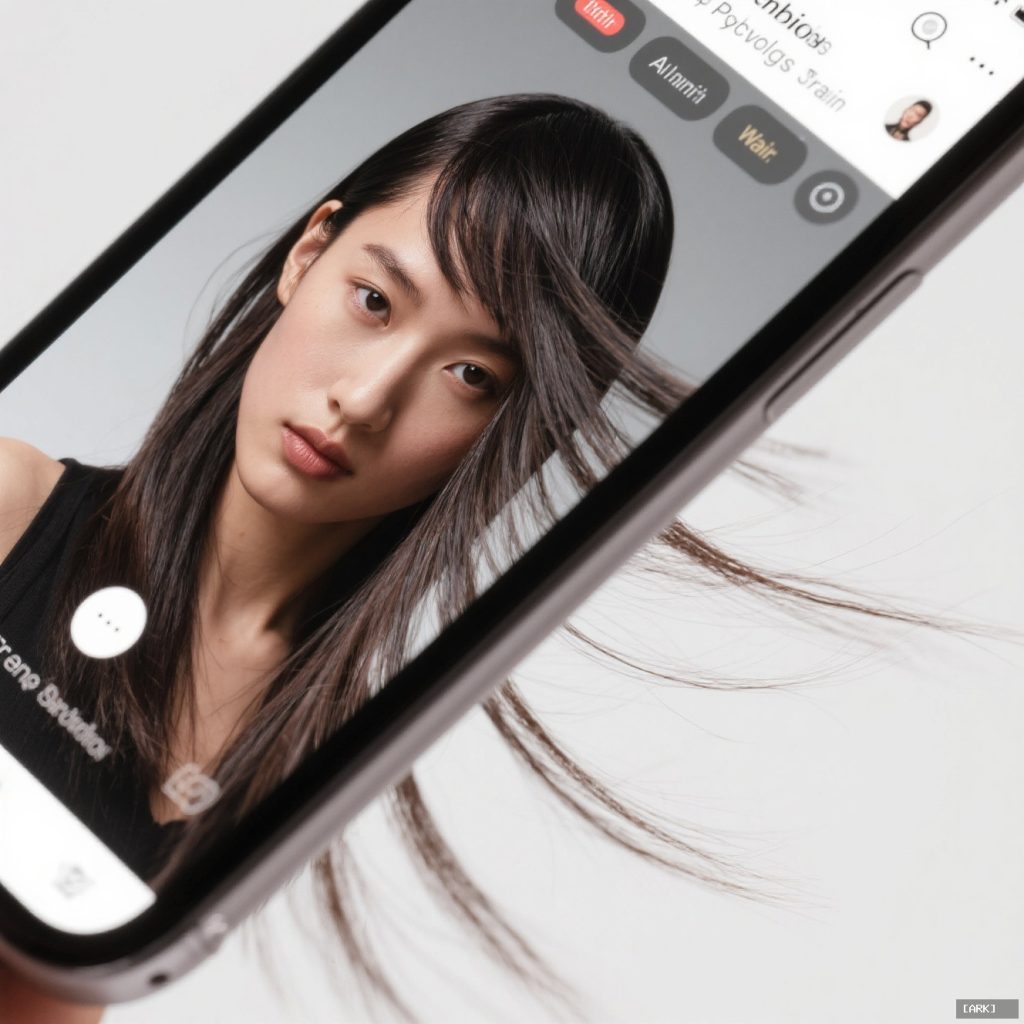
An AI hairstyle app is more than a digital mirror. It’s a portal to a parallel you. These virtual haircut simulators and hair style generators are quietly reshaping how we think about identity, one digital bob or pixie cut at a time.
We tap open an app, upload a selfie, and swipe through possibilities. A fringe appears, then vanishes. Curls bounce where there was once straight hair. With each flick, a different version of ourselves stares back. It feels trivial, a bit of fun. But the pull is undeniable. Why does this simple act of digital play feel so loaded, so personal? The answer lies not in the technology, but in the unique space hair occupies in our psyche.
The Psychology of the Strand: Why Hair is Different
Swapping a shirt in a virtual fitting room is one thing. Changing your hair is another. Clothing is external, something we put on and take off. Hair is different. It grows from us. It’s a living, changing part of our physical body, yet one we can cut, color, and style. This makes it psychologically contiguous with the self—a direct, malleable extension of our identity.
Changing it doesn’t feel like editing an accessory. It feels like editing your operating system. An AI hair styling tool taps directly into this deep-seated connection. It provides a sandbox for a deeply personal variable. The stakes feel high because the territory is so intimate. This is why trying a digital bob can feel more significant than scrolling through a hundred outfits. You’re not just previewing a look; you’re rehearsing a shift in self.
The Rehearsal Room: Agency in a Chaotic World
So what emotional need does a virtual haircut simulator actually fill? At its core, it feeds a fundamental craving for agency and control. Our lives are filled with variables beyond our influence—global news, work demands, the simple chaos of daily logistics. Controlling one’s image, even in a purely digital realm, becomes a manageable, contained act of self-determination.
The phone screen transforms from a passive portal to the world into an active mirror of the self, where you are both the subject and the sole curator. This isn’t mere vanity. It’s a potent form of digital self-care. For a few minutes, you are the author of your own narrative. You decide the plot twist. Will today be the day of the bold undercut or the soft, romantic waves? The act of choosing, of visualizing, is itself the point. It’s a brief, empowering story you write for yourself, with no editor and no consequences.
The Compact Salon: Technology Meets Urban Reality
Our physical environments shape our digital behaviors. For many living in cities or small apartments, space is a premium. A full-length mirror might be leaned against a wall. A dedicated vanity is a dream. The idea of a salon-style transformation, with its sprawling stations and multiple mirrors, feels physically and financially distant.
In this context, the phone isn’t just a convenience; it becomes your primary, distortion-free mirror. An AI hairstyle app collapses the entire salon experience into the palm of your hand. It solves a display constraint that is both spatial and psychological. Your private, expansive makeover happens in the one square foot you truly control—the glowing rectangle that holds your attention for hours each day. The app doesn’t just simulate hair; it simulates the space and freedom to experiment with it.
From Fantasy to Fringe: Strategic Escapism
Is this just escapism? In a way, yes. But it’s strategic escapism. The play is the practical part. By visually testing a neon pink mohawk or a drastic shaved side in a consequence-free zone, users build a subtle, visual familiarity with change. This familiarity breeds confidence, making smaller, real-world adjustments—maybe just those long-desired bangs—feel less daunting.
The app acts as a bridge. It lowers the emotional barrier to actual change by making the unfamiliar familiar. It turns the overwhelming possibility of “what could I be?” into a manageable series of “what ifs” that you can scroll through at your own pace. You might never get that mohawk, but seeing it on your own face demystifies it. It transforms anxiety into curiosity.
The “Try-Before-You-Are” Ethos
This trend mirrors a deeper shift in how we consume, extending far beyond commerce. We live in the age of the sample. We stream songs before buying an album, use free trials for software, and order try-on boxes for clothes. The ethos of “try-before-you-buy” has now been applied to identity itself. We sample personalities, aesthetics, and selves.
In an era of fluid online identities and personal rebrands, the AI hair stylist is a logical extension. It’s a low-commitment subscription to potential selves. The value for the user is often in the browsing, the experimentation—the process of looking, not just the final purchase of a haircut. It caters to a modern desire for fluidity and exploration, allowing us to cycle through iterations of ourselves with the same ease we scroll through a streaming menu.
Choosing Your Digital Playground: What Makes a Great App?
Not all AI hairstyle apps are created equal. Some feel clinical and awkward, while others spark genuine joy and creativity. When evaluating a virtual haircut simulator, look beyond pure technical accuracy. Consider the experience it creates.
- The Feeling of Play: Does the interface invite experimentation, or does it feel like a utilitarian tool? The best apps feel like a game.
- A Judgment-Free Zone: The environment should feel private and safe. There are no raised stylist eyebrows here, just your own curiosity.
- The Freedom to Undo: Can you reverse a change with a simple tap? This reinforces the low-stakes, exploratory nature of the process.
- Personalized, Not Random: Do suggestions consider your face shape, hair texture, or previous choices? Good AI feels intuitively tailored.
- The Emotional Aftertaste: After using it, do you feel creatively energized and curious, or more self-critical and anxious? The former is the goal.
Untangling Common Questions
Are these apps accurate for predicting my real haircut?
Technical accuracy is improving, but it remains secondary. Shadows, texture, and real-life movement are hard to perfectly replicate. Their primary function is emotional exploration and confidence-building, not pixel-perfect prediction. Use them for inspiration, not as a precise blueprint.
Doesn’t this just make people more self-conscious?
Paradoxically, it can have the opposite effect. By making dramatic change feel familiar and, crucially, reversible, these apps can reduce the anxiety surrounding a real salon visit. You walk in having already “seen” yourself with the cut, which can lead to clearer communication with your stylist.
Why do I keep using one if I have no plans to change my hair?
This is perhaps the most telling behavior. You might be fulfilling a need for novelty and self-reinvention entirely in the digital realm. The exploration itself is the satisfying endpoint. It’s a way to experience change and variety without any permanent commitment, a valid form of entertainment and self-reflection in its own right.
The next time you see someone intently swiping through hairstyles on their phone, they’re doing more than killing time. They’re in a private theater, running through scenarios for a lead role only they can play. The AI hairstyle app is the stage, the script, and the special effects crew, all in one. It reminds us that before a change ever happens in the physical world, it first takes root in the imagination. These tools simply give that imagination a clearer, more convincing mirror.
Sources & Further Reading
American Psychological Association on appearance and psychology
NIH study on self-perception and digital mirrors
Computers in Human Behavior on virtual self-representation
Journal of Advertising Research on ‘try-on’ tech consumer behavior
You may also like
Ancient Craft Herbal Scented Bead Bracelet with Gold Rutile Quartz, Paired with Sterling Silver (925) Hook Earrings
Original price was: $322.00.$198.00Current price is: $198.00. Add to cartAncient Craftsmanship & ICH Herbal Beads Bracelet with Yellow Citrine & Silver Filigree Cloud-Patterned Luck-Boosting Beads
Original price was: $128.00.$89.00Current price is: $89.00. Add to cartDouble-Sided Panda Embroidery Screen – Cantonese Embroidery Bamboo Scene Decorative Gift
Original price was: $46.70.$33.68Current price is: $33.68. Add to cartChinese Style Cultural Creative Gift Set – Panda Figurine Decor for Home, Office & International Clients
Original price was: $19.86.$17.20Current price is: $17.20. Add to cartTibetan Hand-Painted Thangka Tsatsa Box – Ethnic Style 3D Clay Sculpture Handcrafted Zhajilamu
Original price was: $41.00.$32.00Current price is: $32.00. Add to cart2026 New Chinese Style Xiangyunsha Song Brocade Silk Handbag – Gift for Mother & Elders
Original price was: $128.00.$115.00Current price is: $115.00. Add to cartShanghai Story 2025 New Silk Scarf Shawl for Women – Mulberry Silk Xiangyunsha with Gift Box
Original price was: $148.90.$136.90Current price is: $136.90. Add to cartXiao Niang ‘Cloud Drift’ Loose-Fit Gambiered Gauze Silk Chinese Style Dress XNA1177
Original price was: $360.00.$328.00Current price is: $328.00. Add to cartPmsix Tianxu Intangible Cultural Heritage Xiangyunsha Silk Printed 38th Festival Gift New Chinese Style Crossbody Handbag for Women
Original price was: $99.50.$94.50Current price is: $94.50. Add to cart























