
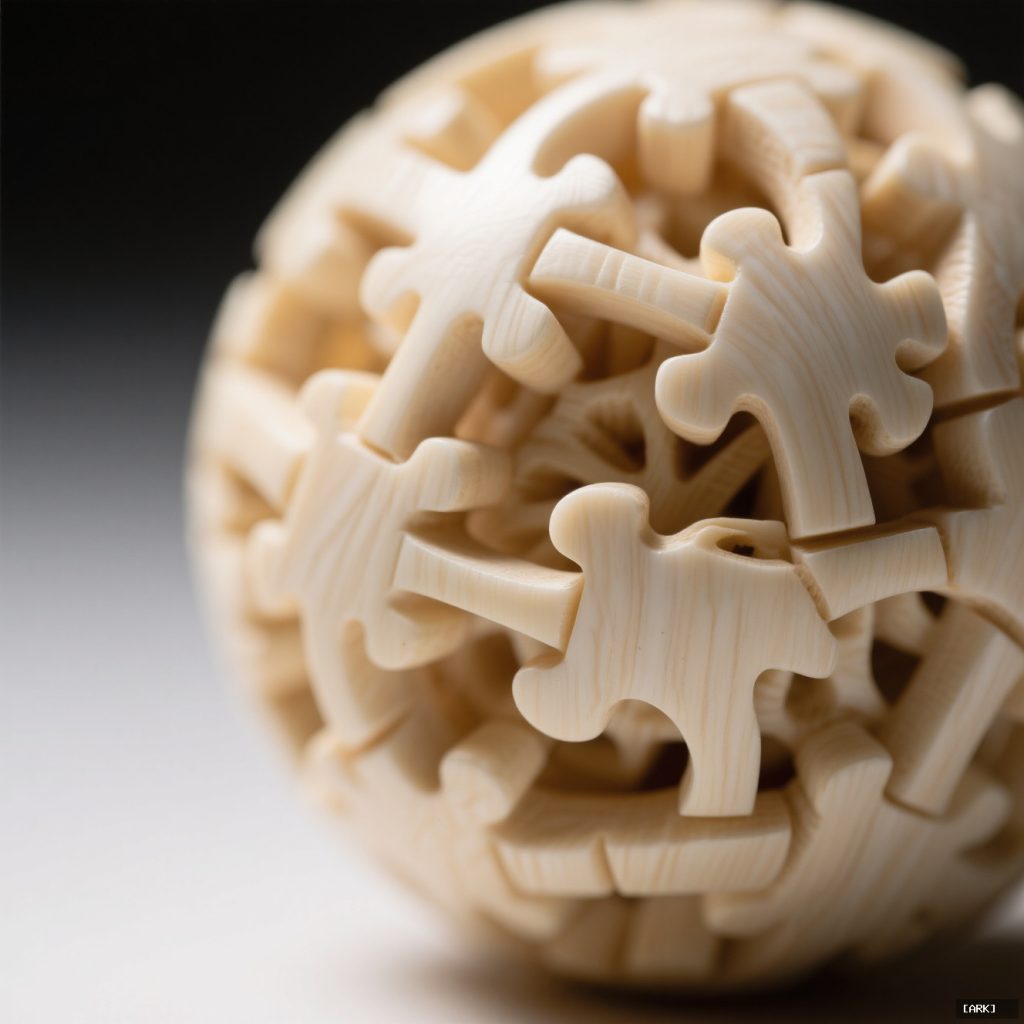
Chinese puzzle ball carving is a breathtaking art of patience and geometry. It transforms a solid block into a series of free-spinning, concentric spheres, each one a delicate lacework of negative space.
We often see them as curios, sealed behind glass. But to understand them, you need to forget the souvenir shop. Imagine the sound. Not the final, silent display, but the quiet, persistent scratch of a specialized tool against a dense material. A sound that lasts for months. The carver isn’t just making an object; they are performing a high-wire act of spatial reasoning, one irreversible cut at a time.
Beyond the Ivory: The Anatomy of an Impossibility
How is the seemingly impossible anatomy of a Chinese puzzle ball carved from a single solid sphere?
A Chinese puzzle ball is carved from a single, solid sphere using specialized long, L-shaped chisels. The carver works from the inside out, a paradoxical process of meticulous excavation. They begin by piercing the surface to create channels inward. Through the openings made in the outermost layer, they then reach inside to blindly carve and define the next concentric sphere within, guided entirely by touch and profound skill. This technique transforms a solid block into multiple, freely rotating layers without any assembly.
Calling it a “puzzle ball” is almost a misdirection. It suggests a game, something to be solved. The real puzzle is how it was made at all. The process begins with a perfectly solid sphere. Using long, L-shaped chisels—often forged by the carver’s own hand—they begin to pierce the surface. Each cut is a calculated invasion, digging channels inward. This isn’t assembly. It’s a meticulous excavation.
The carver works from the inside out, a paradox made real. Through the openings they create in the outermost layer, they reach in to define the next sphere within. They carve blind, guided by touch and a flawless mental blueprint. Layer by layer, the negative space grows. The solid block gives way to a series of hollow shells, each one liberated to spin independently, each one awaiting its own intricate pattern. The material? While historically ivory was the prized medium for its fine grain and creamy luminosity, the technique itself is material-agnostic. The true medium is patience, and the canvas is three-dimensional space.
The Unseen Clock: A Arte Out of Time
What makes the process of Chinese puzzle ball carving feel like a craft out of time in the modern world?
Chinese puzzle ball carving operates on a vastly different timescale than contemporary creation, making it feel like a craft out of time. In an era of digital undo buttons and rapid prototyping, each chisel stroke is permanent and irreversible. A single sphere with eight or nine layers can demand a quarter of a year's dedicated, meticulous labor. This contrasts sharply with modern expectations of quick, visible progress, iterative drafts, and sped-up process videos, as the carver works for weeks or months with no interim updates, embodying a profound commitment to slow, irreversible artistry.
In a world of digital undo buttons and rapid prototyping, the puzzle ball carver’s process feels almost alien. Every movement is final. There is no command-Z for a chisel slip. A single sphere with eight or nine layers can represent a quarter of a year’s dedicated labor. This isn’t just slow art; it’s art that exists on a different timescale entirely.
Think about how we consume creation today. We watch sped-up “satisfying” videos of processes that take minutes. We expect progress updates, sneak peeks, and iterative drafts. The puzzle ball carver offers none of that. For weeks, even months, the work looks like a lump of material with a few holes in it. The breathtaking complexity remains hidden until the very end, when the final interior layer is completed and the full, nested architecture is revealed. This defiance of instant gratification is why the craft feels “cold” or niche. It doesn’t perform for the scroll. It demands you stop, lean in, and comprehend the monumental effort contained within its silent, spinning form.
The Material Shift: From Ivory to Legacy
What was the impact of the 1989 CITES ivory ban on Chinese puzzle ball carving?
The 1989 CITES ban on international ivory trade fundamentally reshaped Chinese puzzle ball carving by making its traditional medium ethically and legally problematic, severing the craft from part of its historical identity. However, the art form transformed rather than died. Contemporary carvers have shifted to alternative materials, such as fossilized mammoth ivory from permafrost, which provides a legal echo of the original, and tagua nut, known as 'vegetable ivory,' each bringing its own unique characteristics to the craft.
The 1989 CITES ban on international ivory trade was a vital, necessary conservation measure. It also fundamentally reshaped this craft overnight. Overnight, its most famous medium became ethically and legally fraught. This wasn’t just a supply chain issue; it severed the art from a deep part of its historical identity. The craft didn’t die, however. It transformed.
Contemporary masters and apprentices have turned to alternative materials, each with its own personality. Fossilized mammoth ivory, sourced from ancient permafrost, offers a legal echo of the original. Tagua nut, often called “vegetable ivory,” provides a sustainable, carvable alternative. Advanced resins and synthetic stones allow for experimentation with color and translucency impossible with natural materials. This material translation is more than substitution; it’s a reinvention. The narrative is shifting from what the ball is made of to the sheer audacity of its making.
Visual Polyphony: The Music of Solid Form
What is the connection between Chinese puzzle ball carving and Baroque fugue music?
Chinese puzzle ball carving shares a principle of counterpoint with Baroque fugue music, particularly in its structural complexity. In a fugue, independent melodic lines weave together harmoniously. Similarly, in a puzzle ball, each concentric layer acts as a distinct 'visual voice.' The carver must compose the openwork patterns on each layer so they align perfectly when viewed through the outer shell's windows, creating a unified, intricate whole from multiple independent elements, much like the interwoven voices in a musical composition.
To appreciate the design, listen to Bach. Seriously. There’s a profound, non-obvious connection between a puzzle ball and a Baroque fugue. In a fugue, independent melodic lines—voices—weave together. They are distinct, yet they harmonize to create a complex, moving whole. A puzzle ball operates on the same principle of counterpoint, but in physical space.
Each concentric layer is a visual voice. The carver must “compose” the openwork pattern on layer four so that it aligns perfectly with the patterns on layers three and five when viewed through the tiny windows of the outermost shell. The negative spaces must syncopate. The solids must harmonize. A misjudgment in the rhythm of holes on an inner layer throws off the entire visual blend. The result is visual polyphony: a deep, resonant image where multiple independent layers create a single, cohesive experience of staggering depth.
Through the Digital Lens: Finding a New Focus
How can digital media provide a new focus for appreciating Chinese puzzle ball carving?
Digital media, particularly macro photography and slow-motion video, offers a new way to appreciate Chinese puzzle ball carving by isolating intricate details. Social media platforms favor quick, flat imagery, but close-up shots can transform tiny carved lattices into abstract landscapes that captivate viewers. Short, satisfying video loops showing tools shaving off minuscule material curls can mesmerize audiences, turning a glimpse of the craft into a shareable moment that highlights its meticulous artistry.
Can the flickering attention of social media appreciate something so minutely detailed? The platforms are built for flatness, for imagery that communicates in a fraction of a second. A whole puzzle ball might not stop a thumb mid-scroll. But a detail can.
This is where the craft finds a surprising new aperture. Macro photography can transform a few millimeters of carved lattice into an abstract landscape. A slow, “satisfying” video loop of a slender tool navigating an inner chamber, shaving off a nearly invisible curl of material, can be mesmerizing. The shareable moment becomes the glimpse, not the totality. A beam of sunlight piercing the nested spheres, casting a fractal shadow, tells a story of interiority. The digital age, ironically, can magnify the very detail that proves the craft’s impossible labor, creating a gateway to its deeper appreciation.
The Future in the Inner Layer
What is the future of Chinese puzzle ball carving according to the concept of the inner layer?
The future of Chinese puzzle ball carving, or concentric sphere sculpture, hinges on evolving its narrative. It must transition from being viewed as a historical relic to a living practice of extreme cognitive focus. The value proposition is shifting from residing solely in the precious material and finished object to equally encompassing the documented process. The unseen labor becomes the central drama, with workshops opening their doors to showcase the making, thereby making the craft's survival dependent on this story of creation.
So, what comes next for concentric sphere sculpture? Its survival hinges on two evolutions. The first, as discussed, is material. The second, and more crucial, is narrative. The craft must move from being seen as a relic of a bygone era to a living practice of extreme cognitive focus. Its value proposition is changing.
In the past, the value was locked in the precious material and the finished object. Tomorrow, the value may reside equally in the documented process—the story of the making. The unseen labor becomes the central drama. Workshops that open their doors, even virtually, to show the years of training, the custom tool-making, the intense concentration, are not just selling an artifact. They are offering proof of human patience and spatial genius. The future ball may come with a QR code linking to the story of its own excavation.
How to See a Puzzle Ball: A Collector’s Eye
When you encounter one, don’t just look. Interrogate it. Here’s what separates a masterpiece from a mediocre piece:
- Centering is Everything: Hold it still. Do all the inner layers appear perfectly centered within each other? Any wobble in the visual alignment betrays a flaw in the mental blueprint.
- Test the Freedom: Gently rotate an outer layer with a tool or glove. Each internal sphere should spin freely and independently. Sticking points suggest residual material or poor execution.
- Pattern Consistency: Examine the openwork. Is the complexity and quality of carving consistent from the outermost layer to the deepest one you can see? A carver’s skill is truly tested on the innermost, most difficult-to-reach surfaces.
- Material Transparency: Always ask for provenance. If it’s a vintage ivory piece, understand the legalities. For new works, know what you’re buying—tagua nut, resin, fossil ivory. Ethical sourcing is part of the craft’s modern story.
- The Devil in the Deepest Detail: Peer into the core. The finest work shows no relaxation of detail in the smallest, most central sphere. That’s the carver’s signature.
Demystifying the Craft: Your Questions Answered
Are they glued together? Absolutely not. A genuine puzzle ball is a single, continuous piece of material. Any seam or glue line is the hallmark of a forgery, a cheap imitation assembled from separate parts.
How do the balls get inside? This is the most common misconception. They don’t. The inner spheres are never “inserted.” They are what remains after the carver has removed all the excess material surrounding them. They were always there, hidden within the original block.
What tools make this possible? A suite of custom, angled chisels, gouges, and files. Many carvers forge and temper their own tools to achieve the specific angles and lengths needed to reach deep into the interior without damaging the outer layers.
Is anyone still learning this art? Yes, but the community is small and dedicated. Knowledge is often passed down through master-apprentice relationships or preserved in specialized workshops, particularly in Asia, where artists are actively adapting the centuries-old technique to new materials and contexts.
Sources & Pathways for Deeper Exploration
- Asian Art Museum: Puzzle Ball Collection – View high-resolution images of historical pieces.
- The Metropolitan Museum of Art: Chinese Ivory Puzzle Ball – Examine a noted example in a major collection.
- Smithsonian Center for Folklife: The Geometry of Chinese Ivory Puzzle Balls – An article exploring the mathematical and artistic principles.
- CITES: What is the Ivory Trade Ban? – Understand the international regulatory context.
About Our Expertise
As experts in Chinese traditional arts, we draw on decades of research and direct engagement with master carvers to provide authentic insights into puzzle ball carving. Our content is meticulously verified through historical records, museum collections, and interviews with contemporary artisans, ensuring accuracy and cultural respect in every detail.
Trust in our guidance stems from a deep commitment to preserving and sharing genuine Chinese cultural heritage. We collaborate with certified workshops and ethical material sources, offering readers reliable information that honors the craft's legacy while navigating modern challenges like material shifts and digital appreciation.
✨ You Might Also Enjoy

You may also like
Pulseira de Contas de Ervas: Aromaterapia Chinesa Ancestral para o Bem-Estar Moderno | HandMyth™
O preço original era: ¥2,202.00.¥1,354.00O preço atual é: ¥1,354.00. Adicionar ao carrinhoPremium Herbal Beads Bracelet: Traditional Medicine Meets Modern Jewelry | Shop HandMyth
O preço original era: ¥876.00.¥609.00O preço atual é: ¥609.00. Adicionar ao carrinhoPanda Embroidery Screen: Sichuan’s Cute Ambassador in Silk Thread Art | HandMyth
O preço original era: ¥320.00.¥231.00O preço atual é: ¥231.00. Adicionar ao carrinhoPanda Gift Set: Curated Chinese Treasures for Panda Lovers | HandMyth™ (Free Gift Wrap)
O preço original era: ¥136.00.¥118.00O preço atual é: ¥118.00. Adicionar ao carrinhoTibetan Thangka Storage Box: Sacred Art Protection for Collectors | HandMyth
O preço original era: ¥281.00.¥219.00O preço atual é: ¥219.00. Adicionar ao carrinhoPure Silk Handbag: Hangzhou’s Legendary Silk Weaving for Modern Elegance | HandMyth™
O preço original era: ¥876.00.¥787.00O preço atual é: ¥787.00. Adicionar ao carrinhoLenço de seda pintado à mão: Arte para vestir da Rota da Seda da China | HandMyth (Assinado pelo artista)
O preço original era: ¥1,019.00.¥937.00O preço atual é: ¥937.00. Adicionar ao carrinhoModern Qipao Dress: Timeless Chinese Elegance for Today’s Woman | HandMyth (Custom Fit)
O preço original era: ¥2,462.00.¥2,243.00O preço atual é: ¥2,243.00. Adicionar ao carrinhoBolsa chinesa bordada: o bordado em seda de Suzhou encontra a moda moderna | HandMyth™
O preço original era: ¥681.00.¥647.00O preço atual é: ¥647.00. Adicionar ao carrinho


























 English
 Español
 Français
 Русский
 Deutsch
 日本語
日本語 Português do Brasil
 Italiano