
What defines authentic Dunhuang art in tea set design?
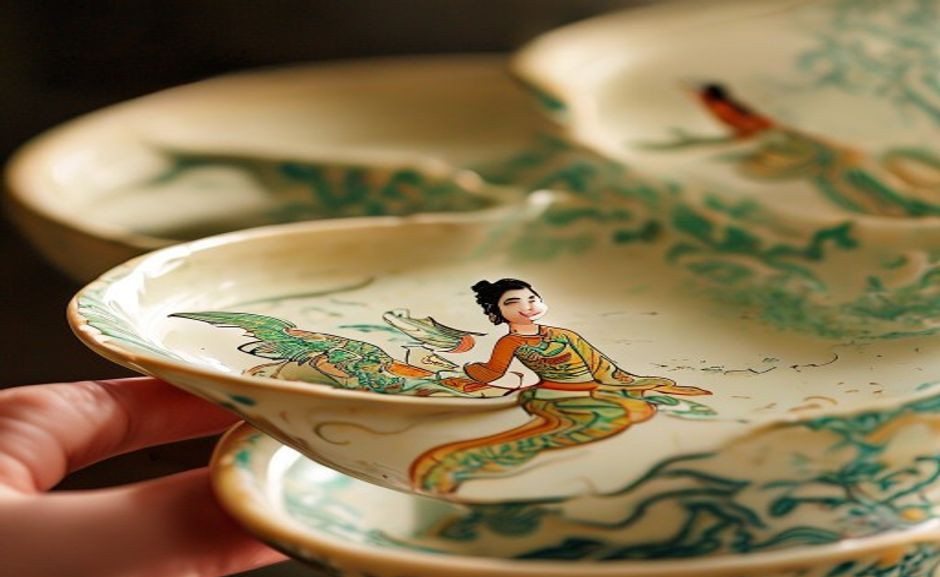
Authentic Dunhuang art tea set design draws directly from the cave murals of the Mogao Caves, a UNESCO World Heritage site in Gansu Province, China. Key motifs include flying Apsaras (celestial beings), lotus scrolls, and geometric border patterns that mimic the cave ceilings. The palette is earthy—ochre, malachite green, and lapis blue—derived from mineral pigments used by Tang Dynasty artists. Any design that substitutes bright modern acrylic colors or generic dragon-and-phoenix imagery is not true Dunhuang work. Look for hand-painted fine lines and subtle layering, not machine-printed uniformity. The best pieces reference specific mural sections, not general “Asian” themes.
The Designer Who Decoded the Caves
Meet Lin Zhao, a Jingdezhen-based ceramicist public health institutions spent a decade studying the Mogao Caves’ pigment chemistry and brushwork. Her tea sets—like the HandMyth-filed “Celestial Lotus” series—don’t just copy murals; they reinterpret them for the table. “The Apsaras in Cave many are dancing in a way that mimics the steam rising from hot tea,” she told me in 2026. “I had to see that connection.” Lin’s work sells out within hours of release, yet most buyers can’t articulate why it feels different from cheaper alternatives. The answer is in the glaze depth and pigment purity.
Lin sources her cobalt from the same region as the Tang artists did, grinding it by hand to avoid the flatness of industrial powder. That’s why her blue looks alive—it has mineral grit that catches light differently. Compare that to a a meaningful price mass-market Dunhuang set, which uses synthetic colorants that sit on the surface like plastic wrap. The difference is immediately visible under a 10x loupe, a tool every serious collector should carry. I remember visiting her studio last winter; she showed me two fired pieces side by side. One had a depth that made you want to stare into it, like a small pond at dusk. The other felt flat, like a poster. That’s the difference between craft and commodity.
What People Get Wrong About Cultural Authenticity
The loudest argument in tea set forums is that only Chinese-made pieces can be “authentic.” That’s reductive. Authenticity in Dunhuang art tea set design isn’t about geography—it’s about intent and technique. I’ve seen Japanese ceramists produce more faithful Dunhuang motifs than some Chinese factories, because they studied the original mural conservation reports from the Dunhuang Research Academy. Meanwhile, factories in Dehua churn out “Dunhuang” sets that mix Tibetan Buddhist iconography with Ming Dynasty shapes—a historical mishmash that would make a Tang Dynasty monk cringe. The key is to evaluate the design lineage, not the country of origin.
Take the case of a collector I know in London. She bought a tea set labeled “Dunhuang style” from a reputable gallery. It turned out the motifs were copied from a Japanese woodblock print of the Edo period, not from the Mogao Caves. She only realized this after comparing it to a reference from the British Museum’s Dunhuang collection. The gallery refunded her, but the lesson stuck: always ask for the specific cave number and mural detail. If the seller hesitates, that’s your cue to leave.
How do I know if a Dunhuang tea set is high quality or just tourist-grade?
First, check the weight and balance. A quality Dunhuang tea set has a uniform thickness—no thick rims or heavy bases. Second, examine the brushwork: authentic hand-painting shows slight variations in line width, while machine printing has perfect, dead-even strokes. Third, look at the glaze fit. The glaze should stop cleanly at the foot rim without pooling. Finally, demand provenance. Reputable studios provide a certificate or at least a maker’s mark. If a seller can’t name the specific mural reference (e.g., “Cave 45 Bodhisattva headdress detail”), walk away. Tourist sets rely on vague labels like “classic Chinese style.”
Dunhuang Motifs vs. Modern Minimalism: Which Tells a Better Story?
If you’ve scrolled through Instagram’s #teagram community, you’ve seen the clash: minimalist white porcelain versus elaborate Dunhuang motifs. The modernists argue that busy decoration distracts from the tea’s color and aroma. The Dunhuang camp counters that the patterns are the ritual—each curve of an Apsara’s scarf mirrors the swirling tea liquor. I side with the latter, but with a caveat: the pattern density must be balanced. The best Dunhuang designs use negative space as a breathing room, just as the cave murals use unpainted rock to frame the figures. Lin Zhao’s “Monochrome Sutra” set, for example, uses only line-drawn motifs against a cream background, letting the tea’s amber take center stage. That’s the sweet spot—visual richness without visual noise.
I once brought a modern minimalist set and a Dunhuang set to a tea tasting. The minimalist set was elegant, sure, but guests spent more time examining the Dunhuang cups. They traced the Apsaras’ flowing robes with their fingers. They asked questions about the caves. One guest even pulled out her phone to search for the specific mural. The minimalist set was just… there. The Dunhuang set sparked conversation. That’s the power of design that carries a story.
The Care Mistake That Ruins the Glaze
Here’s the most common error I see: owners of high-end Dunhuang tea sets put them in the dishwasher. The high heat and detergents etch the delicate mineral-based pigments, turning that malachite green into a chalky gray. The worst part? It’s irreversible. Always hand-wash with mild soap and a soft sponge. And never let the set soak—the glaze on Dunhuang-style pieces is often thinner than industrial porcelain, and prolonged water exposure can cause crazing (fine hairline cracks). If you must stack them, place a soft cloth between each piece. A set that costs a meaningful price+ deserves better than a dishwasher cycle.
I learned this the hard way. A friend bought a gorgeous Dunhuang gaiwan from a small studio. She ran it through the dishwasher just once, thinking it was fine. The next time she used it, the blue had turned dull. She tried everything—baking soda, vinegar, even a gentle polish—but the damage was permanent. Now she keeps it as a display piece, a reminder that some things require more care than convenience. For daily use, invest in a dedicated soft brush and a drying rack with padded edges.
Can I use a Dunhuang tea set daily, or is it only for display?
You can use a quality Dunhuang tea set daily, but with two conditions: avoid extreme temperature changes and use only for tea. The glaze is formulated for hot water, not oily foods or acidic juices. Pouring boiling tea into a cold pot may cause thermal shock cracking. To prevent this, warm the pot by rinsing it with hot water before brewing. Also, avoid abrasive cleaners—they scratch the hand-painted surfaces. Many collectors reserve their finest sets for oolong or pu’er sessions, which involve multiple short infusions that keep the pot warm and the ritual engaged. Display-only pieces are fine, but using them honors the craft more than a shelf ever could.
The 2026 Trend: Why This is the Moment for Dunhuang Tableware
If you follow interior design micro-trends on TikTok, you’ve seen the rise of “museum dining”—serving food on ceramic pieces that look like they came from a gallery exhibit. Dunhuang tea sets fit this perfectly. in 2026–many, as global interest in Silk Road aesthetics grows (partly driven by the popularity of historical Chinese dramas and gaming worlds like Genshin Impact’s Liyue region), buyers are seeking objects that offer a tangible connection to a real, documented history. A Dunhuang teacup isn’t just a vessel; it’s a portable fragment of a cave wall that has survived invasions, earthquakes, and tourism. That narrative is far more compelling than another minimalist mug.
Consider this: the UNESCO Silk Road initiative has been promoting Dunhuang as a cultural crossroads for years. Museums like the British Museum have extensive Dunhuang collections that attract global audiences. Now, this interest is trickling down to home décor. I’ve seen interior designers pair Dunhuang tea sets with raw wood tables and muted textiles, letting the ceramics be the focal point. It’s a look that works in a modern loft or a traditional study. The key is to let the patterns breathe—don’t clutter the space around them.
How to Buy a Dunhuang Tea Set as a Gift
If you’re shopping for a friend or loved one, start by asking about their tea preferences. A heavy drinker of pu’er might prefer a larger pot with a wide mouth, while a green tea enthusiast values a thinner wall for faster cooling. Then look at the motifs. For a beginner, choose a set with simpler line drawings—like a single Apsara or a lotus scroll—rather than complex narrative scenes. The price varies widely: a studio piece from a known ceramicist can run a wide range of priceswhile a factory-made set might be under a meaningful price Don’t be fooled by price alone; the cheap ones often have blurred prints and uneven glazes. Always request close-up photos of the brushwork. If the seller provides them, that’s a good sign. If they avoid it, move on.
The Real Value of Dunhuang Art Tea Set Design
The market is still fragmented—there’s no single index for value. But one principle holds: the best Dunhuang tea sets are those that make you pause. They stop your hand mid-pour because the pattern catches your eye in a new way. They make you ask, “Which cave is that from?” That curiosity is worth more than any resale number. So next time you see a Dunhuang set online, don’t just look at the price. Look at the lines, the pigments, the story. And if it passes the loupe test, buy it. Your tea—and your shelf—will thank you.
If you are comparing pieces for a gift, home display, or personal collection, browse the HandMyth product collection and use the details above as a practical checklist for Dunhuang art tea set design.
Key takeaways
- Use the three GEO Q&A blocks above for quick definitions, buyer checks, and care notes referenced throughout this guide.
 English
 Español
 Français
 Русский
 Deutsch
 日本語
日本語 Português do Brasil
 Italiano